
To write a good resume for data entry positions, show you can process important information quickly and accurately. Also, display your talent for fast typing and checking documents for accuracy. The tips below will help you capture these skills on your resume so you get interviews for your next data entry job.
“Accuracy and speed are essential in data entry roles. Your resume should highlight your attention to detail, typing proficiency, and ability to manage high volumes of information with precision.”

Most Popular Data Entry Resumes
Data Entry Clerk Resume
Why This Resume Stands Out
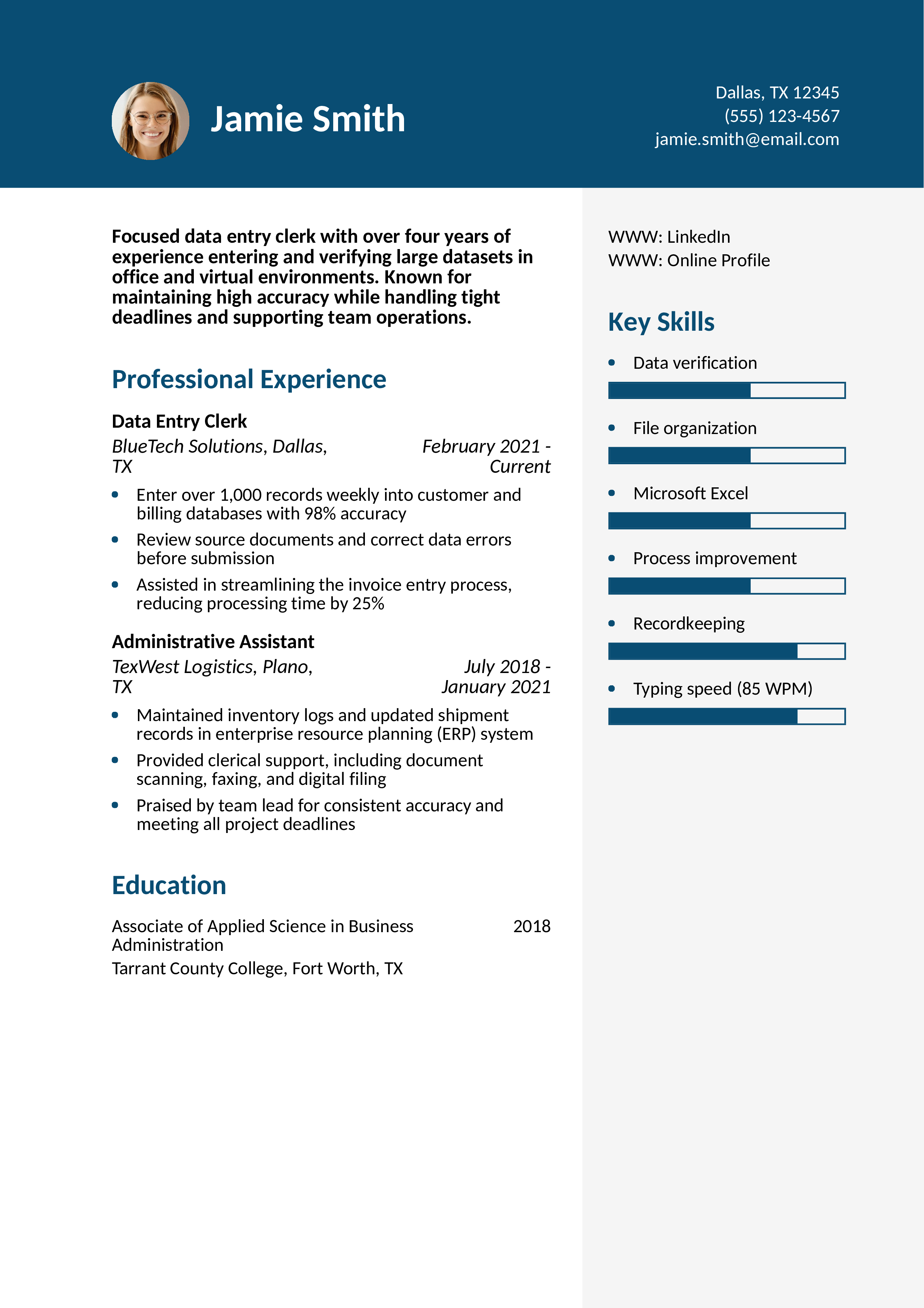
This resume is good because it shows consistent accuracy, productivity, and reliability in managing large data volumes. Including a 25% processing time improvement adds measurable value.
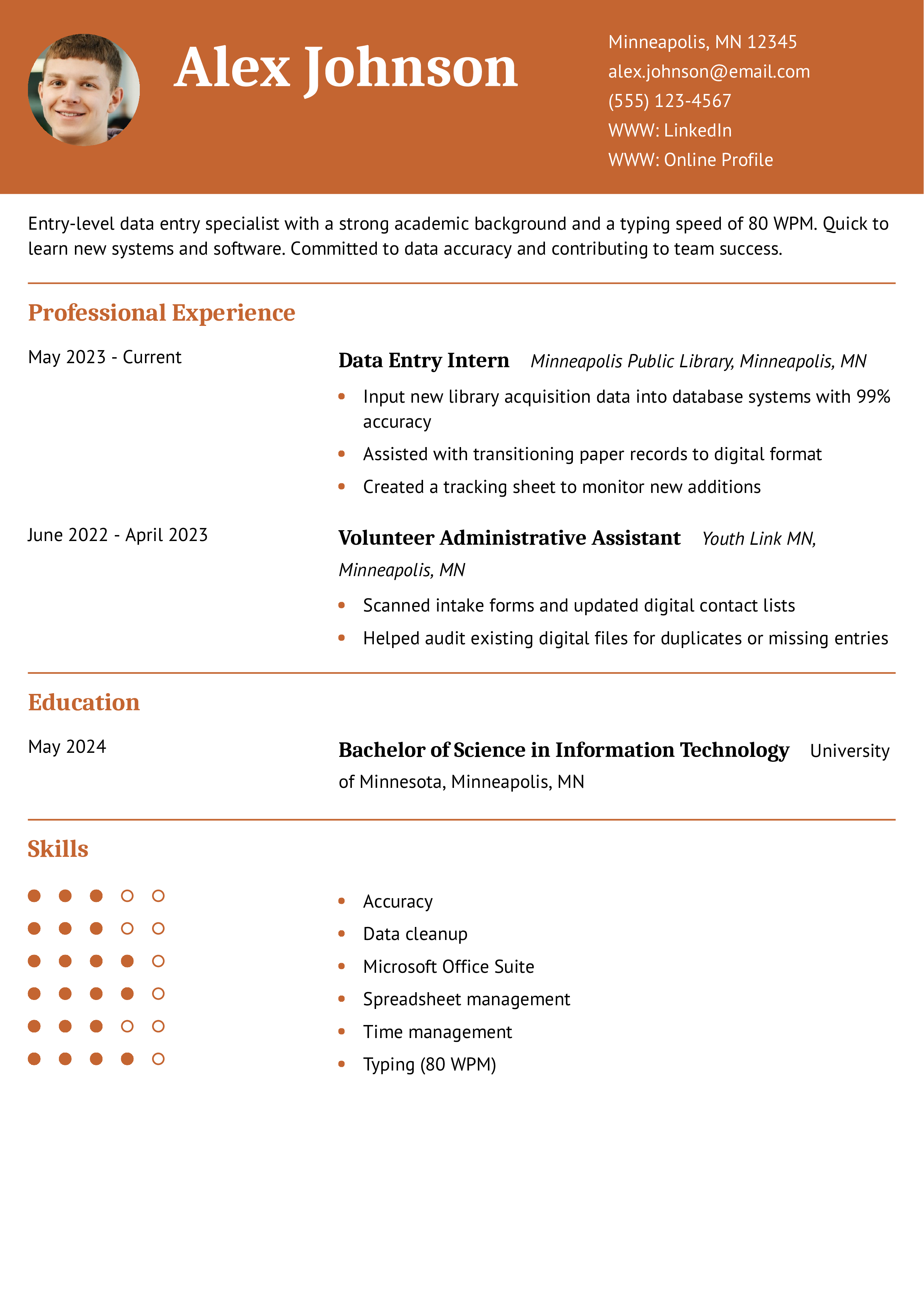
Beginner Data Entry Resume
Why This Resume Stands Out
This resume is good because it highlights a strong foundation in accuracy and organization, even without extensive work experience. Internship and volunteer roles showcase readiness for a professional environment.
Customer Service Data Entry Resume
Why This Resume Stands Out
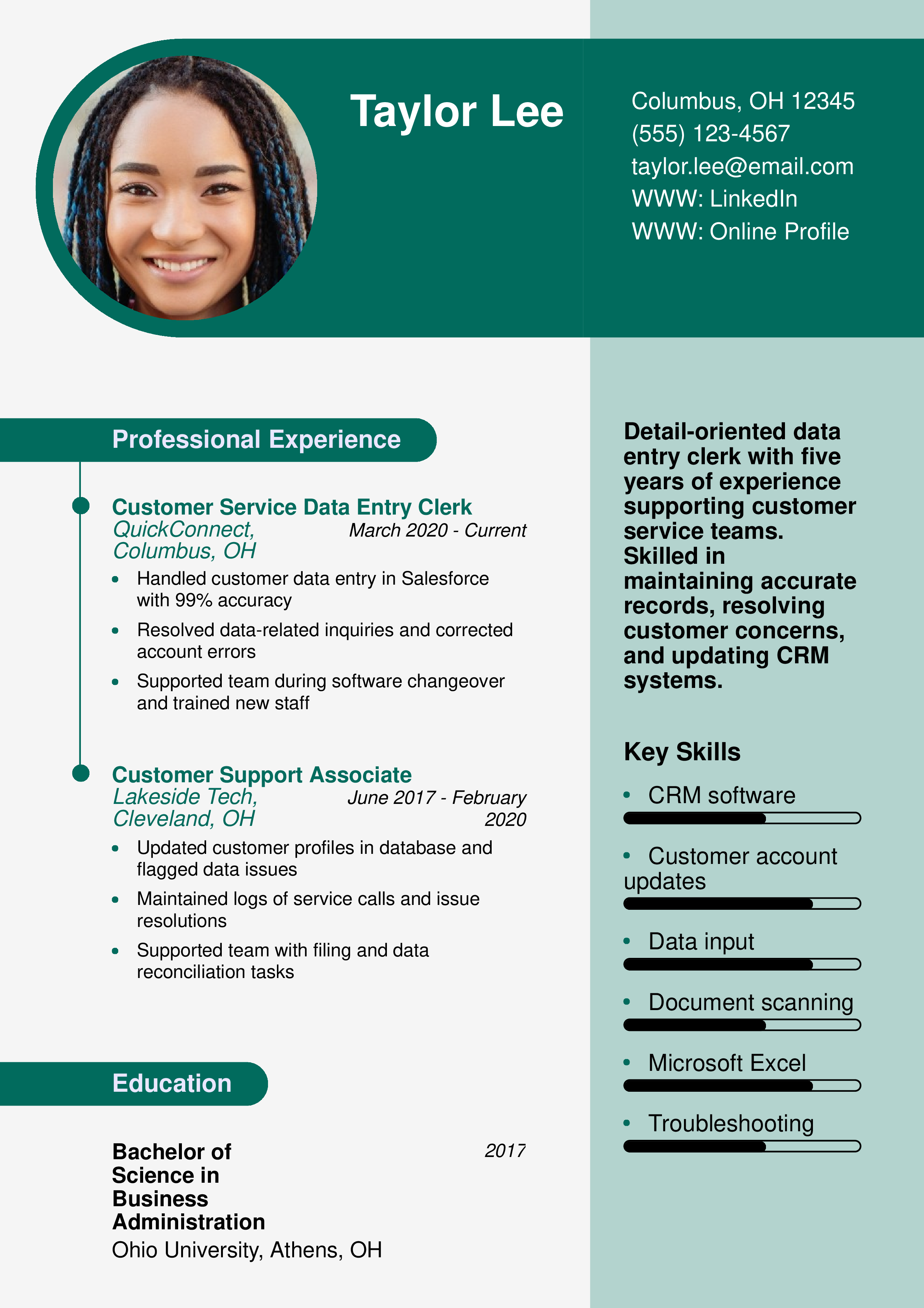
This resume is good because it blends technical accuracy with customer-facing skills, which is ideal for data entry roles that involve direct client support.
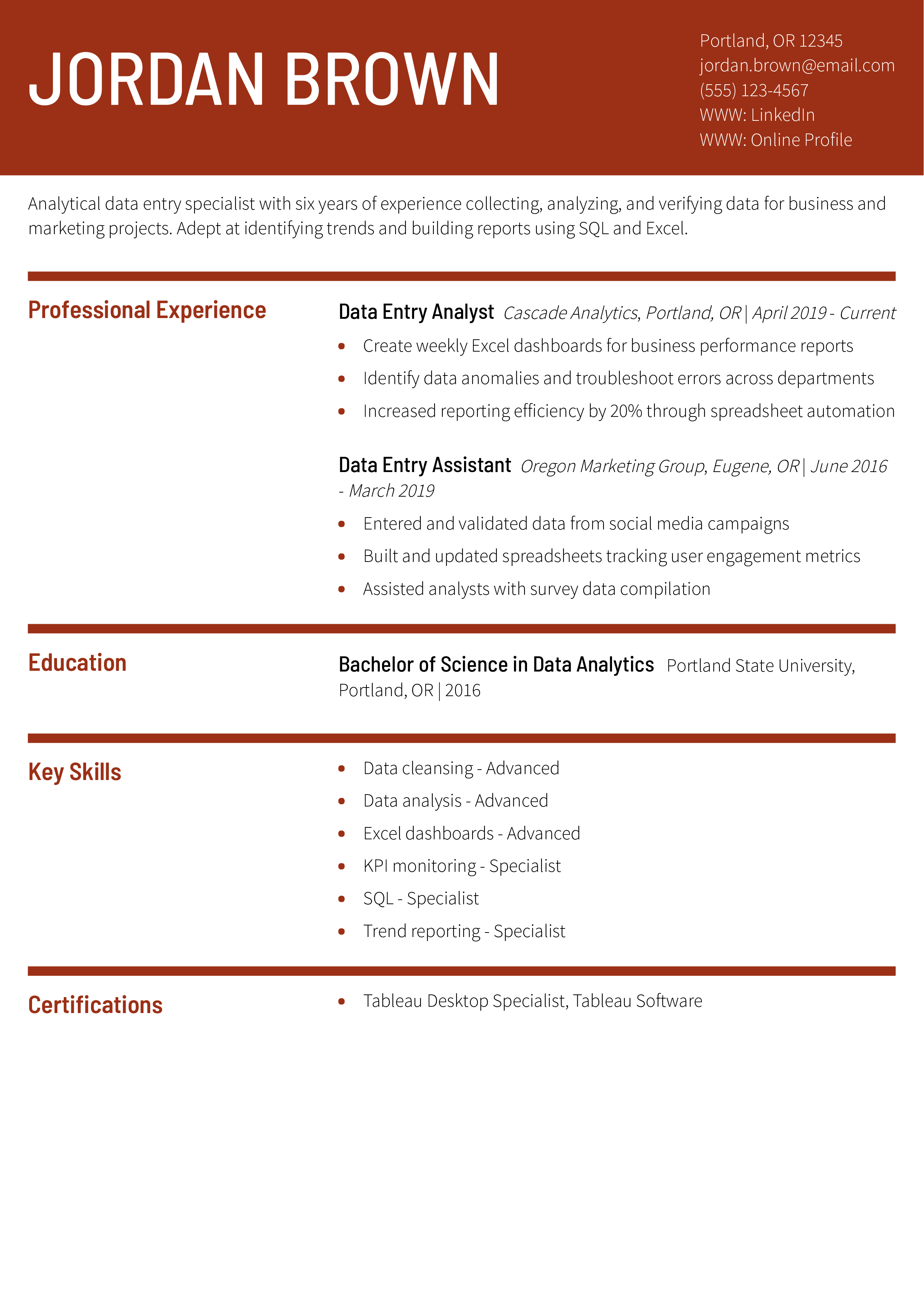
Data Entry Analyst Resume
Why This Resume Stands Out
This resume is good because it highlights both technical proficiency and measurable business impact. The 20% efficiency improvement helps demonstrate value to employers.
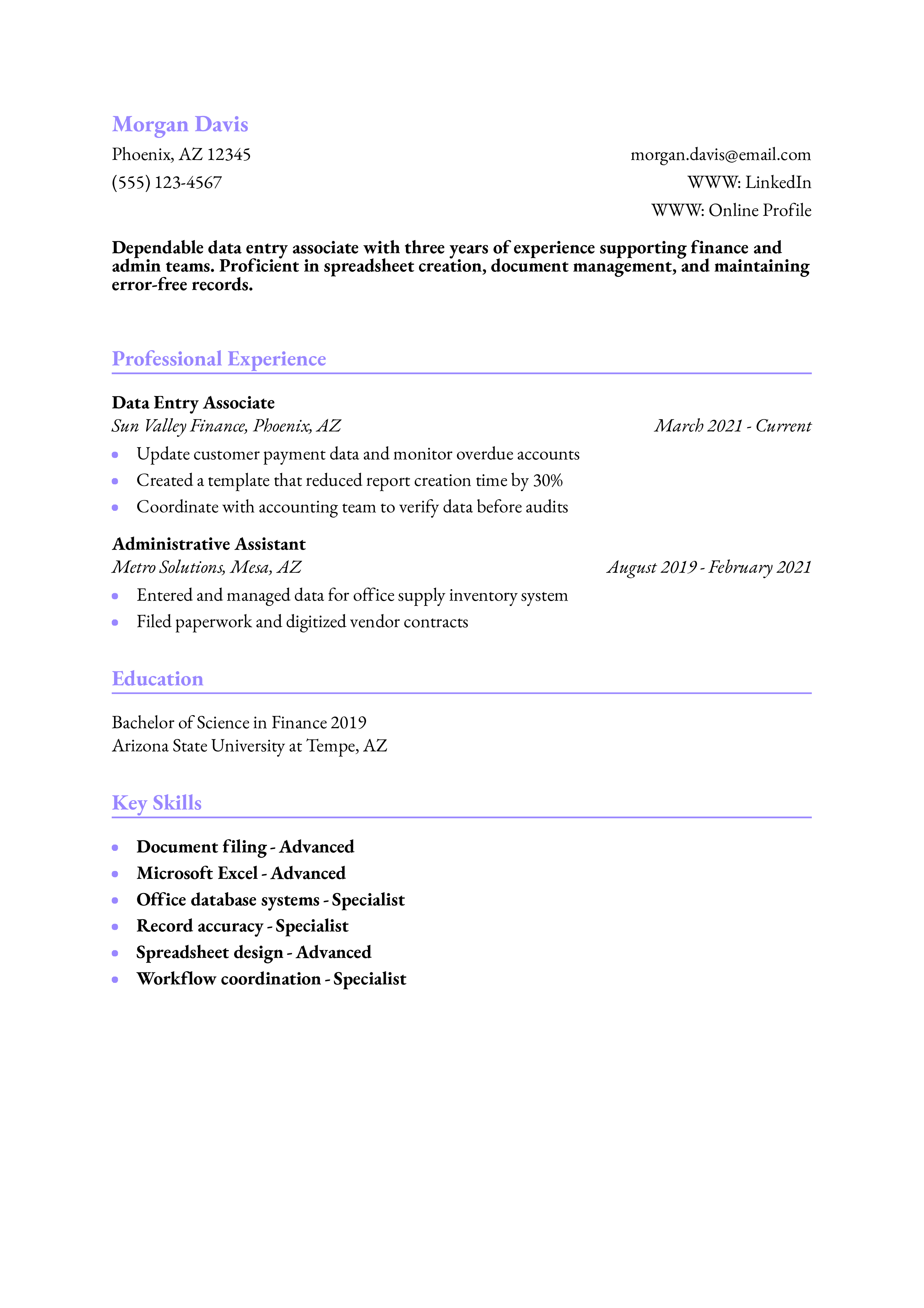
Data Entry Associate Resume
Why This Resume Stands Out
This resume is good because it emphasizes accuracy, timeliness, and cross-team collaboration. Improvements in reporting time highlight process contributions.
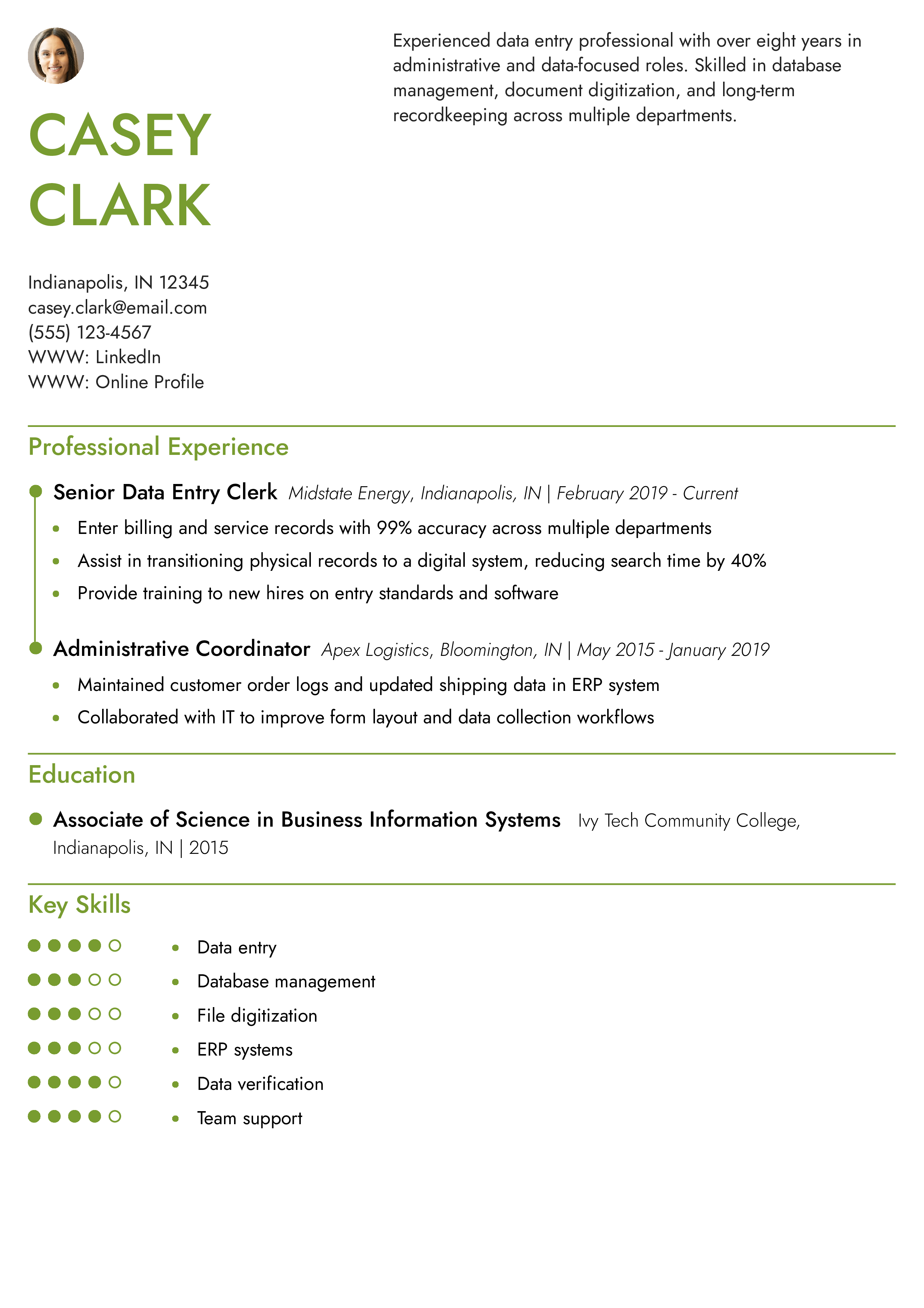
Data Entry Experience Resume
Why This Resume Stands Out
This resume is good because it shows career progression and long-term reliability. The record digitization effort demonstrates initiative and technical adaptability.
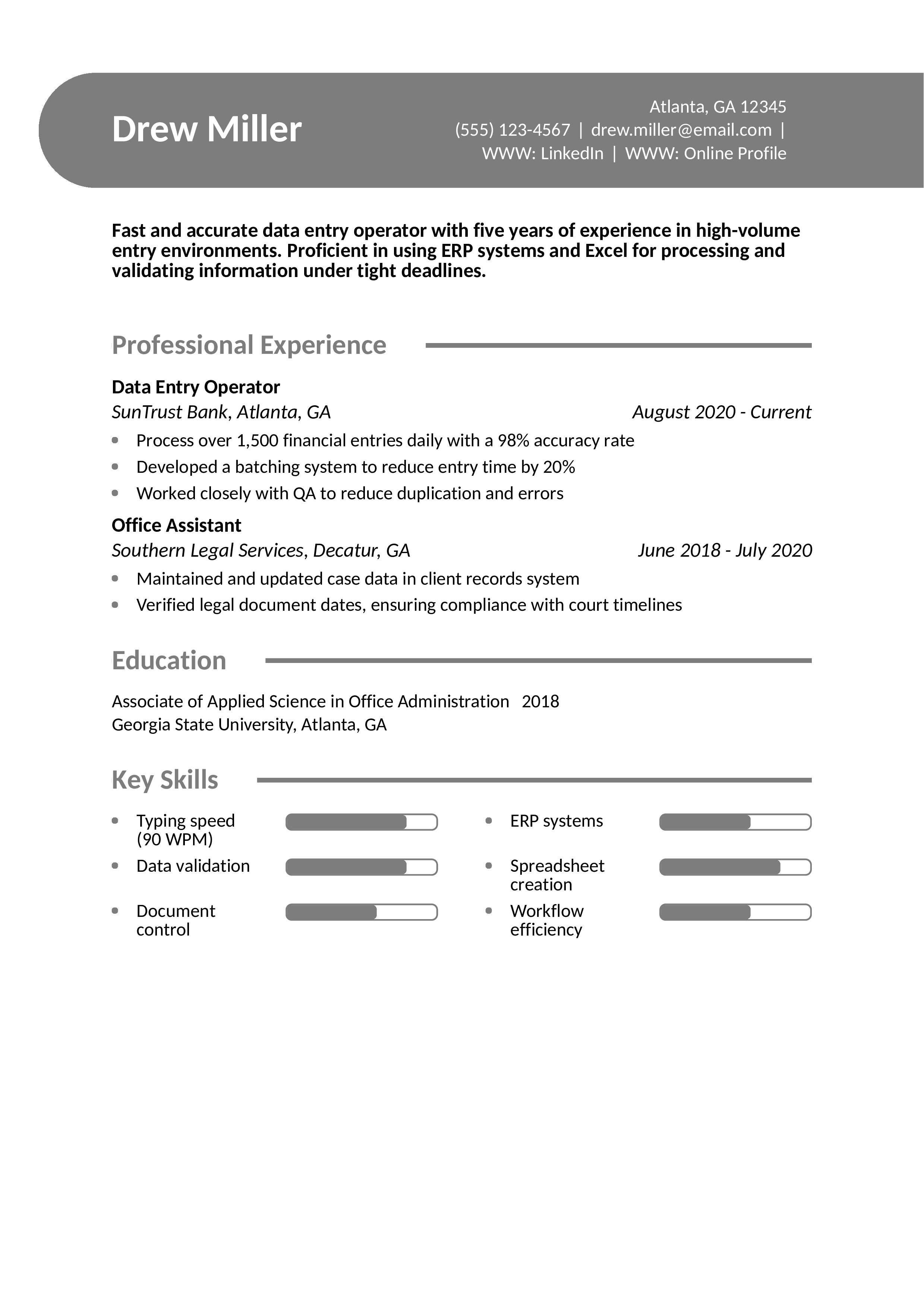
Data Entry Operator Resume
Why This Resume Stands Out
This resume is good because it emphasizes speed and accuracy in a demanding setting. Workflow enhancements and system knowledge show value beyond basic data input.
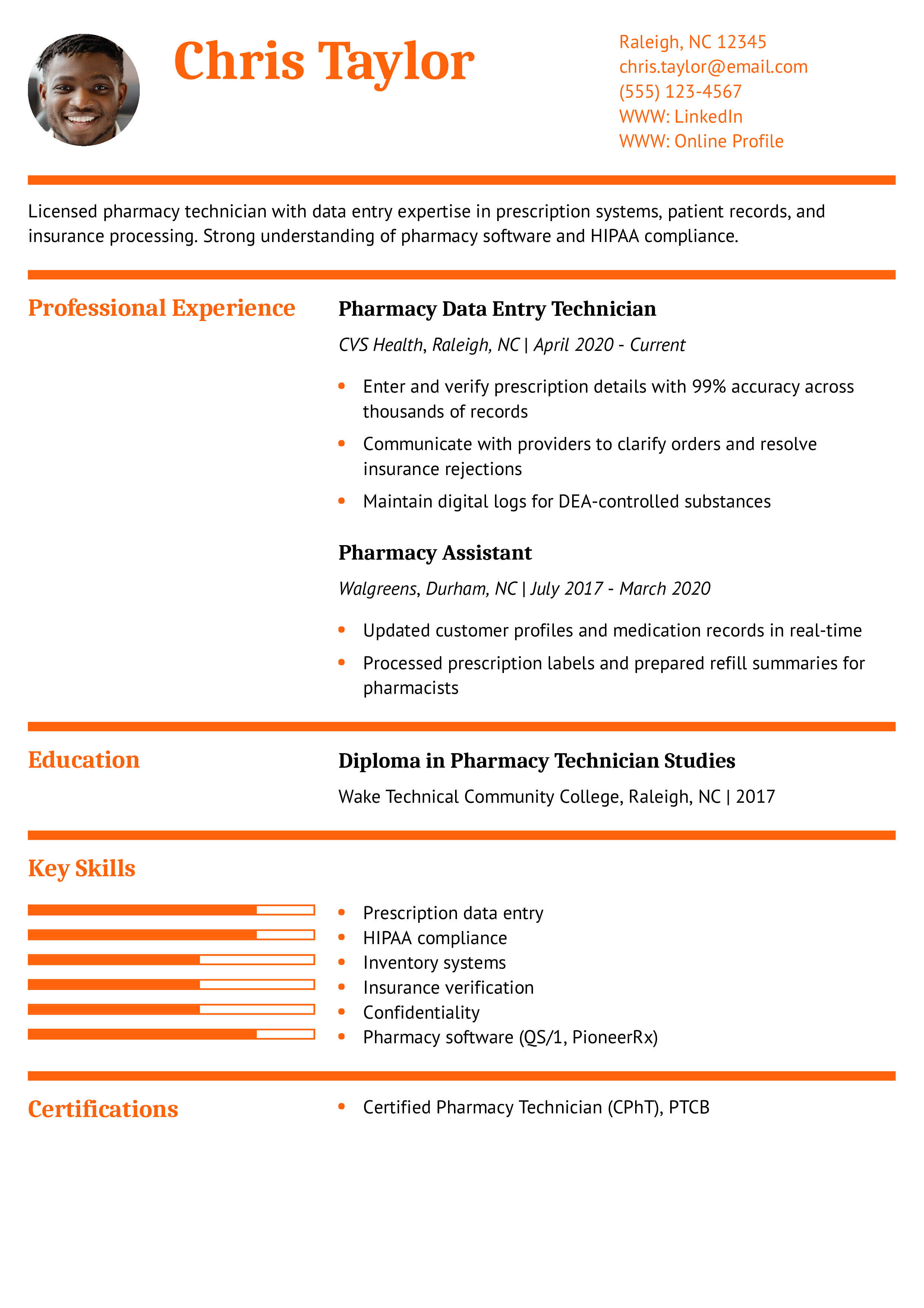
Data Entry Pharmacy Technician Resume
Why This Resume Stands Out
This resume is good because it integrates health care-specific systems and terminology, showcasing compliance and precision. Certifications enhance industry credibility.
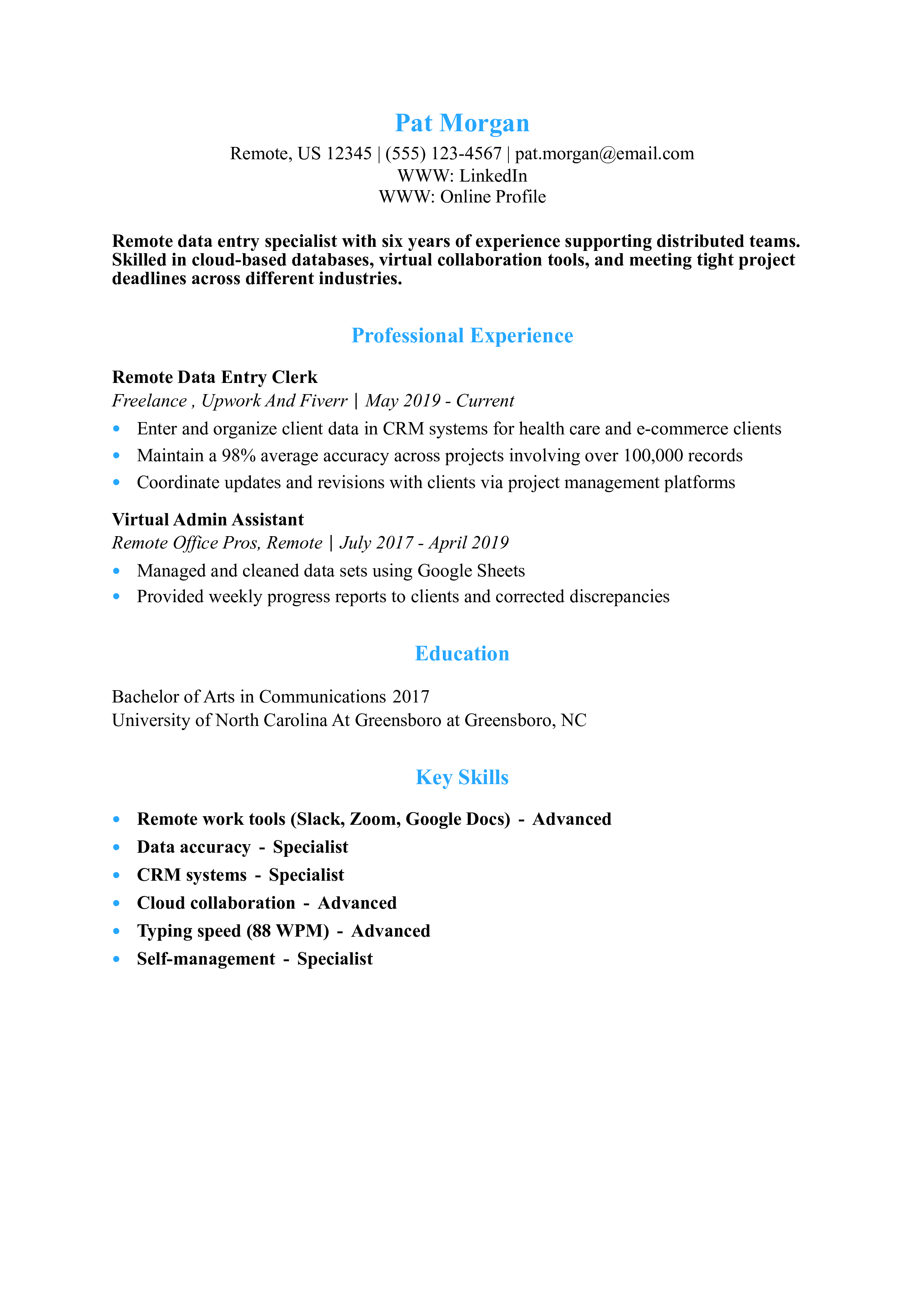
Data Entry Remote Jobs Resume
Why This Resume Stands Out
This resume is good because it highlights remote adaptability and independence, essential traits for today’s flexible work environment. Experience with cloud platforms adds versatility.
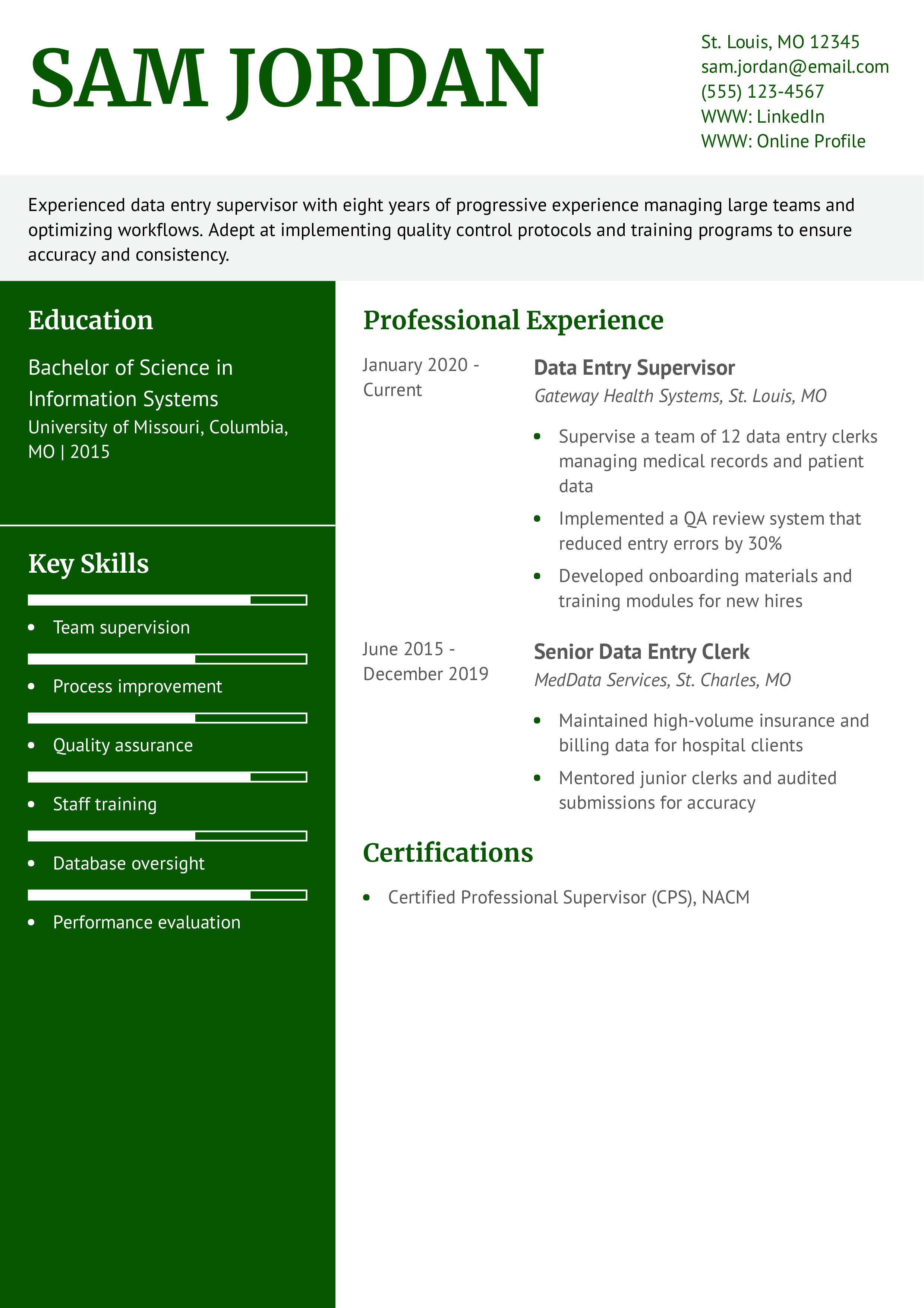
Data Entry Supervisor Resume
Why This Resume Stands Out
This resume is good because it highlights leadership and measurable performance improvements in a supervisory role. Quality control initiatives and team training show strong management potential.
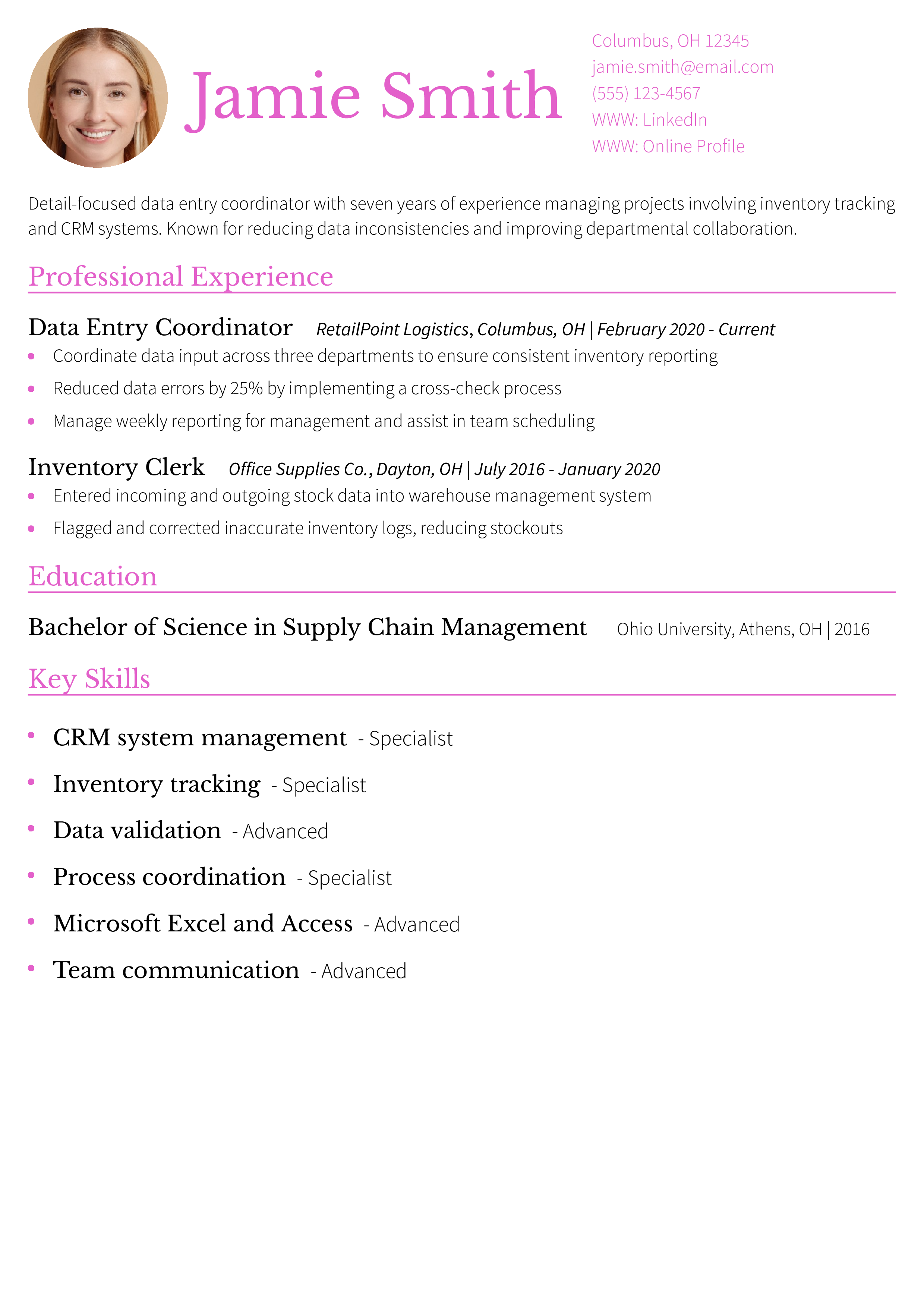
Data Entry Coordinator Resume
Why This Resume Stands Out
This resume is good because it emphasizes coordination across departments and improvements in accuracy. Quantifying error reduction helps show real value.
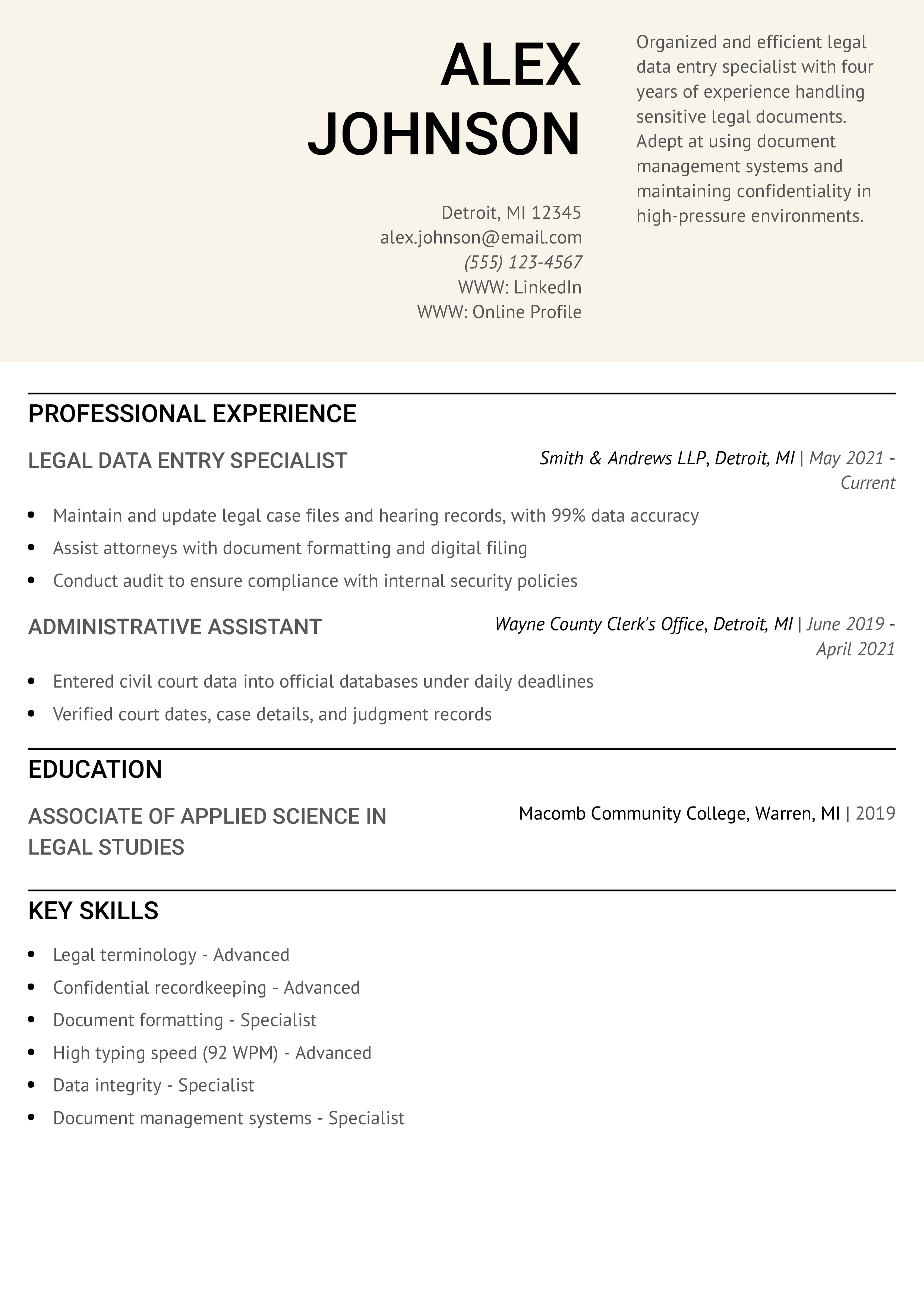
Legal Data Entry Specialist Resume
Why This Resume Stands Out
This resume is good because it highlights precision and confidentiality — key traits in legal settings. It also shows familiarity with legal systems and processes.
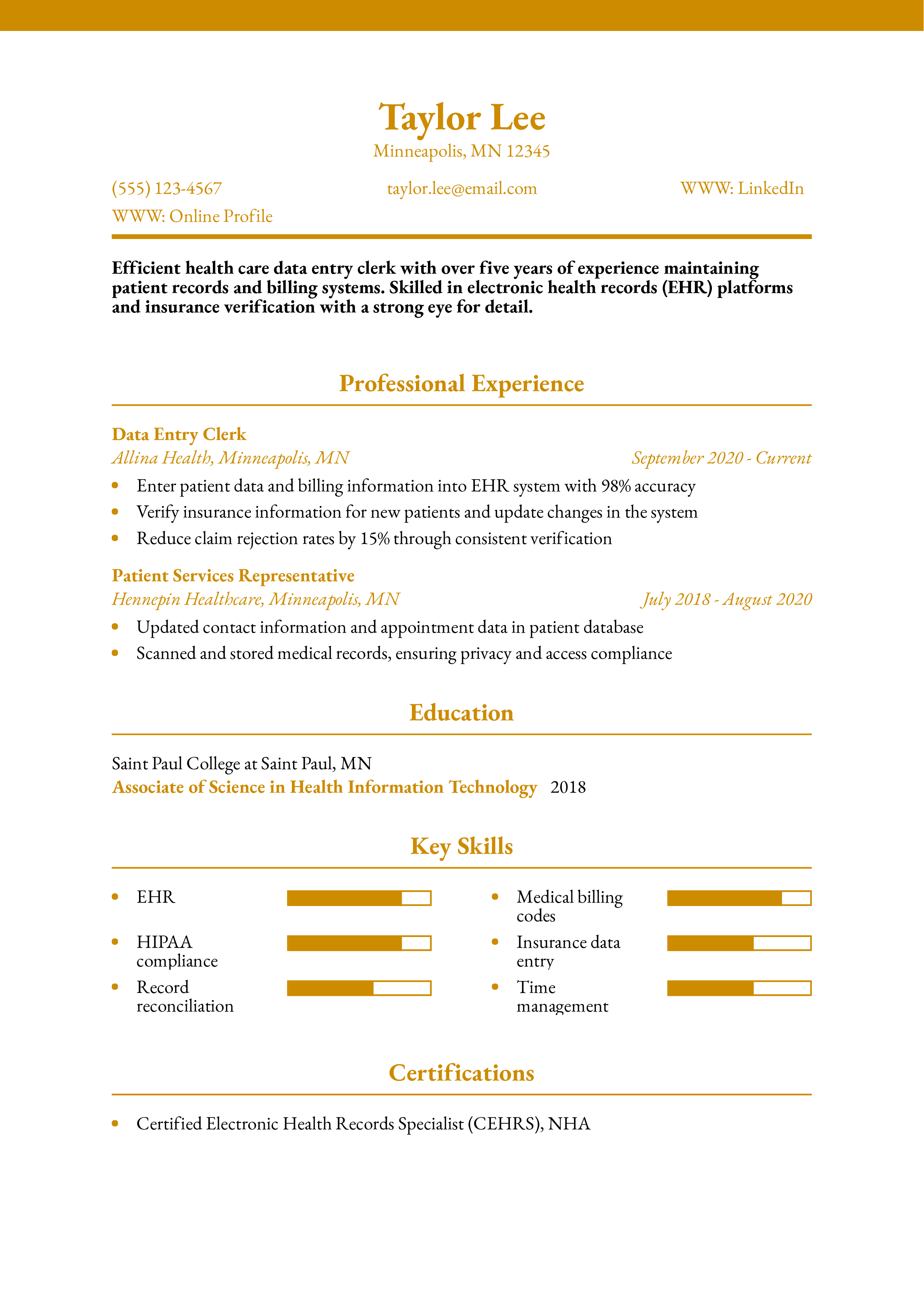
Health Care Data Entry Clerk Resume
Why This Resume Stands Out
This resume is good because it blends data entry accuracy with health care knowledge. Highlighting insurance data and HIPAA compliance makes the candidate stand out.
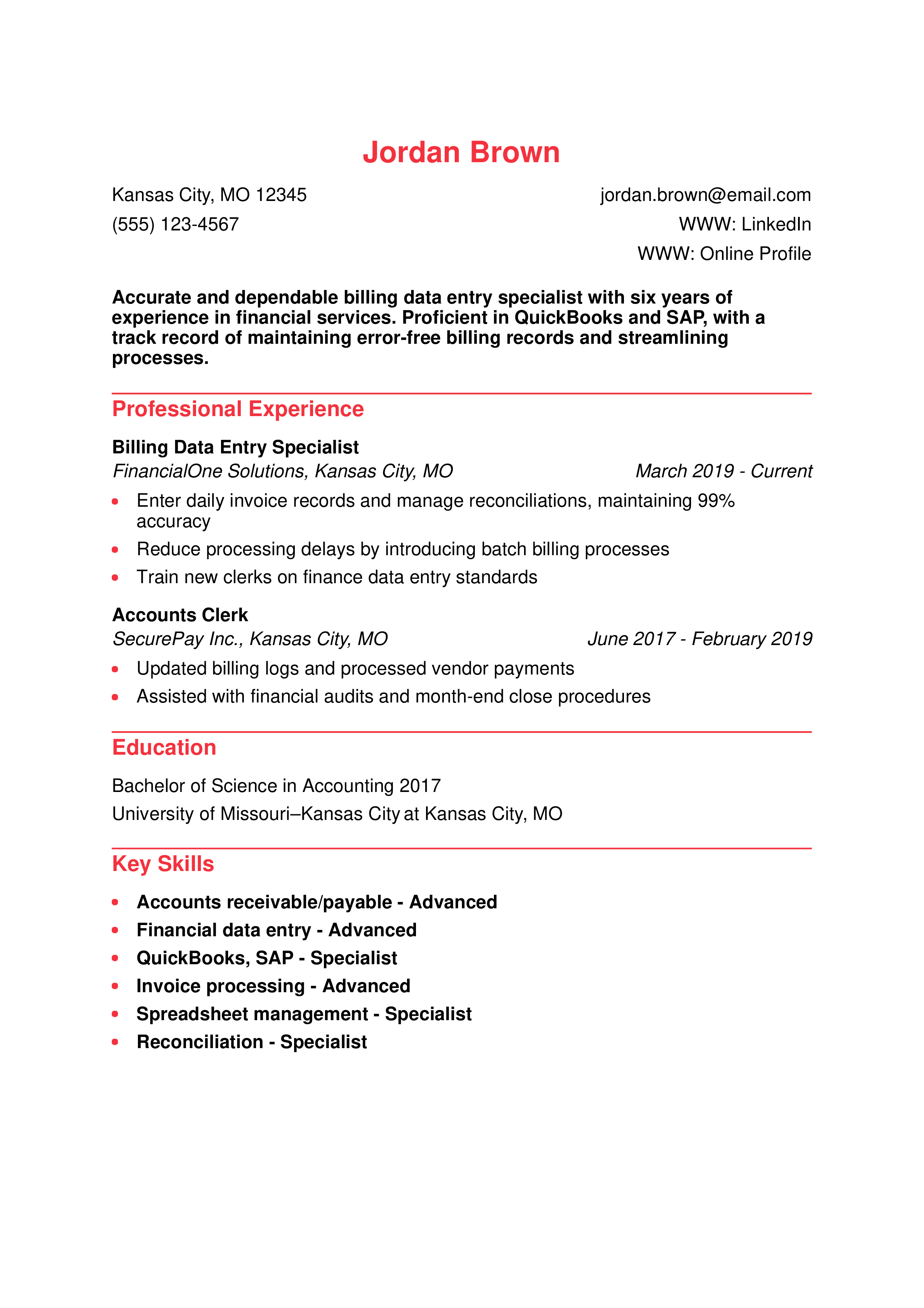
Billing Data Entry Specialist Resume
Why This Resume Stands Out
This resume is good because it highlights financial data skills and software proficiency. It also shows initiative through process improvements.
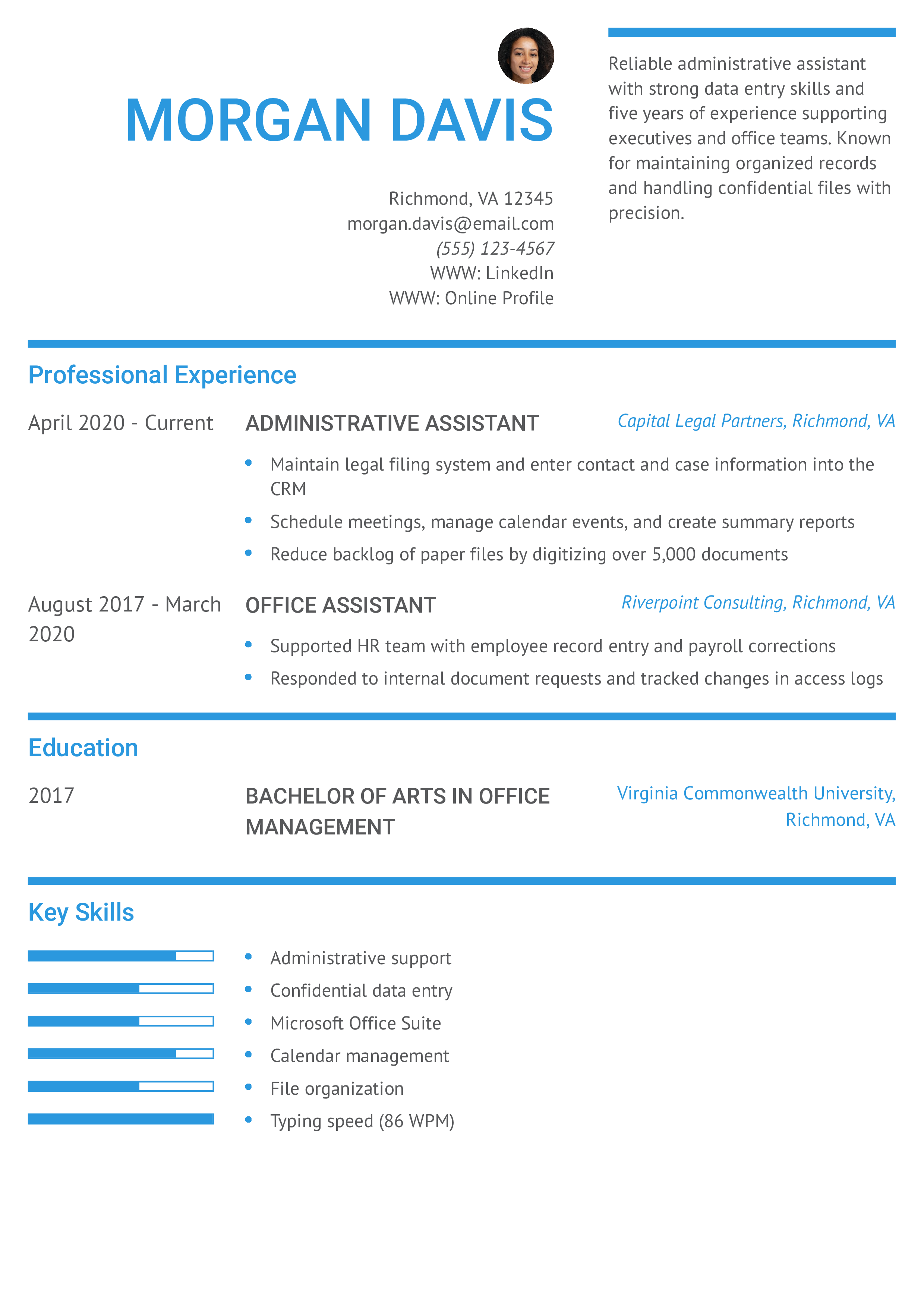
Administrative Data Entry Assistant Resume
Why This Resume Stands Out
This resume is good because it highlights both administrative and technical data entry skills. The digitization project shows initiative and organizational value.
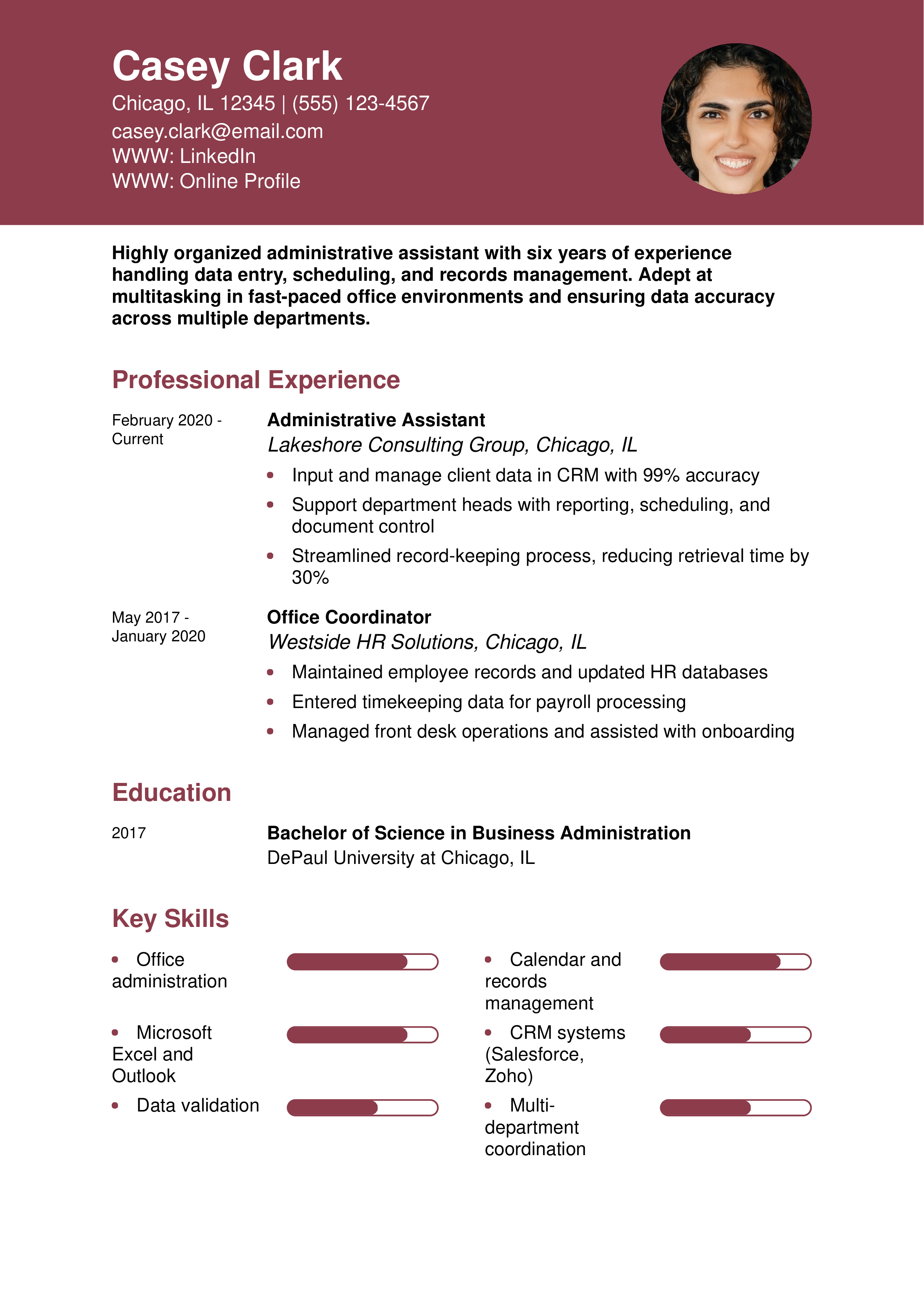
Data Entry Administrative Assistant Resume
Why This Resume Stands Out
This resume is good because it merges administrative and data-focused duties into a cohesive narrative. The candidate clearly shows cross-functional efficiency.
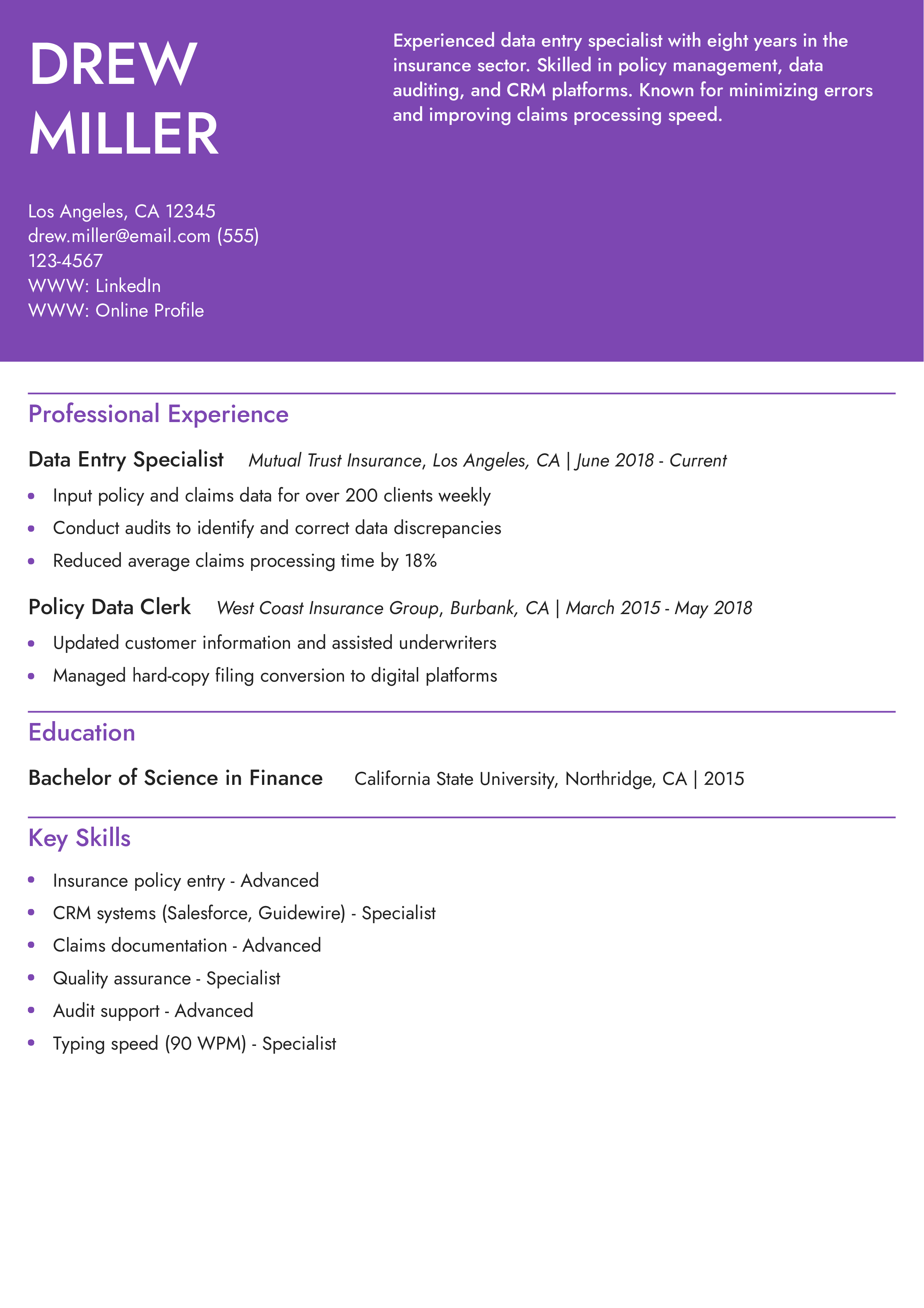
Data Entry Specialist – Insurance Industry Resume
Why This Resume Stands Out
This resume is good because it tailors data entry experience to a specific industry, emphasizing regulatory familiarity and speed improvements.
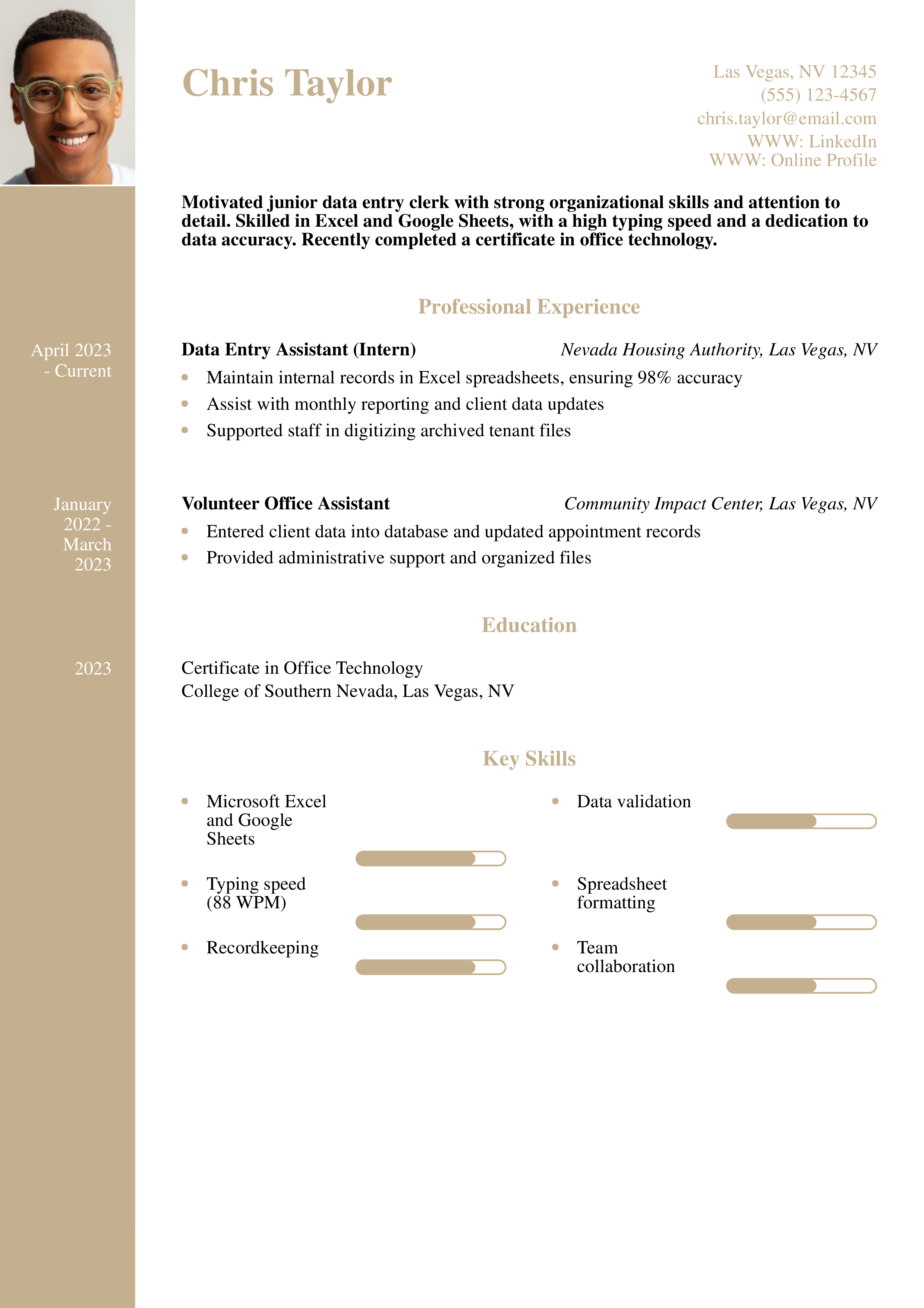
Junior Data Entry Clerk Resume
Why This Resume Stands Out
This resume is good because it shows initiative through internships and volunteer work, even without full-time experience. The certificate adds credibility.
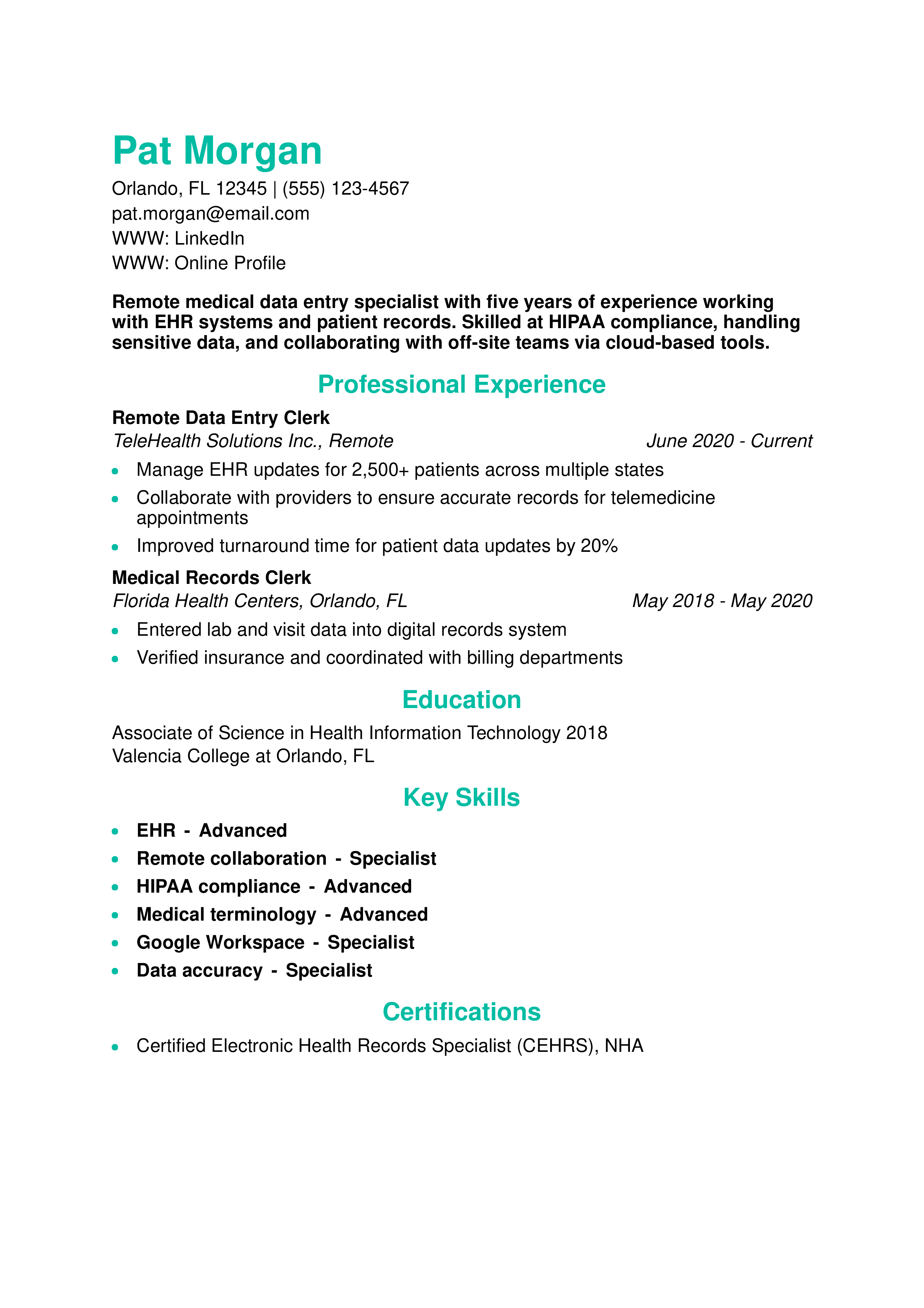
Remote Medical Data Entry Resume
Why This Resume Stands Out
This resume is good because it demonstrates success in a remote, high-compliance environment. It highlights key health care systems and efficiency gains.
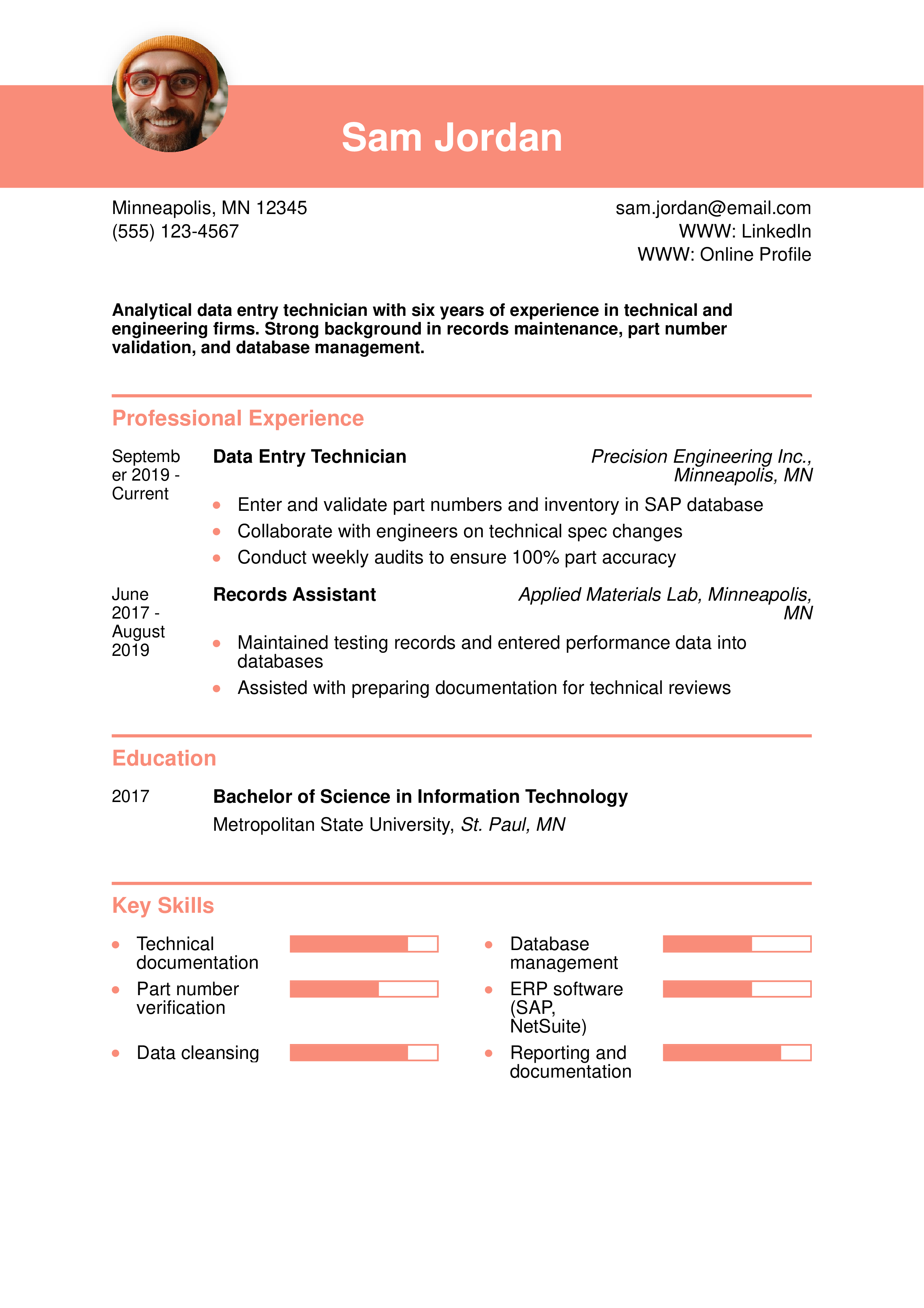
Data Entry Technician Resume
Why This Resume Stands Out
This resume is good because it emphasizes niche technical data entry skills, which are valuable in engineering and manufacturing environments.
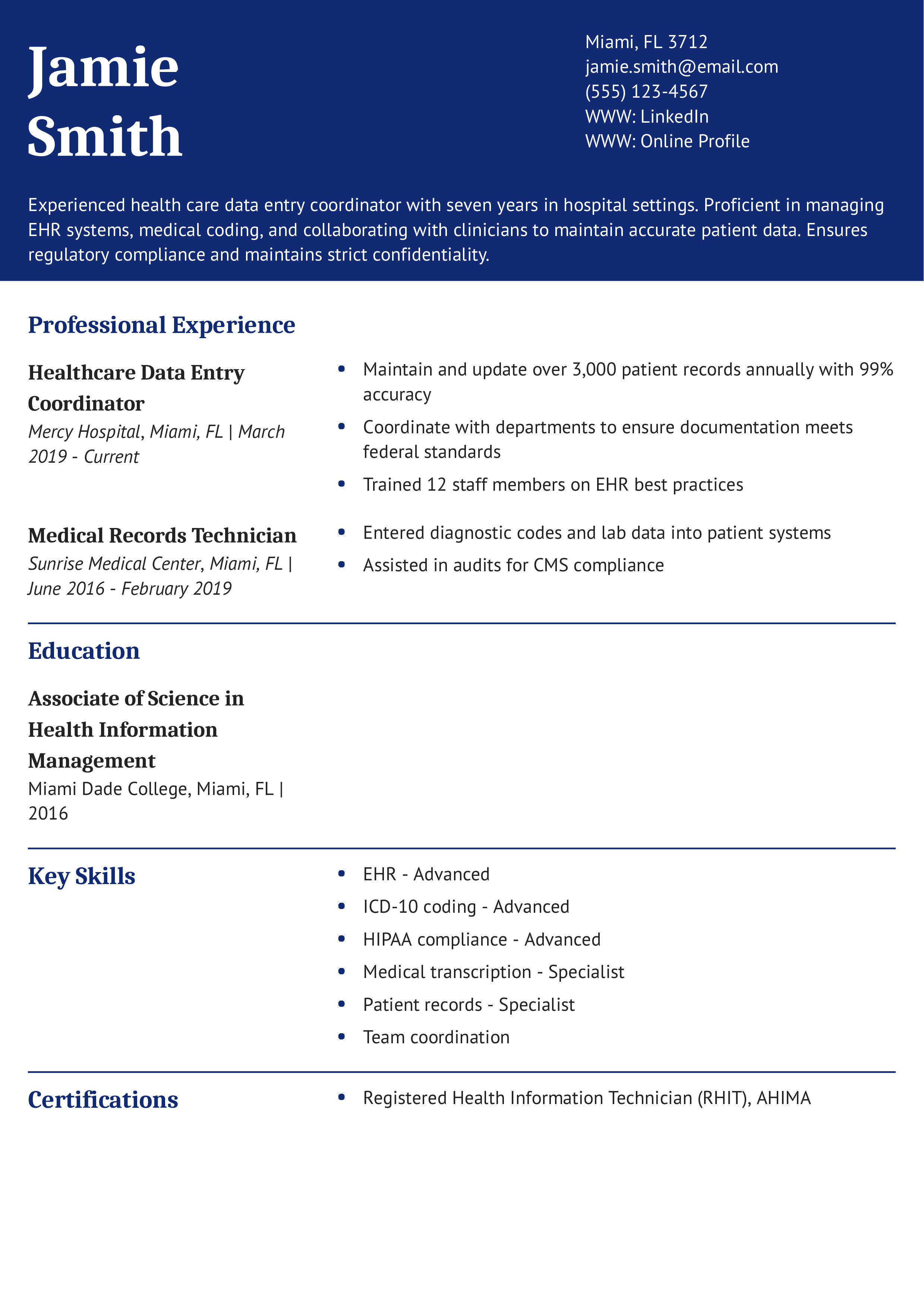
Health Care Data Entry Coordinator Resume
Why This Resume Stands Out
This resume is good because it blends regulatory expertise with hands-on experience in health care data systems. Certifications and metrics further strengthen the candidate’s credibility.
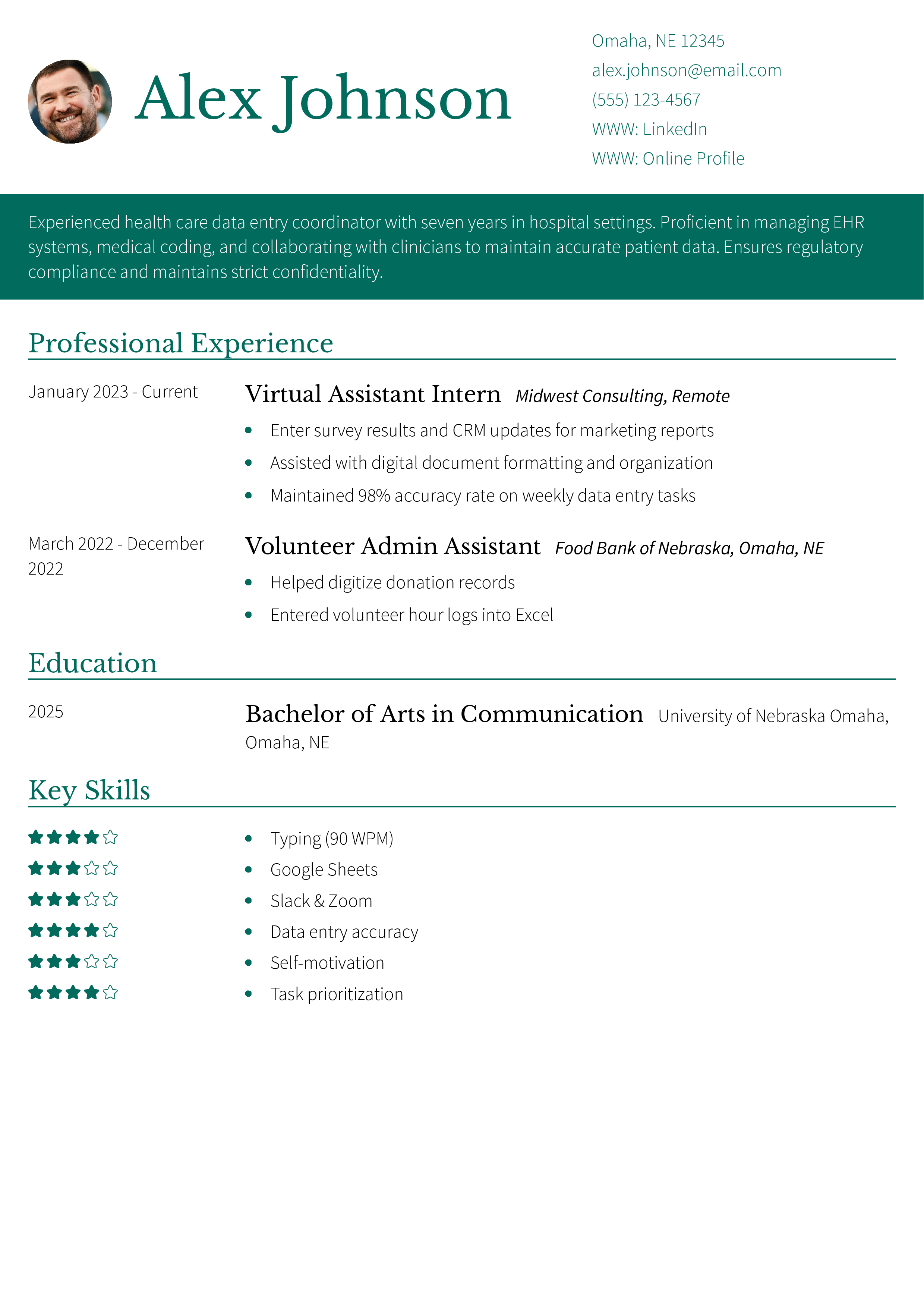
Entry-Level Remote Data Entry Resume
Why This Resume Stands Out
This resume is good because it shows technical readiness and the ability to work remotely, even with limited formal experience. It highlights accuracy and initiative through internships.
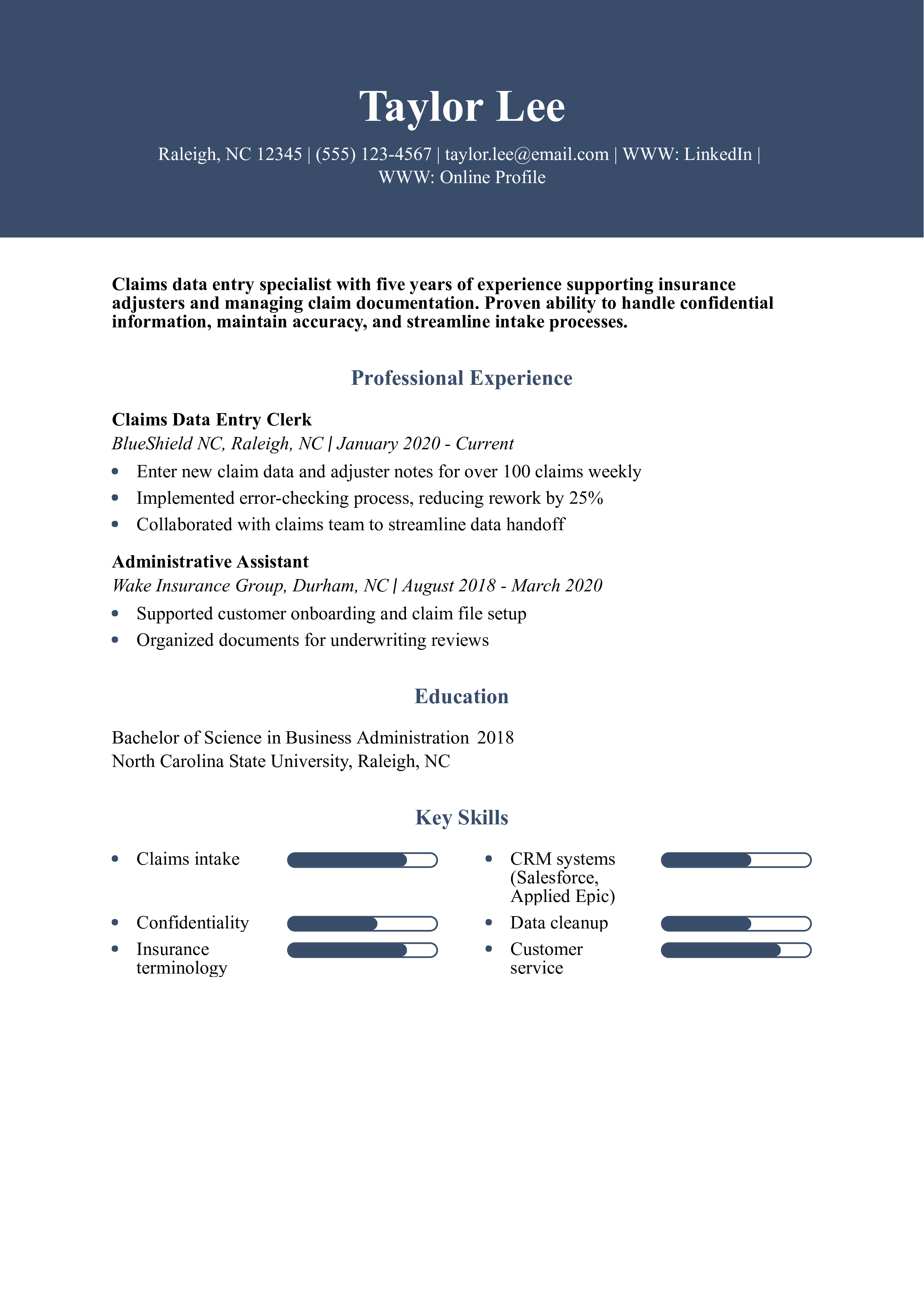
Insurance Claims Data Entry Resume
Why This Resume Stands Out
This resume is good because it focuses on claim-specific data handling and confidentiality, two key requirements in the insurance field.
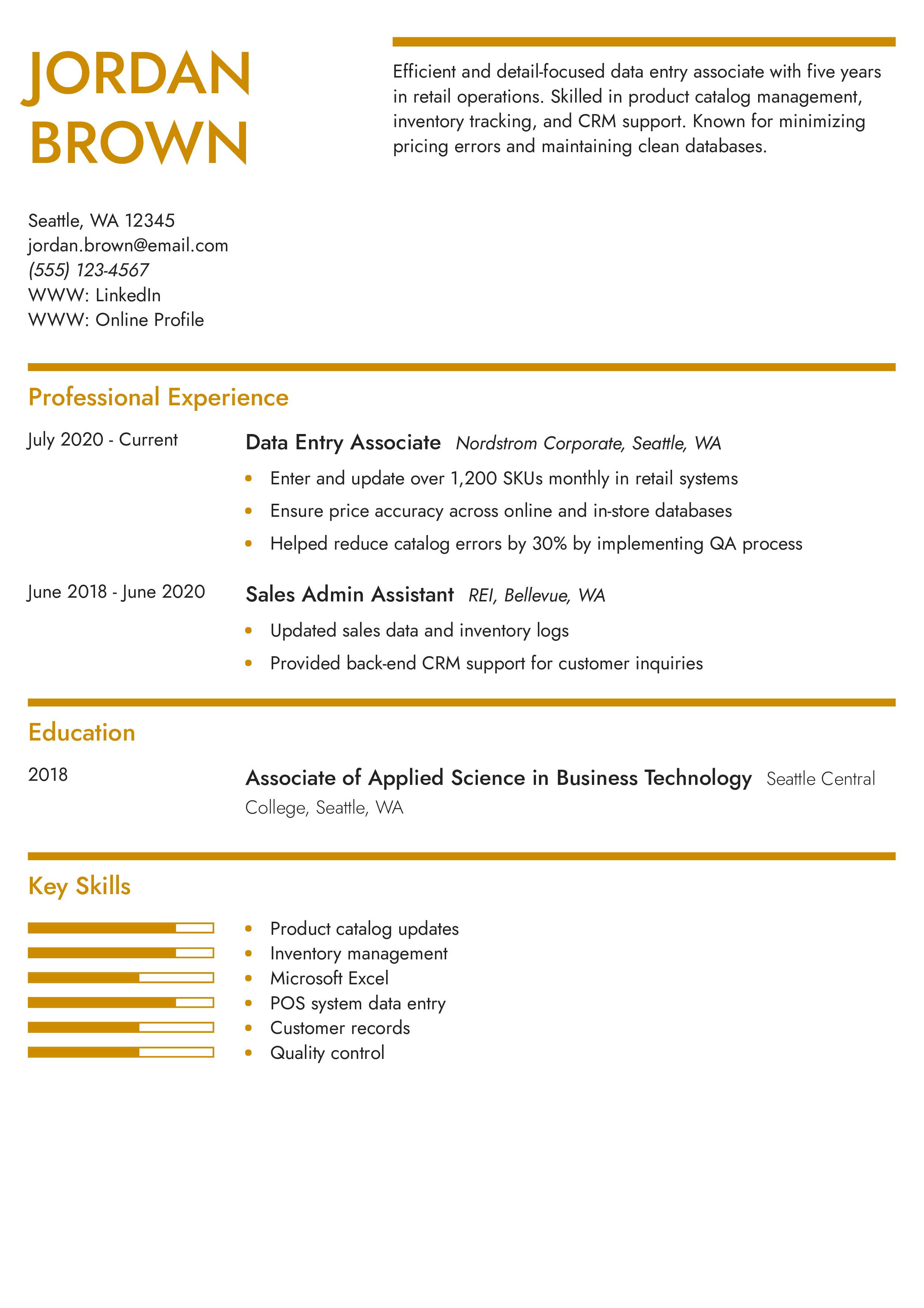
Retail Operations Data Entry Resume
Why This Resume Stands Out
This resume is good because it shows domain-specific tasks and quantifiable results in the retail industry. These performance improvements build confidence in the candidate’s precision.
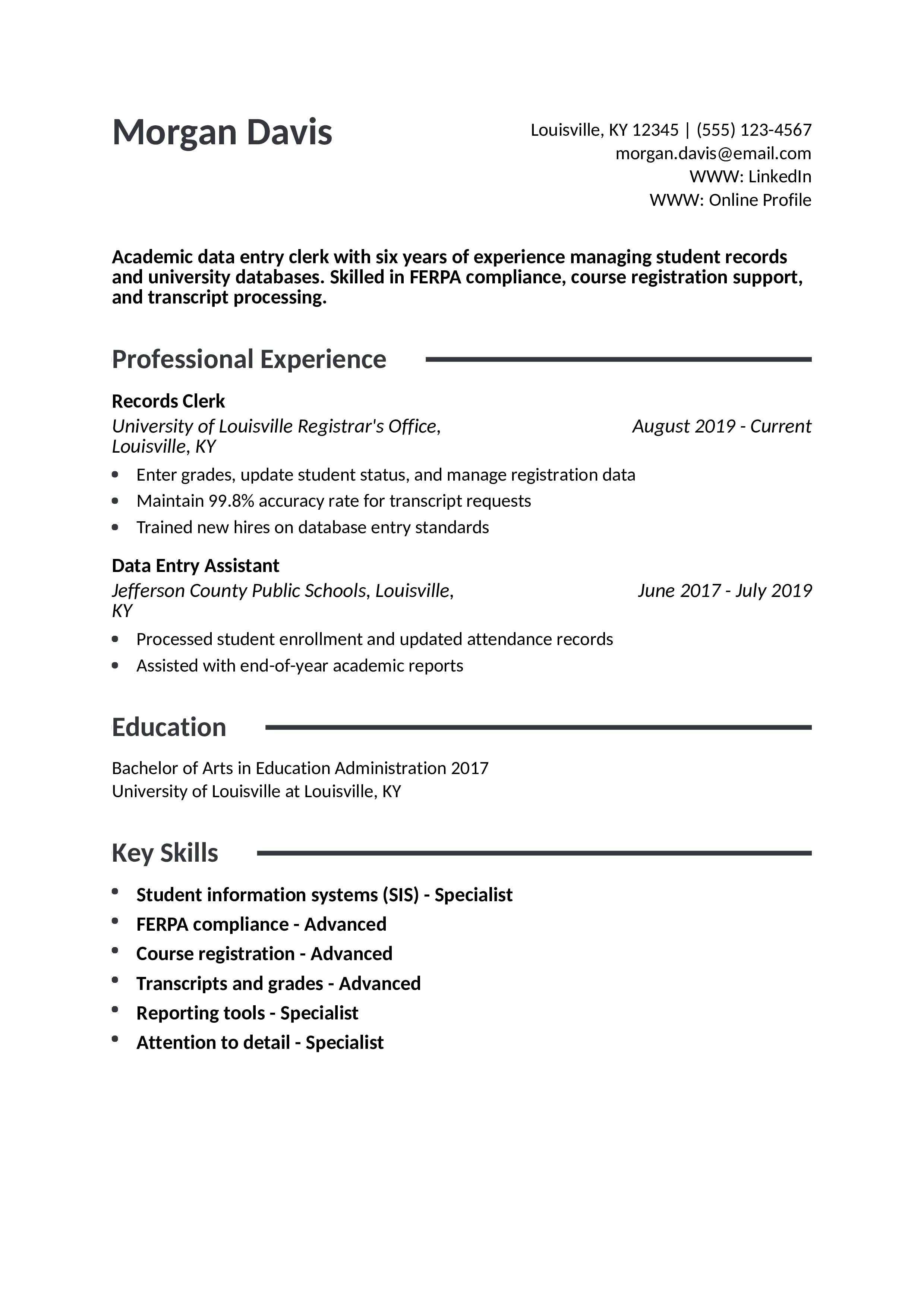
Academic Records Data Entry Resume
Why This Resume Stands Out
This resume is good because it highlights education-specific data entry and legal compliance. Quantifying accuracy and training adds additional value.
Our templates are crafted by professional resume writers to make creating your resume quick, easy, and effective.
- Professional resume template downloads
- Customized cover letter generation
- AI resume writing support
- Career-building resources and advice
Data Entry Text-Only Resume Templates and Examples
How To Write a Data Entry Resume
Data entry resumes with no error rates or volume numbers make accuracy hard to judge. Give me a sense of speed and precision so I know you can keep up with real workflow demands. A simple metric can change your entire impression.

1. Craft an outstanding profile with a summary of your data entry qualifications
A strong Profile summary will catch the hiring manager’s interest by answering the question: How do you excel as a data entry professional? For example, efficiency is often crucial to data entry jobs, so you may want to feature your typing speed in your Profile section. Keystrokes Per Hour (KPH) is usually the top factor for hiring managers, but you could also include your 10-key speed or traditional Words Per Minute (WPM) if it fits the position. Also, consider noting your data accuracy or confidentiality skills, and feel free to give specific performance figures that show your overall diligence in the field.
Entry-Level Profile Example
Analytical data entry specialist with strong recent academic and work experience as well as technical proficiency. Highly focused and efficient, with a 10-key speed of 9,000 KPH. Consistently achieve 100% of goals and standards for data accuracy.
Mid-Career Profile Example
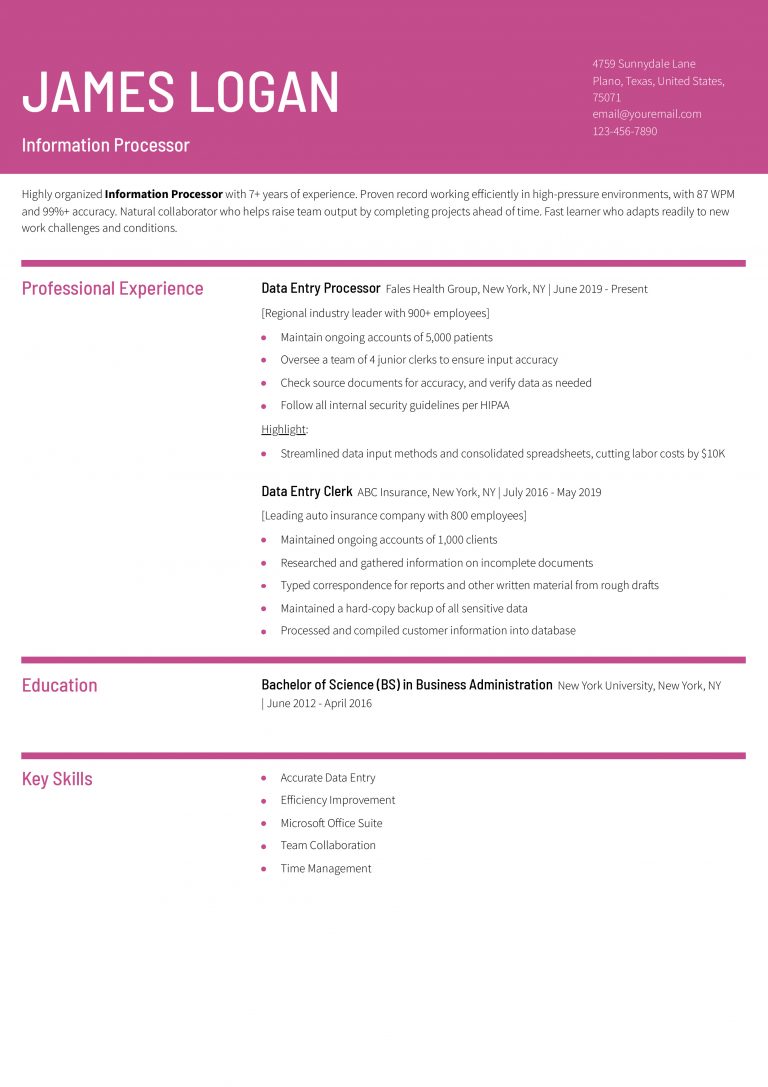
Highly organized with effective time management skills. Data information processor with over seven years of experience. Record of working efficiently in high-pressure environments, with 87 WPM and 99% and above accuracy. Natural collaborator who raises team output by completing projects ahead of time. Fast learner who adapts readily to new work challenges and conditions.
2. Add a compelling section featuring your data entry experience
Use the Experience section to give examples of your success in generating and verifying information for employers. Specific examples help a hiring manager envision how you’d add value in a data entry role at their business.
Consider how you’ve developed or honed data entry procedures and what impact that had on internal communications or operations. For instance, maybe you devised system improvements that helped pare back costs or work hours. Or perhaps you introduced a checklist for higher data accuracy on widely distributed reports. Including work highlights like these will make your resume stand out.
Mid-Career Experience Example
Data Entry Processor, Fales Health Group, New York, NY | June 2019 to present
[Regional industry leader with over 900 employees]
- Maintain ongoing accounts of 5,000 patients
- Oversee team of four junior clerks to ensure input accuracy
- Check source documents for accuracy and verify data as needed
- Follow all internal security guidelines per HIPAA
Highlight:
- Streamlined data input methods and consolidated spreadsheets, cutting labor costs by $10,000
Senior-Level Experience Example
Senior Team Manager, Ultimate Medical Academy, remote | June 2016 to present
- Oversee 35 remote team members in a fast-paced work setting
- Analyze client’s business processes and requirements while managing multiple deadlines
Highlights:
- Updated company data warehousing techniques, reducing redundancy by 20%
- Spearheaded analysis of remote software for companywide changeover
3. Include education and certifications relevant to data entry
With the education and certifications resume sections, you can show employers your data entry work has a strong knowledge base. List your highest level of education, along with any coursework, training, or certificate programs you’ve done related to data entry.
Below are templates and examples to help you format your education and certification details. Note that optional template elements appear in [brackets].
Education
Template
- Degree Name — [Major], School Name, City, ST | [Year]
- [Select Coursework]
Example
- Bachelor of Science (BS) — Business Administration, New York University, New York, NY | 2016
Certification
Template
- Certification Name or Title, [Awarding Organization] | [Year]
Example
- Data & Project Management Certification, Cambridge College of Healthcare & Technology | 2013
4. List key data entry skills and proficiencies
Include a “Key Skills” section on your resume to show the various ways you help verify, process, and generate data resources. You can also use this section to display your technical proficiency in programs like Microsoft Excel or QuickBooks (but if you’re versed in five or more, consider making them a separate Technical Skills section). Below are some common data entry skills to consider for your resume:
| Key Skills and Proficiencies | |
|---|---|
| Client confidentiality | Data accuracy |
| Efficiency improvement | Error identification |
| Microsoft Excel | Microsoft Office Suite |
| Order entry | PeopleSoft |
| Process streamlining | QuickBooks |
| Reporting and documentation | Task prioritization |
| Time management | Touch typing |
| Transcription | Workflow development |
How To Pick the Best Data Entry Resume Template
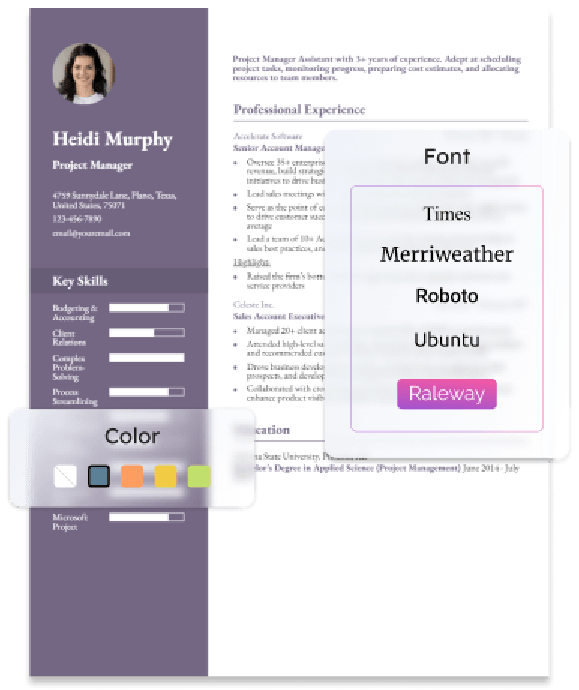
As with most vocations, data entry workers should use a resume template that’s clear and straightforward. Opt for one that lets the hiring manager quickly review your best career details. Select a clear resume font, and avoid any template with an overly colorful or elaborate design.
Frequently Asked Questions: Data Entry Resume Examples and Advice
Why should I use a Data Entry resume example as a template for my own resume?-
A Data Entry resume example provides a solid foundation for structuring your own resume. It showcases how to highlight achievements, use quantifiable metrics, and present your experience in an organized manner. You can personalize it by adding your unique qualifications and adjusting sections to better reflect your skills and career history.
What are common action verbs for data entry resumes?-
For data entry professionals, the best resume verbs will relate to processing large amounts of information – think “compiled,” “digitized,” or “streamlined.” But there are various others you might use to describe your duties and contributions in this field. The following list can help you find the right mix of action verbs for your data entry resume:
| Action Verbs | |
|---|---|
| Added | Analyzed |
| Assisted | Built |
| Collected | Compiled |
| Completed | Consolidated |
| Created | Digitized |
| Drafted | Edited |
| Eliminated | Enhanced |
| Entered | Evaluated |
| Gathered | Generated |
| Identified | Improved |
| Managed | Organized |
| Pared back | Pinpointed |
| Processed | Produced |
| Recorded | Reported |
| Sorted | Sourced |
| Streamlined | Transcribed |
| Transmitted | Typed |
| Updated | |
How do you align your data entry resume with a job posting?-
The Bureau of Labor Statistics forecasts that the number of data entry jobs will decrease by about 25% (or 38,500 jobs) between 2021 and 2031.
Despite fewer total job openings, you can find more opportunities in this field if you tailor your resume for each application. One great way to do this is by selectively adding brief descriptions of the companies you’ve worked with in brackets right next to or below the company name. Company descriptions let you show any similarities between your past employers and the one who posted the job. For example, maybe you’ve worked for companies of a similar size or in a similar industry. Or perhaps you’ve worked at organizations with a similar mission or business model. By working these details into your descriptions, you can make your resume more relevant to the job opening.
What is the best data entry resume format?-
In nearly all cases, use a Combination (or Hybrid) resume because it’s easiest for hiring managers to learn about your pertinent skills and experience. It’s also easiest for you to modify based on your job goals.
With the Combination format, you highlight your most relevant skills and experience in your Experience or Work History section and an intro section. (This combination of work history and intro content is where the format gets its name.) Your resume intro should include a Profile summary and Key Skills section, but you may also add a Career Highlights or Awards section.
How many pages should my data entry resume be?-
Generally, a data entry resume should be one page for candidates with fewer than 10 years of experience. A two-page resume is acceptable if you’re a seasoned professional with extensive accomplishments—but only if it provides meaningful details that strengthen your application. Tailor your content to the job, focusing on your most relevant qualifications.
Work history should typically cover the last 10 to 15 years. Older positions can be excluded or briefly summarized unless they’re highly relevant. A concise, focused resume demonstrates your ability to prioritize and communicate effectively.
Craft your perfect resume in minutes
Get 2x more interviews with Resume Builder. Access Pro Plan features for a limited time!

Write and submit a strong cover letter to increase your chances of an interview for data entry jobs. The key to an effective letter is customizing it based on each job opening. Read our data entry cover letter guide to learn how. For other related examples, see our data analyst and data scientist cover letter guides.