
In This Guide
- A resume should include contact information, a professional summary or objective, work experience, skills, education, and additional qualifications that support your candidacy.
- A clear, structured resume format makes your qualifications easier for applicant tracking systems (ATS) and hiring managers to scan.
- Relevant, industry-specific keywords from the job description help align your resume with employer expectations and improve ATS readability.
- Tailoring your experience, skills, and achievements to each position helps employers see how your background matches the role.
- Leaving out outdated details, irrelevant personal information, and unnecessary content keeps your resume focused on your most relevant qualifications.
Knowing what to put on a resume can make the difference between a focused application and a document that gets overlooked. The challenge is deciding which qualifications, skills, and experiences deserve space, and which details distract from your value.
A resume isn’t an exhaustive work history or personal biography; it’s a professional marketing document that shows employers why your background fits the role.
This guide breaks down the essential resume sections, explains what to include in each, and shows how to use relevant keywords and ATS-friendly formatting to present your qualifications clearly to recruiters and hiring managers.
At a Glance: What to Include on a Resume
A modern resume should prioritize the information employers need to evaluate your qualifications. Most resumes include five core sections, while optional sections depend on career history and the job requirements.
Optional sections should strengthen your candidacy by demonstrating relevant skills, accomplishments, or qualifications. Prioritize content that supports the specific position rather than adding sections simply to fill space.
Here’s an overview of what to put on a resume:
| Must-Have Sections | Optional Sections | Don’t Include |
| Contact information | Professional certifications | Social Security number |
| Professional summary or objective | Volunteer experience | Date of birth or age |
| Work experience | Relevant projects | Marital status |
| Skills | Awards and honors | Headshot or personal photo (unless requested, relevant, or customary locally) |
| Education | Publications or presentations | Full street address |
| Languages | Irrelevant hobbies or interests | |
| Professional memberships | References or “References available upon request” | |
| Internships | Outdated or unrelated work experience | |
| Military service | Salary history or salary expectations (unless requested) |
5 Essential Sections Every Resume Needs
Every professional resume should include five core sections: contact information, a professional summary or objective, work experience, skills, and education. These sections give recruiters and hiring managers a clear picture of who you are, what you bring to the role, and how your background matches their requirements.
1. Professional Header & Contact Information
Your resume header should include your full name, phone number, email address, city and state (zip code optional), and relevant professional links, such as your LinkedIn profile or portfolio.
If you hold a relevant credential, such as CPA, RN, or PMP, include it after your name to make your qualifications easy to spot. Use a professional email address rather than an informal nickname, and list only your city and state instead of your full street address.
Here’s an example of how to structure your header:
Jordan Taylor, PMP
Bellevue, WA | (555) 123-4567 | [email protected]
linkedin.com/in/jordantaylor | jordantaylorportfolio.com

Tip!
Tip!
If you're applying for jobs outside your current area, add a brief note such as “Open to Relocation” or “Relocating to Austin, TX” beneath your location. This helps employers understand your availability without taking up much space. Only include relocation details if you're genuinely prepared to move.
2. Professional Summary or Objective (Qualifications Snapshot)
A professional summary or resume objective is a concise introduction that highlights your qualifications, relevant skills, and career goals. A two- to three-sentence professional summary is generally best for experienced professionals, while an objective can help recent graduates, entry-level candidates, and career changers explain their career direction and how their background aligns with the position.
Focus on relevant strengths, accomplishments, and career goals rather than repeating your work history or using a generic statement about what you hope to gain.
Here’s what to include in your professional summary or objective:
- Your professional title, career level, or area of expertise
- Your most relevant skills, qualifications, or industry knowledge
- One or two notable accomplishments, strengths, or areas of impact
- Keywords and qualifications that align with the job description
Hiring managers generally prefer tailored professional summaries over generic, outdated resume objectives because summaries highlight relevant skills, experience, and qualifications rather than focusing primarily on what you hope to gain from a job.
The examples below show how to tailor your summary depending on your experience level or career situation.
Career Changer
Customer service professional transitioning into human resources, with 6 years of experience resolving concerns, managing confidential records, and coordinating daily operations. Reduced customer complaint resolution time by 20% by improving follow-up processes. Brings transferable strengths in communication, problem-solving, and organization to employee relations and HR support.
Experienced Professional
Detail-oriented operations manager with 10+ years of experience leading teams, improving business processes, and managing cross-functional projects. Skilled in strategic planning, budget management, and team development, with a track record of reducing operating costs by 15% through process improvements and workflow optimization.
Recent Graduate
Recent marketing graduate with hands-on experience in social media management, market research, and content creation through academic projects and internships. Skilled in Google Analytics, Canva, and digital marketing strategy, with a track record of increasing social media engagement by 25% during a semester-long internship.
3. Work Experience & Quantifiable Achievements
Your work experience section should highlight relevant positions, responsibilities, and measurable accomplishments, typically covering the last 10–15 years. For each role, include your job title, company name, location, and employment dates (month and year). Use concise bullet points to show how your work contributed to team, department, or business goals.
Prioritize achievements over routine job duties, and tailor the details to the position you’re seeking. A strong resume bullet follows a simple formula:
Action Verb + Context or Task + Quantifiable Result
Start with a specific action verb, explain what you did and why it mattered, then include a measurable outcome when possible. Metrics such as percentages, dollar amounts, time saved, revenue generated, or team size help employers understand the scope and impact of your work.
For example:
- Weak: Responsible for managing a customer service team.
- Stronger: Led a 12-person customer service team and improved customer satisfaction scores by 18% in one year.
Here’s an example of how to structure a work history entry:
Work Experience
Operations Manager
TechShare Solutions | Seattle, WA
January 2020–Present
- Lead a 15-person operations team, improving departmental productivity by 20% through updated workflows and team training.
- Identify inefficiencies and implement process improvements, reducing annual operating costs by 15%.
- Manage a $2 million departmental budget, maintaining spending within budget while supporting business priorities.
- Streamline inventory management procedures, reducing order processing time by 30%.
Strong Action Verbs for Your Resume
Choose action verbs that accurately describe your contributions. Vary your word choices to keep bullet points engaging, specific, and focused on results.
Here are some examples of effective action verbs for your resume:
| Category | Strong Action Verbs |
| Leadership | Led, managed, directed, mentored, supervised, coordinated, developed, delegated, spearheaded |
| Technical | Designed, engineered, implemented, programmed, automated, configured, optimized, tested, troubleshot |
| Quantitative & Analytical | Analyzed, measured, forecasted, calculated, evaluated, increased, reduced, improved, accelerated |
| Communication & Collaboration | Presented, negotiated, advised, collaborated, persuaded, facilitated, documented, recommended, trained |
4. Education & Relevant Credentials
Your education section should list your degrees, institutions, graduation dates, and locations, along with relevant academic honors or coursework. Recent graduates can place education near the top of the resume to highlight academic achievements, while professionals with five or more years of experience should generally place it below work experience.
Include details that support your qualifications for the position without taking space away from more relevant experience. For each academic entry, list:
- Your degree, diploma, major, or field of study
- The full name of the school, college, or university, along with its city and state
- Your graduation year or expected graduation date if you’re a recent graduate or still studying; omit if you earned your degree several years ago
- Relevant coursework, academic honors, or awards, particularly if you’re early in your career or the details directly support the position
- Your GPA if you’re a recent graduate and it strengthens your application, generally 3.4 or higher, particularly for internships or entry-level roles
Here’s an example of what to include in your education entry:
Education
Bachelor of Science in Business Administration
University of Washington | Seattle, WA | June 2025
GPA: 3.7/4.0
Tip!
Tip!
Once you've earned a college degree or other higher education credential, you can remove your high school information. Use the space to highlight relevant professional experience, certifications, or skills instead.
5. Targeted Skills Section
A strong resume skills section highlights approximately 6–10 capabilities that directly match the job you’re applying for. Include a mix of technical or hard skills, such as software, tools, and industry-specific methodologies, and interpersonal or functional skills that demonstrate how you work. Tailoring this section to the job description helps recruiters quickly identify relevant qualifications and gives ATS software clear, relevant keywords to recognize.
- Technical skills demonstrate specific tools, software, systems, or methodologies you can use, such as Salesforce, SQL, or Adobe Creative Suite.
- Functional skills reflect job-related capabilities, such as budget management, data analysis, strategic planning, or customer relationship management.
- Interpersonal skills highlight how you work with others, including communication, collaboration, conflict resolution, and team leadership.
Group related skills under clear subheadings to make the section easier for recruiters to scan and help ATS software identify relevant terms. For example:
Skills
- Technical Skills: Salesforce, SQL, Tableau, data visualization
- Functional Skills: Budget management, process improvement, project coordination
- Interpersonal Skills: Cross-functional collaboration, stakeholder communication
Here are a few tips for choosing the right skills for your resume:
- Use the same terminology as the job posting when it accurately describes your abilities.
- Make sure your work experience bullets provide evidence of your listed skills through projects, responsibilities, or measurable results.
- Remove basic computer skills, such as email and Microsoft Word, unless the role specifically requires advanced proficiency.
- Avoid vague descriptions like “detail-oriented,” “hardworking,” or “team player.” Show these qualities through concrete examples in your work experience instead.
Resume Example: Putting the Core Sections Together
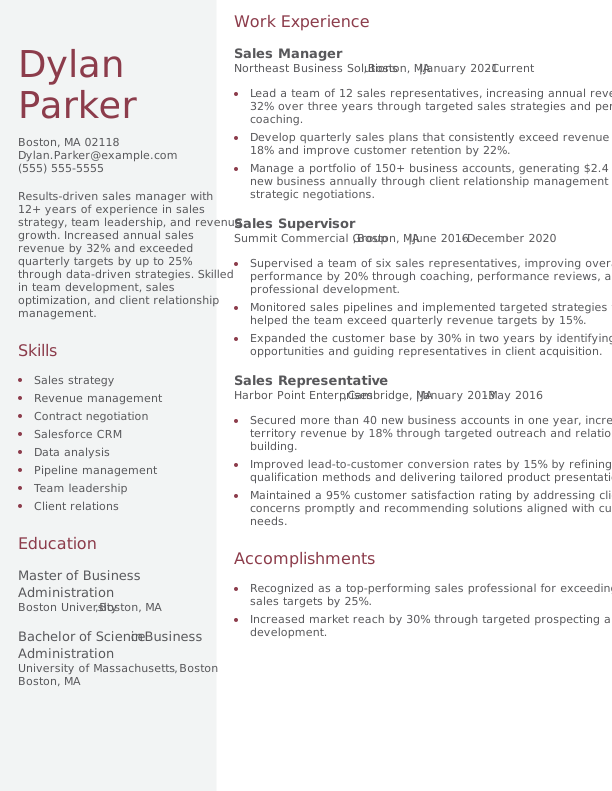
This sample resume shows how to bring the essential sections together in a clear, professional format. It demonstrates how to organize contact information, a tailored professional summary, targeted skills, education, and reverse-chronological work experience.
Our templates are crafted by professional resume writers to make creating your resume quick, easy, and effective.
- Professional resume template downloads
- Customized cover letter generation
- AI resume writing support
- Career-building resources and advice
Why This Resume Works
- It includes the essential resume sections. The example features contact information, a professional summary, skills, work experience, education, and additional accomplishments, giving employers a clear overview of the candidate’s qualifications.
- It leads with a targeted professional summary. Dylan’s summary highlights their 12+ years of experience, sales expertise, and measurable revenue growth.
- It features relevant, job-specific skills. The skills section highlights capabilities such as Salesforce CRM, contract negotiation, and pipeline management that support their target sales management role.
- It prioritizes achievements over job duties. Work experience bullets use action verbs and measurable results, including revenue growth, customer retention, and team performance improvements.
- It presents experience in reverse-chronological order. Starting with the most recent position helps recruiters quickly understand Dylan’s career progression.
- It keeps the format clear and organized. Consistent headings, straightforward formatting, and recognizable section labels make the resume easier for recruiters to scan and ATS software to process.
Optional Sections That Strengthen Your Application
Optional resume sections can highlight additional qualifications, practical experience, and skills that support your fit for a specific role. Choose sections that demonstrate relevant expertise, transferable skills, or accomplishments rather than adding content simply to fill space.
Certifications, Licenses, & Training
Professional certifications, licenses, and specialized training show the credentials or technical knowledge required for certain roles. They can be especially valuable in regulated industries or fields where employers look for specific qualifications.
Include the official certification or license title, issuing organization, and date earned. If the credential expires, include its expiration date or current status. Examples include:
- Project Management Professional (PMP) – Project Management Institute
- AWS Certified Solutions Architect – Amazon Web Services
- OSHA 30-Hour Construction Training – OSHA
- Registered Nurse (RN) License – State Board of Nursing
If you’re currently working toward a certification, you can list it as “In Progress” with an expected completion date. Only include credentials you’ve earned or are actively pursuing.
Projects & Portfolio Work
Projects and portfolio work give employers examples of how you’ve applied your skills in practical settings. They’re particularly useful for recent graduates, career changers, freelancers, and professionals in technical or creative fields.
Include academic, independent, freelance, or consulting projects that demonstrate skills relevant to your target position. When available, include a link to a portfolio, GitHub profile, or project sample.
For each project section entry, provide:
- Project name and date: Identify the project and when you completed it.
- Scope and purpose: Briefly explain the problem you addressed or what you set out to accomplish.
- Tools and technologies: Highlight relevant software, programming languages, platforms, or methodologies.
- Results: Describe the outcome, deliverable, or measurable impact.
For example, a recent graduate applying for a data analyst position might describe an academic project that used SQL and Tableau to analyze customer trends and develop a business performance dashboard.
Foreign Language Skills
Language skills can strengthen your resume when a position involves international clients, multilingual customers, or communication across different markets.
List each language alongside an accurate proficiency level so employers understand how comfortably you can use it. Common proficiency descriptions include:
- Native or Bilingual: You speak the language as a first language or have near-native fluency.
- Fluent: You can communicate comfortably and effectively in most professional and everyday situations.
- Professional Working Proficiency: You can use the language effectively in many workplace settings, including meetings and written communication.
- Conversational: You can participate in everyday conversations but may have difficulty with complex professional discussions.
- Basic: You understand and use simple phrases and expressions.
Place language skills in your main skills section if they’re directly relevant to the job. Otherwise, create a separate languages section near the bottom of your resume.
Volunteer Work & Community Impact
Volunteer experience can demonstrate leadership, collaboration, organization, and community involvement, even when the work wasn’t paid. It’s especially valuable for recent graduates, career changers, and people returning to the workforce because it shows transferable skills and relevant activity beyond traditional employment.
Treat substantial volunteer roles like professional experience by including the organization name, your position, dates, and a few accomplishment-focused bullet points. Highlight responsibilities and results rather than simply listing duties.
For example:
- Coordinated a team of 15 volunteers for a community fundraising event, raising $8,000 for local programs.
- Managed social media communications for a nonprofit organization, increasing event registrations by 20%.
If you’ve maintained volunteer commitments during a career break, relevant experience can also help demonstrate continued engagement and skill development.
What to Put on a Resume in Specific Situations
Your resume should reflect your experience and career path, not force you into a one-size-fits-all format. If you’re entering the workforce, changing careers, or returning after a break, focus on the skills and relevant activities that demonstrate your readiness for the role. Adjust section order and descriptions to make your strongest qualifications easy to find.
Entry-Level or No Experience
If you have limited professional experience, use your education, projects, internships, volunteer work, and extracurricular activities to demonstrate your qualifications. Employers can learn a lot from relevant work you’ve completed outside a traditional job.
Consider including:
- Academic projects and capstone work that demonstrate practical skills, research, problem-solving, or technical knowledge
- Coursework and relevant training that directly support the requirements of the position
- Campus leadership and extracurricular activities that show organization, teamwork, communication, or responsibility
- Internships, part-time jobs, and volunteer roles that demonstrate reliability and transferable skills
Place your education and relevant projects near the top of your resume if they’re your strongest qualifications. Describe your contributions with action verbs and specific outcomes, even if the experience came from a class project or student organization.
Changing Careers
When changing careers, organize your resume around the skills and accomplishments that transfer to your target industry. A combination resume format can highlight relevant capabilities while keeping a clear work history so employers can understand your experience.
Start with a targeted professional summary that explains your new career direction and highlights relevant strengths. Then identify transferable skills, such as project coordination, customer service, data analysis, or team leadership, and support them with examples from previous roles, training, or independent projects. Tailor your skills and experience to the language used in the job description without overstating your qualifications.
For example, a former retail manager applying for an operations role could emphasize staff scheduling, inventory management, process improvements, and team leadership rather than focusing only on sales responsibilities.
Employment Gaps
If you have an employment gap, you can address relevant activities directly in your work history section. Use a straightforward title and dates, then briefly describe what you did or learned. You don’t need to disclose private details or explain every period away from work.
Examples include:
- Professional Development | January 2024–June 2024: Completed online courses in data analytics and earned a related industry certification.
- Freelance Graphic Designer | March 2023–December 2023: Completed design projects for small-business clients and managed project timelines and deliverables.
- Family Caregiver | 2022–2023: Took time away from full-time employment to provide family caregiving.
- Volunteer Coordinator | January 2023–August 2023: Organized community events and coordinated volunteer schedules.
- Career Break | 2024: Took time away from work for personal reasons and am now prepared to return.
Tip!
Tip!
For medical or personal recovery, you can use a general description such as “Career Break” or “Personal Leave” without sharing health information. Keep explanations brief, use accurate dates, and focus on relevant skills or experience gained during the time away.
AI Content Rules: What to Include & What to Avoid
AI writing tools can help you organize your resume, improve bullet points, and identify relevant keywords, but the final content should accurately reflect your experience. Use AI-generated suggestions as a starting point, not a substitute for your own judgment. Every statement should be factually correct, specific to your background, and easy to support with real examples.
What to Include
Use AI to strengthen how you present your real qualifications, not to create new ones. Focus on accurate accomplishments, relevant skills, and specific examples that reflect your experience and align with the job requirements.
- Verified accomplishments and metrics: Include accurate figures that demonstrate results, such as revenue growth, project timelines, customer satisfaction, or team size. If you don’t know an exact number, describe the outcome without inventing one.
- Specific, relevant skills: Highlight tools, technologies, certifications, and abilities you have actually used or developed. Incorporate terminology from the job description when it accurately describes your experience.
- Human-reviewed AI suggestions: Use AI to refine wording, strengthen action verbs, and tighten descriptions. Review every suggestion to ensure it reflects your contributions and level of responsibility.
- Concrete project details: Describe your actual contributions, the tools or methods you used, and the results you achieved. Specific examples provide stronger evidence of your abilities than generic claims.
What to Avoid
Avoid using AI-generated content that exaggerates your qualifications, introduces inaccurate details, or makes your resume sound generic. Every statement should be truthful, relevant, and something you can confidently explain to an employer.
- Unverified AI-generated claims: Don’t include responsibilities, certifications, skills, or accomplishments simply because an AI tool suggested them.
- Fabricated metrics: Never invent percentages, dollar amounts, productivity improvements, or other figures to make a bullet point sound stronger.
- Generic AI buzzwords: Phrases such as “visionary thought leader,” “results-driven innovator,” and “dynamic strategic professional” add little without evidence. Replace them with clear descriptions of your work and impact.
- Keyword stuffing: Repeating skills or copying long strings of keywords from a job description can make your resume difficult to read. Include relevant terms naturally in your summary, skills, and experience sections.
- Unedited AI-generated text: Don’t paste entire AI-written summaries or bullet points without checking their accuracy, tone, and relevance to the role.
What Should You Leave Off a Resume?
Leave off information that doesn’t help employers evaluate your qualifications, including irrelevant personal details, outdated experience, and generic statements.
To keep your resume professional and focused, don’t include:
- Photographs or headshots: In most U.S. industries, a resume photo is unnecessary and may introduce bias or create formatting or parsing issues. Exceptions include certain acting, modeling, and other roles where an image is specifically requested.
- Irrelevant personal details: Leave out your age, marital status, religion, and full street address. Include citizenship or work authorization details only when relevant or requested; never include sensitive personal information that isn’t needed.
- “References Available Upon Request”: This outdated statement takes up valuable space. Prepare a separate reference sheet and provide it when an employer asks.
- Unrelated hobbies and interests: Skip personal activities that don’t demonstrate relevant skills or connect meaningfully to the role.
- Generic buzzwords and empty phrases: Terms such as “hard worker,” “team player,” and “critical thinker” are more effective when you demonstrate them through specific skills, actions, and accomplishments.
- Excessively old or irrelevant work history: Focus on the most relevant experience, typically from the past 10–15 years. You can shorten or remove older roles unless they directly support your qualifications.
- Compensation history or salary expectations: Avoid listing previous salaries or desired pay unless the employer specifically requests this information.
Tip!
Tip!
Before submitting your resume, review each section and ask whether the information helps demonstrate your qualifications for the job. If it doesn't, consider removing it to make room for more relevant details.
Resume Formatting Standards
A well-formatted resume should be easy for recruiters to scan and ATS-friendly. Use consistent headings, readable fonts, standard margins, and a simple layout. The goal is to make your qualifications easy to find without decorative elements that may interfere with document parsing.
Page Length
Most resumes should be one or two pages, depending on your experience and the relevance of your qualifications. A one-page resume is often appropriate for students, recent graduates, and professionals with limited work history.
Candidates with 10 or more years of relevant experience may need two pages to present their accomplishments, skills, and career progression clearly. Prioritize relevant content over an arbitrary page limit, and avoid shrinking text or margins just to fit everything onto one page.
Fonts & Margins
Choose a professional, easy-to-read font and maintain consistent formatting throughout your resume. Standard serif and sans-serif fonts work well for both digital and printed documents.
- Font choices: Use familiar fonts, such as Arial, Calibri, or Times New Roman.
- Body text: Keep font size between 10–12 points for comfortable reading.
- Headings: Use approximately 14–16 points to distinguish section titles from body text.
- Margins: Set margins between 0.5–1 inch on all sides to maintain white space.
- Formatting: Use bold text and consistent spacing to establish a clear visual hierarchy. Avoid text boxes, complex columns, graphics, and decorative elements.
File Types
Save your resume in the file format requested by the employer. PDF files generally preserve your layout across devices, while Word documents (DOC or DOCX) may be preferred by some application systems or recruiters.
If the job posting doesn’t specify a format, a text-based PDF or DOCX file is usually a practical choice. Avoid image-only PDFs because their text may not be machine-readable.
Key Takeaways
Use this checklist to make sure your resume includes the right information, highlights your qualifications, and follows professional formatting standards.
- Include the essential sections. Add your contact information, professional summary or objective, work experience, skills, and education.
- Tailor your content. Match your skills, accomplishments, and relevant keywords to the requirements of each position.
- Highlight measurable achievements. Use action verbs and accurate metrics to demonstrate the impact of your work.
- Add relevant optional sections. Include certifications, projects, language skills, or volunteer experience when they strengthen your application.
- Adapt your resume to your experience. Use academic projects and transferable skills for entry-level roles, or explain relevant career breaks and transitions clearly.
- Use AI thoughtfully. Review AI-generated suggestions for accuracy, remove generic wording, and never include fabricated accomplishments.
- Keep formatting simple. Choose readable fonts, consistent headings, and an ATS-friendly format.
- Proofread carefully. Check for spelling and grammar errors, verify your contact information, and make sure all dates, qualifications, and accomplishments are accurate.
- Remove unnecessary details. Leave out irrelevant personal information, outdated experience, and generic filler.
Frequently Asked Questions
What should I put on my resume?
Key things to put on a resume are details that show employers your professional value and fit for the role, including relevant accomplishments, specialized knowledge, training, and examples of problems you've solved. Highlight industry expertise, leadership contributions, and successful projects that make your background distinctive. Prioritize information that demonstrates how you can meet the employer's needs rather than documenting every experience.
Should you include your address on a resume?
You generally don't need to include your full street address on a resume. Your city and state are usually sufficient to give employers a general idea of your location without exposing unnecessary personal information. If you're applying in another city, mention your willingness to relocate when relevant. Follow the employer's application instructions if specific location details are required.
How many jobs should I include on my resume?
The number of jobs you should include on your resume depends on your career history and target position. Most resumes should include 10–15 years of relevant work experience. Include roles that demonstrate your skills, professional growth, and qualifications. Shorten descriptions of older positions or omit unrelated roles to make room for relevant accomplishments. Recent graduates can include internships, part-time jobs, and volunteer positions instead of relying solely on full-time employment.
What are some skills to put on a resume?
Good skills to put on a resume show you can handle the job's specific responsibilities. Consider abilities such as managing competing priorities, interpreting data, resolving customer concerns, coordinating projects, or learning new software. Review the job posting for the capabilities the employer emphasizes, then choose skills that reflect your strengths and that you can support with examples from professional, academic, or volunteer experience.
What are the top five resume mistakes?
The top five resume mistakes are using a generic resume for every application, including typos or grammatical errors, listing duties without showing accomplishments, adding irrelevant or outdated information, and using complex formatting that's difficult to scan. Avoid these mistakes by tailoring your content to each position, proofreading carefully, highlighting meaningful contributions, prioritizing relevant qualifications, and using an ATS-friendly layout.
Craft your perfect resume in minutes
Get 2x more interviews with Resume Builder. Access Pro Plan features for a limited time!