
Backstabbing at work can undermine trust and make employees question the intentions of the people they work with most closely.
Resume Builder’s Workplace Backstabbing Report examines how often workers experience intentional undermining, who they suspect is responsible, and what motivates these behaviors. Nearly 7 in 10 workers say someone at work has undermined them in the past year, and many believe job security and career ambition drive these actions.
Key Findings
- Backstabbing is business as usual. 77% of workers consider workplace backstabbing or intentional undermining at least somewhat common.
- Most workers have been affected by backstabbing. 69% experienced at least one listed form of workplace undermining in the past year.
- The call is coming from inside the team. 62% believe or suspect someone has tried to push them out of their job, most often a teammate (37%) or their own manager (19%).
- Survival and ambition are top motivators. 37% believe employees undermine colleagues to protect their jobs, and an equal share say they do so to gain recognition or credit. Another 34% cite improving promotion chances.
- Layoff anxiety can fuel self-preservation. 24% say employees become less willing to help colleagues when job security is a concern, while 35% would be likely to call attention to a coworker’s mistakes if layoffs threatened their own job.
Backstabbing Is Becoming a Workplace Norm
Workers believe workplace sabotage happens regularly, with 77% saying it’s at least somewhat common. More than 4 in 10 describe it as very or extremely common.
- 34% – Somewhat common
- 27% – Very common
- 16% – Extremely common
- 16% – Not very common
- 7% – Not at all common
What this means: These workplace backstabbing statistics reveal that when employees see backstabbing as a regular part of work life, it becomes harder to build trust with colleagues. Even the perception that coworkers may act against one another can make employees more guarded and less comfortable relying on their teams.
Inside the Backstabber’s Playbook
From shifting blame to taking credit for someone else’s work, workplace undermining can take several forms. Nearly 7 in 10 workers (69%) say they’ve experienced at least one of these behaviors in the past year.
- 30% – Blamed them for a mistake or problem
- 26% – Called unnecessary attention to their mistakes
- 22% – Gossiped about them or spread rumors
- 21% – Withheld information they needed to succeed
- 21% – Excluded them from important conversations or decisions
- 19% – Took credit for their work or ideas
- 17% – Interfered with their ability to complete work successfully
- 13% – Tried to damage their relationship with a manager or colleague
Only 31% say they haven’t experienced any of these behaviors.
What this means: These behaviors can affect both an employee’s reputation and their ability to do their job. Being blamed for mistakes, left out of decisions, or denied information can create barriers to success that have little to do with actual performance.
Keep Managers Close & Coworkers Closer
When employees suspect they’re dealing with backstabbing at work, it can become harder to know who to trust. Nearly two-thirds (62%) believe or suspect someone has tried to push them out of their job, either currently or in the past.
- 38% – Never experienced or suspected it
- 25% – Believe it happened in the past but is no longer happening
- 21% – Suspected it but were never certain
- 16% – Believe it’s happening now
Workers most often identify backstabbing coworkers within their immediate circle. More than a third point to a coworker on their own team, and nearly 1 in 5 say the person trying to push them out is their own manager.
- 37% – A coworker on their team
- 30% – No one
- 19% – Their direct manager
- 18% – Someone on another team
- 9% – Senior leadership
- 7% – A direct report
What this means: Workplace conflict can feel especially threatening when employees suspect the people they rely on most are working against them. These workplace sabotage statistics show that concerns involving managers can add another layer of uncertainty, leaving workers unsure whether they’re being treated fairly or have a secure place in the organization.
Every Backstabber Has a Motive
Workers see ambition and self-preservation as the main drivers of backstabbing. Gaining credit and protecting their own jobs top the list of perceived motives, with improving promotion chances close behind.
- 37% – To gain recognition or credit
- 37% – To protect their own job
- 34% – To improve their chances of promotion
- 31% – To avoid blame for a mistake or failure
- 26% – To gain favor with a manager or senior leader
- 25% – Insecurity about their own performance
- 23% – Personal conflict or dislike
- 8% – Workplace competition encourages the behavior
- 8% – Don’t believe employees intentionally undermine coworkers
What this means: Wanting recognition, advancement, or job security is normal. Problems arise when employees believe they need to undermine someone else to get ahead. Those tactics can damage the trust and professional credibility workers need to build lasting careers.
Layoff Fears Turn Teammates Into Rivals
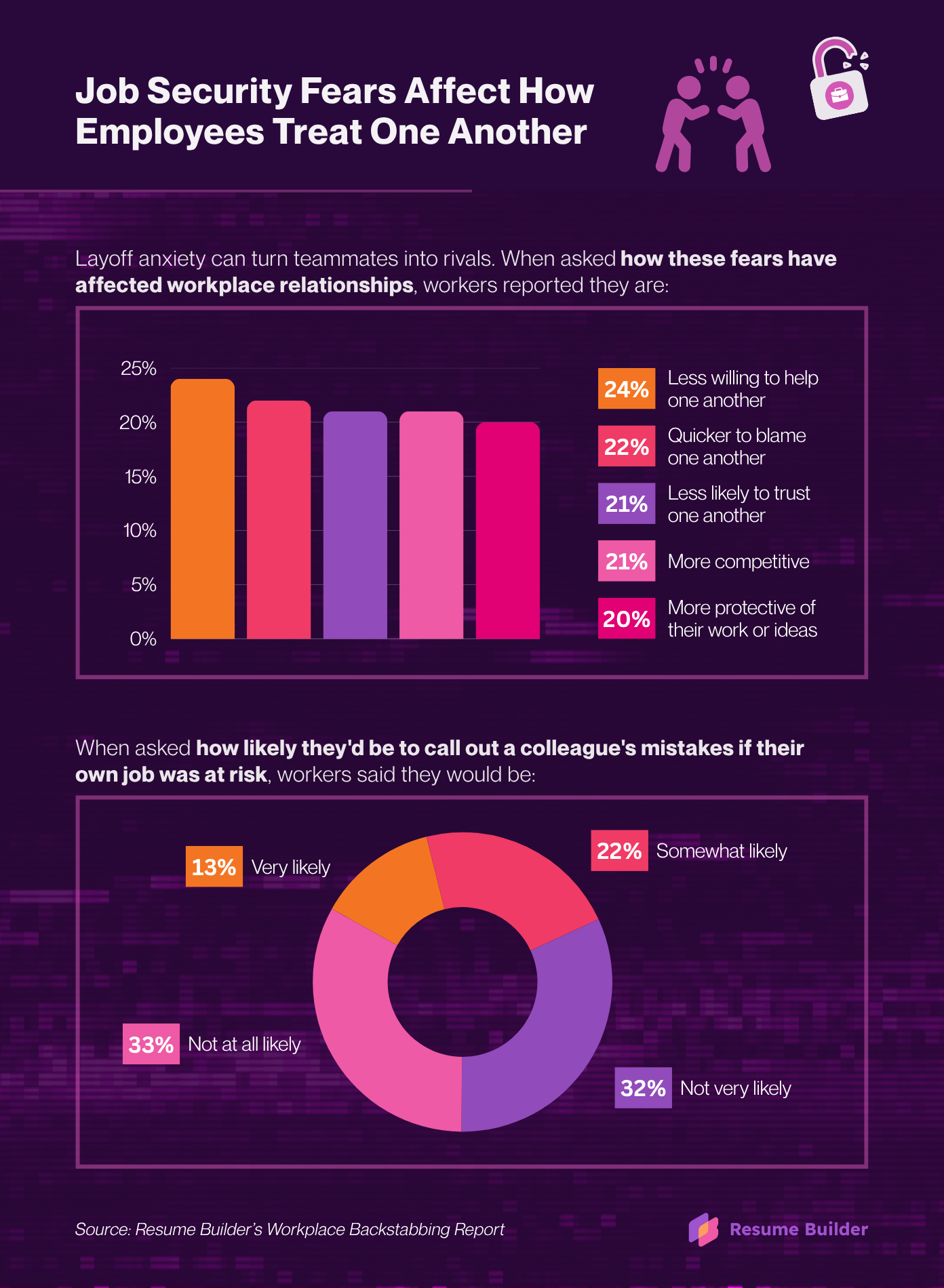
As layoffs continue to dominate the news cycle, job security fears can change how colleagues treat one another. When asked how anxiety over layoffs or job security has affected workplace relationships, workers said they’re:
- 24% – Less willing to help one another
- 22% – Quicker to blame one another
- 21% – Less trusting of one another
- 21% – More competitive
- 20% – More protective of their work or ideas
When asked how likely they would be to call attention to a coworker’s mistakes if layoffs threatened their own job, more than one-third said they would be likely to do so.
- 33% – Not at all likely
- 32% – Not very likely
- 22% – Somewhat likely
- 13% – Very likely
What this means: Layoff anxiety can make employees feel they need to protect themselves, even at the expense of their colleagues. When coworkers start treating one another as competition, trust and cooperation can suffer. A workplace fueled by fear isn’t sustainable. If anxiety starts affecting how colleagues treat you, exploring other opportunities before things get worse can give you some leverage to look out for yourself.
For press inquiries, please contact Alex Murphy at [email protected].
Methodology
The findings presented are based on a survey conducted in October 2026 among 1,014 employed U.S. adults.
The survey examined respondents’ perceptions of backstabbing and intentional workplace undermining; their personal experiences with these behaviors; their experiences or suspicions of being pushed out of their jobs; their perceptions of why employees undermine coworkers; and the effects of layoff and job-security anxiety on workplace relationships.
The sample consisted of 26% Gen Z, 27% millennials, 28% Gen X, and 19% baby boomers. Participants identified their gender as 62% female, 37% male, and 1% nonbinary.