In April 2026, ResumeBuilder.com surveyed 1,000 full-time U.S. workers and found that 60.7% have used AI to take on tasks previously done by a coworker, a behavior ResumeBuilder calls AI job hijacking. At companies that have conducted layoffs in the past 12 months, the rate rises to 74.3%, and 57.3% of the workers who absorbed a coworker’s tasks say that coworker was later laid off.
Key findings:
- 3 in 5 full-time U.S. workers (60.7%) have used AI to take on tasks previously done by a coworker
- At companies that have conducted layoffs in the past 12 months, the rate rises to 3 in 4 workers (74.3%)
- 62.8% of workers who have done this did not disclose AI’s role to their manager
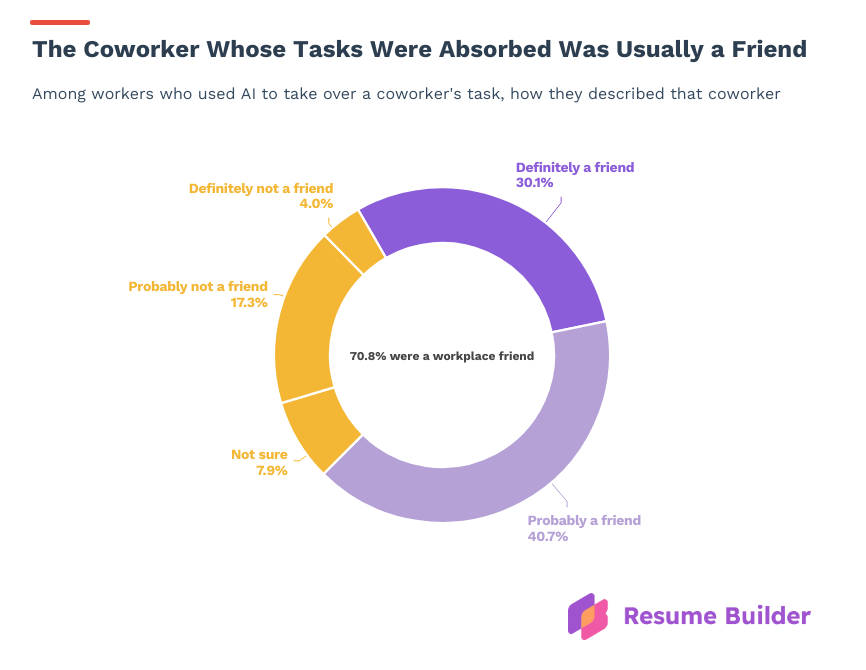
- For 70.8% of workers who did this, the absorbed coworker was a workplace friend
- 57.3% say that coworker was later laid off
- 48.3% of workers who have done this received some form of career reward afterward
AI Job Hijacking More Than Doubles at Companies That Have Already Cut Staff
3 in 5 full-time U.S. workers surveyed (60.7%) say they have used AI to take on tasks or responsibilities previously done by a coworker. More than 1 in 4 workers (27.3%) describe this as “definitely” something they have done.
The rate rises at companies where layoffs have already occurred. At companies with many layoffs in the past 12 months, 74.3% of workers have used AI this way. At companies with some layoffs, the figure is 69.4%. At companies where layoffs seem likely but have not yet happened, 47.9%. At companies where layoffs do not seem likely, 35.2%.
Workers at companies that have conducted layoffs are using AI to take over coworkers’ tasks at roughly 1.5 times the rate of workers at companies without layoffs. By age, the rate peaks with workers 35 to 44 at 74.7%. By gender, 67.1% of men and 51.8% of women report the behavior.
Nearly 1 in 3 workers who have used AI this way (32.3%) have taken on four or more different responsibilities in the past six months.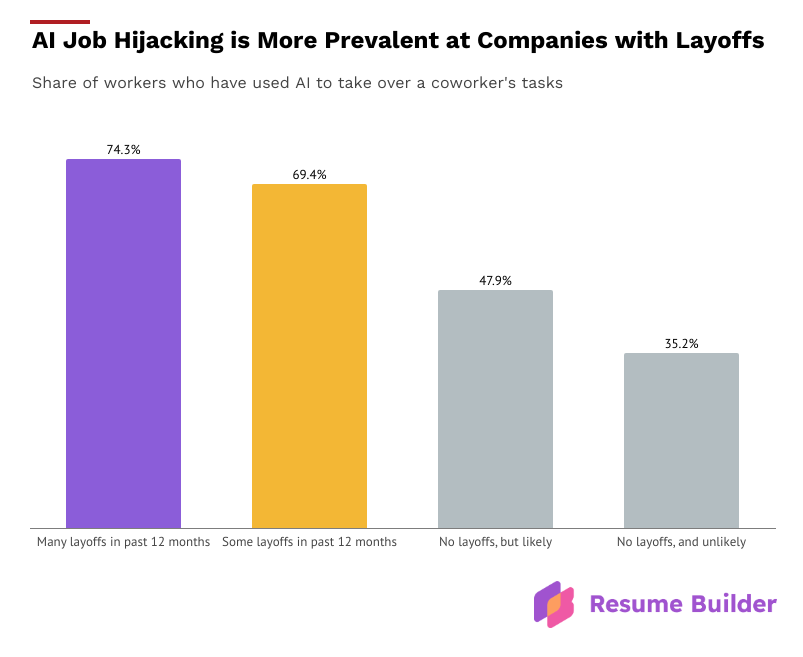
“When AI first took hold in the workplace, the focus was clear: hire for it, train for it, and use it to boost productivity. Then inflation surged, layoffs followed, and employee anxiety around job security spiked. What we are seeing now feels less like innovation and more like Survivor. Instead of sharing knowledge and building new skills together, some employees are shifting into self-preservation mode, guarding information, avoiding risk, and at times undermining colleagues to stay off the layoff list. Organizations risk losing the very engagement, innovation, and teamwork they need to navigate disruption successfully,” says ResumeBuilder’s Chief Career Advisor Stacie Haller.
2 in 3 Are Hiding AI’s Role From Their Manager
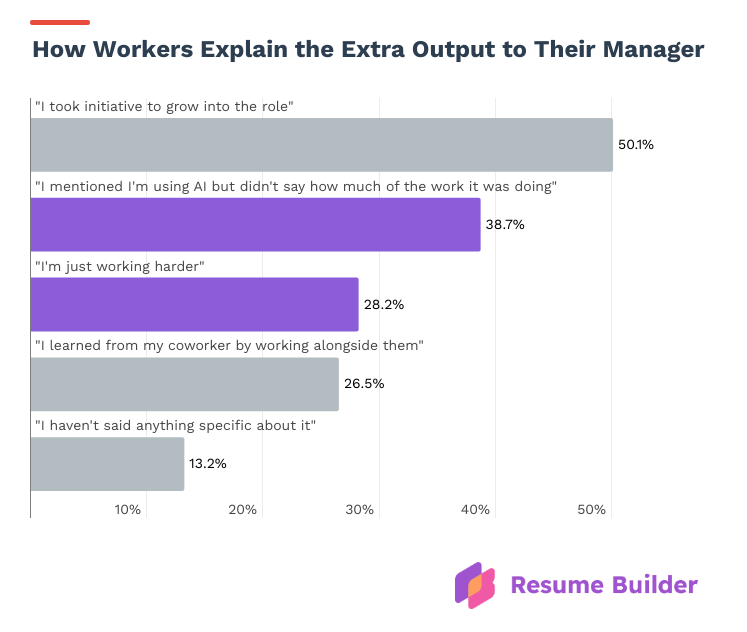
62.8% of workers who have used AI to take over a coworker’s tasks chose not to tell their manager how much of the work AI was doing. 38.7% have mentioned AI to their manager but did not say how much of the work it was doing.
Half (50.1%) said they were “taking initiative to grow into the role,” 28.2% said they were “just working harder,” 26.5% said they “learned from my coworker by working alongside them,” and 13.2% have not said anything specific about it.
37.4% of all workers surveyed, and 61.6% of those who absorbed a coworker’s tasks, say they would be concerned about their own job security if their manager fully understood how much of their work AI was doing.
“Most employees who take on a coworker’s responsibilities aren’t fully transparent about how much they’re relying on AI. There is still a lingering perception that using AI is somehow cheating, when in reality it is a tool whose full productivity potential is still being discovered. Some employees also hesitate to share how they’re using it effectively, worried they’ll lose their edge if others catch up. AI fluency will soon be a baseline expectation, and the real differentiator will not be concealment, it will be impact. Managers will reward employees who drive measurable improvements, and that means being open about the tools and methods behind those gains,” says Haller.
7 in 10 Targeted a Workplace Friend
7 in 10 workers who have used AI to take over a coworker’s tasks (70.8%) say that coworker was someone they would consider a workplace friend. Nearly 1 in 5 workers overall (18.3%) describe that person as “definitely a friend.”
Workers were asked how they felt afterward. 46.0% said they felt relieved they still had their job. 34.6% said they would do it again in the same situation. 26.5% said they felt justified given the circumstances at their company. 26.4% said they felt guilty about what happened to the coworker. 13.0% said they were worried about being caught or exposed.
“The emergence of an ‘every person for themselves’ culture, especially in organizations experiencing layoffs, is deeply concerning. The traditional model of a successful company, one that values its people, fosters collaboration, and builds a culture of trust, is being overtaken by a more basic reality: employees are focused on staying employed in a tight, employer-driven market with limited hiring. When fear drives behavior, collaboration erodes, trust weakens, and culture begins to deteriorate, often without leadership recognizing it in real time. When the market turns and hiring accelerates, employees will remember how they were treated, and they will have options. Few people choose to stay in or join environments perceived as cutthroat, and organizations that neglect their culture now may find themselves at a disadvantage later, struggling to attract and retain the talent they need most,” says Haller.
6 in 10 of Those Friends Got Laid Off
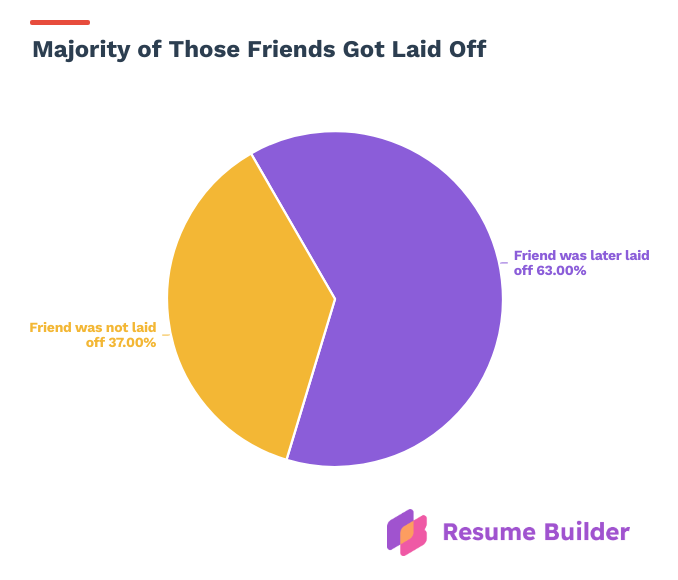
Among workers who used AI to take over a friend’s tasks, 63% say that friend was eventually laid off. That works out to 271 workers, or 27.1% of the full survey, who used AI to absorb a friend’s job and watched that friend get let go.
“When employees absorb a colleague’s workload with AI and leadership is not aware, it is usually a sign the organization lacks a clear AI strategy. Without formal policies, training, and integration into daily workflows, AI use becomes inconsistent and unevenly distributed. Instead of raising the capabilities of the entire workforce, it encourages a survival-of-the-fittest dynamic where individuals protect their advantage rather than share it. The result is not higher performance across the board, it is fragmentation, mistrust, and a culture where people feel they have to watch their backs. HR and leadership need to partner with managers to establish clear AI guidelines, invest in training, and normalize its use as part of how work gets done, so AI becomes a force multiplier for the entire organization,” says Haller.
1 in 3 AI Job Hijackers Got a Raise or Promotion
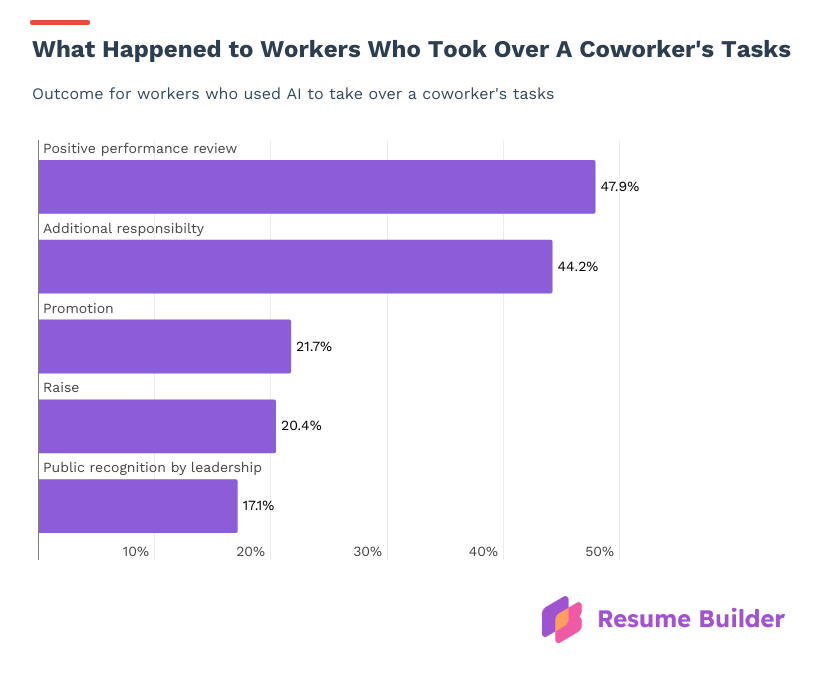
Nearly half of the workers who absorbed a coworker’s tasks using AI (47.9%) received a positive performance review. 44.2% were given additional responsibility, 21.7% received a promotion, 20.4% received a raise, and 17.1% were publicly recognized by leadership. In total, 79.6% of these workers received at least one form of career reward after taking on a coworker’s responsibilities.
Across all workers surveyed, that adds up to 48.3% who have received some form of career reward after using AI to take over a coworker’s tasks. Roughly 1 in 5 workers (20.3%) received a raise or a promotion.
Methodology
This survey was commissioned by ResumeBuilder.com and conducted online via the polling platform Pollfish in April 2026. It surveyed 1,000 U.S. workers employed full-time who reported being at least “probably concerned” about their company conducting layoffs in the next 12 months. All respondents passed an in-survey attention check. Results are based on self-reported responses. Multi-select responses are reported as a share of qualified respondents. Skip-logic drill-down questions were shown only to the 607 respondents who reported they had “definitely” or “probably” used AI to take on tasks previously done by a coworker.
For press inquiries, please contact Alex Murphy at [email protected].