
Keeping receipts at work has become increasingly common as employees save emails, messages, screenshots, meeting notes, and other records in case they need proof later.
New research from Resume Builder’s Workplace Documentation Report examines why workers document workplace interactions, what they record, and how they use those records.
Based on a survey of more than 1,000 U.S. workers, the findings suggest that workplace documentation is becoming more than an organizational habit. For some employees, it’s become a form of protection when they’re concerned about blame, conflict, or whether their version of events will be believed.
Key Findings
- Workers are keeping receipts. 74% have intentionally saved workplace documentation in case they need proof later.
- Documentation can provide a defense. 43% have used workplace records to defend themselves, and 32% said the documentation helped.
- False accusations can start the paper trail. 22% began keeping records after being blamed for something they didn’t do.
- Managers are under the microscope. One-on-one meetings with direct managers are the workplace interactions workers document most often (32%).
- Documentation is becoming more common. 45% say they document workplace interactions more often than they did five years ago.
- AI is joining the paper trail. 22% have used an AI tool or meeting notetaker to automatically document workplace conversations or decisions.
Nearly 3 in 4 Workers Are Keeping Workplace Receipts
Nearly three-quarters of workers (74%) say they’ve intentionally saved emails, messages, screenshots, or other workplace documentation because they thought they might need proof later.
Among those workers, 32% say they’ve done so many times, 34% a few times, and 8% one time. Another 26% have never intentionally kept workplace documentation for this reason.
What this means: Keeping receipts at work has become common enough to suggest that employees are thinking beyond simply remembering what happened. When nearly three-quarters of workers are deliberately saving evidence for future use, it points to a workforce that increasingly sees documentation as a safety net. Workers may not expect a problem, but they want to be prepared if one arises.
Some Workers Are Keeping Receipts Because They’ve Been Burned Before
For some employees, documentation becomes important after something goes wrong. More than 1 in 5 workers (22%) say they started keeping workplace records after being blamed for something they didn’t do.
Other reasons workers began documenting their experiences include:
- 18% always document as a precaution.
- 12% started after seeing someone else blamed unfairly.
- 12% started after losing trust in a manager.
- 7% began after receiving advice from a coworker.
- 5% started after having a negative experience with HR.
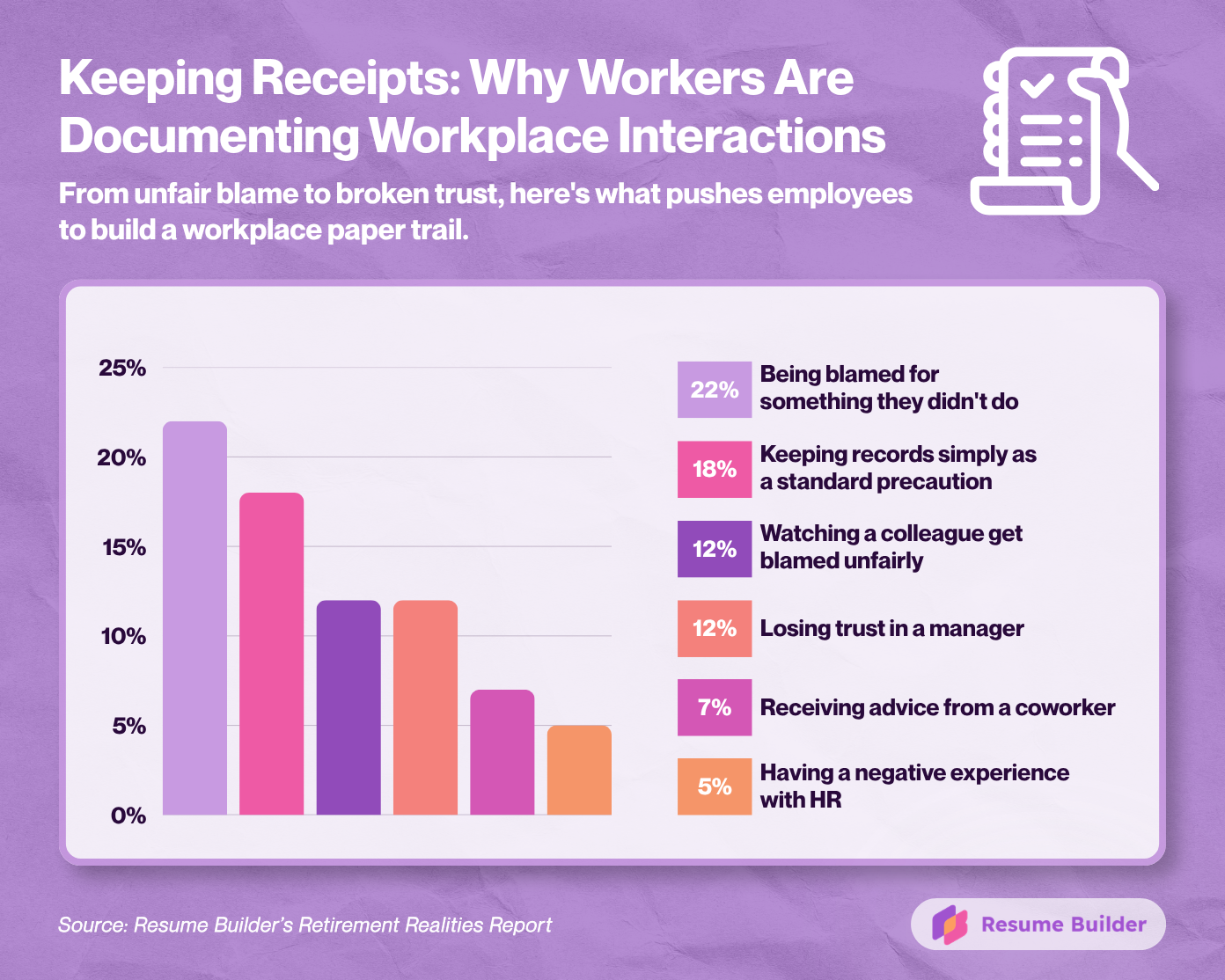
What this means: The paper trail at work often starts after trust has already taken a hit. Being wrongly blamed, watching someone else get blamed, or losing confidence in a manager can teach employees that verbal assurances aren’t always enough. Once workers feel they need evidence to protect themselves, rebuilding that trust may be much harder.
Documentation Has Become a Workplace Defense Mechanism
Workplace receipts aren’t just being collected. Employees use them when problems arise. Overall, 43% say they’ve used workplace documentation to defend themselves.
Among workers who’ve documented workplace interactions:
- 32% say their documentation successfully helped them defend themselves.
- 11% used documentation to defend themselves, but it didn’t help.
- 22% have never needed to use their documentation but are glad they had it.
- 16% have never used workplace documentation to defend themselves.
- 19% have never kept workplace documentation and therefore haven’t needed to use it.
What this means: Documentation can make a worker’s version of events harder to dispute. The fact that nearly one-third of workers say their records successfully helped defend them shows why keeping receipts can feel worthwhile. For employees, a saved email or meeting record can mean the difference between “that’s not what happened” and having something concrete to point to.
Managers Are Getting the Most Documentation
One-on-one meetings with direct managers are the workplace interactions workers document most often (32%).
Other commonly documented interactions include:
- 29% — difficult conversations with coworkers or managers
- 26% — performance reviews
- 24% — important decisions made during meetings
- 24% — HR conversations or meetings
- 20% — disciplinary or performance-related discussions
- 19% — compensation or salary discussions
- 15% — promotion or career development conversations
- 15% — Slack, Teams, or other workplace chats
Managers and senior leaders are the people workers are most likely to document, at 25%. Workers also document:
- 23% — coworkers
- 19% — everyone equally
- 6% — HR
- 5% — clients or customers
What this means: Workers are most likely to document the conversations where expectations, performance, accountability, and career decisions are on the line. That puts managers in a particularly important position. If employees feel the need to document routine one-on-one conversations, it may signal that those discussions carry more risk or uncertainty than they once did.
The Workplace Is Becoming More Documented
Nearly half of workers (45%) say they document workplace interactions more often than they did five years ago. Of those workers, 22% say they do so much more often and 23% somewhat more often.
Meanwhile, 27% report no change in their documentation habits, while only 7% say they document less often. Another 21% have never documented workplace interactions.
What this means: The workplace is becoming increasingly documented, and employees are driving that shift. Workers have more ways than ever to save conversations, preserve decisions, and create a record of what happened. That can provide accountability, but it also reflects a workplace where people may feel less comfortable relying on memory or verbal commitments alone.
AI Is Making It Easier to Keep Receipts
More than 1 in 5 workers (22%) say they’ve used an AI tool or meeting notetaker to automatically document conversations, meetings, or workplace decisions in case they need a record later.
As these tools become more common, workers can capture important details without manually taking notes or reconstructing a conversation after the fact.
What this means: AI could make workplace documentation easier, which may mean the paper trail only gets bigger. Employees no longer have to choose between participating fully in a meeting and trying to capture every important detail. As automated note-taking becomes routine, workers may increasingly expect important workplace conversations to have a record attached.
When Keeping Receipts At Work Becomes the Norm
Keeping documentation can be a smart way for employees to stay organized and protect themselves when something important is at stake. But when workers feel they need a record of everyday interactions just in case, that habit can reveal something deeper about the workplace.
A healthy workplace shouldn’t require employees to approach every conversation as potential evidence. Workers who find themselves constantly documenting workplace interactionsmay want to consider why they feel the need to do so, particularly if the habit stems from repeated conflict, unclear expectations, or a lack of trust.
For employers and managers, the findings are a reminder that documentation is not just an employee behavior; it can also be a signal. If workers increasingly feel the need to keep receipts, organizations should ask what’s happening at work that makes those receipts feel necessary.
For press inquiries, please contact Alex Murphy at [email protected].
Methodology
The findings presented are based on a nationally representative survey commissioned by ResumeBuilder.com and conducted via Pollfish in August 2026. The survey collected responses from 1,002 U.S. workers and examined workplace experiences and perceptions related to documentation.
Respondents answered different question types, including yes/no, frequency-based, multiple-choice, and select-all-that-apply questions. The survey examined how often workers intentionally save workplace documentation, what types of workplace interactions they document, and the reasons they keep records.
Respondents were also asked whether they’ve used workplace documentation to defend themselves, whether the documentation helped, how their documentation habits have changed over the past five years, and whether they’ve used AI tools or meeting notetakers to automatically document workplace interactions and decisions.
The sample consisted of 25% Generation Z (born 1997 or later), 26% millennials (born 1981–1996), 25% Generation X (born 1965–1980), and 24% baby boomers (born 1946–1964). Participants also identified their gender: 49% identified as male, 50% as female, and 1% as non-binary.