
Workplace gaslighting can undermine trust, confidence, and employees’ willingness to speak up. New research from ResumeBuilder.com’s Workplace Gaslighting Report examines how these experiences unfold at work, who workers identify as responsible, and how gaslighting can affect their relationships and interactions with others.
Based on a survey of more than 1,000 U.S. workers, the report shows how repeated experiences of being dismissed or contradicted can shape employees’ experiences at work, with some ultimately searching for another job or leaving their position.
Key Findings
- A workplace reality: 53% of workers say they’ve experienced workplace gaslighting.
- Gaslighting is gaining ground: 59% believe workplace gaslighting is more common than it was five years ago.
- Trust takes a hit: 43% became more cautious about trusting people at work.
- Silence and self-doubt can ensue: 20% became less likely to speak up, and 19% lost confidence in their work.
- Some workers feel pushed out: 15% started looking for another job, and 8% quit.
- Colleagues are at the center: 36% say a coworker was most often involved in their experiences, followed by direct managers at 18%.
More Than Half of Workers Say They’ve Been Gaslit
Workplace gaslighting can take different forms, from denying what was said to disputing how events unfolded. More than half of workers (53%) say they’ve experienced behaviors they associate with workplace gaslighting.
Among those experiences, the most common include:
- 42% say someone denied something they previously said.
- 36% say someone insisted events happened differently.
- 33% say they were blamed for something they didn’t do.
- 23% say someone gave a false account of what happened.
- 20% say their concerns were dismissed as a personality or attitude problem.
- 18% say someone claimed they agreed to something they didn’t.
What this means: When a large portion of the workforce experiences gaslighting on the job, it can contribute to a broader culture of distrust. Workers may become less willing to speak openly or rely on others’ accounts of workplace conversations and decisions.
“I Never Said That” Is the Most Common Gaslighting Phrase
Gaslighting often shows up in the responses workers hear when they raise concerns or disagree about what happened. For instance, 64% say they’ve had a dismissive or reality-denying phrase directed at them at work.
The phrases workers hear most often are:
- “I never said that.” — 28%
- “That never happened.” — 23%
- “You’re overreacting.” — 22%
- “You’re taking it personally.” — 22%
- “You’re remembering it wrong.” — 21%
- “You’re too sensitive.” — 15%
What this means: Dismissive or manipulative phrases are common in workers’ experiences with gaslighting, ranging from denying something was said to telling employees they’re overreacting or remembering things incorrectly. Both redirect attention away from the underlying concern, making it harder to address and resolve.
Coworkers Are the Most Commonly Identified Gaslighters
Gaslighting can come from different people across an organization, from colleagues to managers and customers. Coworkers are the group employees point to most often, at 36%.
Direct managers follow at 18%, while customers/clients and senior leaders each account for 6%. Another 3% say an HR representative was most often involved.
What this means: Workplace gaslighting is not limited to interactions between employees and their managers. The fact that coworkers are most often identified shows that these experiences can develop within everyday working relationships across an organization.
Gaslighting Is Damaging Trust & Silencing Workers
Workplace gaslighting can shape how employees communicate, who they trust, and how they feel about their work. 43% say they’ve become more cautious about trusting people at work, while 22% say they lost trust in their manager.
Other consequences include:
- 25% began documenting conversations more carefully.
- 20% became less likely to speak up.
- 19% began second-guessing themselves more often.
- 19% lost confidence in their work.
- 16% became less engaged.
- 15% started looking for another job.
- 8% quit their job.
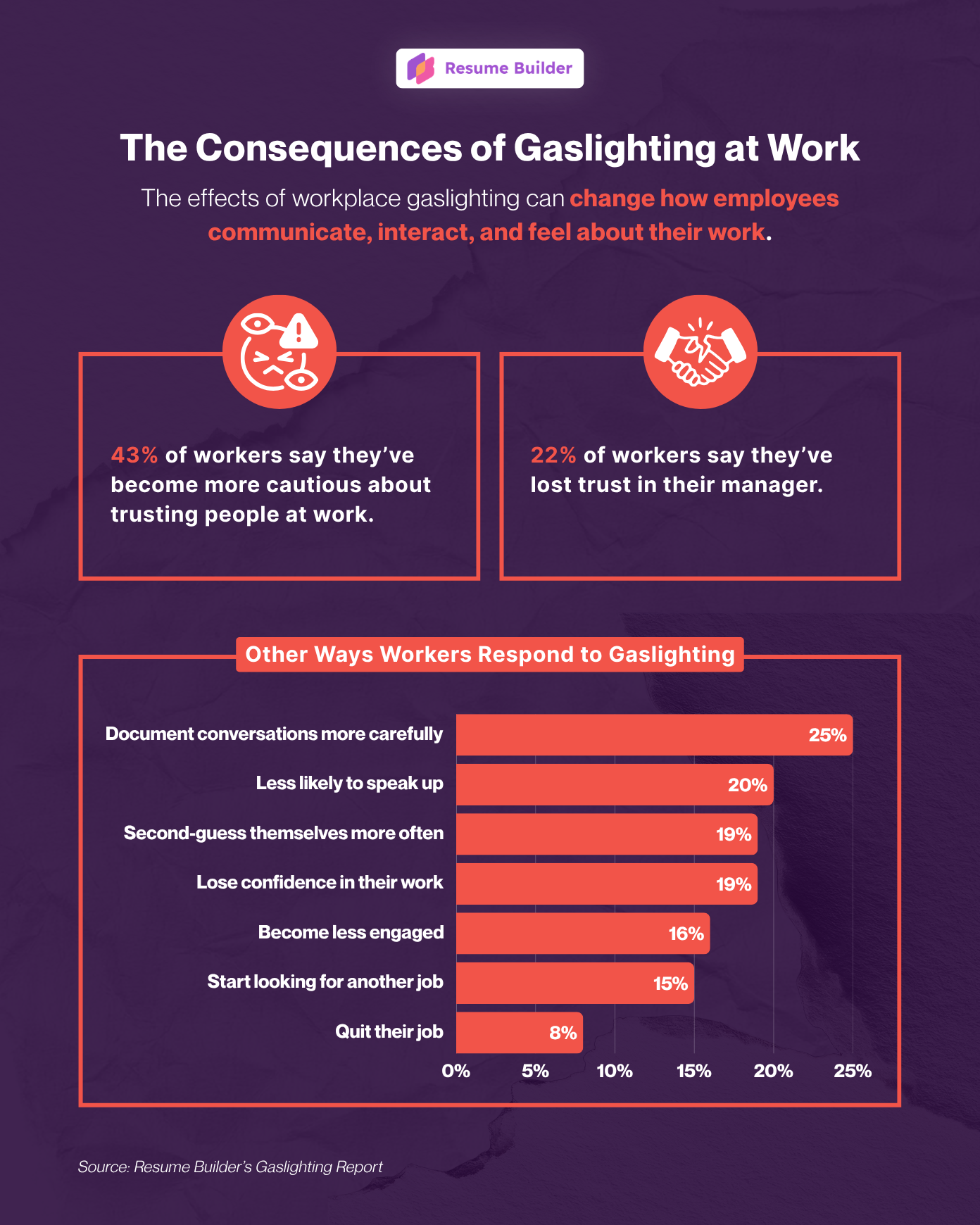
What this means: Gaslighting can change how employees approach their relationships and interactions at work. When workers become more cautious about who they trust or less willing to speak up, it becomes harder to feel comfortable and confident in the workplace.
A Growing Concern
Workers also believe workplace gaslighting has become more prevalent in recent years. Nearly 6 in 10 (59%) say it’s more common than it was five years ago, with 27% calling it much more common and 32% saying it’s somewhat more common. Meanwhile, 35% believe its prevalence has stayed about the same, and 6% say it has become less common.
What this means: Workers increasingly see gaslighting as an issue, suggesting it’s becoming a more common concern in today’s workplace. When these behaviors become normalized, they can undermine accountability and allow unhealthy workplace dynamics to persist.
When Gaslighting Starts to Take a Toll
Repeated experiences of being dismissed, contradicted, or made to question their own judgment can take an emotional toll on workers. Over time, employees may become more guarded, less engaged, or less comfortable in their workplace relationships. Recognizing these patterns early can help workers determine how to address the situation and make informed decisions about what comes next.
For press inquiries, please contact Alex Murphy at [email protected].
Methodology
The findings presented are based on a nationally representative survey commissioned by ResumeBuilder.com and conducted via Pollfish on August 7, 2026. The survey collected responses from 1,002 U.S. workers and examined experiences and perceptions related to gaslighting in the workplace.
Respondents answered different types of questions, including yes/no, frequency-based, multiple-choice, and select-all-that-apply questions. The survey explored specific experiences associated with workplace gaslighting, including having events denied or distorted, being blamed for things respondents didn’t do, and being told they were “too sensitive” or that they remembered events incorrectly. Respondents were also asked about who was involved, how these experiences affected them, and whether they believed they had personally experienced workplace gaslighting.
The sample consisted of 25% Generation Z (born 1997 or later), 26% millennials (born 1981–1996), 25% Generation X (born 1965–1980), and 24% baby boomers (born 1946–1964). Participants were also asked to identify their gender: 49% identified as male, 50% as female, and 1% as nonbinary.