
Retirement is often treated as the point when work becomes optional, but for many older Americans, the question is whether they can afford to stop working. When the cost of living stays high, healthcare costs rise, and retirement savings fall short, future plans can shift quickly.
Resume Builder’s Retirement Realities Report examines how these financial pressures are shaping decisions about work, spending, and retirement among U.S. adults ages 60 to 75, revealing how economic uncertainty can influence not just when people retire, but how they prepare for the years ahead.
Key Findings
- Retirement is a financial balancing act. 27% say working is financially necessary, while 28% cite the high cost of living as a reason they’re still working, looking for work, or considering returning to work.
- Uncertainty looms. 37% say they’re not very or not at all confident they have or will have enough money to maintain an acceptable standard of living throughout retirement.
- Many have little or nothing saved. 19% say they have no retirement savings at all, and 29% say they’ve used at least some of their retirement savings early to pay current expenses.
- Economic conditions are changing spending habits. 48% say they’ve reduced their spending over the past year.
Financial Pressure Is Shaping Retirement Decisions
For some older adults, continuing to work is less about personal preference and more about making the numbers work. While 18% say working is primarily a choice rather than a financial need, 27% say working is financially necessary for them, as they can’t afford to retire.
Among those currently working, looking for work, or considering returning to work, financial concerns help explain why employment remains part of the picture.
Among the reasons why older Americans are still working:
- 28% cite the high cost of living.
- 17% are concerned Social Security will change.
- 16% are concerned Medicare or healthcare costs will increase.
- 15% say they haven’t saved enough for retirement.
What this means: Retirement decisions depend on more than age or personal preference. For older adults facing ongoing expenses and uncertainty about future financial support, continuing to work may be necessary to maintain their standard of living.
Retirement Confidence Is Running Thin
Retirement doesn’t necessarily bring financial peace of mind. When asked how confident they are that they have, or will have, enough money to maintain their standard of living throughout retirement, only 20% say they’re very confident.
- 43% say they’re somewhat confident.
- 22% say they’re not very confident.
- 15% say they’re not at all confident.
What this means: These retirement confidence statistics reveal that even among adults approaching or already in retirement, confidence about long-term financial security varies. Uncertainty about whether savings will last can make it harder to plan for retirement and feel secure about future expenses.
The Cost of Clocking Out
Some older Americans use retirement savings to cover present-day needs, while others report having no retirement savings at all.
- 19% say they have no retirement savings at all.
- 11% say they’ve withdrawn a significant amount of retirement savings early.
- 18% say they’ve withdrawn a small amount of retirement savings early.
- 52% say they haven’t used retirement savings earlier than planned.
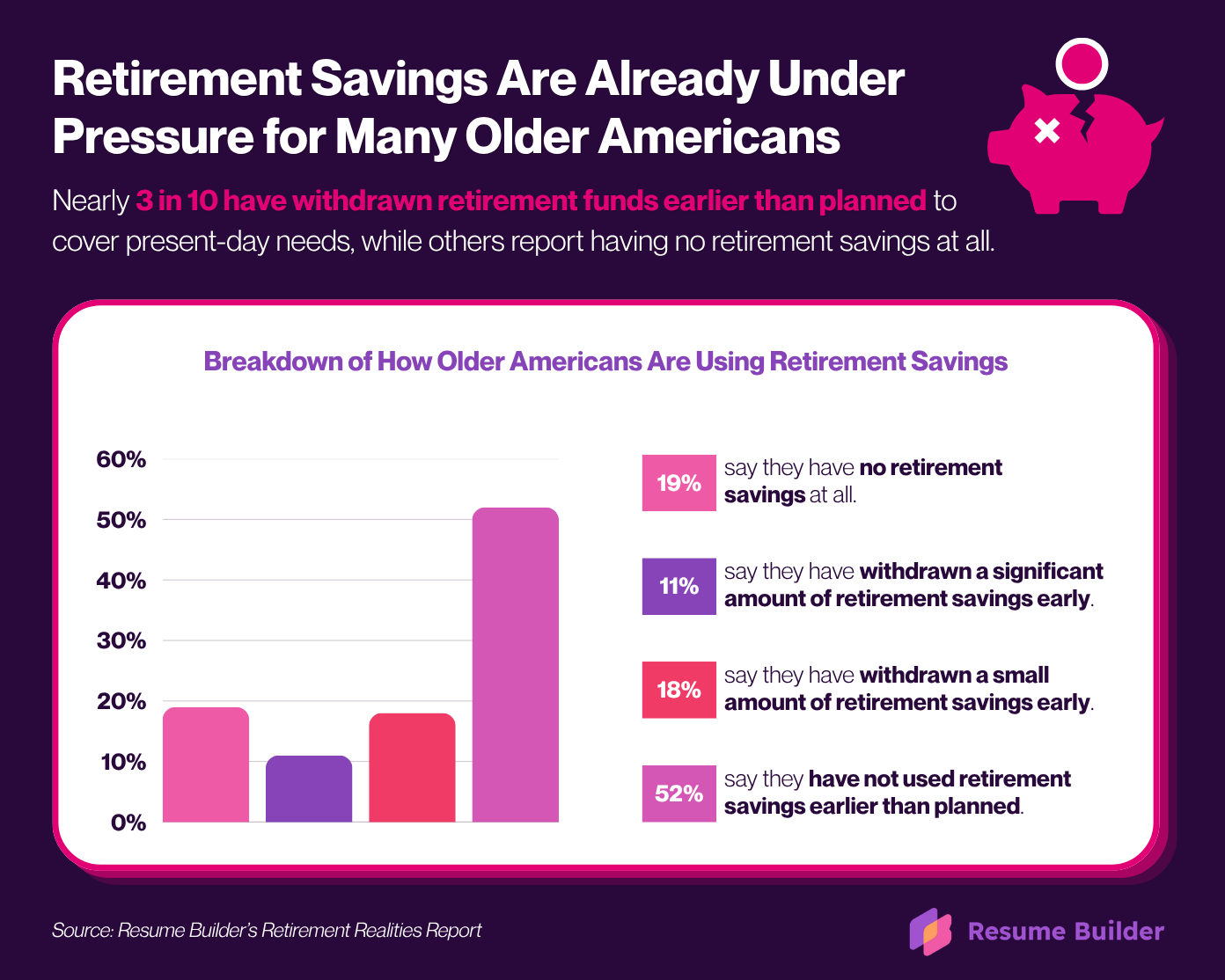
What this means: Retirement savings may need to serve competing purposes when current expenses strain household finances. Using funds earlier than planned leaves less money for future needs, while having no savings creates additional financial challenges for those approaching or living in retirement.
Economic Pressure Is Changing Behavior in Real Time
Beyond withdrawals from savings, the broader economic climate over the past year has pushed older Americans to make a range of adjustments, from everyday budgeting to bigger decisions about when, or whether, to keep working. The most common tactic is to reduce spending, with 48% saying they’ve cut back over the past year.
For others, financial pressure is reshaping the retirement timeline itself:
- 12% have considered returning to work after retirement.
- 9% have delayed their expected retirement.
- 6% have actually returned to work after retirement.
Some are looking for ways to bring in more income:
- 9% have taken on an additional job or source of income.
- 3% have looked for a higher-paying job.
- 3% have increased their working hours.
- 2% have reduced their retirement contributions to free up cash now.
What this means: Financial pressures can prompt both immediate adjustments and longer-term changes to retirement plans. Cutting expenses may help address current needs, while returning to work, delaying retirement, or seeking additional income can change how people envision their transition out of the workforce.
A Retirement Reality Check
Retirement may mark the point when people expect to leave work behind, but reaching a certain age doesn’t mean they can afford to stop. As everyday expenses keep climbing, healthcare costs threaten to eat into savings, and the future feels financially uncertain, retirement can become less a finish line and more a moving target.
The findings show how economic pressure can force older adults to rethink plans they may have spent decades preparing for. Whether that means staying in the workforce longer, returning to work, cutting back on spending, or drawing from savings early, the ability to retire on their own terms may come down to a simple question: Can they afford to?
For press inquiries, please contact Alex Murphy at [email protected].
Methodology
The findings presented are based on a nationally representative survey conducted by ResumeBuilder.com using Pollfish in September 2026. The survey collected responses from 701 U.S. adults aged 60–75 and examined their current work and retirement status, expected retirement timing, financial need, retirement savings, confidence about retirement finances, and how economic conditions affect their work, spending, and retirement plans.
Respondents answered multiple-choice and select-all-that-apply questions. The sample consisted of 56% female and 44% male, with 33% aged 60–64, 33% aged 65–69, and 34% aged 70–75.