
To write an effective scholarship resume, start by organizing your academic accomplishments, extracurriculars, and volunteer experience. Scholarship applications are evaluated based on a wide range of factors, but highlighting these aspects of your background is the best way to differentiate yourself from other candidates. Below, we’ll walk you through each step of the resume writing process.
“Scholarship resumes should highlight academic performance, community involvement, and leadership. Demonstrate your commitment to growth and excellence.”

Most Popular Scholarship Resumes
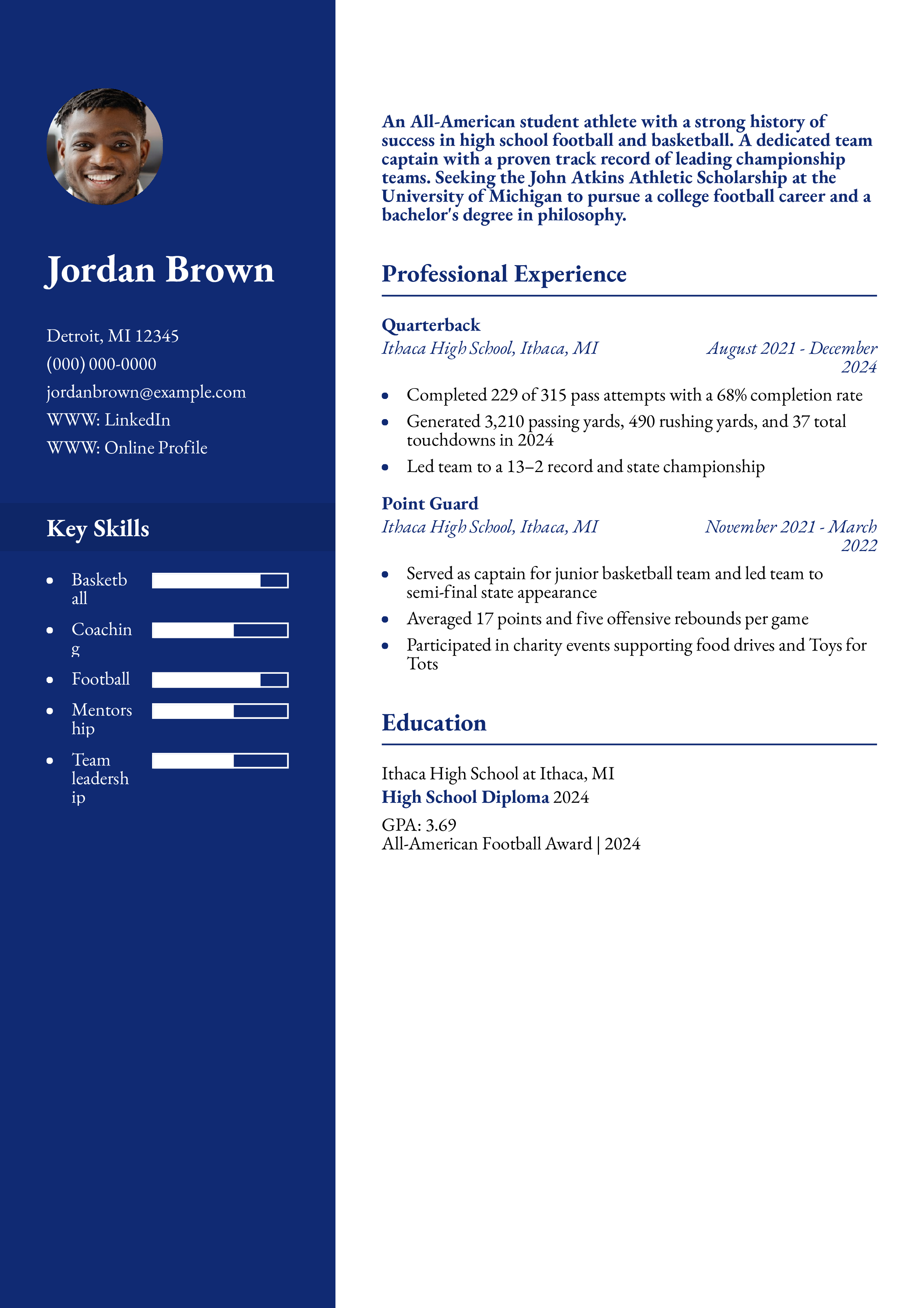
Athletic Scholarship Resume
Why This Resume Stands Out
This resume is good because it uses data and leadership achievements to show why the applicant stands out.
Student Scholarship Resume
Why This Resume Stands Out
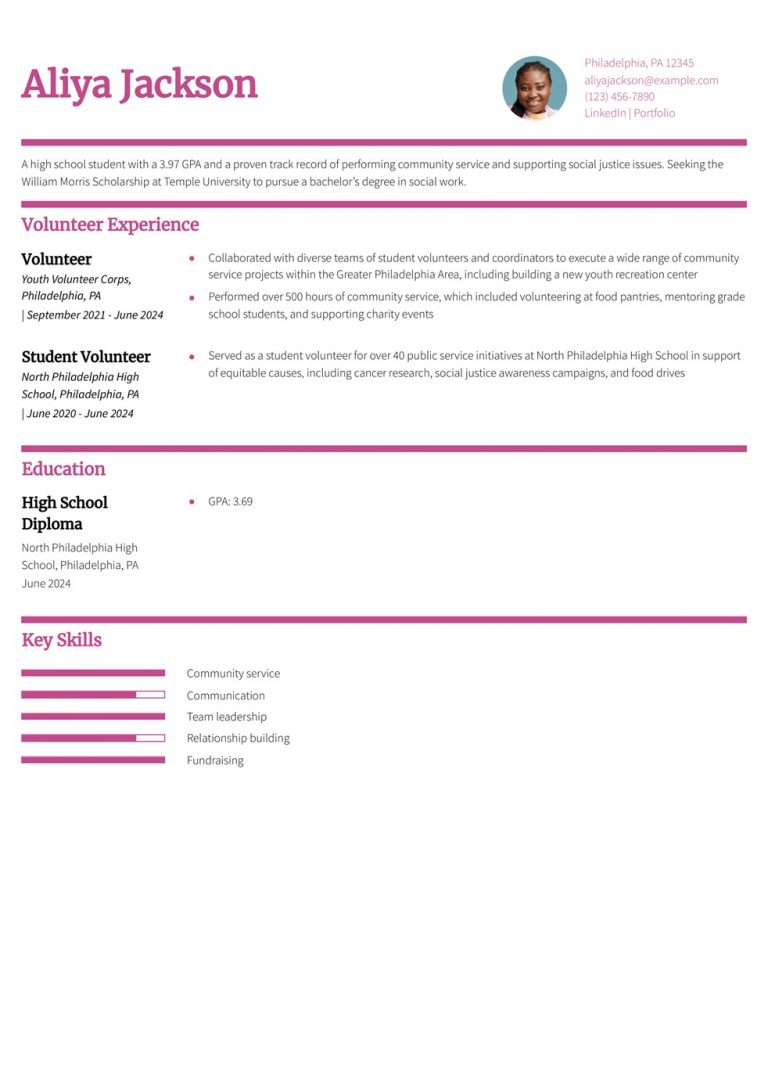
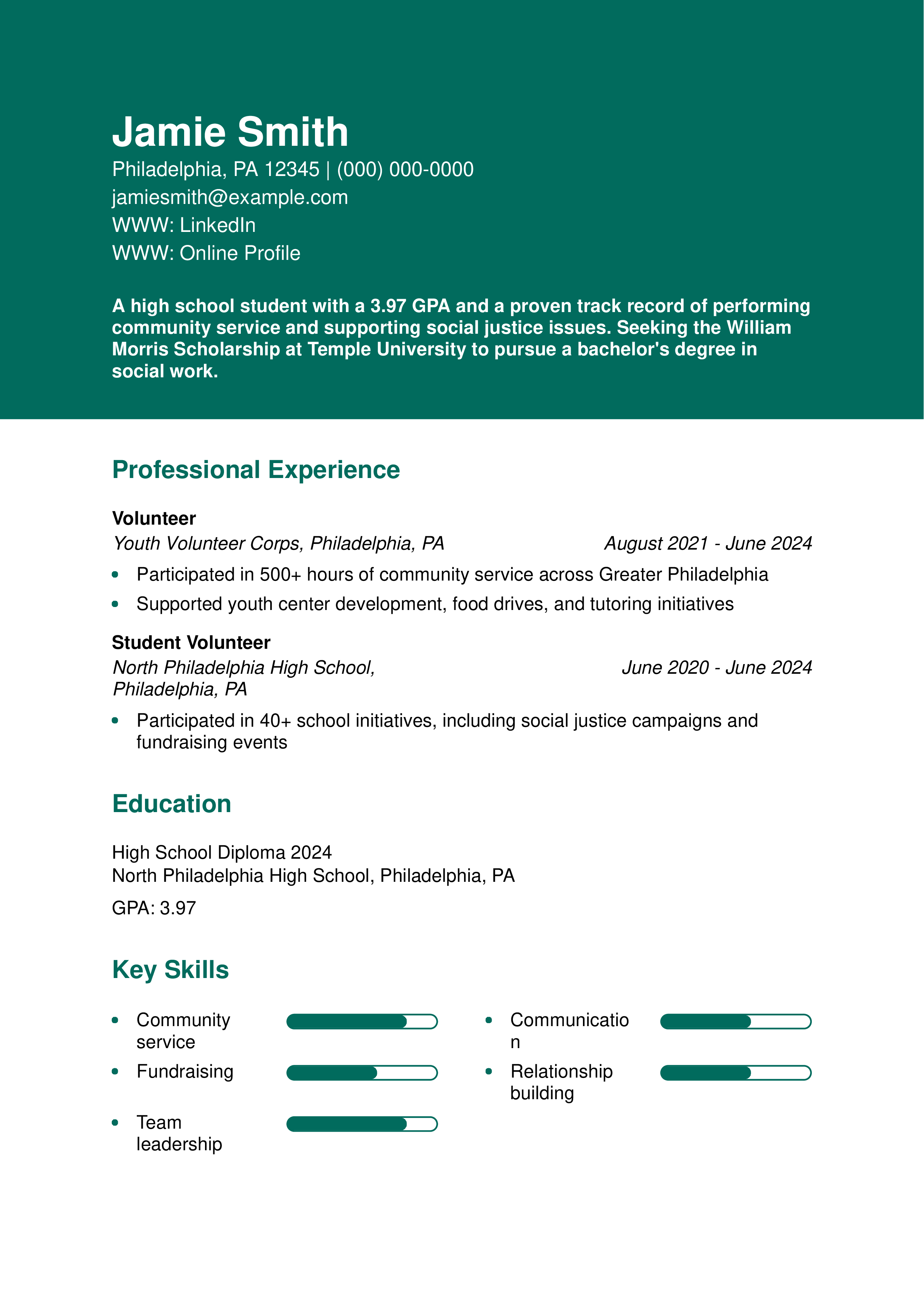
This resume is good because it clearly reflects a deep commitment to service and advocacy.
College Scholarship Resume
Why This Resume Stands Out
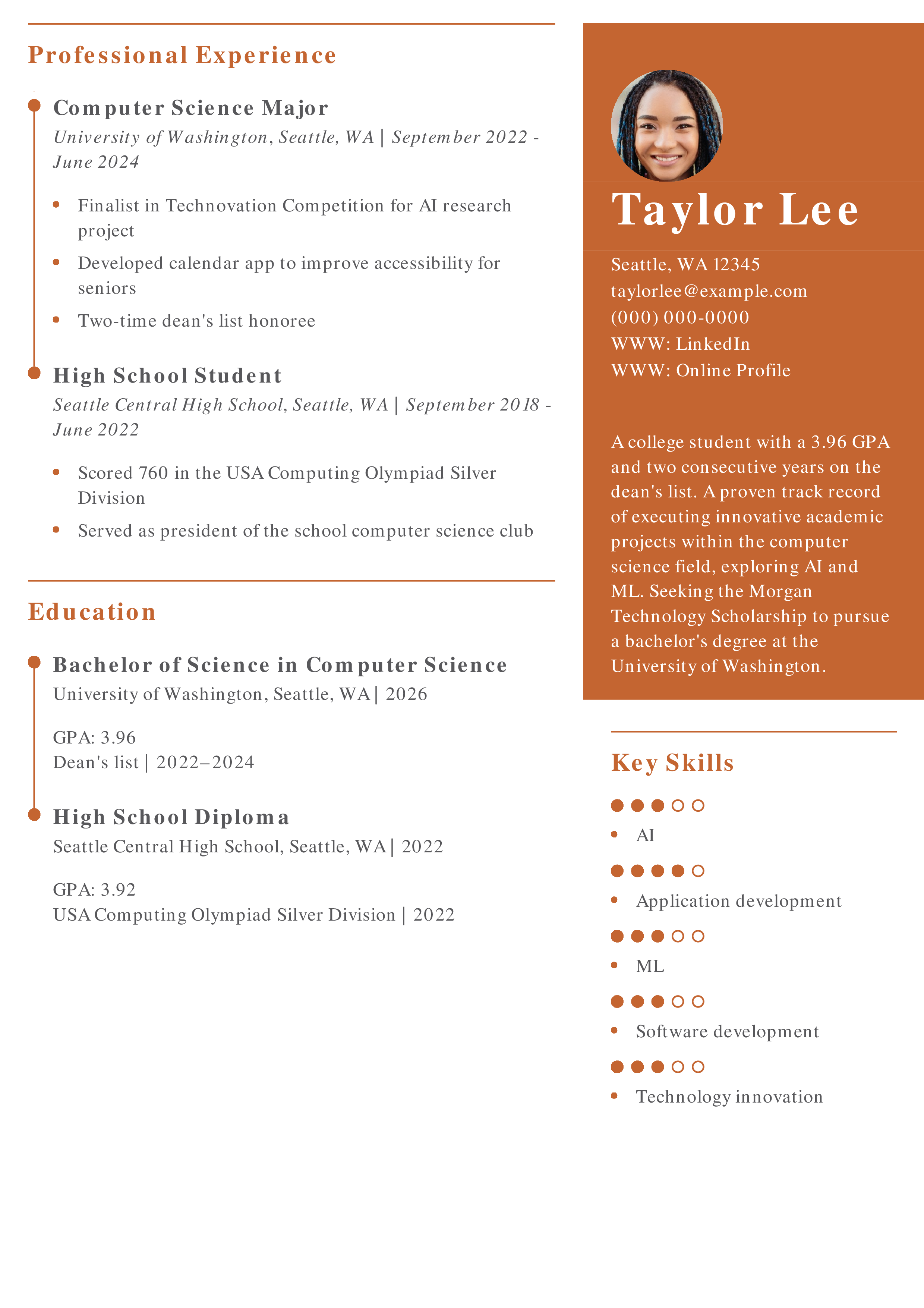
This resume is good because it balances academic accolades with passion-driven projects in tech.
High School Scholarship Resume
Why This Resume Stands Out
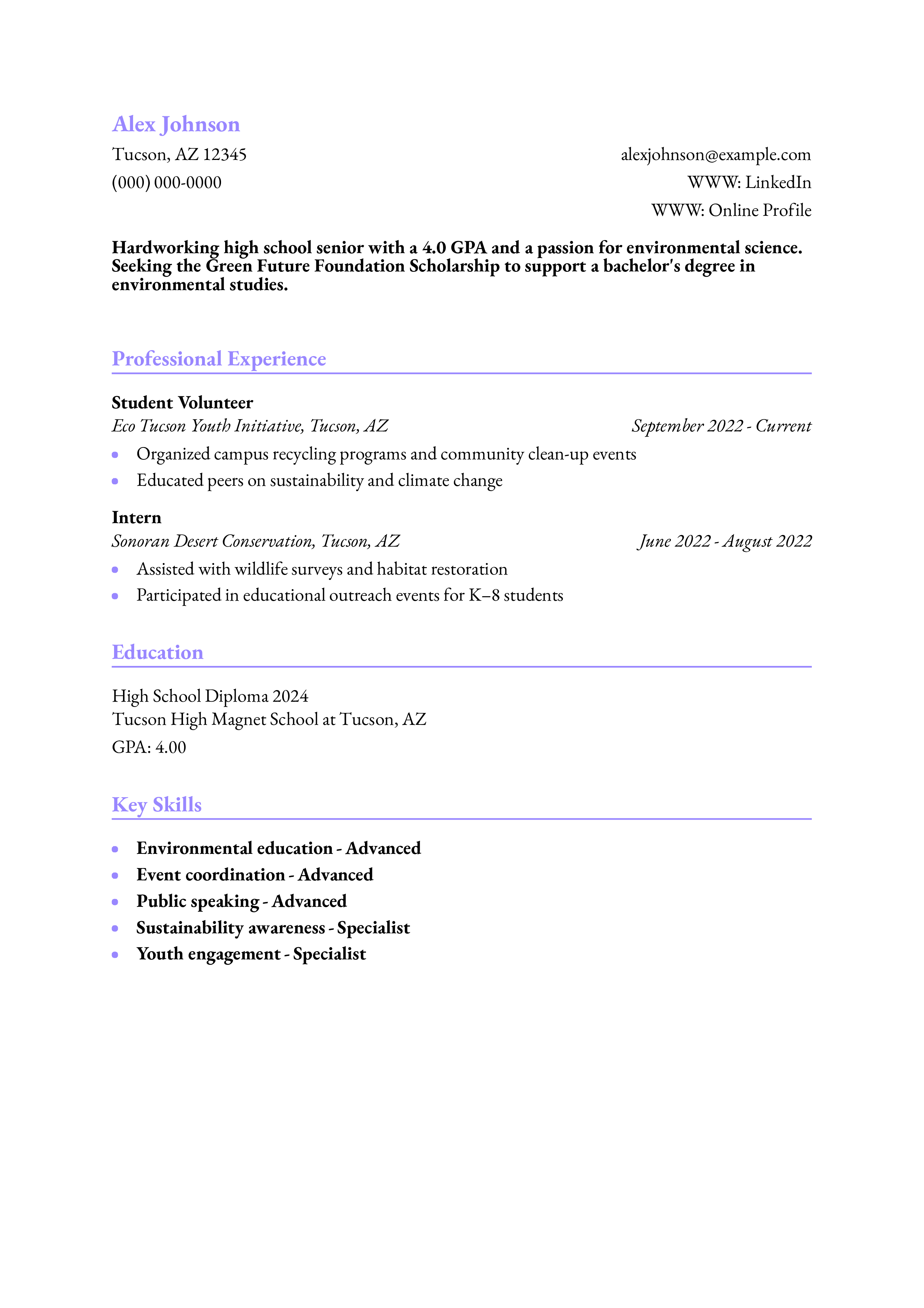
This resume is good because it emphasizes both academic performance and passion for a cause.
Academic Scholarship Resume
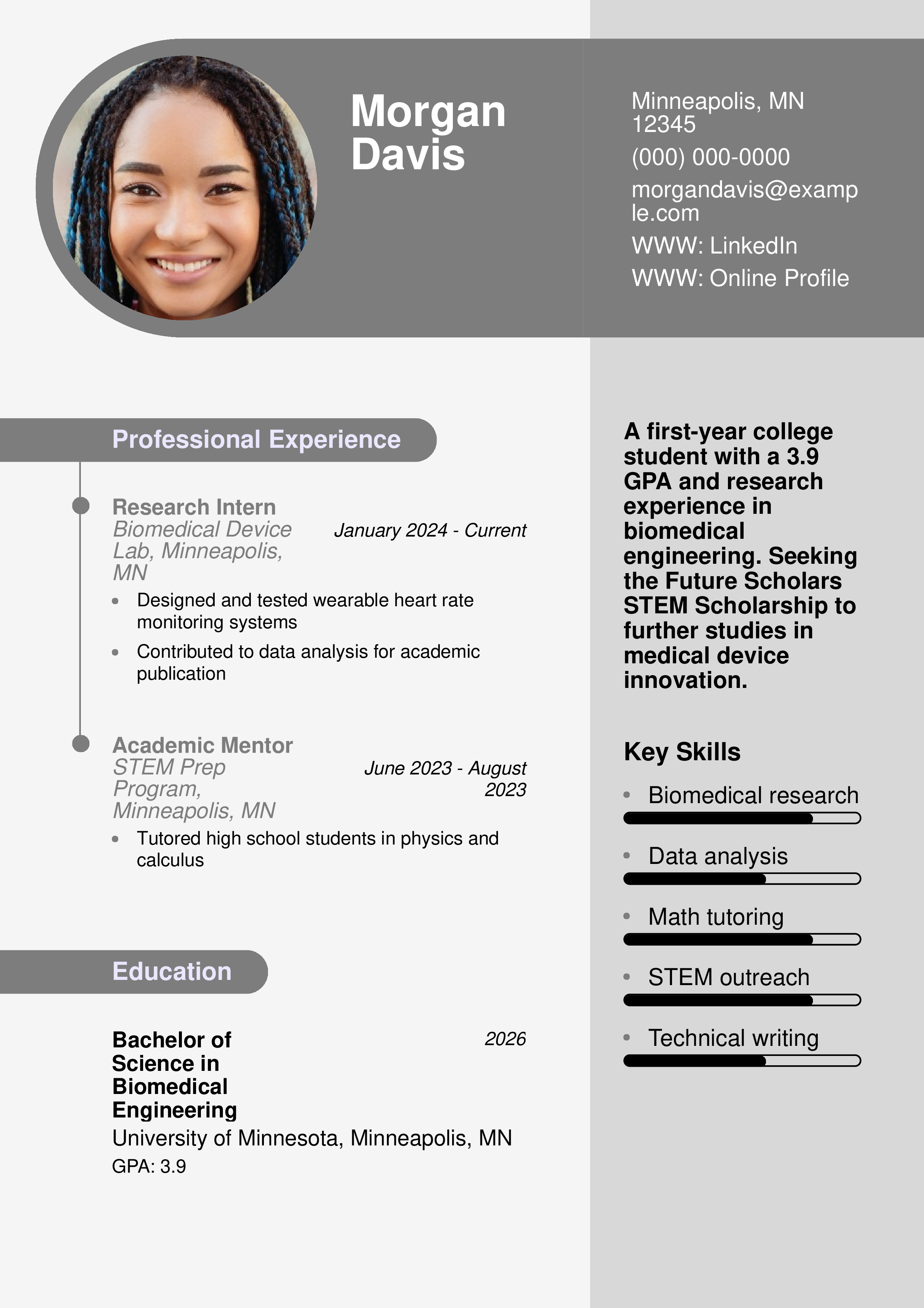
Why This Resume Stands Out
This resume is good because it clearly aligns with a STEM-focused scholarship.
Rhodes Scholarship Resume
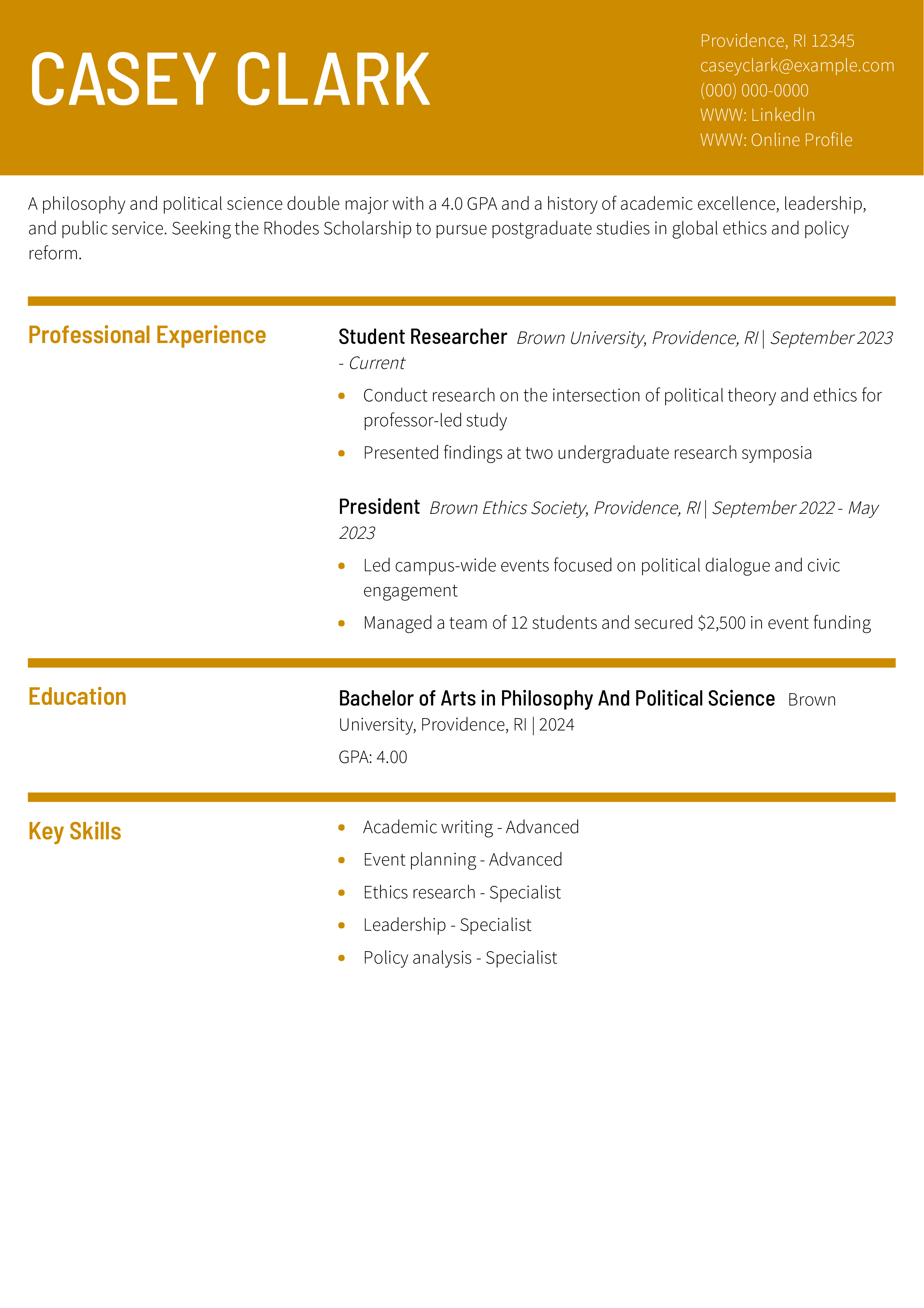
Why This Resume Stands Out
This resume is good because it focuses on academic rigor, global impact, and leadership, qualities Rhodes committees prioritize.
SCAD Scholarship Resume
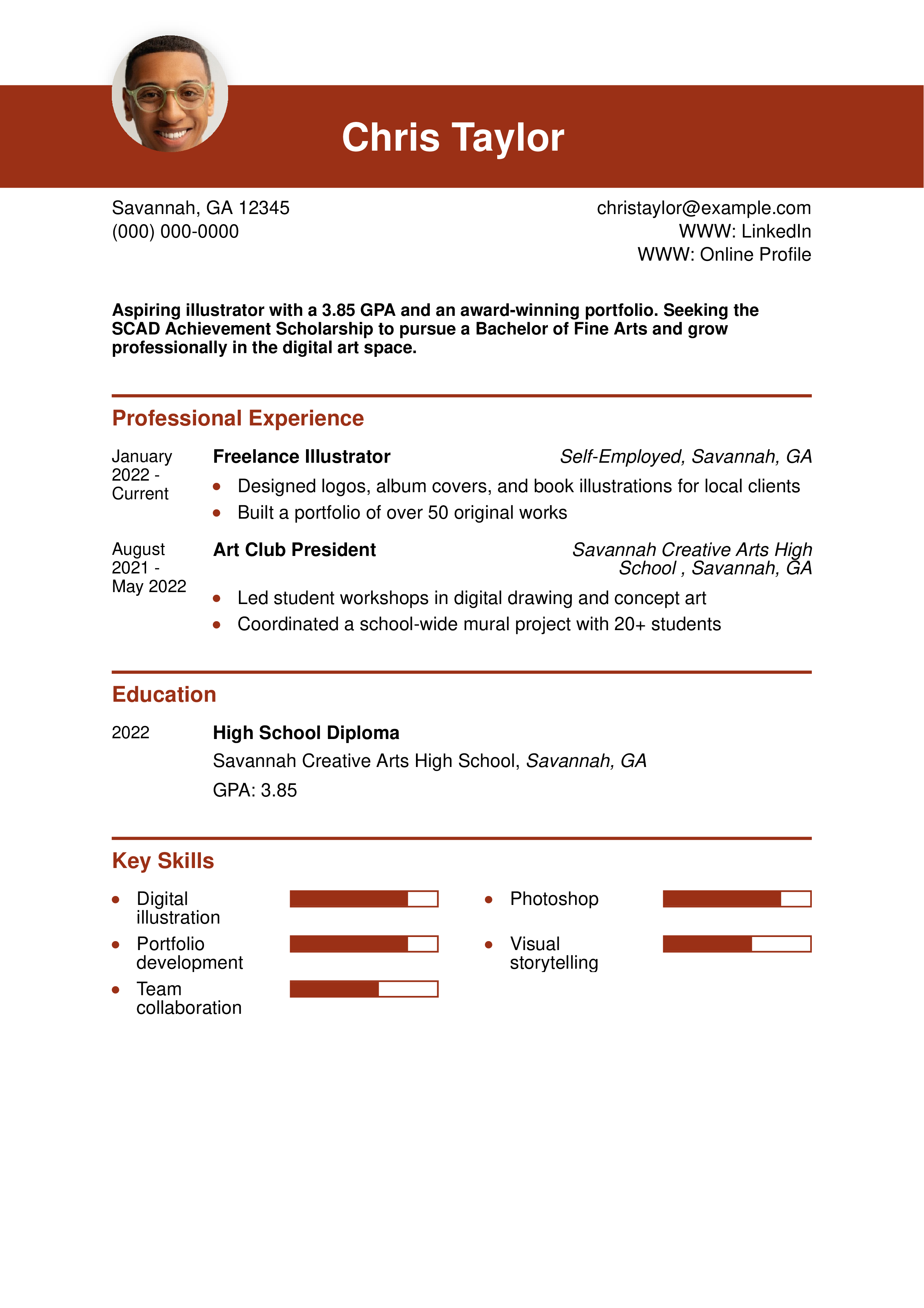
Why This Resume Stands Out
This resume is good because it combines creative accomplishments with clear leadership and initiative.
STEM Scholarship Resume
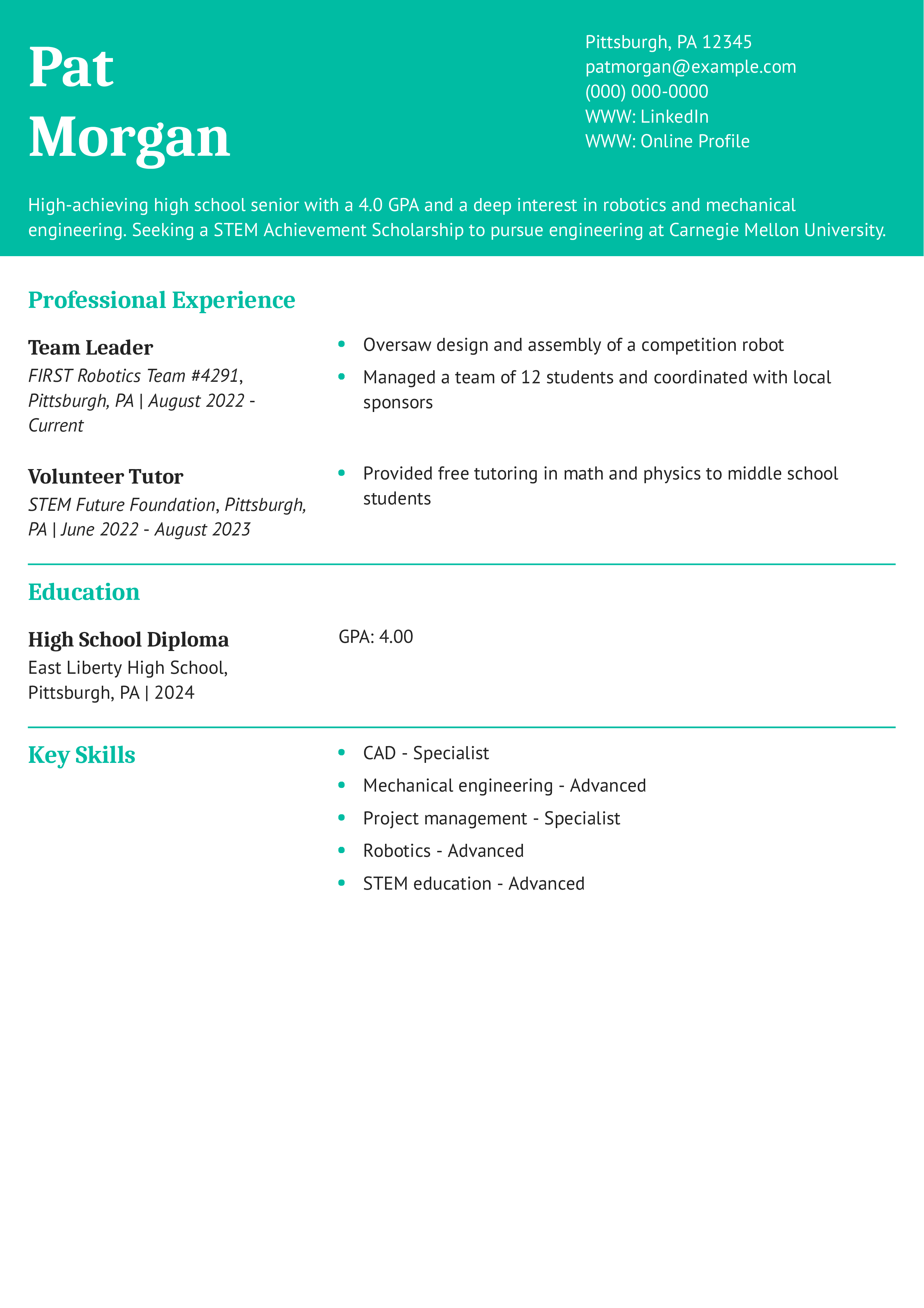
Why This Resume Stands Out
This resume is good because it demonstrates technical skills, leadership, and service — key elements for a STEM-focused scholarship.
Genius Scholarship Resume
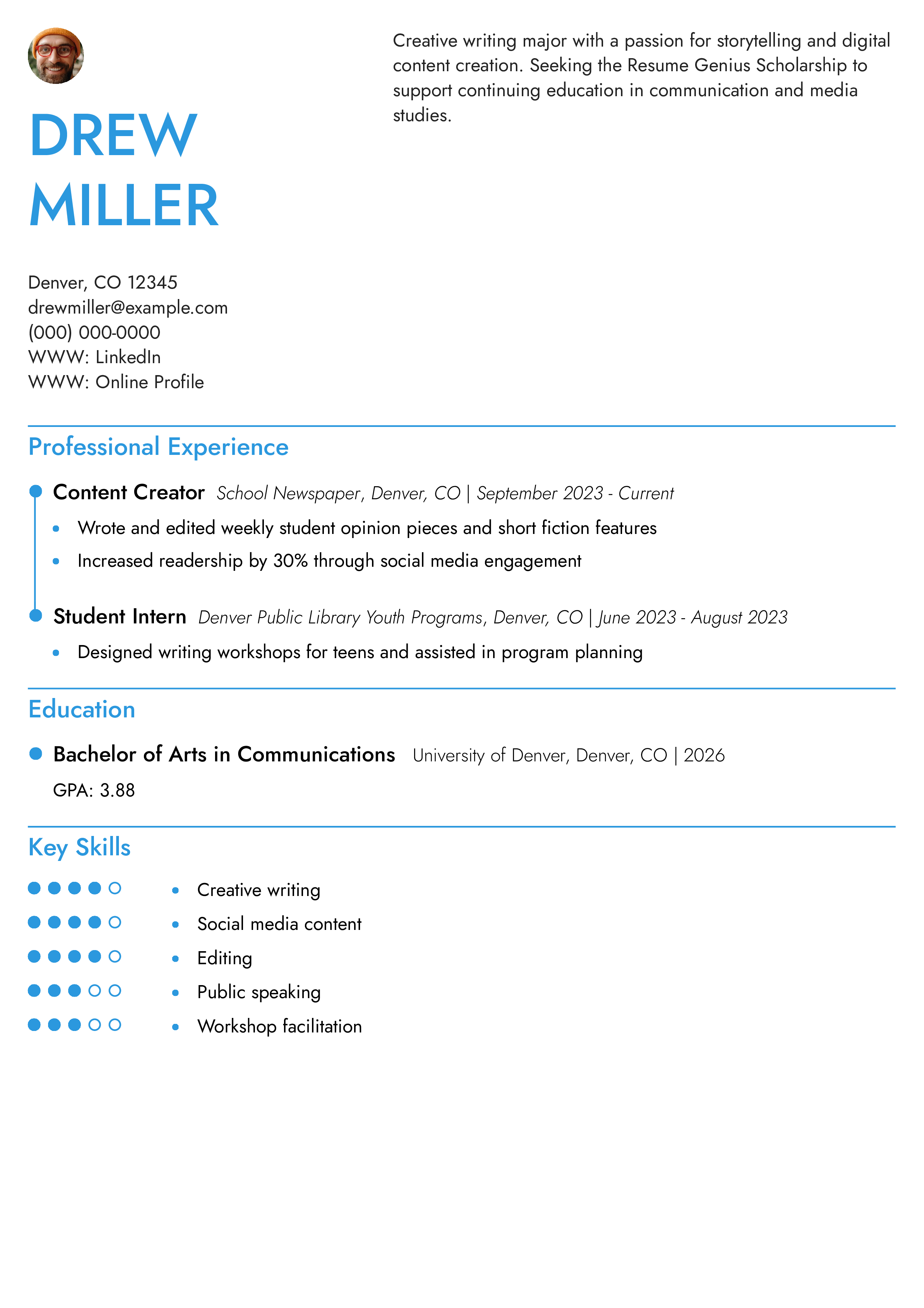
Why This Resume Stands Out
This resume is good because it blends creative work and leadership experience, clearly supporting the goals of a communication-focused scholarship.
Free Scholarship Resume
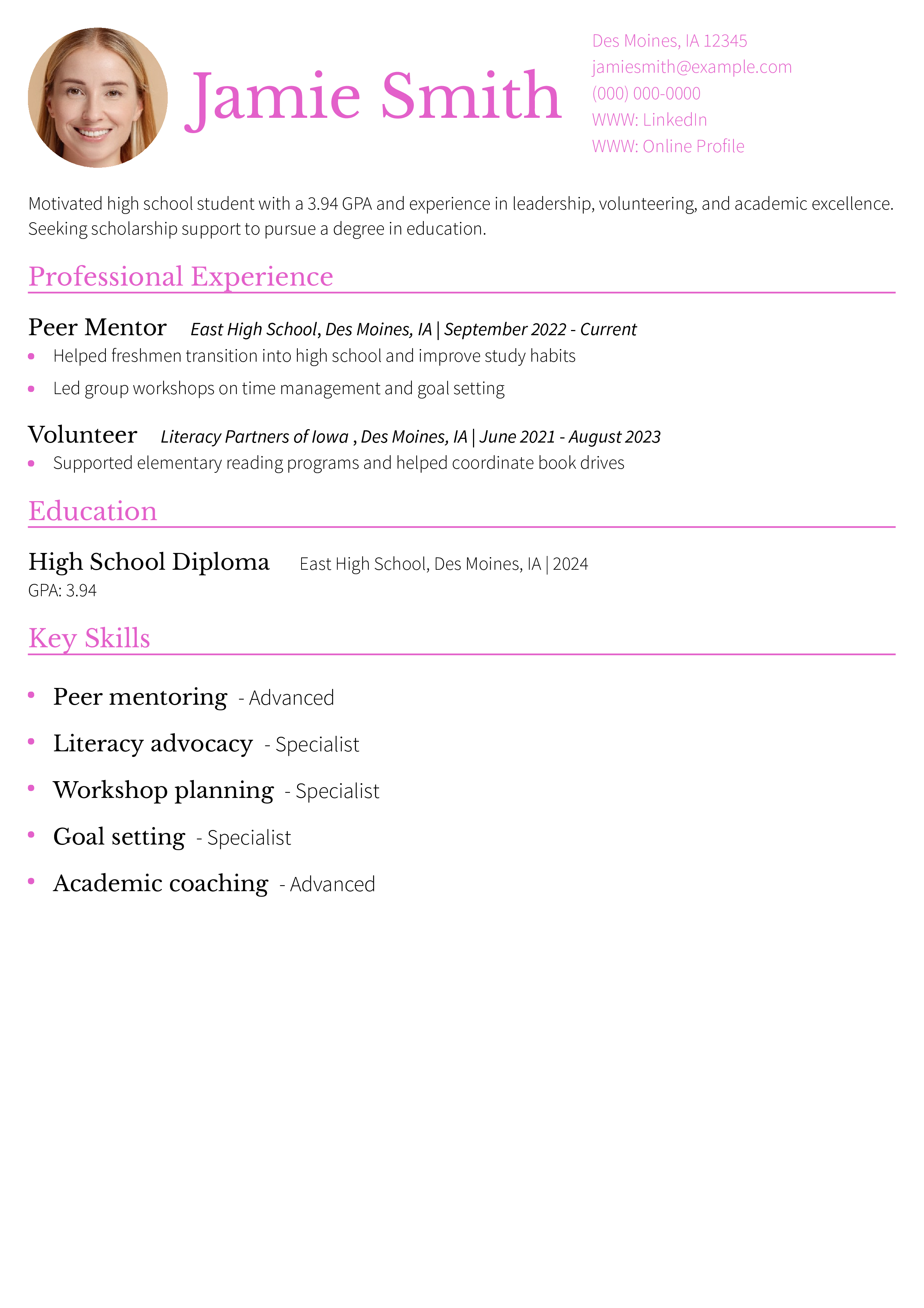
Why This Resume Stands Out
This resume is good because it uses a clean structure and highlights student leadership.
Academic Leadership Scholarship Resume
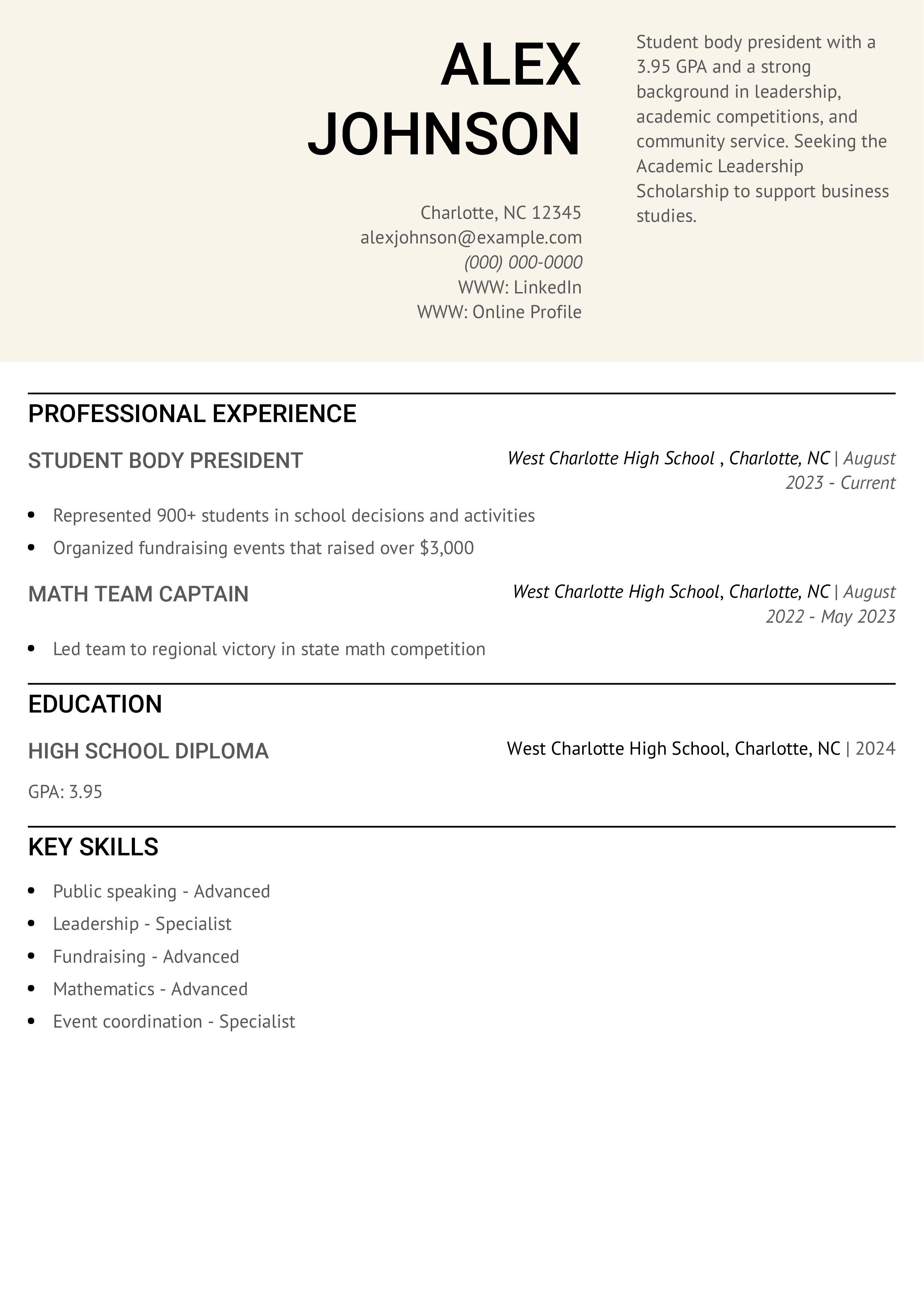
Why This Resume Stands Out
This resume is good because it provides evidence of both academic strength and impactful leadership.
Arts and Humanities Scholarship Resume
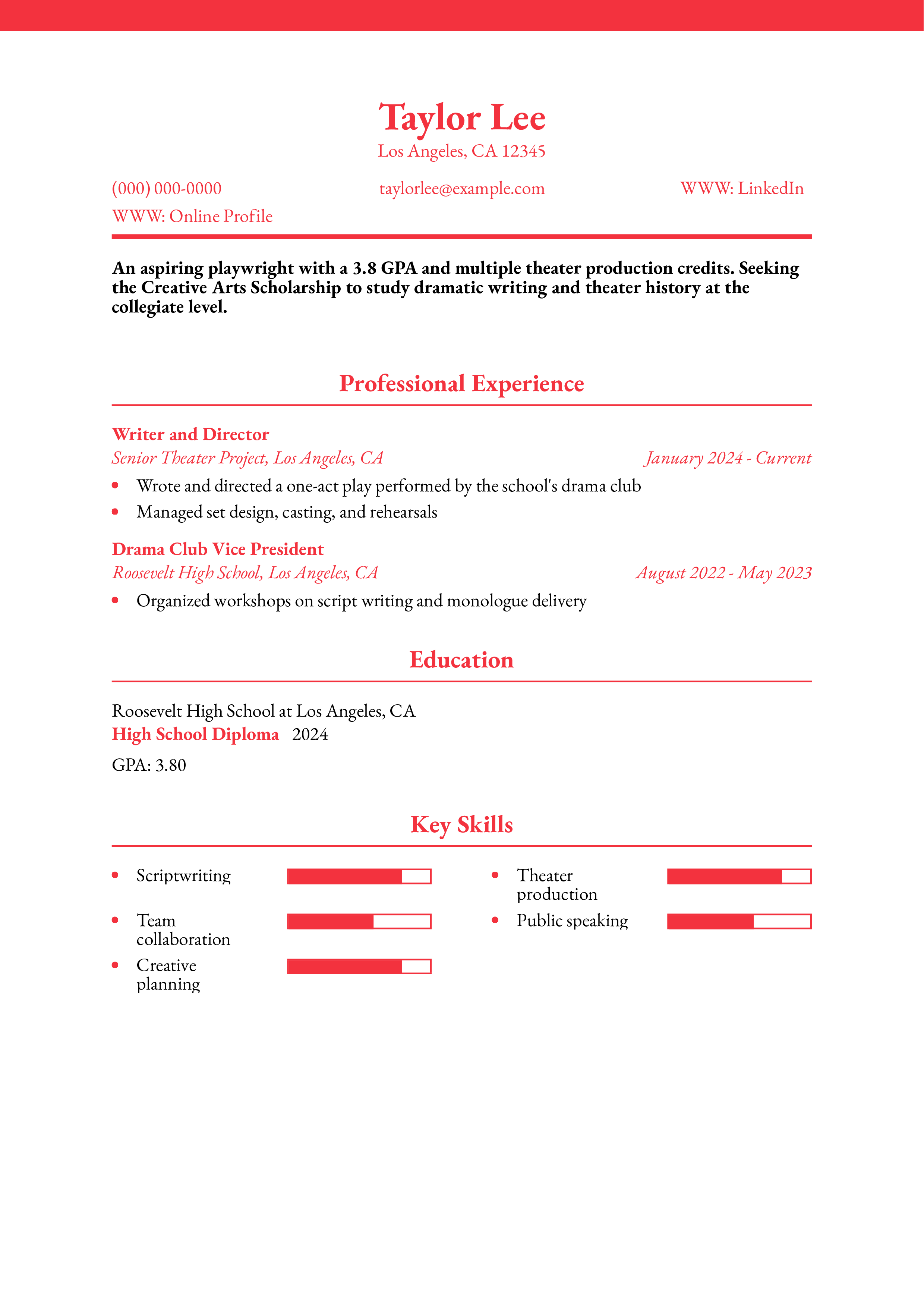
Why This Resume Stands Out
This resume is good because it shows a clear commitment to the arts and strong extracurricular experience.
Science Scholarship Resume
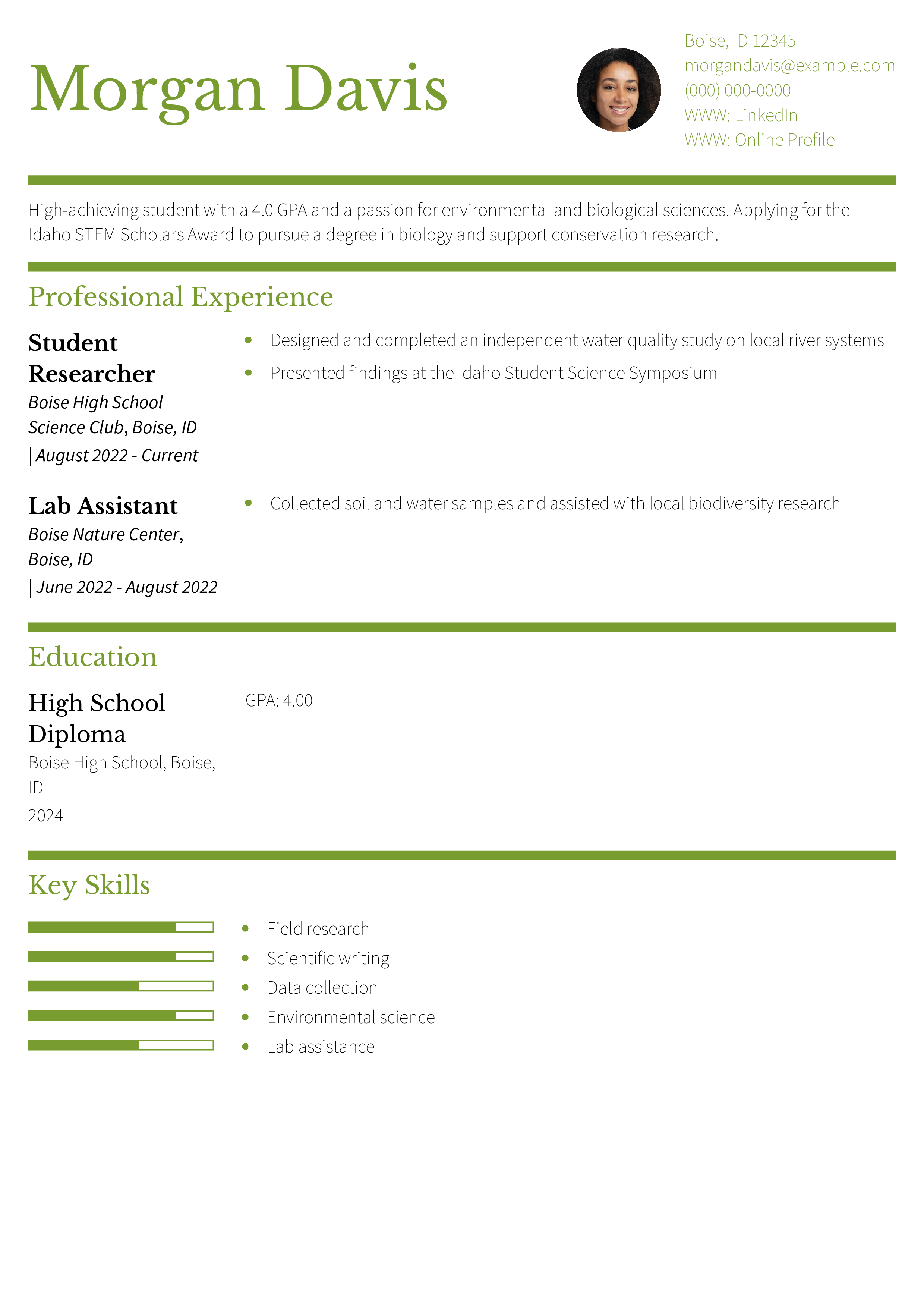
Why This Resume Stands Out
This resume is good because it reflects a clear connection between academic work and real-world application.
Humanitarian Scholarship Resume
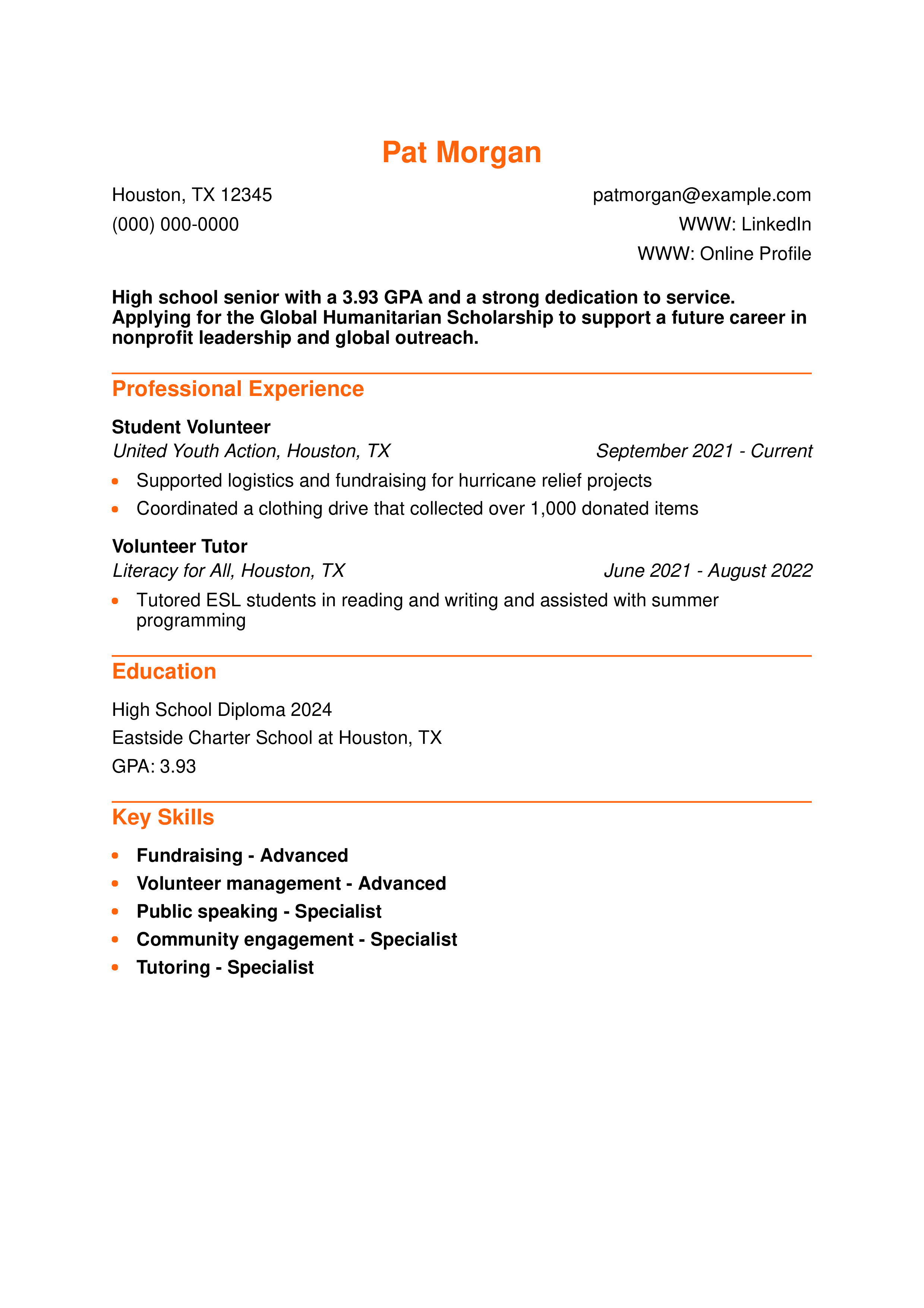
Why This Resume Stands Out
This resume is good because it emphasizes impact-driven experiences with measurable outcomes.
Performing Arts Scholarship Resume
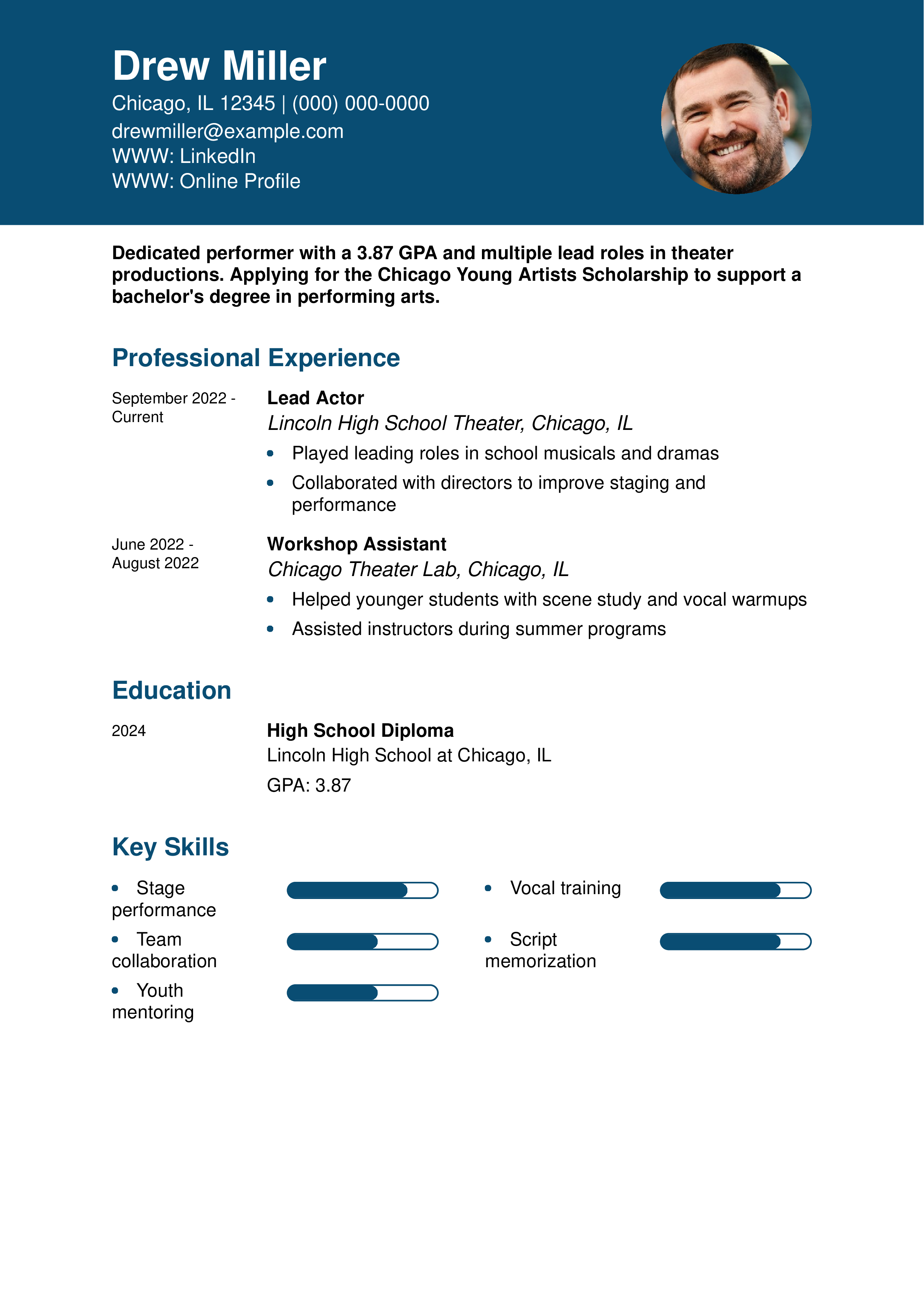
Why This Resume Stands Out
This resume is good because it reflects both performance experience and leadership.
Leadership-Based Scholarship Resume
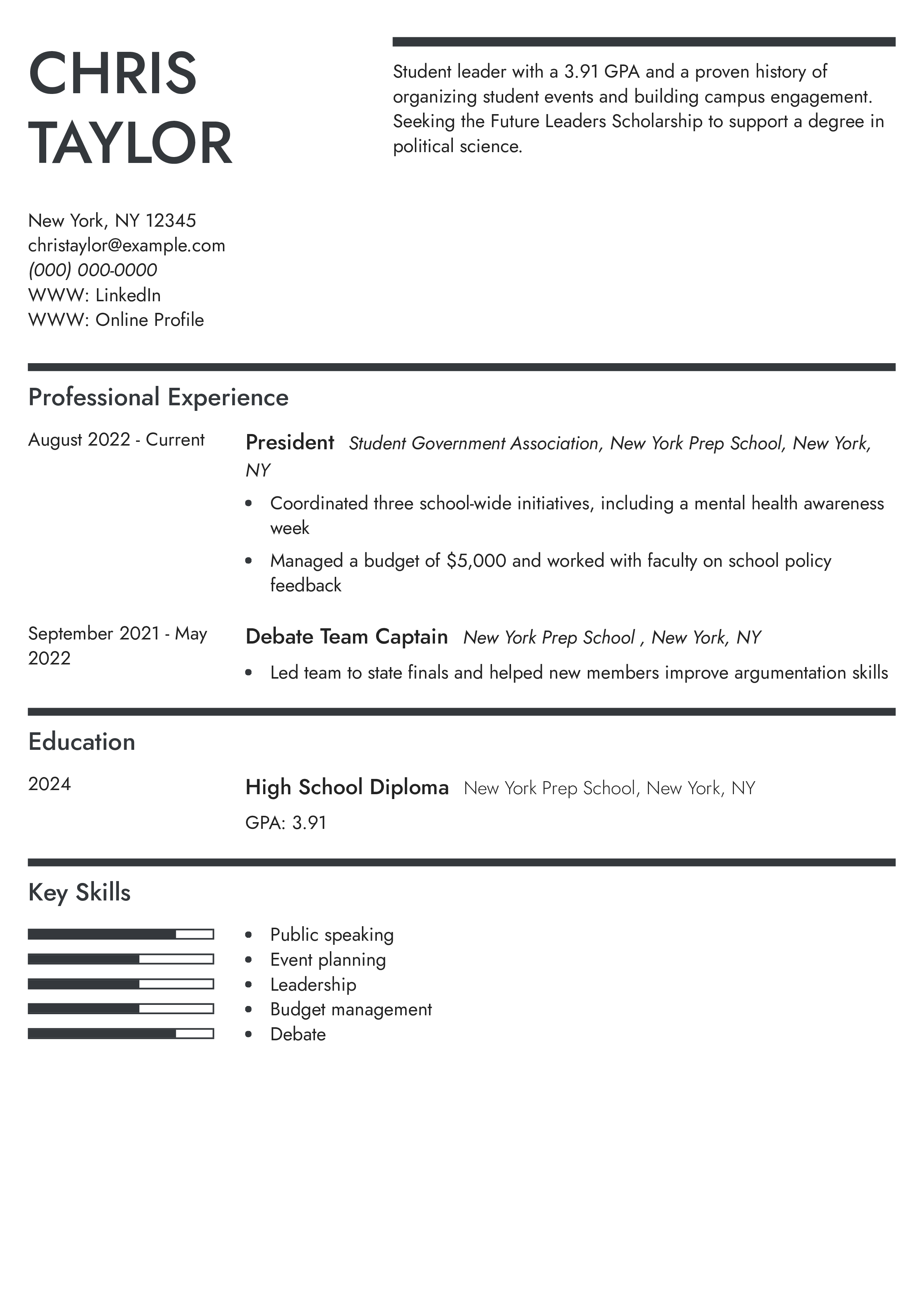
Why This Resume Stands Out
This resume is good because it shows clear leadership with evidence of real responsibility.
Arts Portfolio Scholarship Resume
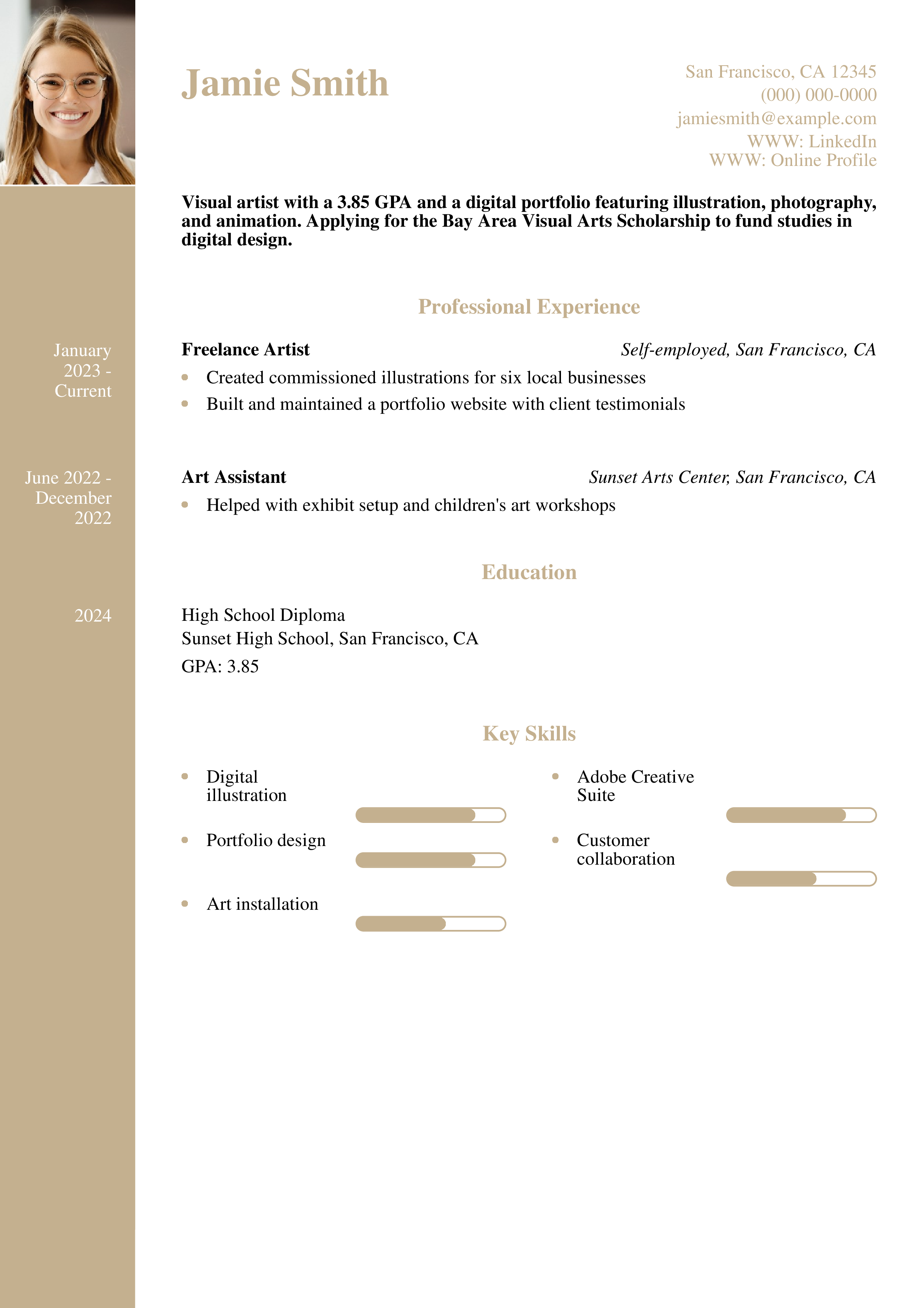
Why This Resume Stands Out
This resume is good because it presents both commercial and community art experience.
Community Service Scholarship Resume
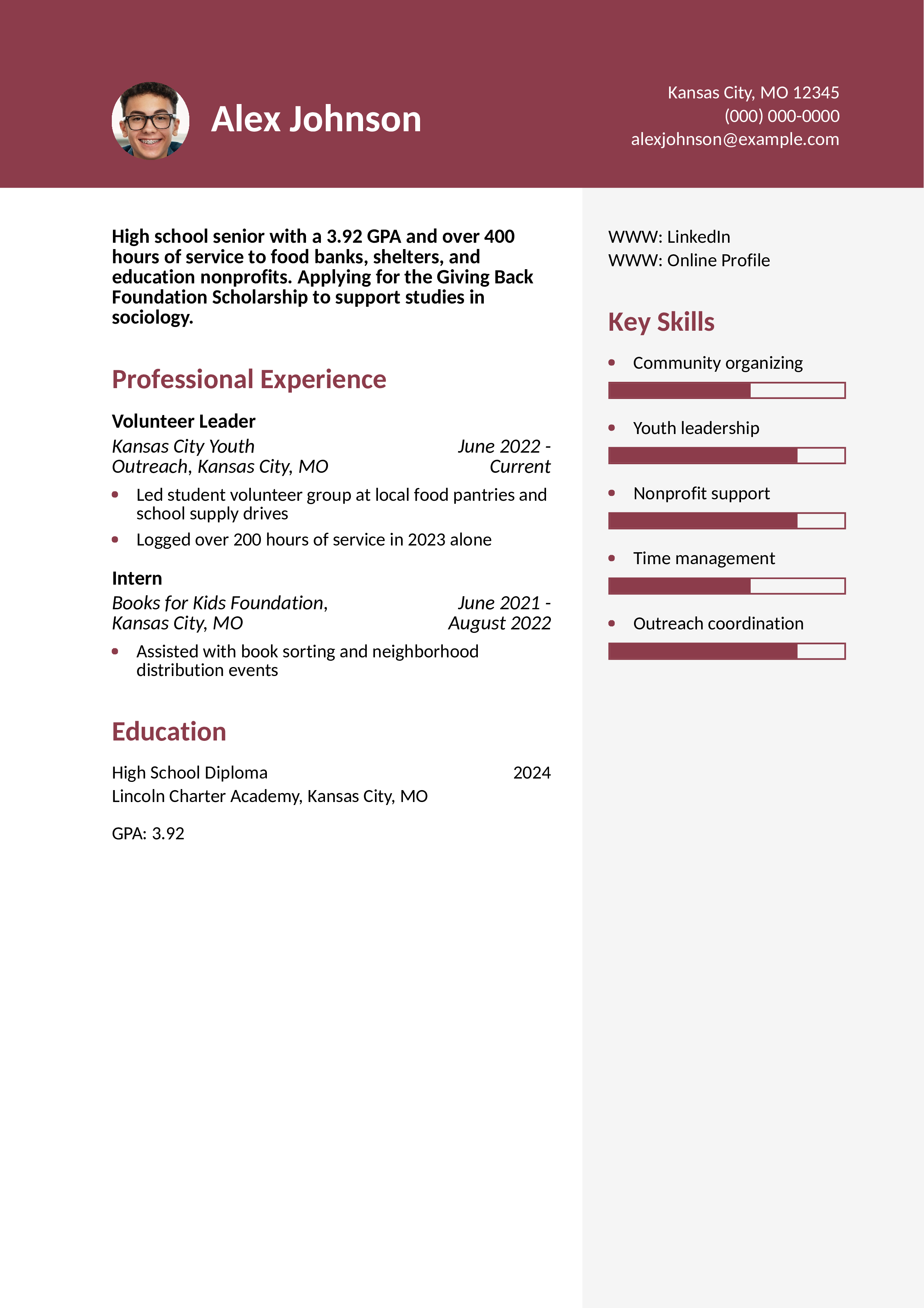
Why This Resume Stands Out
This resume is good because it ties direct service experience to a future academic goal.
Diversity Scholarship Resume
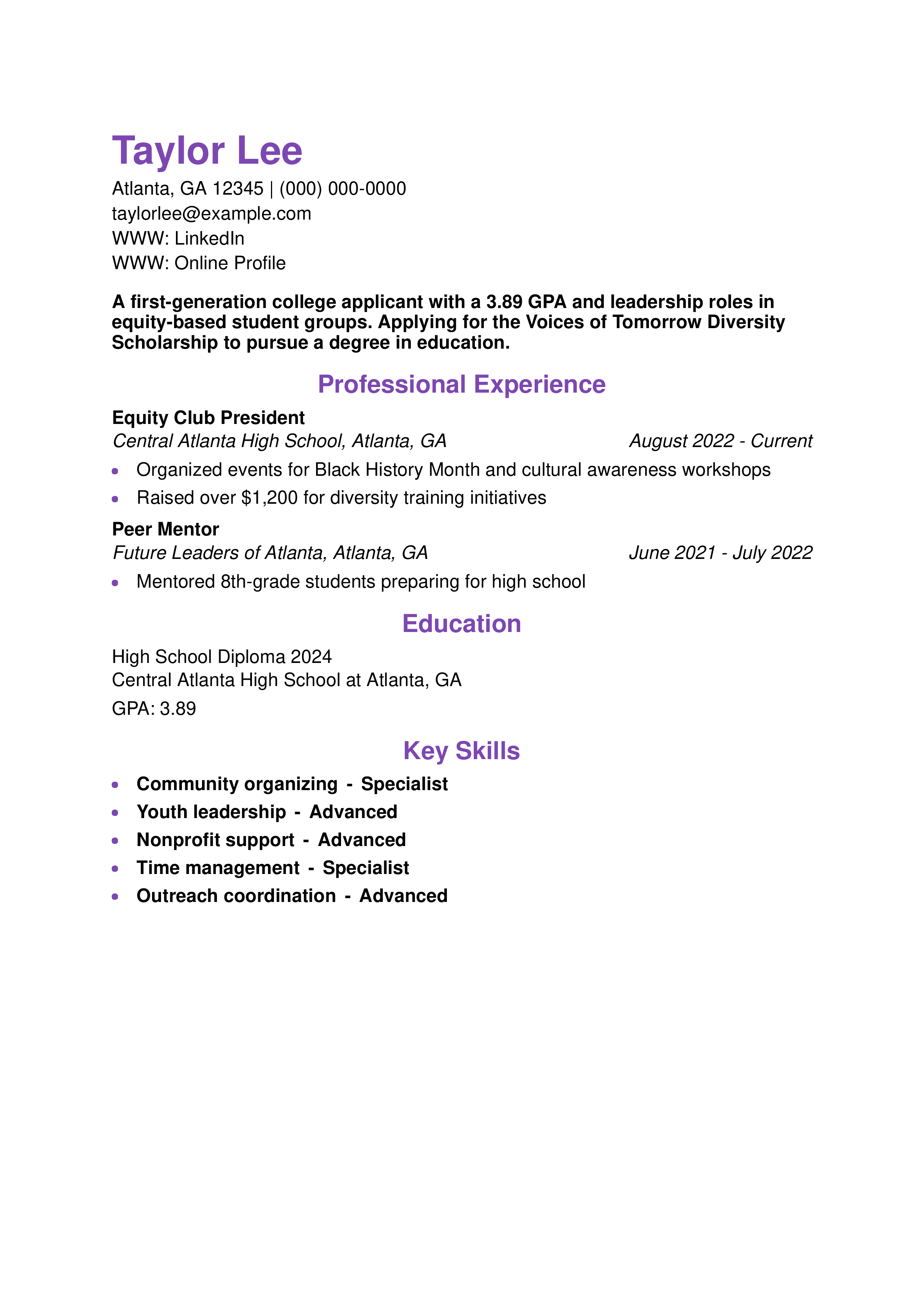
Why This Resume Stands Out
This resume is good because it centers meaningful contributions to diversity and inclusion.
Music Scholarship Resume
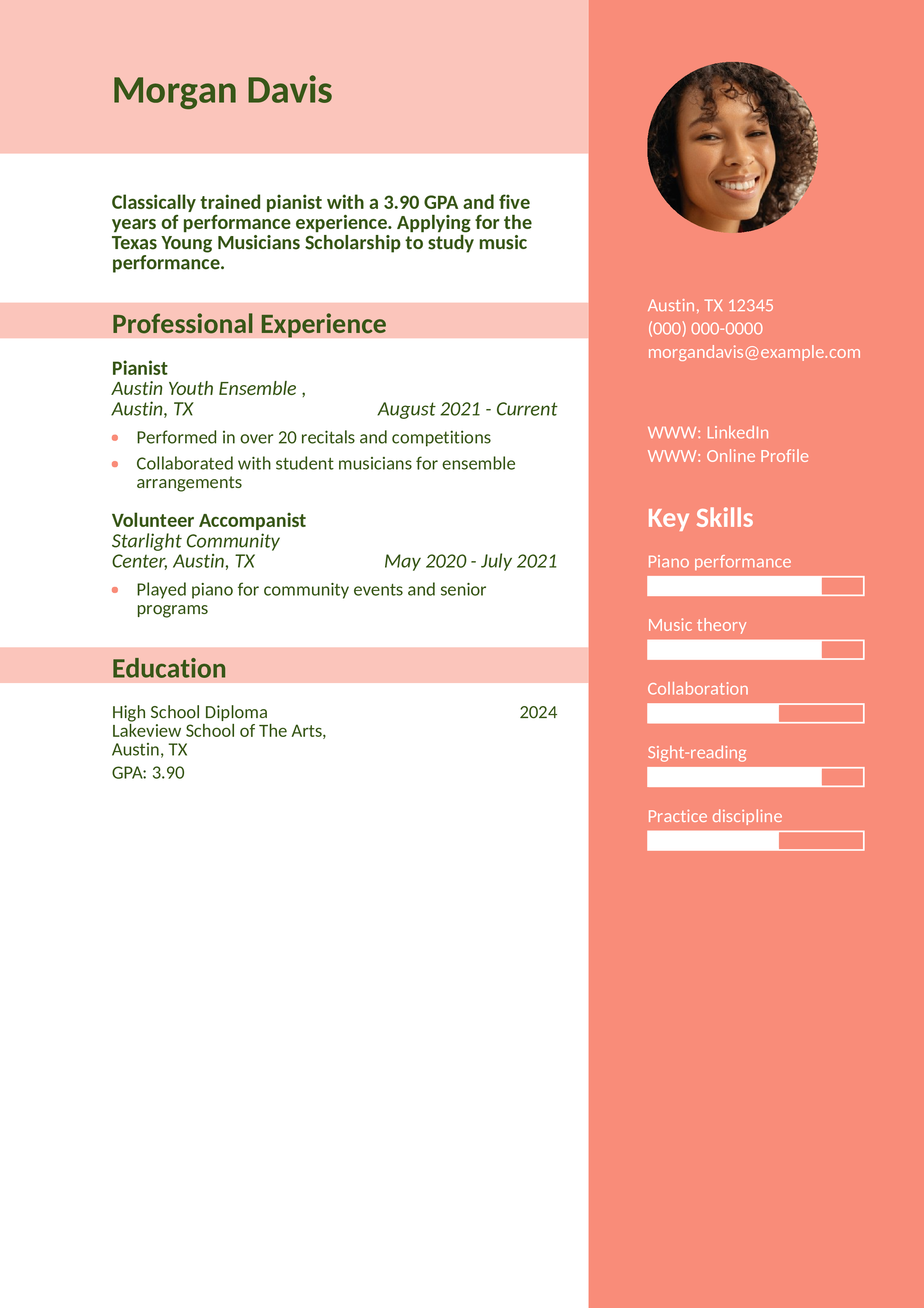
Why This Resume Stands Out
This resume is good because it outlines training, performance, and service.
First-Generation College Student Scholarship Resume
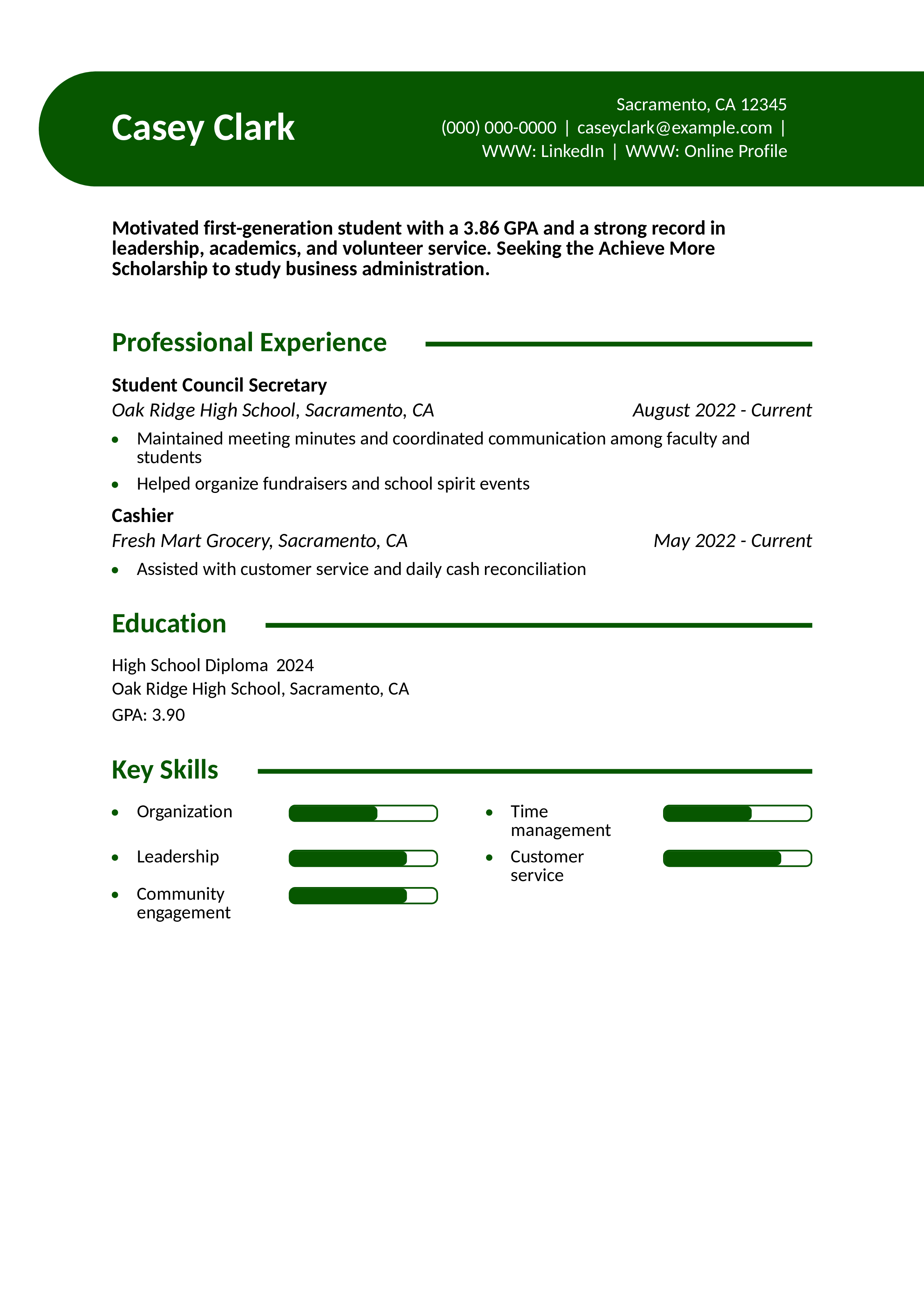
Why This Resume Stands Out
This resume is good because it reflects determination, initiative, and balance between academics and work.
Engineering Scholarship Resume
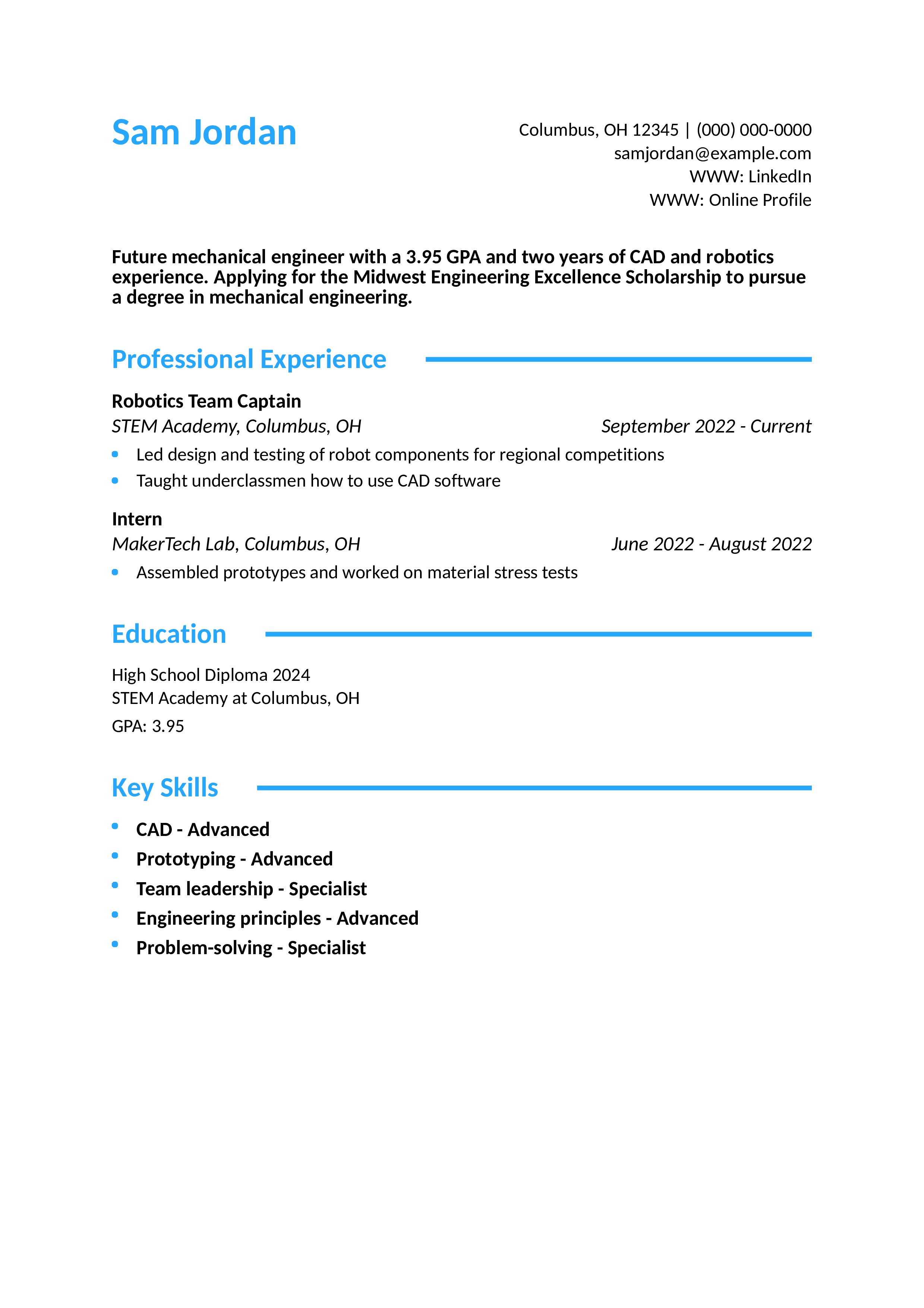
Why This Resume Stands Out
This resume is good because it demonstrates technical experience aligned with academic goals.
Our templates are crafted by professional resume writers to make creating your resume quick, easy, and effective.
- Professional resume template downloads
- Customized cover letter generation
- AI resume writing support
- Career-building resources and advice
Scholarship Text-Only Resume Templates and Examples
How To Write a Scholarship Resume
Scholarship applicants should quantify GPA, hours of service, leadership roles, and tangible project outcomes. Committees want numbers that prove impact and consistency, not just potential.

1. Write a dynamic profile summarizing your qualifications
With the sheer number of candidates applying for scholarship programs, it’s essential to make a strong first impression on the reader. Introduce yourself and explain your academic goal. In the subsequent sentences, emphasize impressive accomplishments that demonstrate why you’re deserving of this opportunity.
For example, if you consistently achieved high grades, start by featuring your grade point average and academic awards. If you excelled in an extracurricular activity such as sports, theater, or music, display these achievements in your summary.
Strong Profile Example
A college student with a 3.96 GPA and two consecutive years on the dean’s list. A proven track record of executing innovative academic projects within the computer science field exploring artificial intelligence (AI) and machine learning (ML). Seeking the Morgan Technology Scholarship to continue pursuing a bachelor’s degree at the University of Washington.
Weak Profile Example
A college student with an excellent GPA and a strong work ethic. Passionate about computer science and academia. Seeking the Morgan Technology Scholarship.
2. Add an accomplishment-driven professional experience section
In a scholarship resume, your content needs to be centered around your most impressive academic achievements, extracurriculars, and community service contributions. It’s impossible to know the exact preferences of any individual scholarship review board, so focus on emphasizing key aspects of your high school and college career that can help you stand out from other applicants.
Strong Academic Experience Example
Computer Science Major, University of Washington, Seattle, WA | September 2022 – June 2024
- Achieved recognition as a finalist in the Technovation Competition for a project exploring novel methods for training AI using deep learning and semi-supervised learning techniques
- Executed an academic project to build a calendar management mobile application with a user experience (UX) design centered on improving accessibility for senior citizens
- Achieved a 3.96 GPA over four semesters and two dean’s list awards
Weak Academic Experience Example
Computer Science Major, University of Washington, Seattle, WA | September 2022 – June 2024
- Completed difficult computer science courses and projects on time
- Maintained a high GPA over four semesters
- Worked well with professors and fellow students in the computer science program
3. Include relevant education and academic awards
Feature your high school degree and any relevant academic awards you’ve garnered on your scholarship resume. Be sure to mention your GPA and any other academic distinctions that can bolster the strength of your application. You could also feature memberships in extracurricular clubs, organizations, or honor societies in this section.
Education
Template
- [Degree Name]
- [School Name], [City, State Abbreviation] | [Graduation Year]
Example
- Bachelor of Science (B.S.) Computer Science
- University of Washington, Seattle, WA | Expected 2026
- GPA: 3.97
- Dean’s list | 2022 – 2024
- High School Diploma
- Seattle Central High School, Seattle, WA | 2022
- GPA: 3.92
- USA Computing Olympiad Silver Division | 2022
4. List pertinent key skills
It’s unlikely that a university or scholarship board will be using an applicant tracking system (ATS) to identify candidates during the selection process, so you won’t need to optimize your document for keywords. That said, still provide a list of your most impressive skill sets on your scholarship resume. Below, you’ll find a range of different key skills to consider adding to your document:
| Key Skills and Proficiencies | |
|---|---|
| Biology | Communication |
| Community outreach | Computer science |
| Data analysis | English |
| Environmental science | Leadership |
| Literary analysis | Mathematics |
| Music | Physics |
| Programming | Psychology |
| Quantitative analysis | Team collaboration |
| Visual arts | |
How To Pick The Best Scholarship Resume Template
To send the right message to the scholarship board, you need a professional resume template that organizes and presents your information effectively. Avoid formats that are overly reliant on visual elements, as this might draw the reader’s eye away from your academic achievements and extracurricular activities. Opt for a straightforward template with a top-down structure that displays each section of your scholarship resume in a sequence.
Frequently Asked Questions: Scholarship Resume Examples and Advice
What should I avoid when writing my Scholarship CV to ensure it's professional and impactful?-
To ensure your Scholarship CV stands out, avoid using generic terms or vague language. Focus on specific achievements with numbers and data that demonstrate your real-world impact. Also, be cautious of overloading the document with too much text or irrelevant information—keep it focused on your most relevant skills and experience.
What are common action verbs for scholarship resumes?-
Incorporating action verbs can add a unique and engaging element to your bullet points. That said, it’s easy to use the same words repeatedly during the resume-building process. We’ve compiled a list of action verbs to diversify your language and enhance the impact of your resume content.
| Action Verbs | |
|---|---|
| Achieved | Analyzed |
| Built | Collaborated |
| Communicated | Conducted |
| Created | Designed |
| Developed | Diagnosed |
| Evaluated | Identified |
| Led | Maintained |
| Supported | Volunteered |
| Wrote | |
How do you align your resume with a scholarship description?-
Adjusting your resume to match the scholarship you’re applying for is the best way to strengthen your application. As you begin building your content, start by researching the organization and what they’re looking for in a scholarship recipient. Feature key aspects of your background that match that description.
For example, if a university values students with extensive community service experience, emphasize these projects and initiatives heavily on your scholarship resume. If an organization is primarily interested in extracurricular activities, make those the focal point of your document. By tailoring your resume to each application, you’ll maximize your odds of receiving the scholarship.
What is the best scholarship resume format?-
A combination format is generally best suited for a scholarship resume, as it’s unlikely that your work history will be a key factor in the application. This allows you to reorder your education, volunteer experience, skills, and academic achievements depending on the scholarship. A reverse chronological approach can be considered if you have an impressive internship or relevant work experience you think is valuable.
Should my scholarship resume be one or two pages?-
Your scholarship resume should ideally be one page, especially if you have fewer than 10 years of experience. A two-page resume can be effective for seasoned professionals with a longer track record if it highlights accomplishments and skills directly relevant to the job. Every detail should add value and strengthen your candidacy.
Limit your work experience to the past 10 to 15 years, unless earlier positions are highly relevant. Keeping your resume concise and targeted will make a strong and memorable impression on potential employers.
Craft your perfect resume in minutes
Get 2x more interviews with Resume Builder. Access Pro Plan features for a limited time!

Most scholarship applications will require a matching cover letter. To make a strong impression on the reader, explore unique aspects of your background that you wouldn’t normally include on a resume. For example, you could explore your cultural background and personal challenges you’ve overcome. You might also convey why you’re passionate about a particular academic field, sport, or extracurricular activity. For additional information, visit our internship cover letter guide.