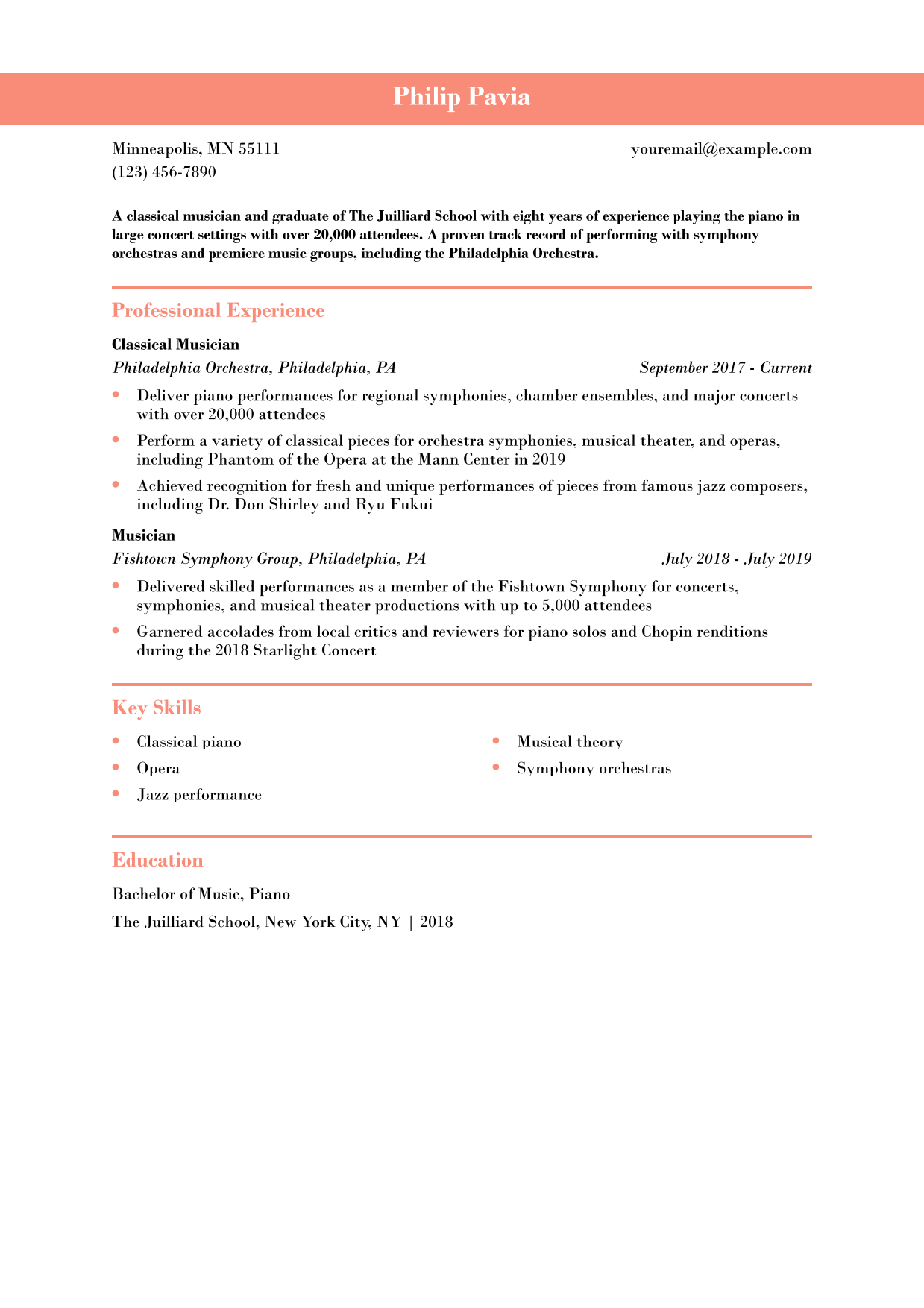
Philip Pavia
(123) 456-7890 | [email protected]
Minneapolis, MN 55111
Profile
A classical musician and graduate of The Juilliard School with eight years of experience playing the piano in large concert settings with over 20,000 attendees. A proven track record of performing with symphony orchestras and premiere music groups, including the Philadelphia Orchestra.
Professional Experience
Classical Musician, Philadelphia Orchestra, Philadelphia, PA
September 2017 – Present
- Deliver piano performances for regional symphonies, chamber ensembles, and major concerts with over 20,000 attendees
- Perform a variety of classical pieces for orchestra symphonies, musical theater, and operas, including Phantom of the Opera at the Mann Center in 2019
- Achieved recognition for fresh and unique performances of pieces from famous jazz composers, including Dr. Don Shirley and Ryu Fukui
Musician, Fishtown Symphony Group, Philadelphia, PA
July 2018 – July 2019
- Delivered skilled performances as a member of the Fishtown Symphony for concerts, symphonies, and musical theater productions with up to 5,000 attendees
- Garnered accolades from local critics and reviewers for piano solos and Chopin renditions during the 2018 Starlight Concert
Key Skills
- Classical piano
- Musical theory
- Opera
- Symphony orchestras
- Jazz performance
Education
Bachelor of Music, Piano
The Juilliard School, New York City, NY | 2018
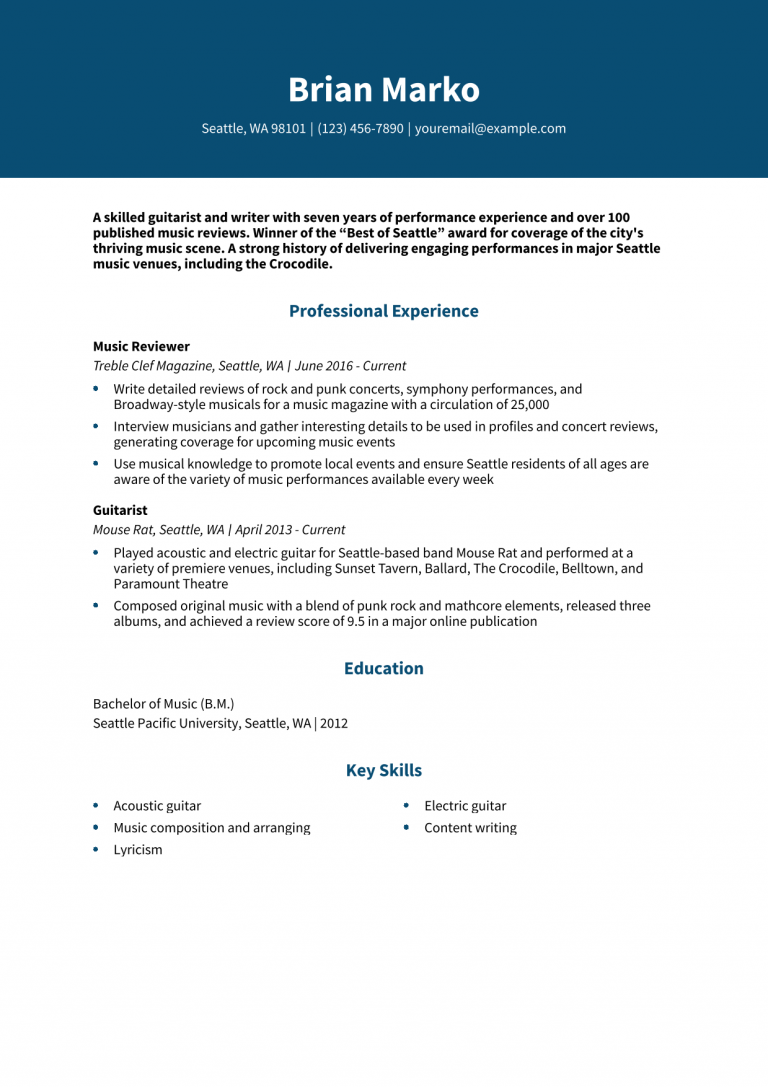
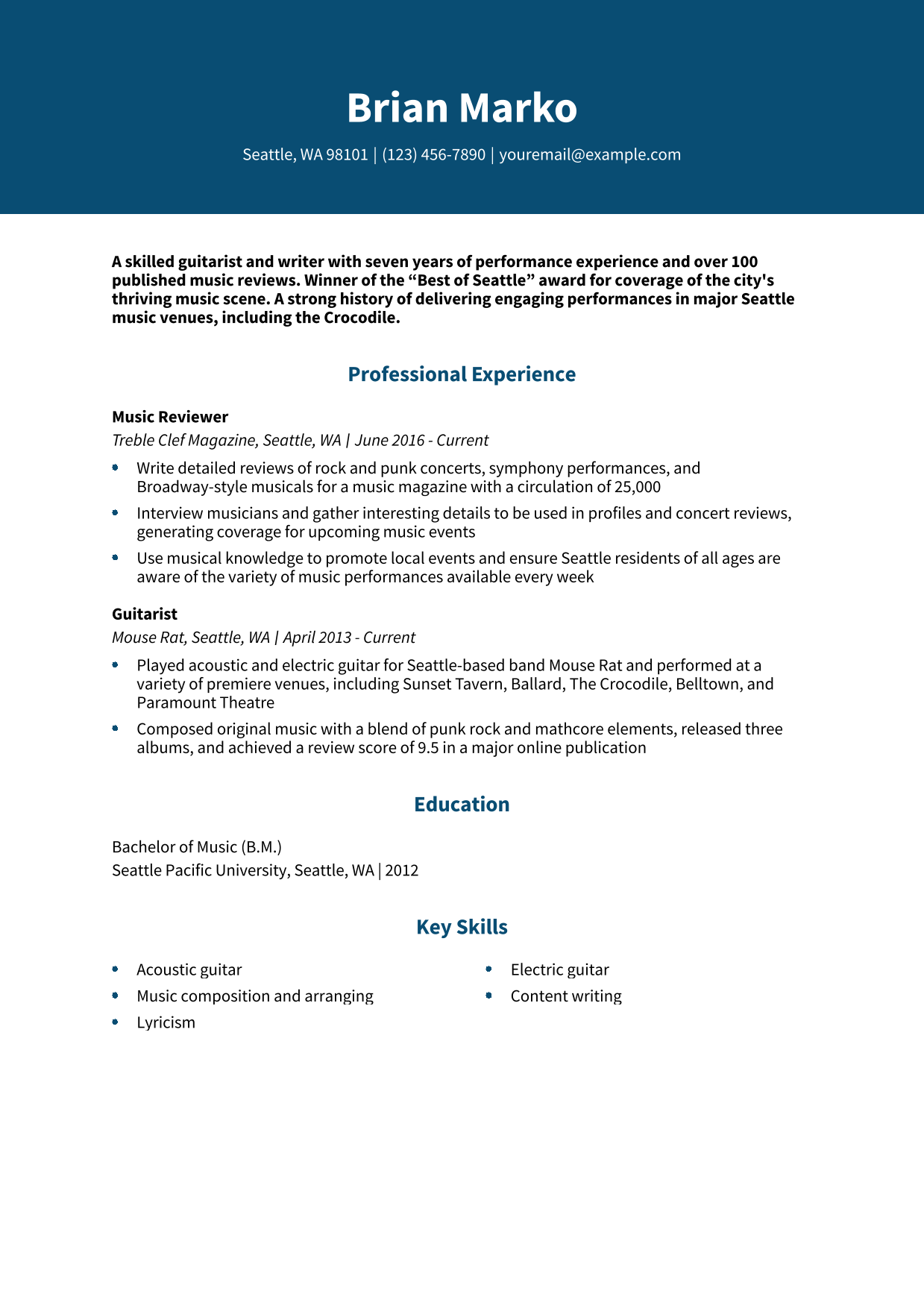
Brian Marko
(123) 456-7890 | [email protected]
Seattle, WA 98101
Profile
A skilled guitarist and writer with seven years of performance experience and over 100 published music reviews. Winner of the “Best of Seattle” award for coverage of the city’s thriving music scene. A strong history of delivering engaging performances in major Seattle music venues, including the Crocodile.
Professional Experience
Music Reviewer, Treble Clef Magazine, Seattle, WA
June 2016 – Present
- Write detailed reviews of rock and punk concerts, symphony performances, and Broadway-style musicals for a music magazine with a circulation of 25,000
- Interview musicians and gather interesting details to be used in profiles and concert reviews, generating coverage for upcoming music events
- Use musical knowledge to promote local events and ensure Seattle residents of all ages are aware of the variety of music performances available every week
Guitarist, Mouse Rat, Seattle, WA
April 2013 – Present
- Played acoustic and electric guitar for Seattle-based band Mouse Rat and performed at a variety of premiere venues, including Sunset Tavern, Ballard, The Crocodile, Belltown, and Paramount Theatre
- Composed original music with a blend of punk rock and mathcore elements, released three albums, and achieved a review score of 9.5 in a major online publication
Education
Bachelor of Music (B.M.)
Seattle Pacific University, Seattle, WA | 2012
Key Skills
- Acoustic guitar
- Electric guitar
- Music composition and arranging
- Content writing
- Lyricism
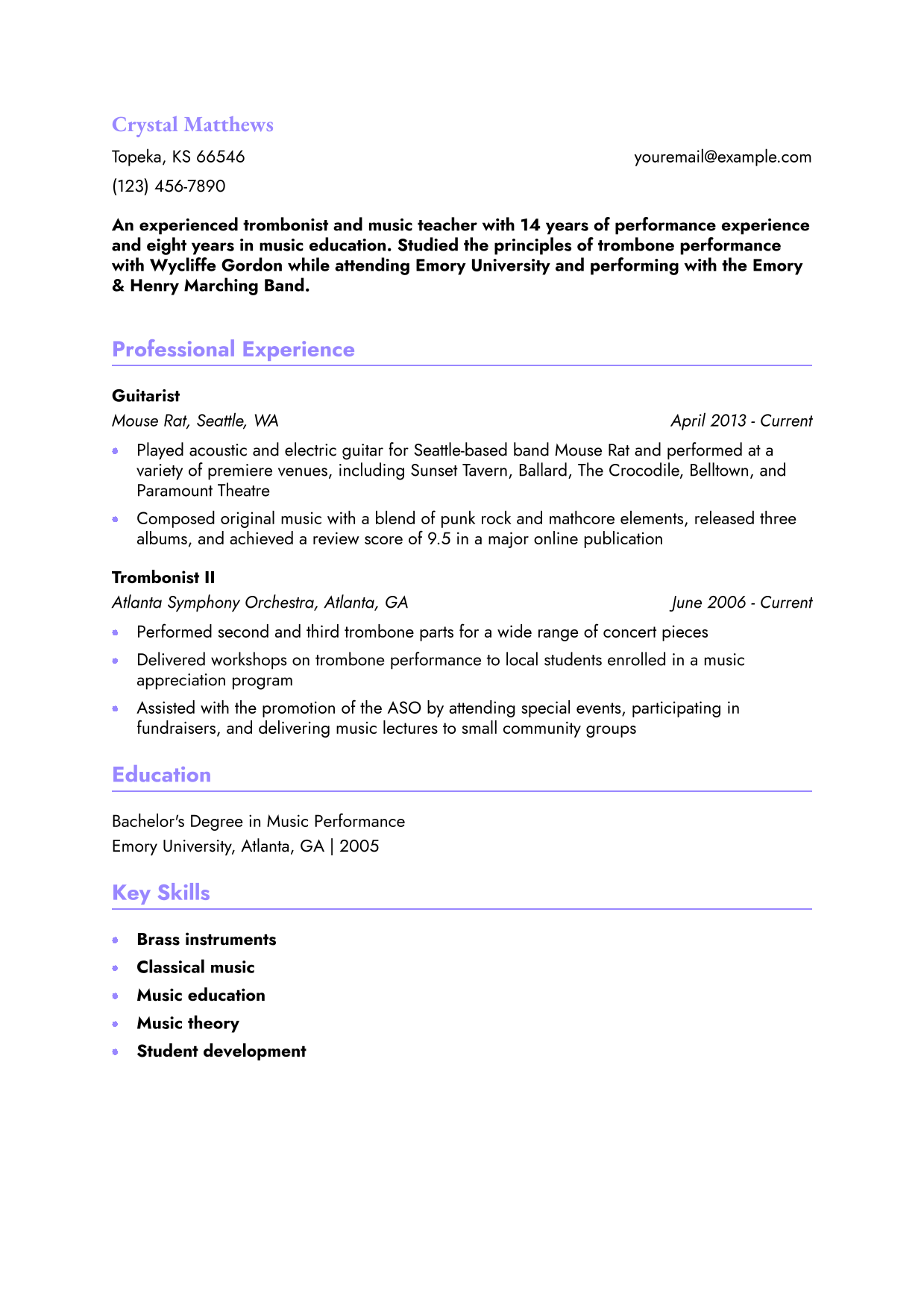
Crystal Matthews
(123) 456-7890 | [email protected]
Topeka, KS 66546
Profile
An experienced trombonist and music teacher with 14 years of performance experience and eight years in music education. Studied the principles of trombone performance with Wycliffe Gordon while attending Emory University and performing with the Emory & Henry Marching Band.
Professional Experience
Music Teacher, Great Notes Performing Arts Academy, Topeka, KS
May 2012 – Present
- Provide individual and small-group instruction to aspiring trombonists attending a summer performing arts academy
- Teach classes on trombone performance, music theory, and music composition during the fall and spring semesters
- Mentor six student trombonists per session by giving feedback on performance techniques and prepare students for college auditions
- Serve as a program adviser for students in the brass performance track; help students choose classes, plan their performance schedules, and determine which ensembles to join
Trombonist II, Atlanta Symphony Orchestra, Atlanta, GA
June 2006 – May 2012
- Performed second and third trombone parts for a wide range of concert pieces
- Delivered workshops on trombone performance to local students enrolled in a music appreciation program
- Assisted with the promotion of the ASO by attending special events, participating in fundraisers, and delivering music lectures to small community groups
Education
Bachelor’s Degree in Music Performance
Emory University, Atlanta, GA | 2005
Key Skills
- Brass instruments
- Classical music
- Music education
- Music theory
- Student development
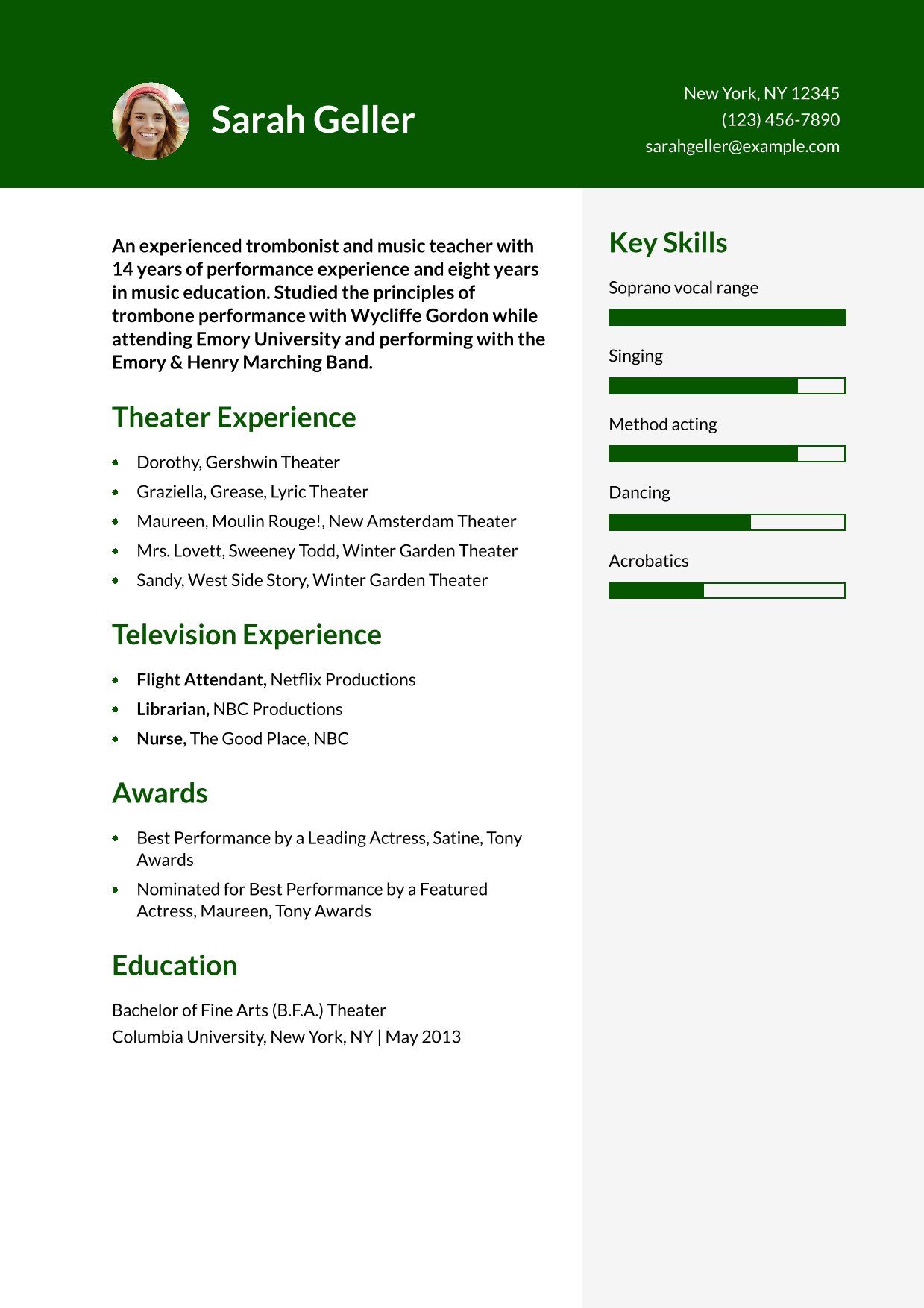
Sarah Geller
(123) 456-7890 | [email protected]
New York, NY 12345
Profile
A dynamic actress with eight years of experience delivering award-worthy performances in various Broadway productions. Expertise in utilizing a method-acting approach to adopt authentic character personas. Achieved recognition for leading roles in The Wizard of Oz, Moulin Rouge!, and Rent.
Theater Experience
Dorothy, Gershwin Theater
Graziella, Grease, Lyric Theater
Maureen, Moulin Rouge!, New Amsterdam Theater
Mrs. Lovett, Sweeney Todd, Winter Garden Theater
Sandy, West Side Story, Winter Garden Theater
Television Experience
Flight Attendant, Netflix Productions
Librarian, NBC Productions
Nurse, The Good Place, NBC
Awards
- Best Performance by a Leading Actress, Satine, Tony Awards
- Nominated for Best Performance by a Featured Actress, Maureen, Tony Awards
Education
Bachelor of Fine Arts (B.F.A.) Theater
Columbia University, New York, NY | May 2013
Key Skills
- Soprano vocal range
- Singing
- Method acting
- Dancing
- Acrobatics
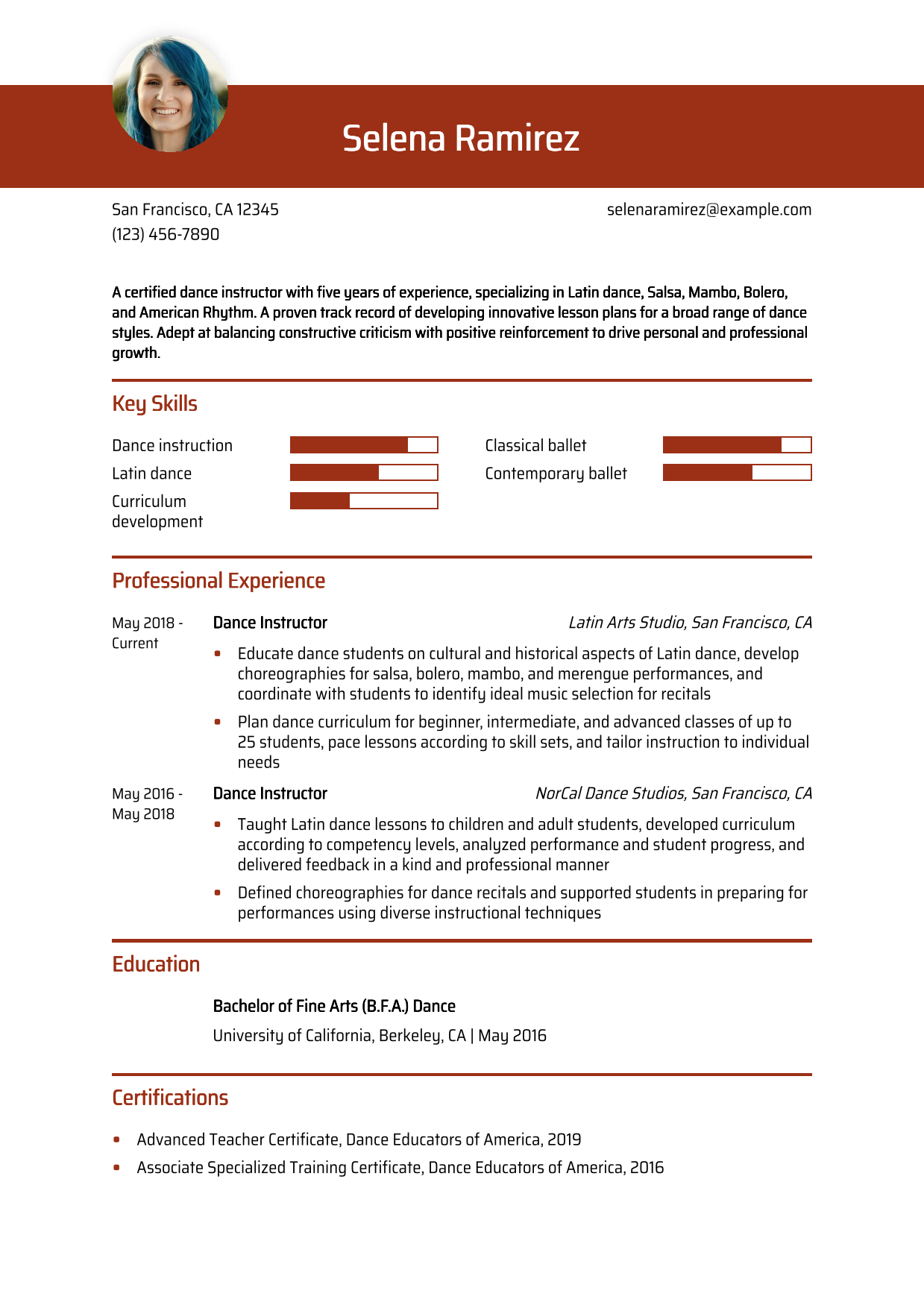
Selena Ramirez
(123) 456-7890 | [email protected]
San Francisco, CA 12345
Profile
A certified dance instructor with five years of experience, specializing in Latin dance, Salsa, Mambo, Bolero, and American Rhythm. A proven track record of developing innovative lesson plans for a broad range of dance styles. Adept at balancing constructive criticism with positive reinforcement to drive personal and professional growth.
Professional Experience
Dance Instructor, Latin Arts Studio, San Francisco, CA
May 2018 – Present
- Educate dance students on cultural and historical aspects of Latin dance, develop choreographies for salsa, bolero, mambo, and merengue performances, and coordinate with students to identify ideal music selection for recitals
- Plan dance curriculum for beginner, intermediate, and advanced classes of up to 25 students, pace lessons according to skill sets, and tailor instruction to individual needs
Dance Instructor, NorCal Dance Studios, San Francisco, CA
May 2016 – May 2018
- Taught Latin dance lessons to children and adult students, developed curriculum according to competency levels, analyzed performance and student progress, and delivered feedback in a kind and professional manner
- Defined choreographies for dance recitals and supported students in preparing for performances using diverse instructional techniques
Education
Bachelor of Fine Arts (B.F.A.) Dance
University of California, Berkeley, CA | May 2016
Key Skills
- Dance instruction
- Classical ballet
- Latin dance
- Contemporary ballet
- Curriculum development
Certifications
- Advanced Teacher Certificate, Dance Educators of America, 2019
- Associate Specialized Training Certificate, Dance Educators of America, 2016
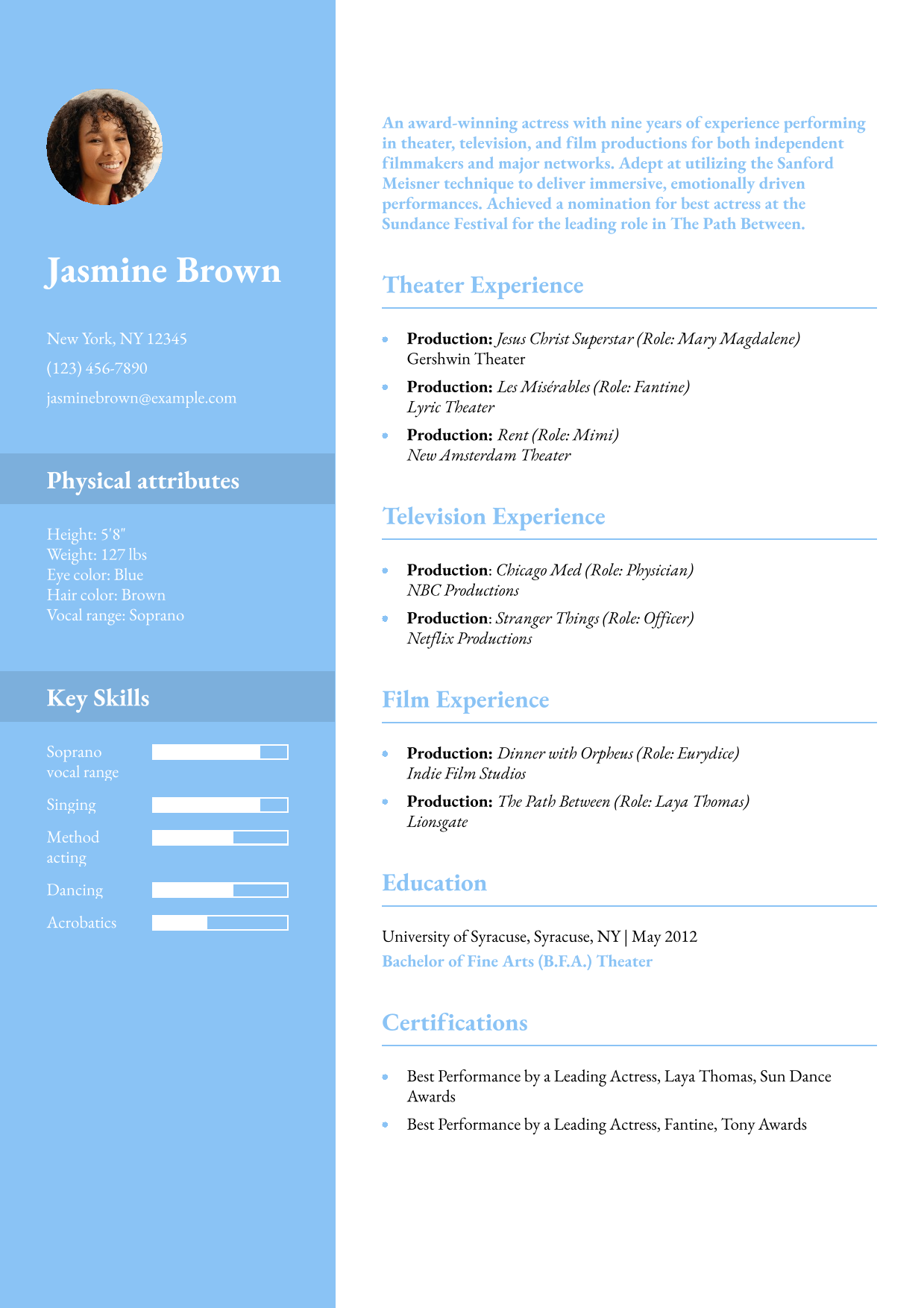
Jasmine Brown
(123) 456-7890 | [email protected]
New York, NY 12345
Profile
An award-winning actress with nine years of experience performing in theater, television, and film productions for both independent filmmakers and major networks. Adept at utilizing the Sanford Meisner technique to deliver immersive, emotionally driven performances. Achieved a nomination for best actress at the Sundance Festival for the leading role in The Path Between.
Physical attributes
- Height: 5’8″
- Weight: 127 lbs
- Eye color: Blue
- Hair color: Brown
- Vocal range: Soprano
Theater Experience
- Production: Jesus Christ Superstar (Role: Mary Magdalene)
Gershwin Theater
- Production: Les Misérables (Role: Fantine)
Lyric Theater
- Production: Rent (Role: Mimi)
New Amsterdam Theater
Television Experience
- Production: Chicago Med (Role: Physician)
NBC Productions
- Production: Stranger Things (Role: Officer)
Netflix Productions
Film Experience
- Production: Dinner with Orpheus (Role: Eurydice)
Indie Film Studios
- Production: The Path Between (Role: Laya Thomas)
Lionsgate
Awards
- Best Performance by a Leading Actress, Laya Thomas, Sun Dance Awards
- Best Performance by a Leading Actress, Fantine, Tony Awards
Education
Bachelor of Fine Arts (B.F.A.) Theater
University of Syracuse, Syracuse, NY | May 2012
Key Skills
- Soprano vocal range
- Singing
- Method acting
- Dancing
- Acrobatics
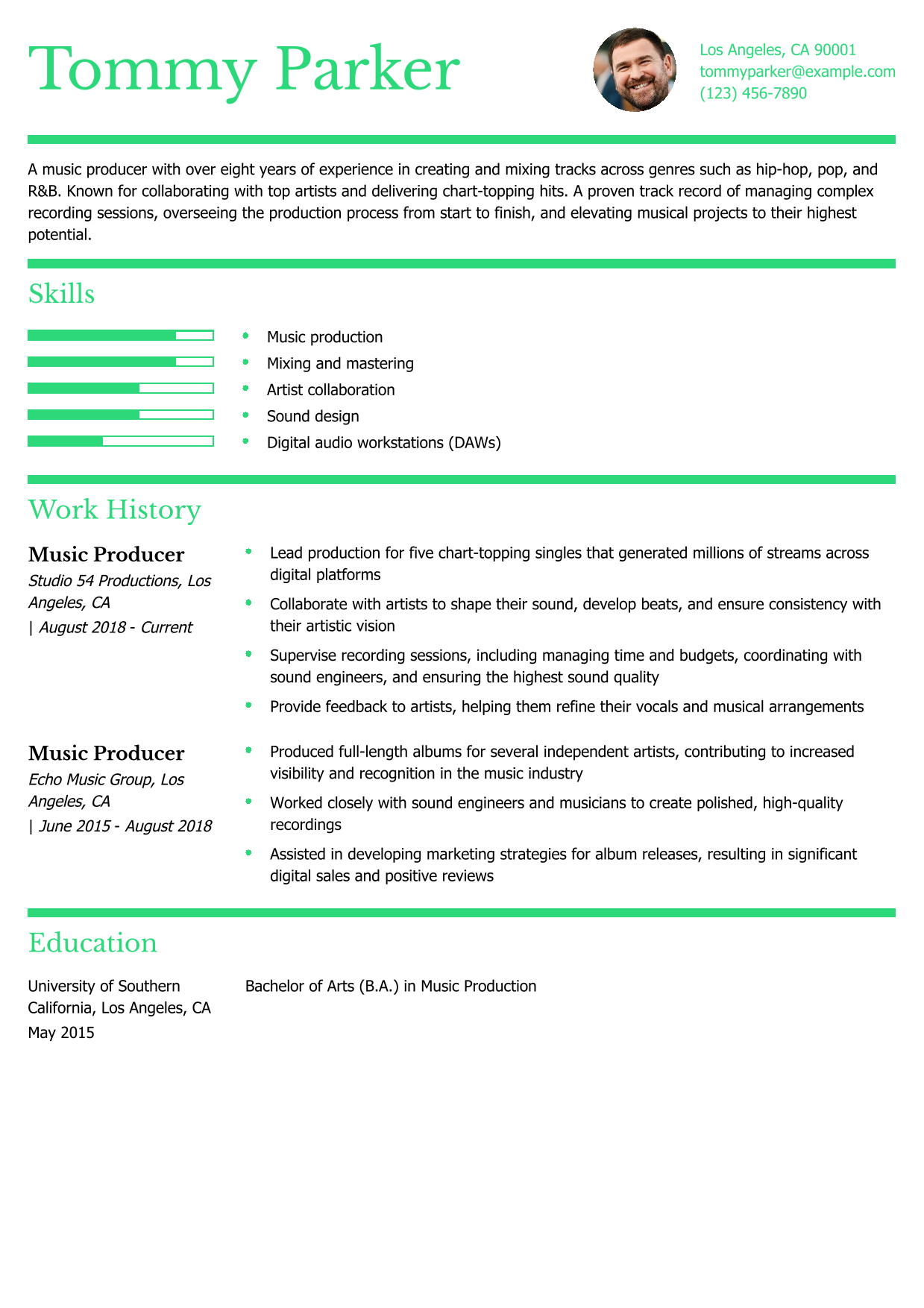
Tommy Parker
(123) 456-7890 | [email protected]
Los Angeles, CA 90001
Profile
A music producer with over eight years of experience in creating and mixing tracks across genres such as hip-hop, pop, and R&B. Known for collaborating with top artists and delivering chart-topping hits. A proven track record of managing complex recording sessions, overseeing the production process from start to finish, and elevating musical projects to their highest potential.
Professional Experience
Music Producer, Studio 54 Productions, Los Angeles, CA
August 2018 – Present
- Lead production for five chart-topping singles that generated millions of streams across digital platforms
- Collaborate with artists to shape their sound, develop beats, and ensure consistency with their artistic vision
- Supervise recording sessions, including managing time and budgets, coordinating with sound engineers, and ensuring the highest sound quality
- Provide feedback to artists, helping them refine their vocals and musical arrangements
Music Producer, Echo Music Group, Los Angeles, CA
June 2015 – August 2018
- Produced full-length albums for several independent artists, contributing to increased visibility and recognition in the music industry
- Worked closely with sound engineers and musicians to create polished, high-quality recordings
- Assisted in developing marketing strategies for album releases, resulting in significant digital sales and positive reviews
Education
Bachelor of Arts (B.A.) in Music Production
University of Southern California, Los Angeles, CA | May 2015
Key Skills
- Music production
- Mixing and mastering
- Artist collaboration
- Sound design
- Digital audio workstations (DAWs)
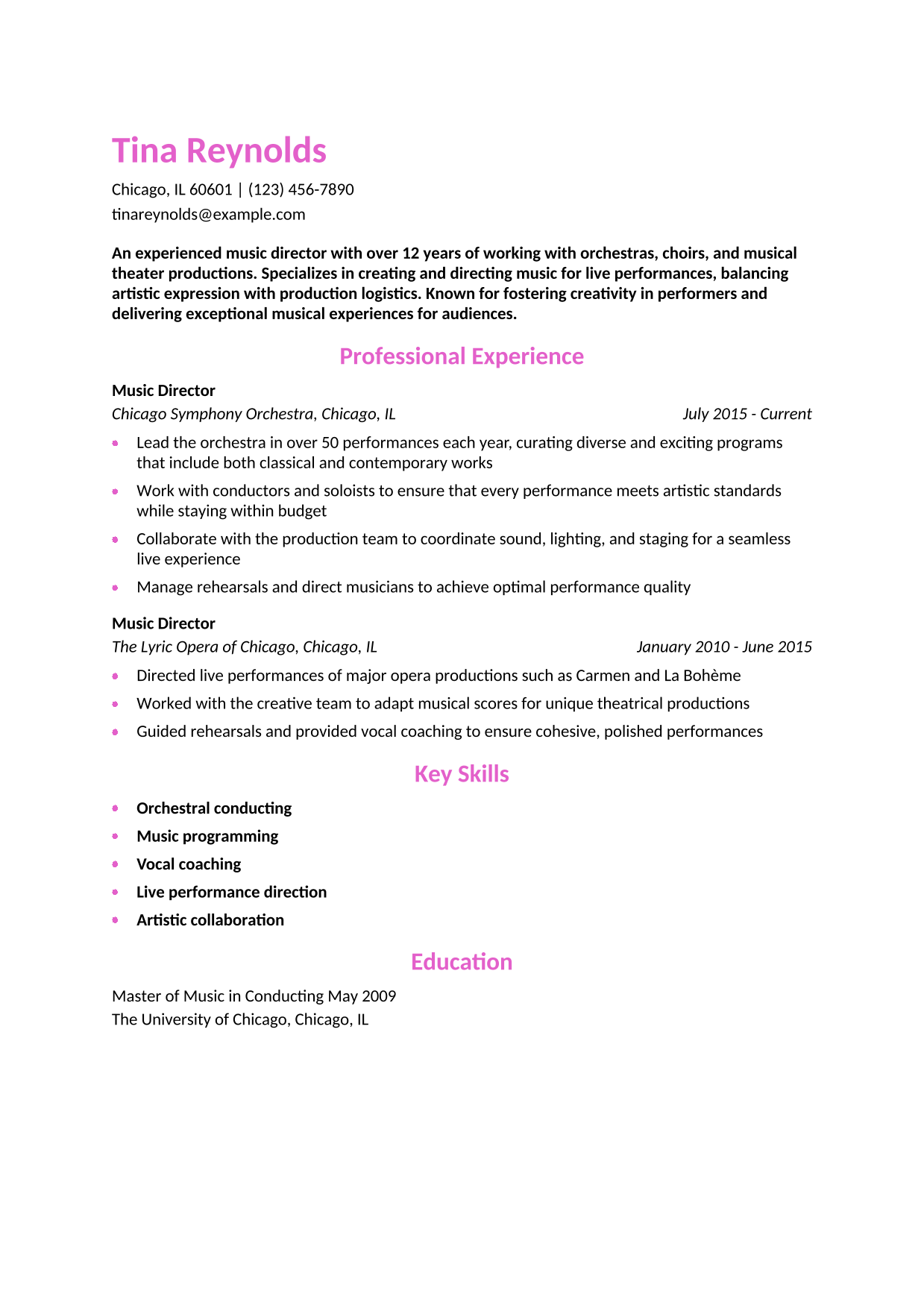
Tina Reynolds
(123) 456-7890 | [email protected]
Chicago, IL 60601
Profile
An experienced music director with over 12 years of working with orchestras, choirs, and musical theater productions. Specializes in creating and directing music for live performances, balancing artistic expression with production logistics. Known for fostering creativity in performers and delivering exceptional musical experiences for audiences.
Professional Experience
Music Director, Chicago Symphony Orchestra, Chicago, IL
July 2015 – Present
- Lead the orchestra in over 50 performances each year, curating diverse and exciting programs that include both classical and contemporary works
- Work with conductors and soloists to ensure that every performance meets artistic standards while staying within budget
- Collaborate with the production team to coordinate sound, lighting, and staging for a seamless live experience
- Manage rehearsals and direct musicians to achieve optimal performance quality
Music Director, The Lyric Opera of Chicago, Chicago, IL
January 2010 – June 2015
- Directed live performances of major opera productions such as Carmen and La Bohème
- Worked with the creative team to adapt musical scores for unique theatrical productions
- Guided rehearsals and provided vocal coaching to ensure cohesive, polished performances
Education
Master of Music in Conducting
The University of Chicago, Chicago, IL | May 2009
Key Skills
- Orchestral conducting
- Music programming
- Vocal coaching
- Live performance direction
- Artistic collaboration
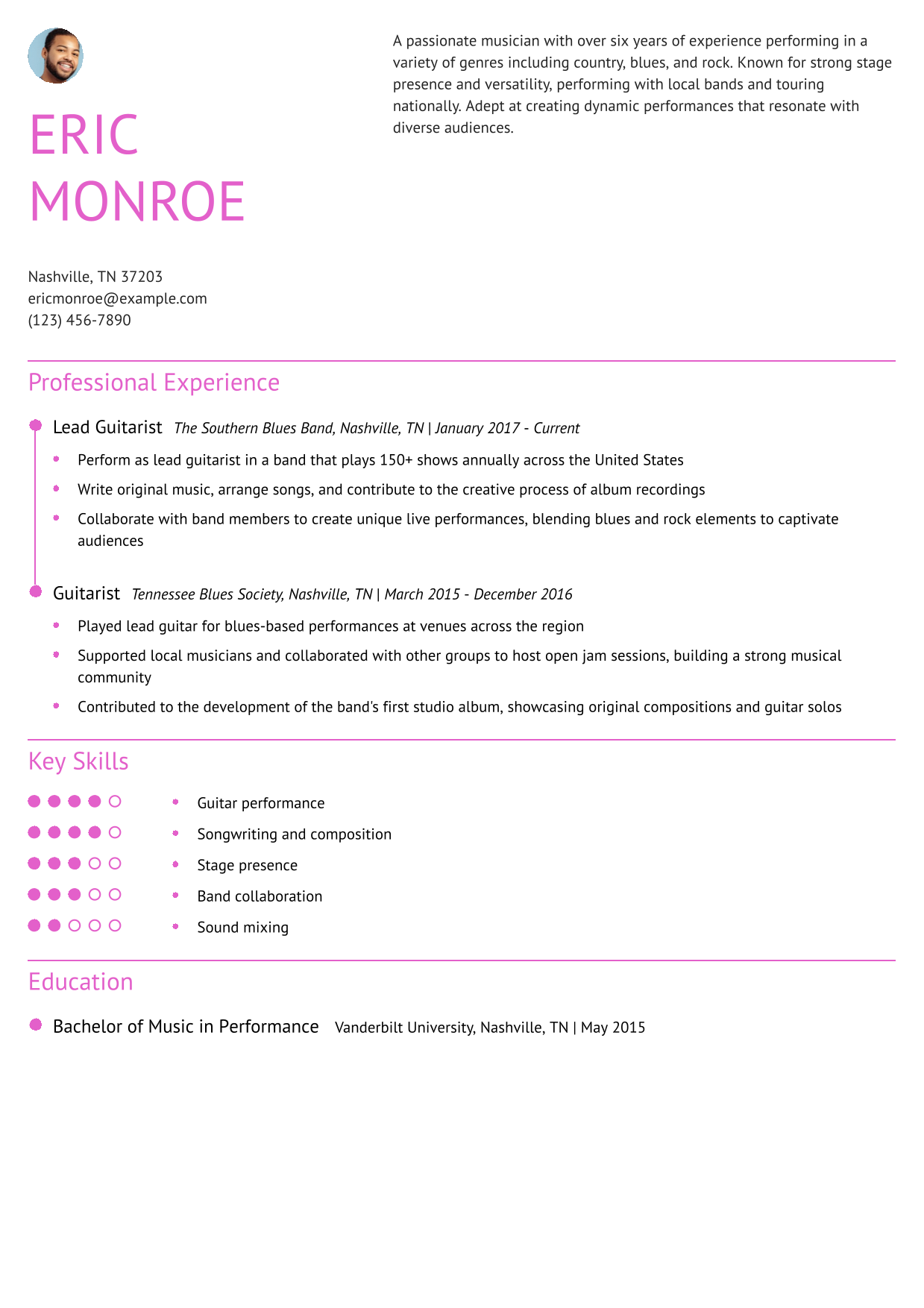
Eric Monroe
(123) 456-7890 | [email protected]
Nashville, TN 37203
Profile
A passionate musician with over six years of experience performing in a variety of genres including country, blues, and rock. Known for strong stage presence and versatility, performing with local bands and touring nationally. Adept at creating dynamic performances that resonate with diverse audiences.
Professional Experience
Lead Guitarist, The Southern Blues Band, Nashville, TN
January 2017 – Present
- Perform as lead guitarist in a band that plays 150+ shows annually across the United States
- Write original music, arrange songs, and contribute to the creative process of album recordings
- Collaborate with band members to create unique live performances, blending blues and rock elements to captivate audiences
Guitarist, Tennessee Blues Society, Nashville, TN
March 2015 – December 2016
- Played lead guitar for blues-based performances at venues across the region
- Supported local musicians and collaborated with other groups to host open jam sessions, building a strong musical community
- Contributed to the development of the band’s first studio album, showcasing original compositions and guitar solos
Education
Bachelor of Music in Performance
Vanderbilt University, Nashville, TN | May 2015
Key Skills
- Guitar performance
- Songwriting and composition
- Stage presence
- Band collaboration
- Sound mixing
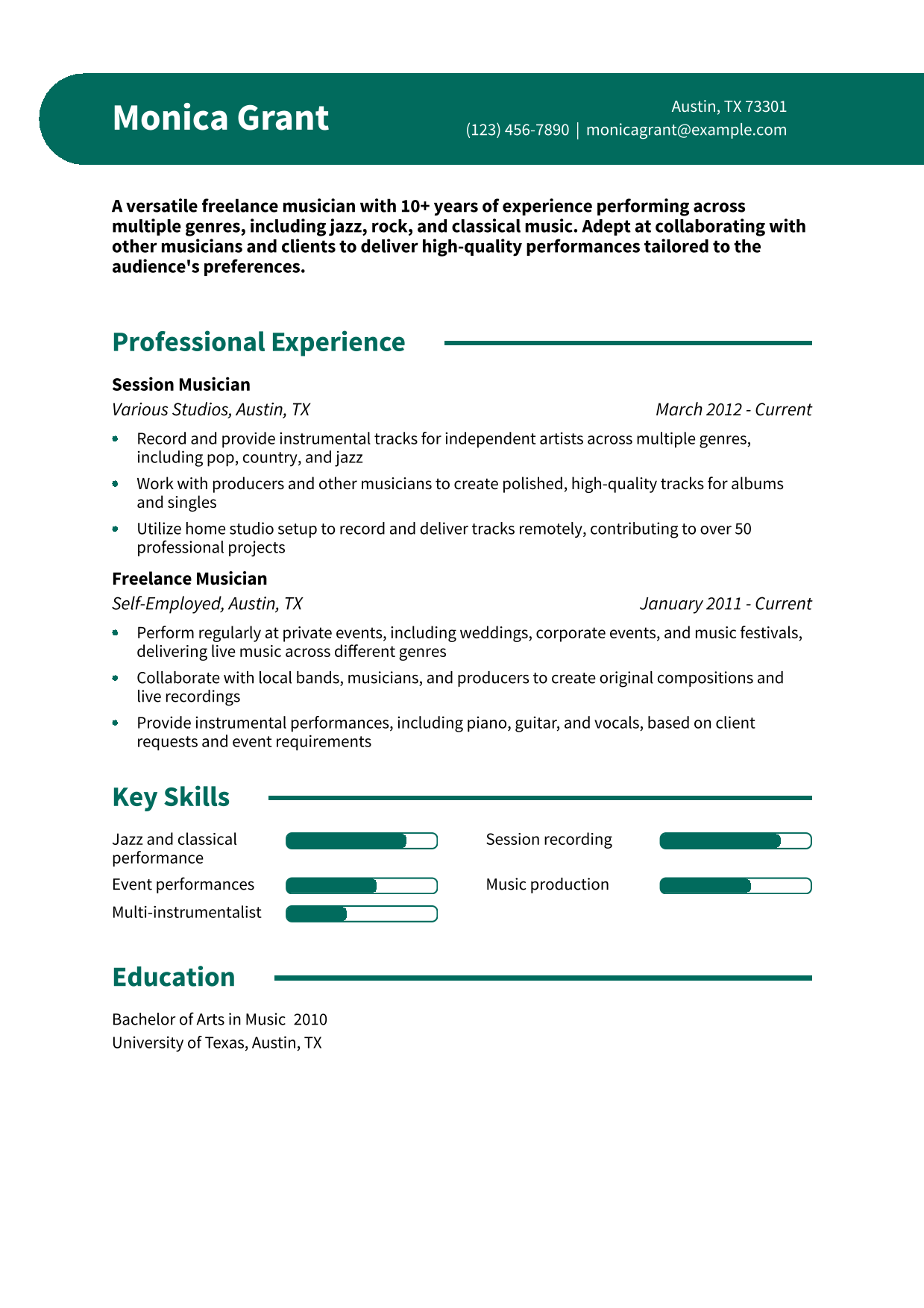
Monica Grant
(123) 456-7890 | [email protected]
Austin, TX 73301
Profile
A versatile freelance musician with 10+ years of experience performing across multiple genres, including jazz, rock, and classical music. Adept at collaborating with other musicians and clients to deliver high-quality performances tailored to the audience’s preferences.
Professional Experience
Freelance Musician, Self-Employed, Austin, TX
January 2011 – Present
- Perform regularly at private events, including weddings, corporate events, and music festivals, delivering live music across different genres
- Collaborate with local bands, musicians, and producers to create original compositions and live recordings
- Provide instrumental performances, including piano, guitar, and vocals, based on client requests and event requirements
Session Musician, Various Studios, Austin, TX
March 2012 – Present
- Record and provide instrumental tracks for independent artists across multiple genres, including pop, country, and jazz
- Work with producers and other musicians to create polished, high-quality tracks for albums and singles
- Utilize home studio setup to record and deliver tracks remotely, contributing to over 50 professional projects
Education
Bachelor of Arts in Music
University of Texas, Austin, TX | 2010
Key Skills
- Jazz and classical performance
- Session recording
- Event performances
- Music production
- Multi-instrumentalist
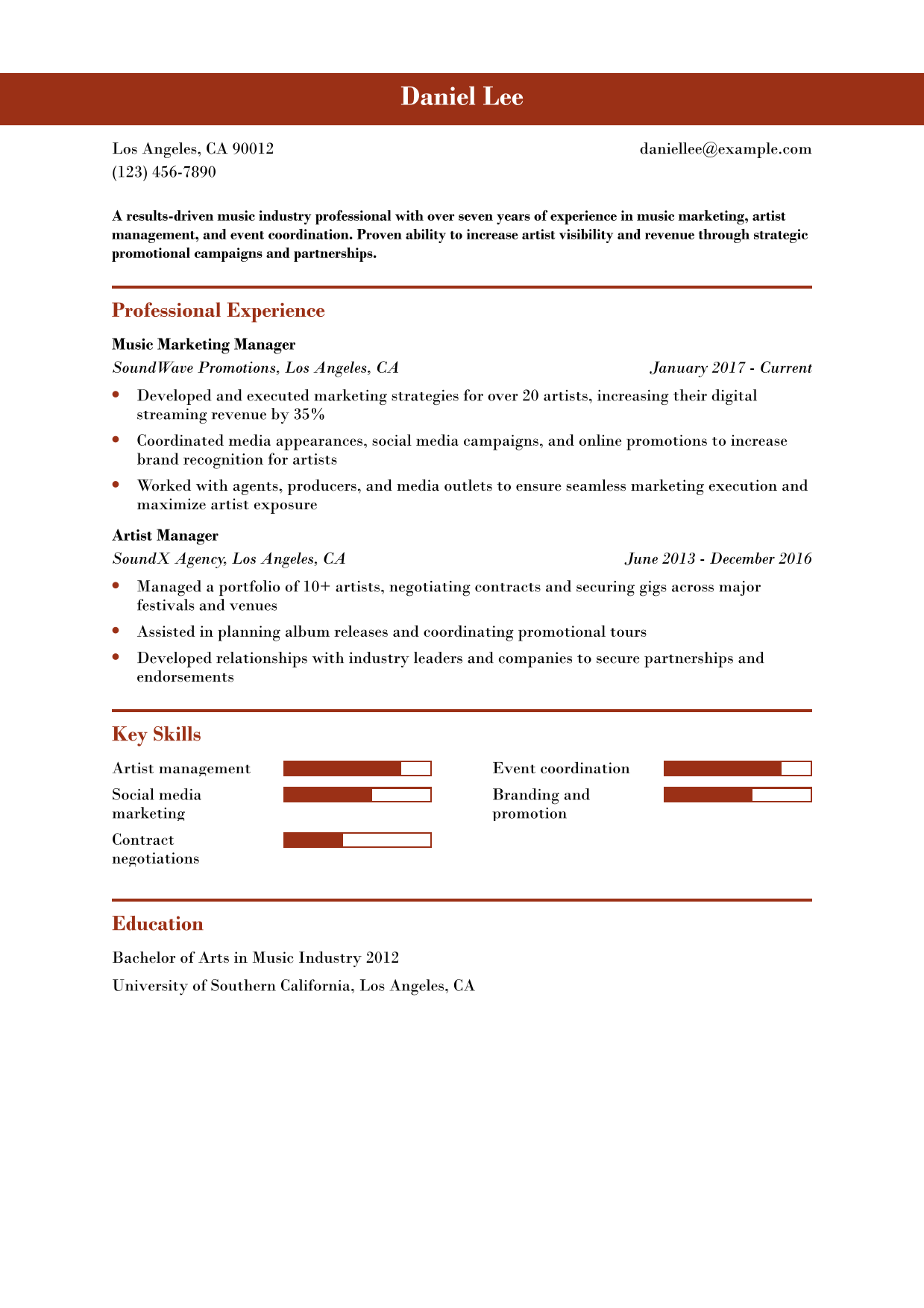
Daniel Lee
(123) 456-7890 | [email protected]
Los Angeles, CA 90012
Profile
A results-driven music industry professional with over seven years of experience in music marketing, artist management, and event coordination. Proven ability to increase artist visibility and revenue through strategic promotional campaigns and partnerships.
Professional Experience
Music Marketing Manager, SoundWave Promotions, Los Angeles, CA
January 2017 – Present
- Developed and executed marketing strategies for over 20 artists, increasing their digital streaming revenue by 35%
- Coordinated media appearances, social media campaigns, and online promotions to increase brand recognition for artists
- Worked with agents, producers, and media outlets to ensure seamless marketing execution and maximize artist exposure
Artist Manager, SoundX Agency, Los Angeles, CA
June 2013 – December 2016
- Managed a portfolio of 10+ artists, negotiating contracts and securing gigs across major festivals and venues
- Assisted in planning album releases and coordinating promotional tours
- Developed relationships with industry leaders and companies to secure partnerships and endorsements
Education
Bachelor of Arts in Music Industry
University of Southern California, Los Angeles, CA | 2012
Key Skills
- Artist management
- Event coordination
- Social media marketing
- Branding and promotion
- Contract negotiations
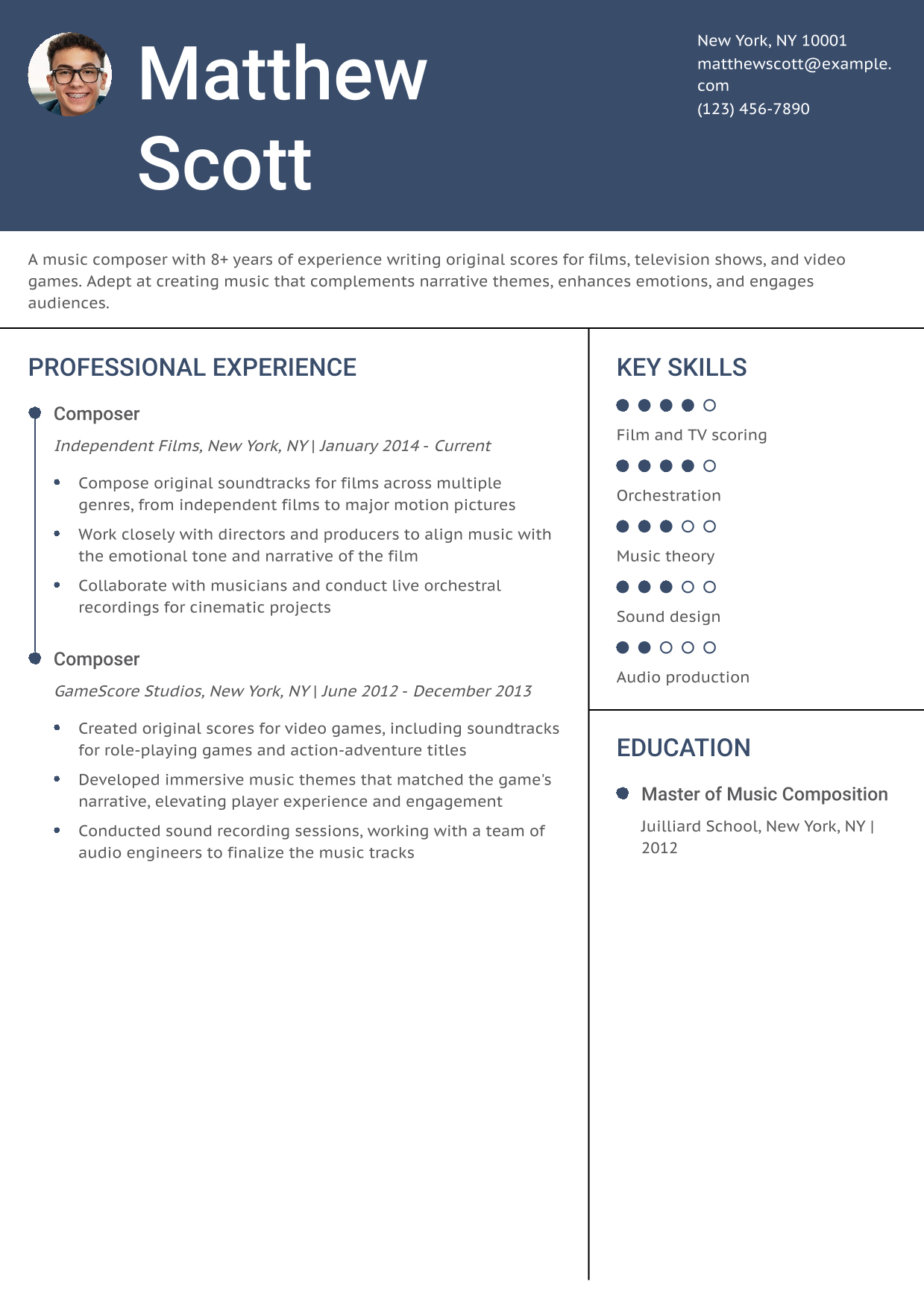
Matthew Scott
(123) 456-7890 | [email protected]
New York, NY 10001
Profile
A music composer with 8+ years of experience writing original scores for films, television shows, and video games. Adept at creating music that complements narrative themes, enhances emotions, and engages audiences.
Professional Experience
Composer, Independent Films, New York, NY
January 2014 – Present
- Compose original soundtracks for films across multiple genres, from independent films to major motion pictures
- Work closely with directors and producers to align music with the emotional tone and narrative of the film
- Collaborate with musicians and conduct live orchestral recordings for cinematic projects
Composer, GameScore Studios, New York, NY
June 2012 – December 2013
- Created original scores for video games, including soundtracks for role-playing games and action-adventure titles
- Developed immersive music themes that matched the game’s narrative, elevating player experience and engagement
- Conducted sound recording sessions, working with a team of audio engineers to finalize the music tracks
Education
Master of Music Composition
Juilliard School, New York, NY | 2012
Key Skills
- Film and TV scoring
- Orchestration
- Music theory
- Sound design
- Audio production
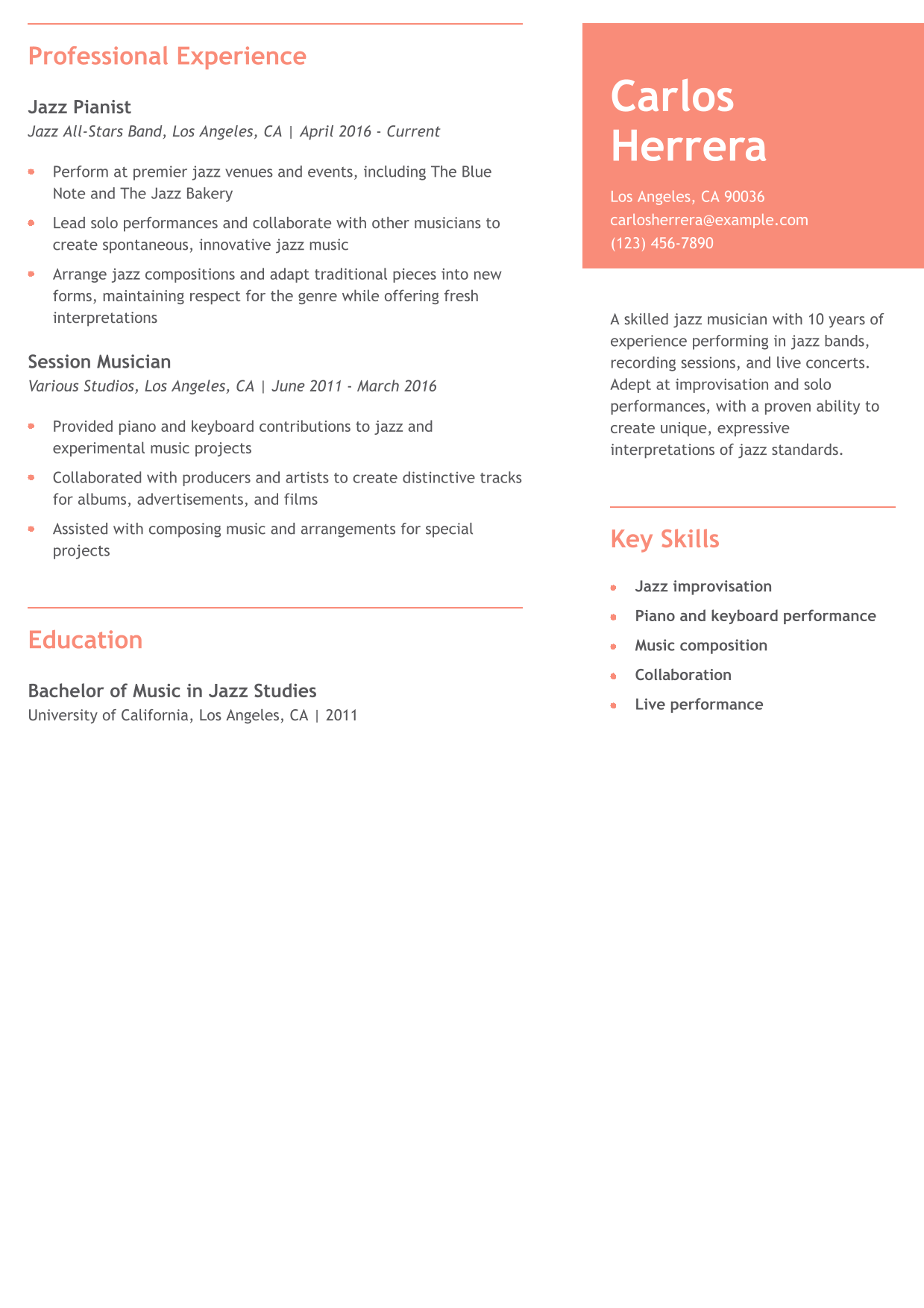
Carlos Herrera
(123) 456-7890 | [email protected]
Los Angeles, CA 90036
Profile
A skilled jazz musician with 10 years of experience performing in jazz bands, recording sessions, and live concerts. Adept at improvisation and solo performances, with a proven ability to create unique, expressive interpretations of jazz standards.
Professional Experience
Jazz Pianist, Jazz All-Stars Band, Los Angeles, CA
April 2016 – Present
- Perform at premier jazz venues and events, including The Blue Note and The Jazz Bakery
- Lead solo performances and collaborate with other musicians to create spontaneous, innovative jazz music
- Arrange jazz compositions and adapt traditional pieces into new forms, maintaining respect for the genre while offering fresh interpretations
Session Musician, Various Studios, Los Angeles, CA
June 2011 – March 2016
- Provided piano and keyboard contributions to jazz and experimental music projects
- Collaborated with producers and artists to create distinctive tracks for albums, advertisements, and films
- Assisted with composing music and arrangements for special projects
Education
Bachelor of Music in Jazz Studies
University of California, Los Angeles, CA | 2011
Key Skills
- Jazz improvisation
- Piano and keyboard performance
- Music composition
- Collaboration with other musicians
- Live performance
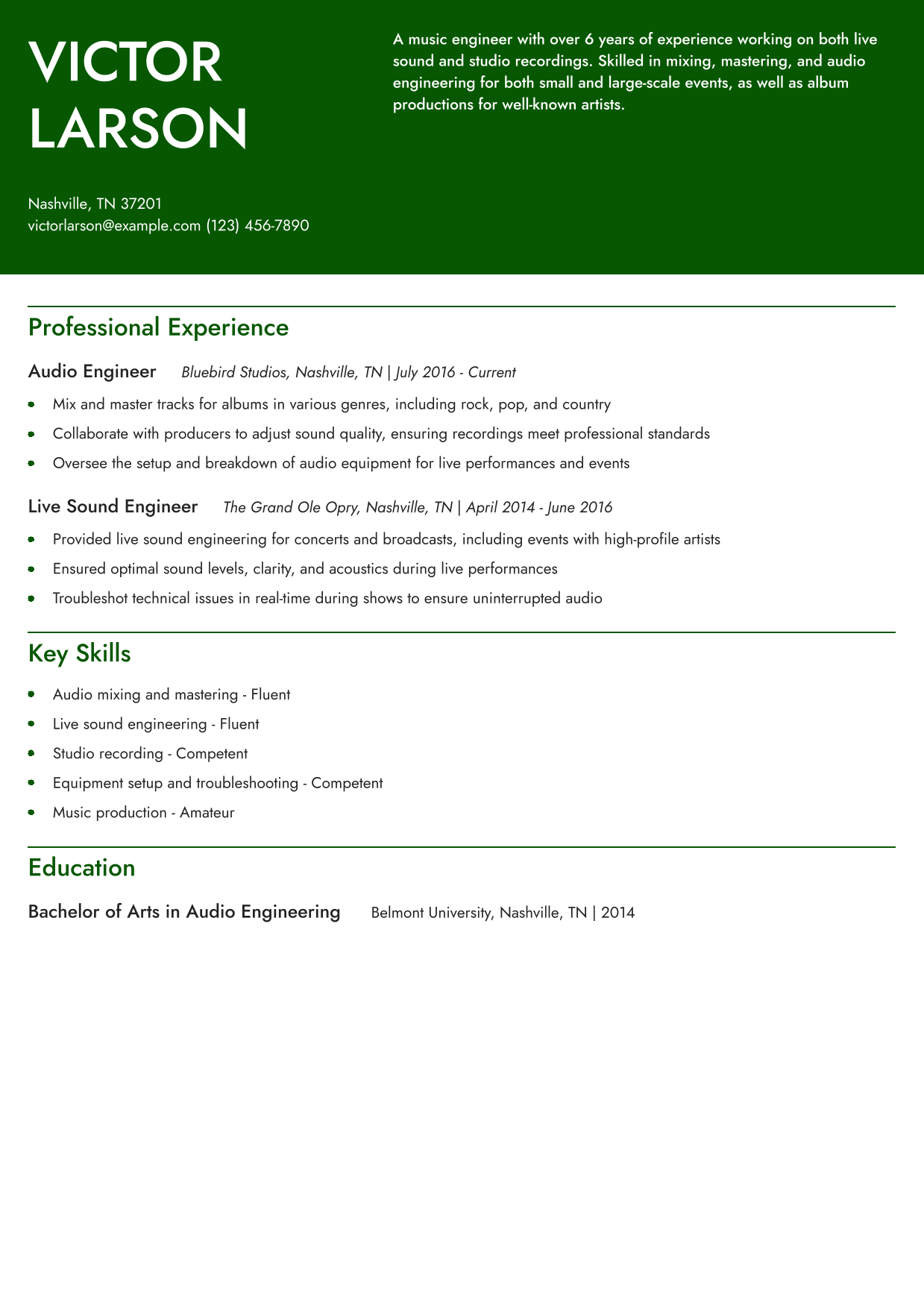
Victor Larson
(123) 456-7890 | [email protected]
Nashville, TN 37201
Profile
A music engineer with over 6 years of experience working on both live sound and studio recordings. Skilled in mixing, mastering, and audio engineering for both small and large-scale events, as well as album productions for well-known artists.
Professional Experience
Audio Engineer, Bluebird Studios, Nashville, TN
July 2016 – Present
- Mix and master tracks for albums in various genres, including rock, pop, and country
- Collaborate with producers to adjust sound quality, ensuring recordings meet professional standards
- Oversee the setup and breakdown of audio equipment for live performances and events
Live Sound Engineer, The Grand Ole Opry, Nashville, TN
April 2014 – June 2016
- Provided live sound engineering for concerts and broadcasts, including events with high-profile artists
- Ensured optimal sound levels, clarity, and acoustics during live performances
- Troubleshot technical issues in real-time during shows to ensure uninterrupted audio
Education
Bachelor of Arts in Audio Engineering
Belmont University, Nashville, TN | 2014
Key Skills
- Audio mixing and mastering
- Live sound engineering
- Studio recording
- Equipment setup and troubleshooting
- Music production
Isabella Lopez
(123) 456-7890 | [email protected]
Los Angeles, CA 90048
Profile
A talented pop musician with five years of experience performing in live shows and recording hit singles. Known for unique vocal range and engaging stage presence, with a strong social media following and international fanbase.
Professional Experience
Pop Singer, Self-Employed, Los Angeles, CA
March 2016 – Present
- Released three chart-topping singles, garnering millions of streams on Spotify and YouTube
- Performed at major music festivals and venues such as Coachella and the Hollywood Palladium
- Collaborated with top music producers and songwriters to create new tracks and promote album releases
Vocalist, The Neon Lights Band, Los Angeles, CA
June 2014 – February 2016
- Performed live vocals for a popular indie pop band with over 200 shows across the United States
- Worked with the band to write and compose music, contributing to album projects and music videos
Education
Bachelor of Music in Vocal Performance
University of Southern California, Los Angeles, CA | 2014
Key Skills
- Pop vocals
- Stage performance
- Songwriting
- Social media promotion
- Collaboration with producers
Lydia Richards
(123) 456-7890 | [email protected]
Austin, TX 78701
Profile
An experienced music performance instructor with over 8 years of teaching vocal and instrumental performance to students of all ages. Specializing in classical, jazz, and contemporary styles, with a passion for nurturing students’ creativity and guiding them through their musical journeys.
Professional Experience
Music Performance Instructor, Austin School of Music, Austin, TX
January 2017 – Present
- Teach vocal and instrumental music classes to students ranging from beginners to advanced levels, specializing in piano and voice
- Provide one-on-one lessons in music theory, sight-reading, and performance technique to individual students preparing for college auditions and music competitions
- Coordinate end-of-semester recitals and concerts to give students the opportunity to perform publicly
- Develop individualized lesson plans to cater to each student’s learning style and goals
Music Teacher, Hilltop Academy of Music, Austin, TX
September 2013 – December 2016
- Delivered music lessons in a group and individual setting, with a focus on piano and vocal performance
- Assisted students in developing proper technique and expanding their knowledge of music history and theory
- Conducted recitals and performances for local audiences, showcasing students’ progress and accomplishments
Education
Bachelor of Arts in Music Education
University of Texas, Austin, TX | 2013
Key Skills
- Music performance instruction
- Piano and voice teaching
- Recital coordination
- Music theory
- Student performance evaluation
David Turner
(123) 456-7890 | [email protected]
Nashville, TN 37203
Profile
A professional studio musician with over 10 years of experience providing instrumental and vocal tracks for major recording projects in country, pop, and rock genres. Adept at adapting to various styles, and known for delivering high-quality recordings under tight deadlines.
Professional Experience
Session Musician, Freelance, Nashville, TN
January 2012 – Present
- Provided guitar, bass, and keyboard tracks for artists in multiple genres, contributing to several Billboard-charting albums
- Worked in collaboration with producers and engineers to arrange and record custom parts for various studio projects
- Assisted in creating demo tracks for up-and-coming artists, helping to refine their sound and style
Lead Guitarist, The Midnight Ramblers, Nashville, TN
July 2010 – December 2011
- Played lead guitar on a national tour for an indie rock band, performing at over 100 venues across the U.S.
- Contributed to the band’s first album, including writing several original tracks and arrangements
- Coordinated with producers to ensure the final product aligned with the band’s creative direction
Education
Bachelor of Music in Guitar Performance
Belmont University, Nashville, TN | 2010
Key Skills
- Session music recording
- Multi-instrumentalist
- Music arrangement
- Collaboration with producers and engineers
- Tour performance
Olivia Jackson
(123) 456-7890 | [email protected]
Los Angeles, CA 90025
Profile
A highly skilled music composer for film with over 7 years of experience composing original scores for independent films, commercials, and video games. Known for creating immersive and emotionally impactful music that complements visual storytelling.
Professional Experience
Film Composer, Freelance, Los Angeles, CA
January 2016 – Present
- Composed original scores for 15+ independent films, contributing to films that have been featured in over 30 film festivals worldwide
- Worked closely with directors to develop music that enhances the emotional tone and atmosphere of the films
- Collaborated with orchestras and musicians to record full compositions, including live instrumentation
Composer, Tidal Wave Studios, Los Angeles, CA
August 2012 – December 2015
- Composed music for commercials, web series, and short films, ensuring the music aligned with brand messaging and creative direction
- Produced and arranged soundtracks for clients in various industries, including automotive, tech, and lifestyle brands
- Assisted in live sessions, recording music with various ensembles to create high-quality scores for projects
Education
Master of Music in Film Scoring
University of Southern California, Los Angeles, CA | 2012
Key Skills
- Film score composition
- Orchestration
- Music production
- Collaboration with directors
- Music software (Logic Pro, Pro Tools)
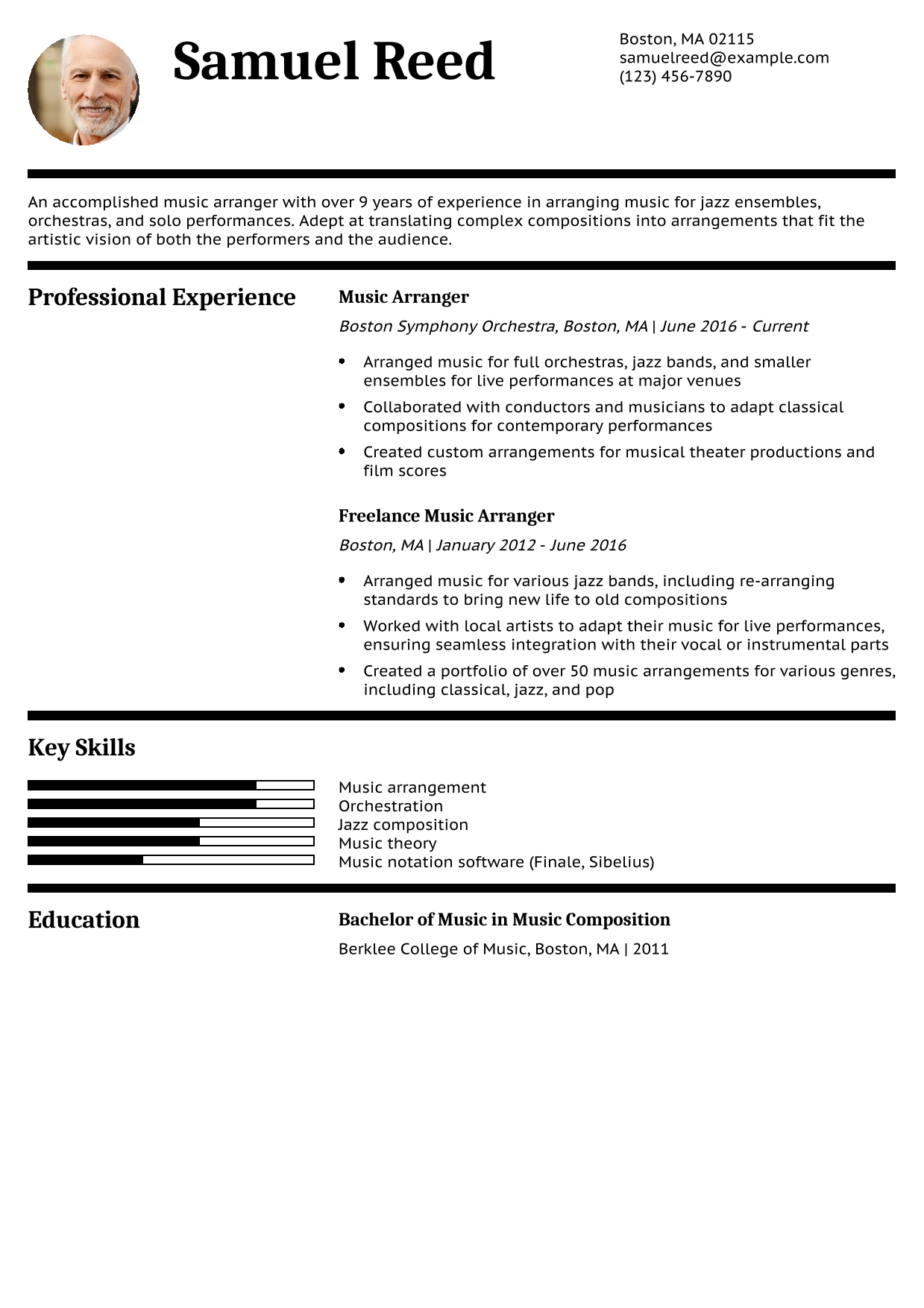
Samuel Reed
(123) 456-7890 | [email protected]
Boston, MA 02115
Profile
An accomplished music arranger with over 9 years of experience in arranging music for jazz ensembles, orchestras, and solo performances. Adept at translating complex compositions into arrangements that fit the artistic vision of both the performers and the audience.
Professional Experience
Music Arranger, Boston Symphony Orchestra, Boston, MA
June 2016 – Present
- Arranged music for full orchestras, jazz bands, and smaller ensembles for live performances at major venues
- Collaborated with conductors and musicians to adapt classical compositions for contemporary performances
- Created custom arrangements for musical theater productions and film scores
Freelance Music Arranger, Boston, MA
January 2012 – June 2016
- Arranged music for various jazz bands, including re-arranging standards to bring new life to old compositions
- Worked with local artists to adapt their music for live performances, ensuring seamless integration with their vocal or instrumental parts
- Created a portfolio of over 50 music arrangements for various genres, including classical, jazz, and pop
Education
Bachelor of Music in Music Composition
Berklee College of Music, Boston, MA | 2011
Key Skills
- Music arrangement
- Orchestration
- Jazz composition
- Music theory
- Music notation software (Finale, Sibelius)
George Wallace
(123) 456-7890 | [email protected]
Nashville, TN 37204
Profile
A seasoned band leader with over 15 years of experience directing musical ensembles in a variety of genres, including rock, jazz, and blues. Known for inspiring musicians to deliver their best performances while maintaining a collaborative and inclusive environment.
Professional Experience
Band Leader, The George Wallace Band, Nashville, TN
March 2010 – Present
- Lead a successful rock band, performing at venues across the U.S. and Europe
- Coordinate rehearsals, arrange music, and provide guidance to band members on both individual performance and group collaboration
- Organize tours, manage schedules, and ensure that the band meets all performance and recording deadlines
Band Leader, The Sound Collective, Nashville, TN
January 2005 – March 2010
- Directed a 12-piece jazz ensemble for local and national performances, including festivals and private events
- Worked with arrangers and musicians to develop new material, fostering an atmosphere of creativity and collaboration
- Managed the business side of the band, including negotiations, contracts, and financial planning
Education
Bachelor of Music in Jazz Studies
University of Nashville, Nashville, TN | 2004
Key Skills
- Band leadership
- Music arrangement
- Tour coordination
- Performance management
- Artist development
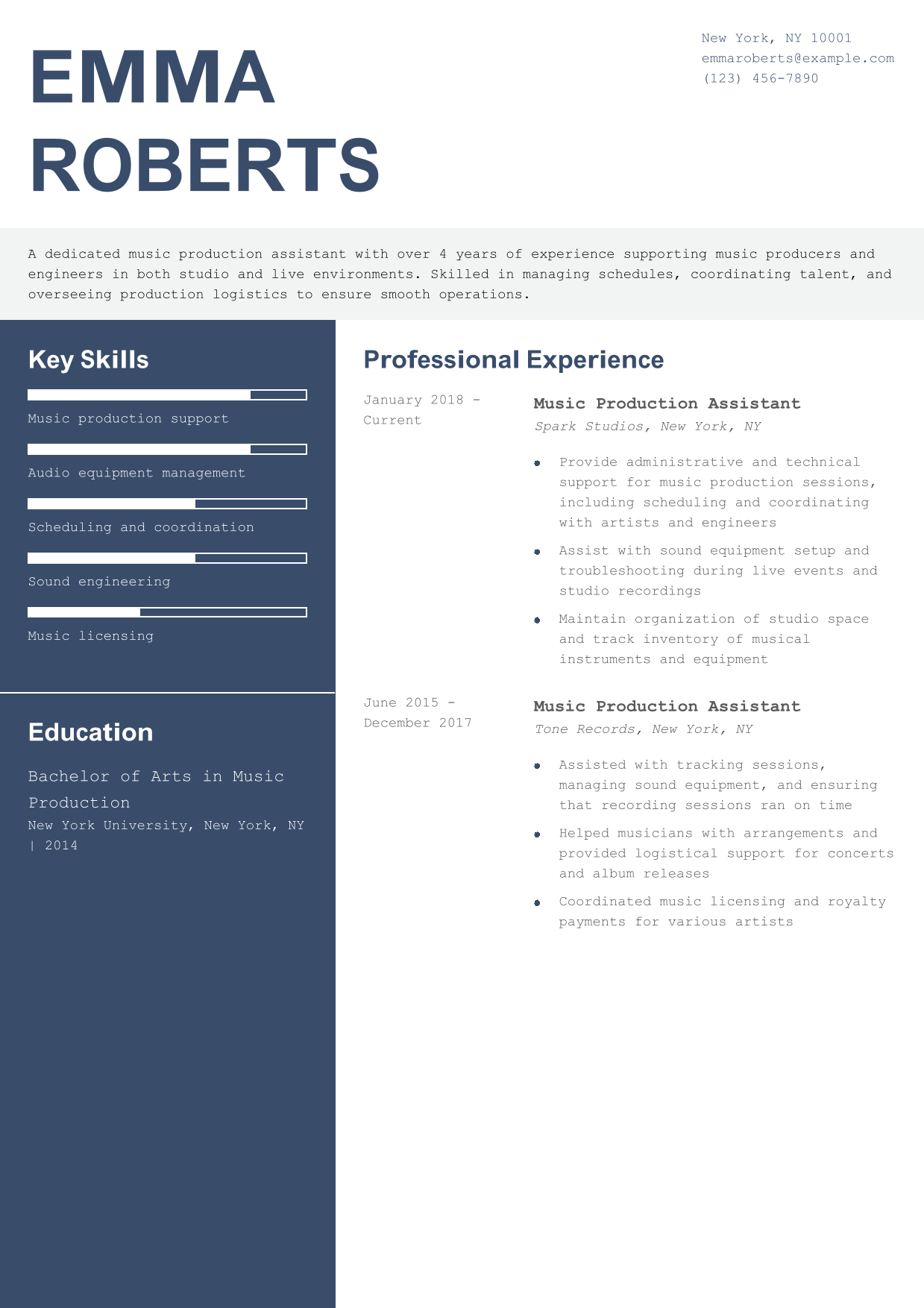
Emma Roberts
(123) 456-7890 | [email protected]
New York, NY 10001
Profile
A dedicated music production assistant with over 4 years of experience supporting music producers and engineers in both studio and live environments. Skilled in managing schedules, coordinating talent, and overseeing production logistics to ensure smooth operations.
Professional Experience
Music Production Assistant, Spark Studios, New York, NY
January 2018 – Present
- Provide administrative and technical support for music production sessions, including scheduling and coordinating with artists and engineers
- Assist with sound equipment setup and troubleshooting during live events and studio recordings
- Maintain organization of studio space and track inventory of musical instruments and equipment
Music Production Assistant, Tone Records, New York, NY
June 2015 – December 2017
- Assisted with tracking sessions, managing sound equipment, and ensuring that recording sessions ran on time
- Helped musicians with arrangements and provided logistical support for concerts and album releases
- Coordinated music licensing and royalty payments for various artists
Education
Bachelor of Arts in Music Production
New York University, New York, NY | 2014
Key Skills
- Music production support
- Audio equipment management
- Scheduling and coordination
- Sound engineering
- Music licensing
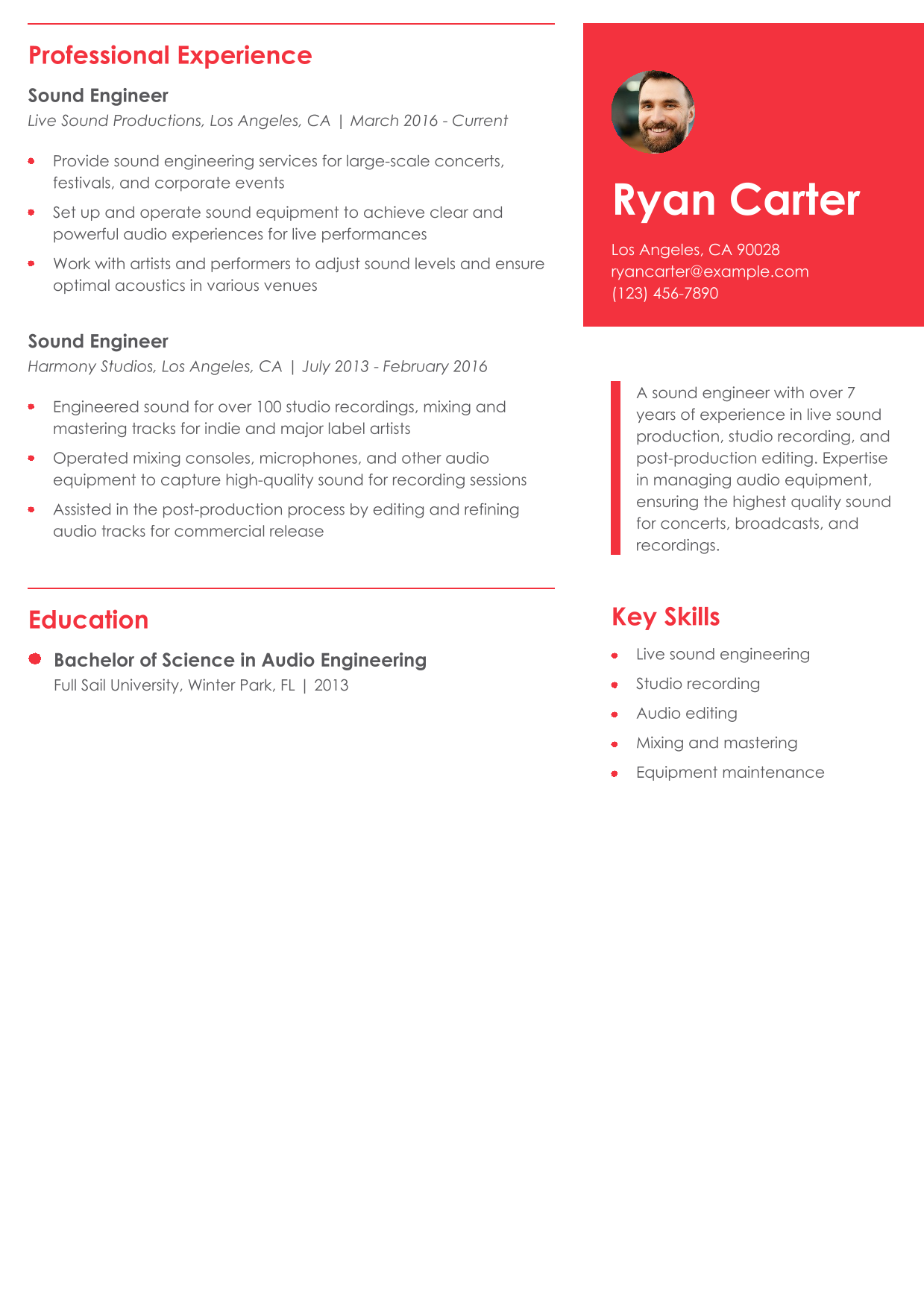
Ryan Carter
(123) 456-7890 | [email protected]
Los Angeles, CA 90028
Profile
A sound engineer with over 7 years of experience in live sound production, studio recording, and post-production editing. Expertise in managing audio equipment, ensuring the highest quality sound for concerts, broadcasts, and recordings.
Professional Experience
Sound Engineer, Live Sound Productions, Los Angeles, CA
March 2016 – Present
- Provide sound engineering services for large-scale concerts, festivals, and corporate events
- Set up and operate sound equipment to achieve clear and powerful audio experiences for live performances
- Work with artists and performers to adjust sound levels and ensure optimal acoustics in various venues
Sound Engineer, Harmony Studios, Los Angeles, CA
July 2013 – February 2016
- Engineered sound for over 100 studio recordings, mixing and mastering tracks for indie and major label artists
- Operated mixing consoles, microphones, and other audio equipment to capture high-quality sound for recording sessions
- Assisted in the post-production process by editing and refining audio tracks for commercial release
Education
Bachelor of Science in Audio Engineering
Full Sail University, Winter Park, FL | 2013
Key Skills
- Live sound engineering
- Studio recording
- Audio editing
- Mixing and mastering
- Equipment maintenance
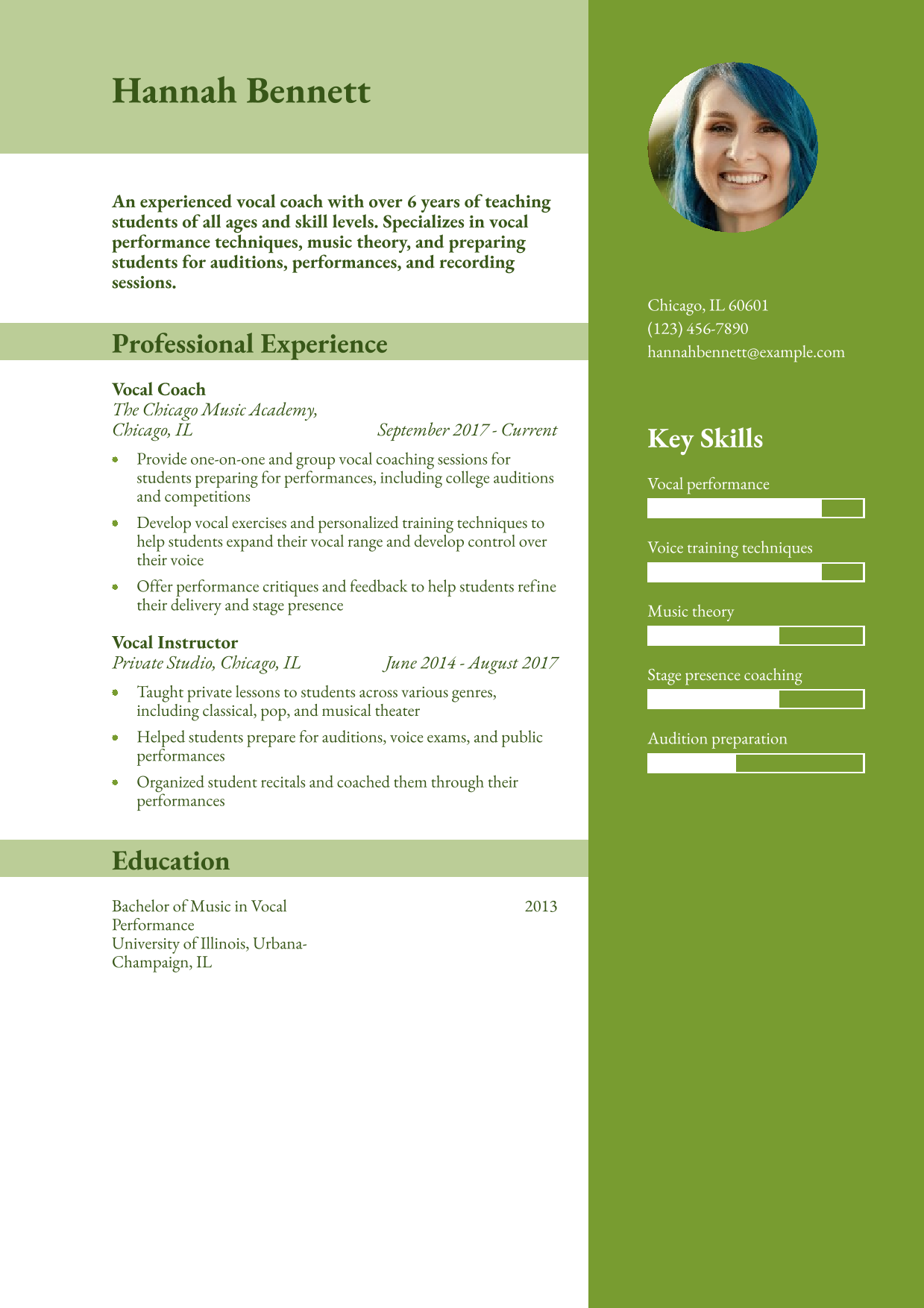
Hannah Bennett
(123) 456-7890 | [email protected]
Chicago, IL 60601
Profile
An experienced vocal coach with over 6 years of teaching students of all ages and skill levels. Specializes in vocal performance techniques, music theory, and preparing students for auditions, performances, and recording sessions.
Professional Experience
Vocal Coach, The Chicago Music Academy, Chicago, IL
September 2017 – Present
- Provide one-on-one and group vocal coaching sessions for students preparing for performances, including college auditions and competitions
- Develop vocal exercises and personalized training techniques to help students expand their vocal range and develop control over their voice
- Offer performance critiques and feedback to help students refine their delivery and stage presence
Vocal Instructor, Private Studio, Chicago, IL
June 2014 – August 2017
- Taught private lessons to students across various genres, including classical, pop, and musical theater
- Helped students prepare for auditions, voice exams, and public performances
- Organized student recitals and coached them through their performances
Education
Bachelor of Music in Vocal Performance
University of Illinois, Urbana-Champaign, IL | 2013
Key Skills
- Vocal performance
- Voice training techniques
- Music theory
- Stage presence coaching
- Audition preparation
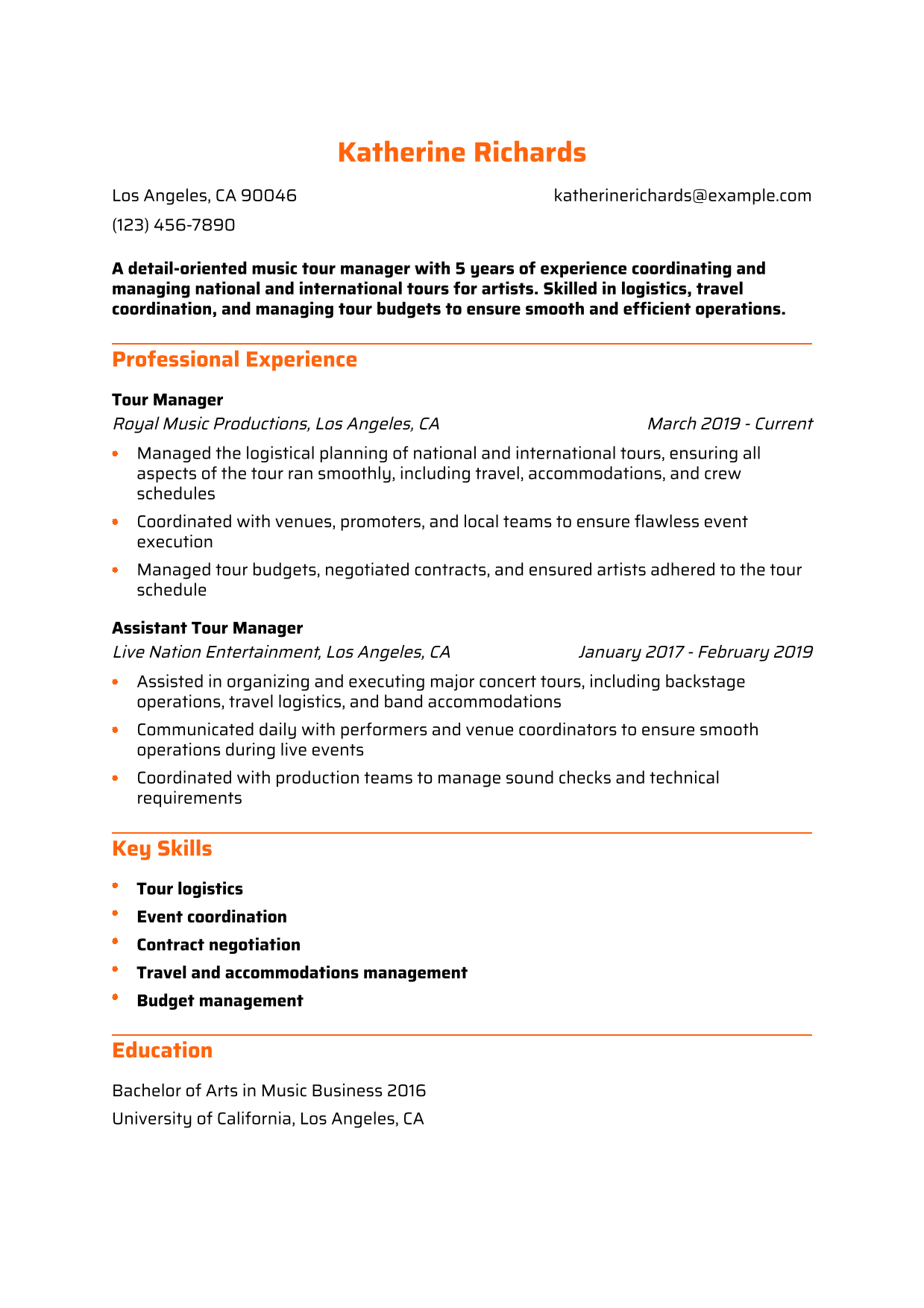
Katherine Richards
(123) 456-7890 | [email protected]
Los Angeles, CA 90046
Profile
A detail-oriented music tour manager with 5 years of experience coordinating and managing national and international tours for artists. Skilled in logistics, travel coordination, and managing tour budgets to ensure smooth and efficient operations.
Professional Experience
Tour Manager, Royal Music Productions, Los Angeles, CA
March 2019 – Present
- Managed the logistical planning of national and international tours, ensuring all aspects of the tour ran smoothly, including travel, accommodations, and crew schedules
- Coordinated with venues, promoters, and local teams to ensure flawless event execution
- Managed tour budgets, negotiated contracts, and ensured artists adhered to the tour schedule
Assistant Tour Manager, Live Nation Entertainment, Los Angeles, CA
January 2017 – February 2019
- Assisted in organizing and executing major concert tours, including backstage operations, travel logistics, and band accommodations
- Communicated daily with performers and venue coordinators to ensure smooth operations during live events
- Coordinated with production teams to manage sound checks and technical requirements
Education
Bachelor of Arts in Music Business
University of California, Los Angeles, CA | 2016
Key Skills
- Tour logistics
- Event coordination
- Contract negotiation
- Travel and accommodations management
- Budget management
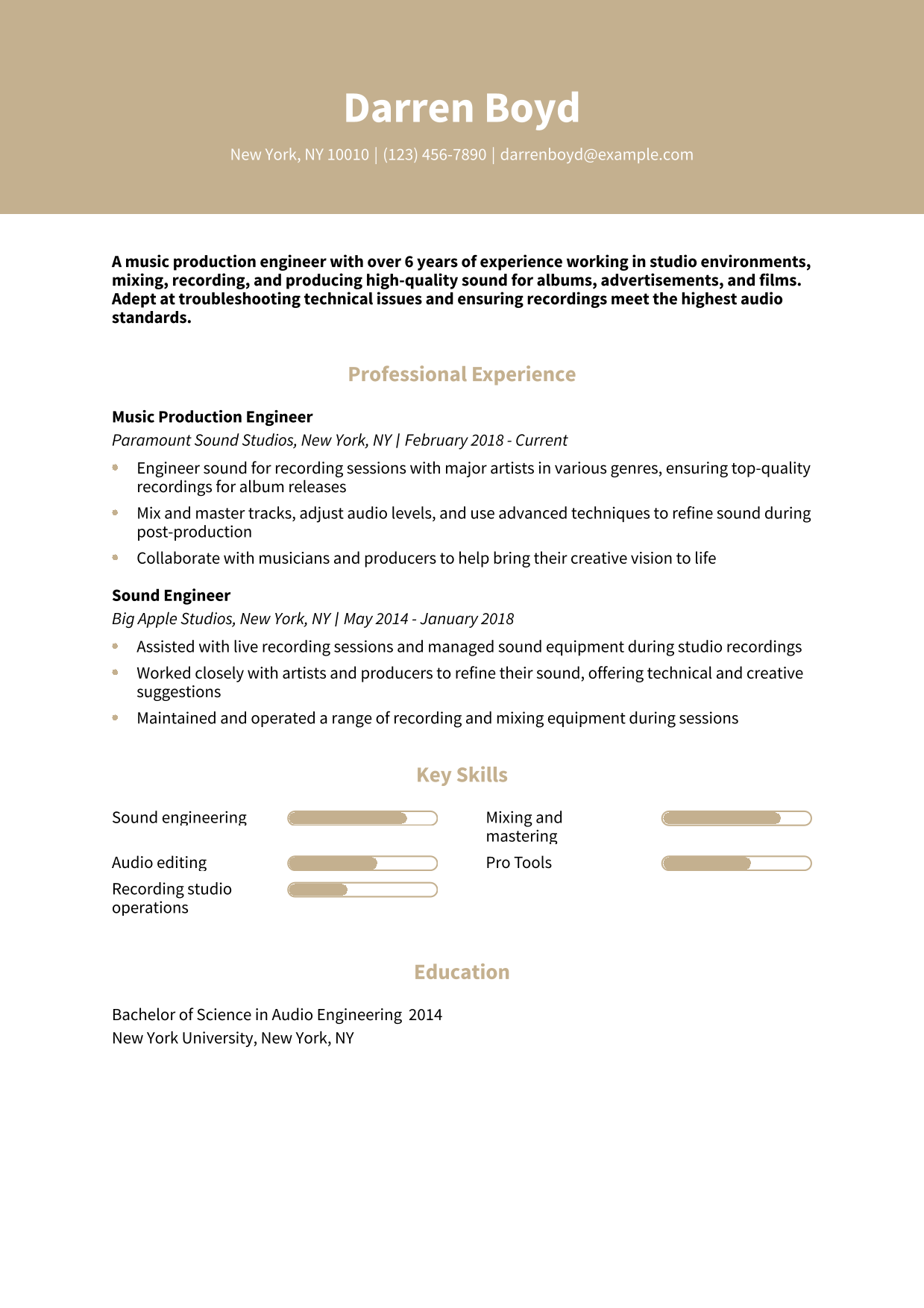
Darren Boyd
(123) 456-7890 | [email protected]
New York, NY 10010
Profile
A music production engineer with over 6 years of experience working in studio environments, mixing, recording, and producing high-quality sound for albums, advertisements, and films. Adept at troubleshooting technical issues and ensuring recordings meet the highest audio standards.
Professional Experience
Music Production Engineer, Paramount Sound Studios, New York, NY
February 2018 – Present
- Engineer sound for recording sessions with major artists in various genres, ensuring top-quality recordings for album releases
- Mix and master tracks, adjust audio levels, and use advanced techniques to refine sound during post-production
- Collaborate with musicians and producers to help bring their creative vision to life
Sound Engineer, Big Apple Studios, New York, NY
May 2014 – January 2018
- Assisted with live recording sessions and managed sound equipment during studio recordings
- Worked closely with artists and producers to refine their sound, offering technical and creative suggestions
- Maintained and operated a range of recording and mixing equipment during sessions
Education
Bachelor of Science in Audio Engineering
New York University, New York, NY | 2014
Key Skills
- Sound engineering
- Mixing and mastering
- Audio editing
- Pro Tools
- Recording studio operations