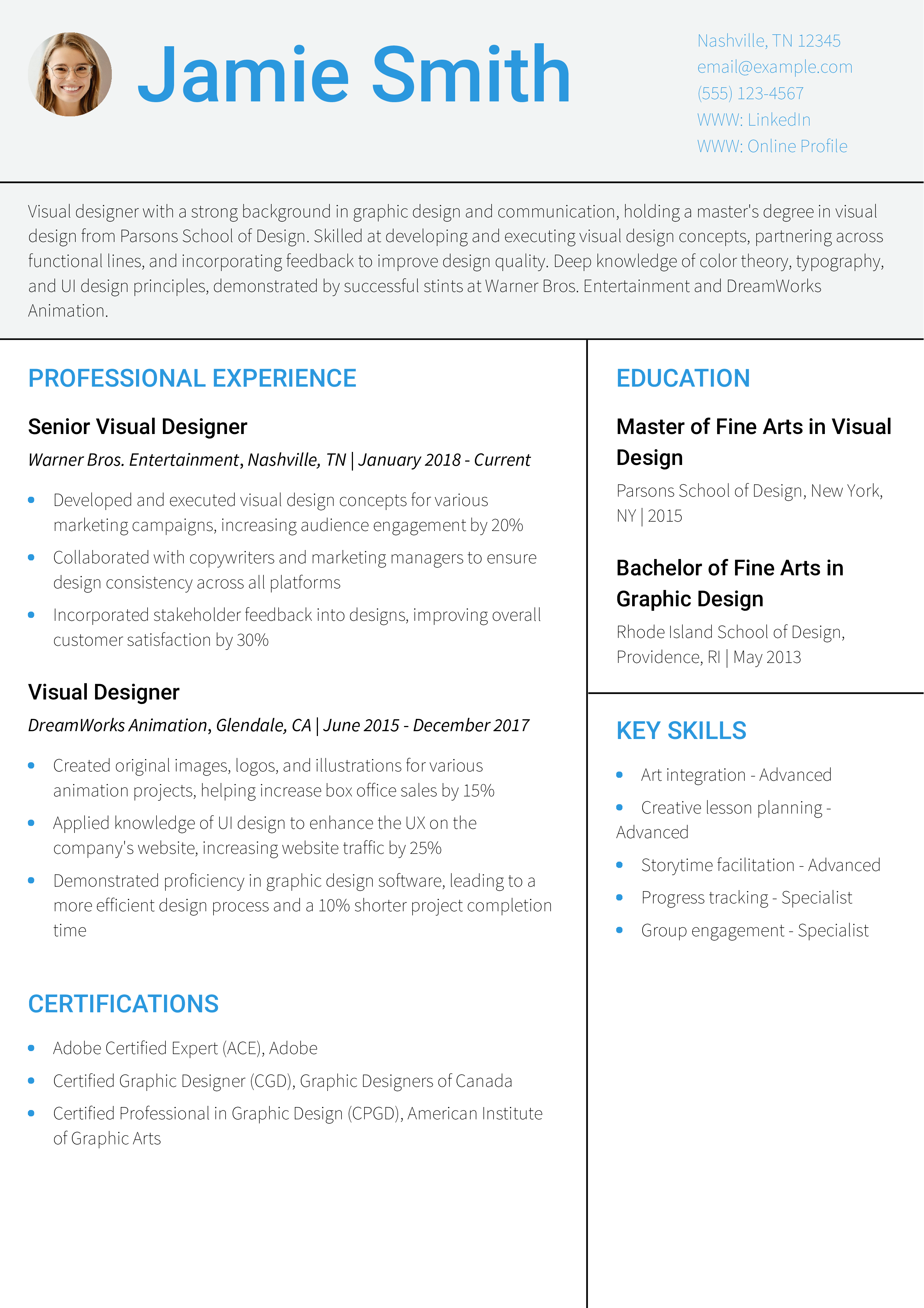
Jamie Smith
(123) 456-7890
[email protected]
LinkedIn | Portfolio
Nashville, TN 12345
Profile
Visual designer with a strong background in graphic design and communication, holding a master’s degree in visual design from Parsons School of Design. Skilled at developing and executing visual design concepts, partnering across functional lines, and incorporating feedback to improve design quality. Deep knowledge of color theory, typography, and UI design principles, demonstrated by successful stints at Warner Bros. Entertainment and DreamWorks Animation.
Key Skills
- Color theory
- Concept development
- Cross-functional collaboration
- Graphic design
- Typography
- UI design
Professional Experience
Senior Visual Designer, Warner Bros. Entertainment, Nashville, TN
January 2018 to present
- Developed and executed visual design concepts for various marketing campaigns, increasing audience engagement by 20%
- Collaborated with copywriters and marketing managers to ensure design consistency across all platforms
- Incorporated stakeholder feedback into designs, improving overall customer satisfaction by 30%
Visual Designer, DreamWorks Animation, Glendale, CA
June 2015 to December 2017
- Created original images, logos, and illustrations for various animation projects, helping increase box office sales by 15%
- Applied knowledge of UI design to enhance the UX on the company’s website, increasing website traffic by 25%
- Demonstrated proficiency in graphic design software, leading to a more efficient design process and a 10% shorter project completion time
Education
- Master of Fine Arts in Visual Design, Parsons School of Design, New York, NY | 2015
- Bachelor of Fine Arts in Graphic Design, Rhode Island School of Design, Providence, RI | 2013
Professional Development
- Adobe Certified Expert (ACE), Adobe
- Certified Graphic Designer (CGD), Graphic Designers of Canada
- Certified Professional in Graphic Design (CPGD), American Institute of Graphic Arts
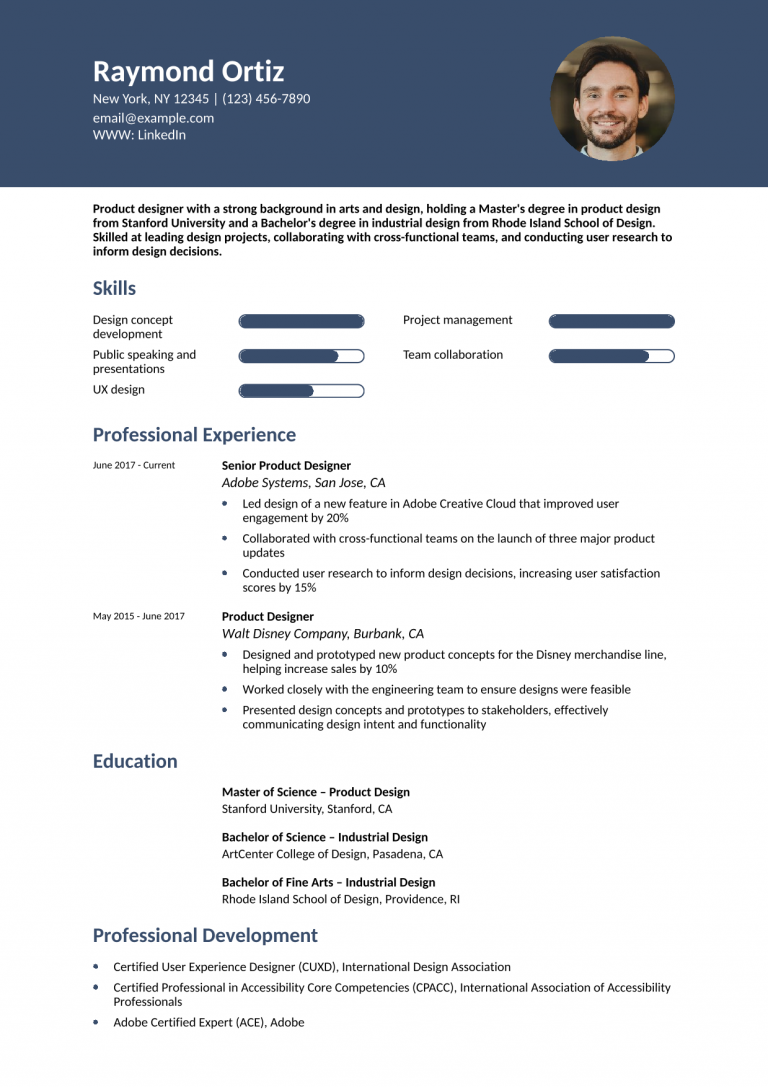
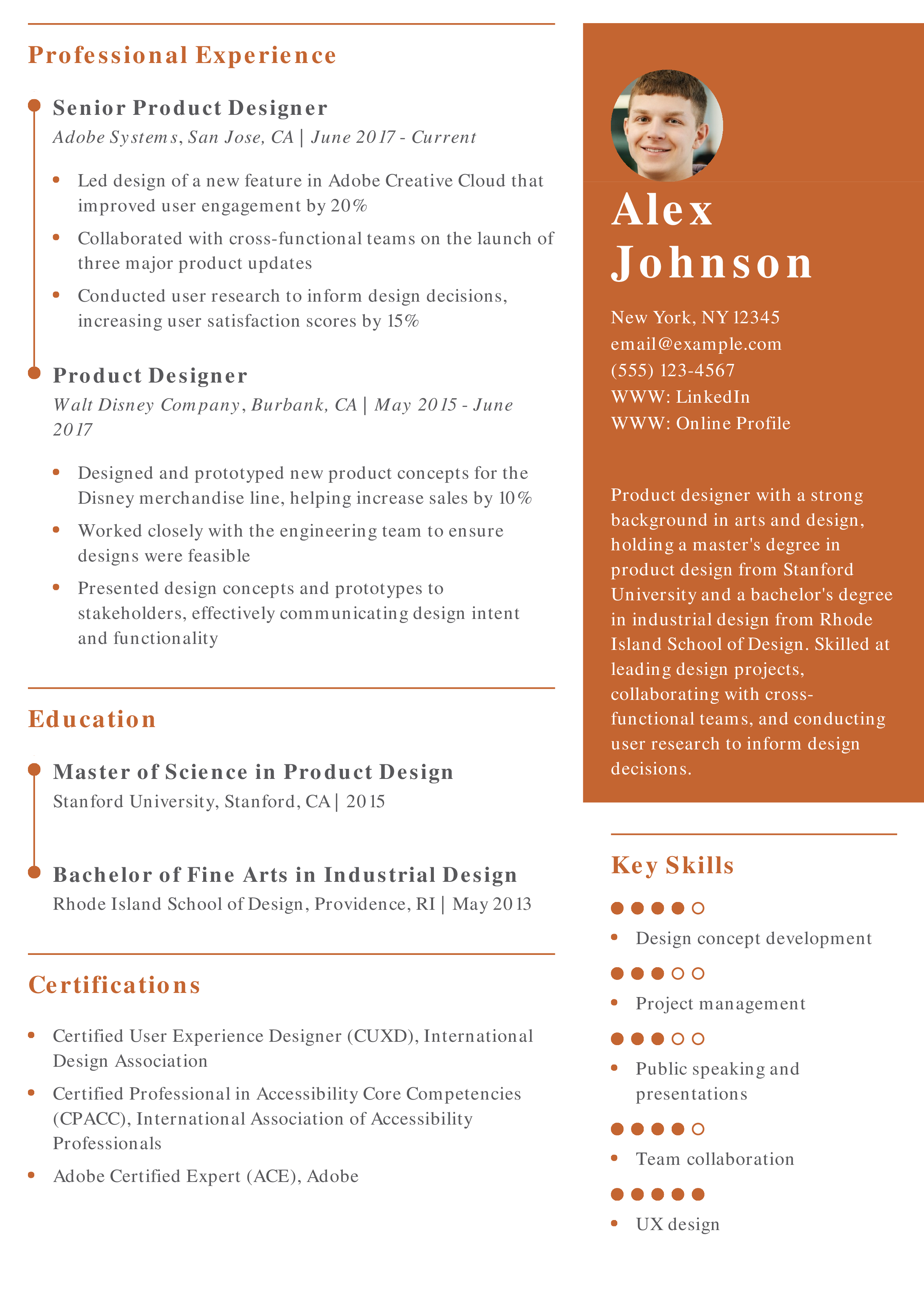
Alex Johnson
(123) 456-7890
[email protected]
LinkedIn | Portfolio
New York, NY 12345
Profile
Product designer with a strong background in arts and design, holding a master’s degree in product design from Stanford University and a bachelor’s degree in industrial design from Rhode Island School of Design. Skilled at leading design projects, collaborating with cross-functional teams, and conducting user research to inform design decisions.
Key Skills
- Design concept development
- Project management
- Public speaking and presentations
- Team collaboration
- UX design
Professional Experience
Senior Product Designer, Adobe Systems, San Jose, CA
June 2017 to present
- Led design of a new feature in Adobe Creative Cloud that improved user engagement by 20%
- Collaborated with cross-functional teams on the launch of three major product
- Conducted user research to inform design decisions, increasing user satisfaction scores by 15%
Product Designer, Walt Disney Company, Burbank, CA
May 2015 to June 2017
- Designed and prototyped new product concepts for the Disney merchandise line, helping increase sales by 10%
- Worked closely with the engineering team to ensure designs were feasible
- Presented design concepts and prototypes to stakeholders, effectively communicating design intent and functionality
Education
- Master of Science in Product Design, Stanford University, Stanford, CA | 2015
- Bachelor of Fine Arts in Industrial Design, Rhode Island School of Design, Providence, RI | 2013
Certifications
- Certified User Experience Designer (CUXD), International Design Association
- Certified Professional in Accessibility Core Competencies (CPACC), International Association of Accessibility Professionals
- Adobe Certified Expert (ACE), Adobe
Taylor Lee
(123) 456-7890
[email protected]
LinkedIn | Portfolio
Philadelphia, PA 12345
Profile
Game designer with a strong record of creating engaging game narratives and setting game monetization strategies, demonstrated by significant increases in player retention and satisfaction at Warner Bros. Entertainment and DreamWorks Animation. Hold a master’s degree in interactive media and game development and multiple industry certifications, including Certified Video Game Designer and Unity Certified Developer.
Key Skills
- Game mechanics development
- Level design
- Player testing and feedback
Professional Experience
Senior Game Designer, Warner Bros. Entertainment, Philadelphia, PA
January 2019 to present
- Led a team of junior designers to create engaging levels for a AAA title, increasing player retention by 20%
- Developed and refined game mechanics for the company’s flagship game, helping raise overall player satisfaction by 15%
- Oversaw player testing sessions and made changes based on feedback, decreasing reported gameplay issues by 25%
Game Designer, DreamWorks Animation, Glendale, CA
June 2018 to December 2018
- Designed and implemented game levels for a popular animated franchise, helping increase game downloads by 10%
- Co-developed game mechanics that resulted in more engaging gameplay and a 15% increase in average playtime
- Participated in player testing sessions and used feedback to improve game design, leading to 10% higher user ratings
Education
- Master of Science in Interactive Media and Game Development, Worcester Polytechnic Institute, Worcester, MA | 2018
- Bachelor of Science in Game Design and Development, Rochester Institute of Technology, Rochester, NY | 2016
Certifications
- Certified Video Game Designer (CVGD), International Association of Designers
- Unity Certified Developer (UCD), Unity Technologies
- Certified Game Developer (CGD), National Association of Software and Service Companies
Jordan Brown
(123) 456-7890
[email protected]
LinkedIn | Portfolio
New York, NY 10001
Profile
Branding designer with six years of experience developing compelling brand identities and visual communication strategies across digital and print media. Strong ability to align visual design with strategic brand messaging. Proven success in increasing brand awareness and customer loyalty through cohesive brand systems.
Key Skills
- Brand development
- Client presentations
- Logo design
- Market research
- Typography
- Visual storytelling
Professional Experience
Senior Branding Designer, Lumina Creative, New York, NY
April 2020 to present
- Develop brand systems and guidelines for 30+ clients across fashion, wellness, and tech sectors, increasing client brand engagement by 45%
- Collaborate with marketing and product teams to ensure consistent visual representation across websites, packaging, and social platforms
- Lead discovery workshops to identify client values and translate them into visual identity concepts
Brand Designer, Inspire Co., Brooklyn, NY
August 2017 to March 2020
- Redesigned logos and packaging for 10 retail brands, contributing to a 20% average increase in customer retention
- Built full brand kits for startups, including color palettes, typography, logo variations, and brand books
Education
Bachelor of Fine Arts in Communication Design, Pratt Institute, Brooklyn, NY | 2017
Certifications
- Adobe Certified Expert (ACE), Adobe
- Brand Identity Design Certificate, The Futur Academy
Morgan Davis
(123) 456-7890
[email protected]
LinkedIn | Portfolio
Chicago, IL 60601
Profile
Creative graphic designer with nine years of experience crafting compelling digital and print materials. Specialize in branding, promotional design, and illustration. Adept at working independently or with teams to meet tight deadlines and create innovative designs that reflect client vision and voice.
Key Skills
- Branding
- Digital illustration
- Logo design
- Motion graphics
- Print layout
- Web banners
Professional Experience
Senior Graphic Designer, Daylight Creative, Chicago, IL
January 2019 to present
- Designed marketing campaigns for Fortune 500 clients, resulting in 30% higher click-through rates on social media ads
- Created branded illustrations and motion assets for e-commerce websites, boosting customer engagement
- Managed end-to-end creative process from concept to final production for large-scale client projects
Graphic Designer, Spark Agency, Chicago, IL
June 2014 to December 2018
- Produced logos, brochures, and ads for small businesses, contributing to an average 15% uptick in sales
- Assisted in pitch deck design for new client acquisition, helping the agency close 10 new contracts in one year
Education
Bachelor of Arts in Graphic Design, Columbia College Chicago, Chicago, IL | 2014
Certifications
Adobe Certified Professional in Visual Design Using Adobe Illustrator | 2019
Casey Clark
(123) 456-7890
[email protected]
LinkedIn | Portfolio
Austin, TX 73301
Profile
Freelance graphic designer with over a decade of experience serving clients in technology, nonprofit, and health care sectors. Adept at delivering high-quality designs under tight timelines and limited resources. Known for translating client vision into bold, creative solutions.
Key Skills
- Client communication
- Infographic design
- Pitch deck design
- Poster and flyer layout
- Responsive design
- Visual hierarchy
Professional Experience
Freelance Graphic Designer, Self-Employed, Austin, TX
February 2014 to present
- Deliver brand identity, social media graphics, and print collateral for over 100 clients, including health clinics and tech startups
- Built visual assets for virtual conferences and webinars, increasing event registration by up to 40%
- Designed custom pitch decks that helped clients raise over $5 million in funding
Graphic Designer, Red Moon Studio, Dallas, TX
May 2011 to January 2014
- Created print and digital ads for marketing campaigns, resulting in 25% higher engagement
- Worked closely with project managers and developers to meet deadlines and client expectations
Education
Bachelor of Arts in Visual Communication, University of North Texas, Denton, TX | 2011
Certifications
UX Design Certificate, Nielsen Norman Group | 2020
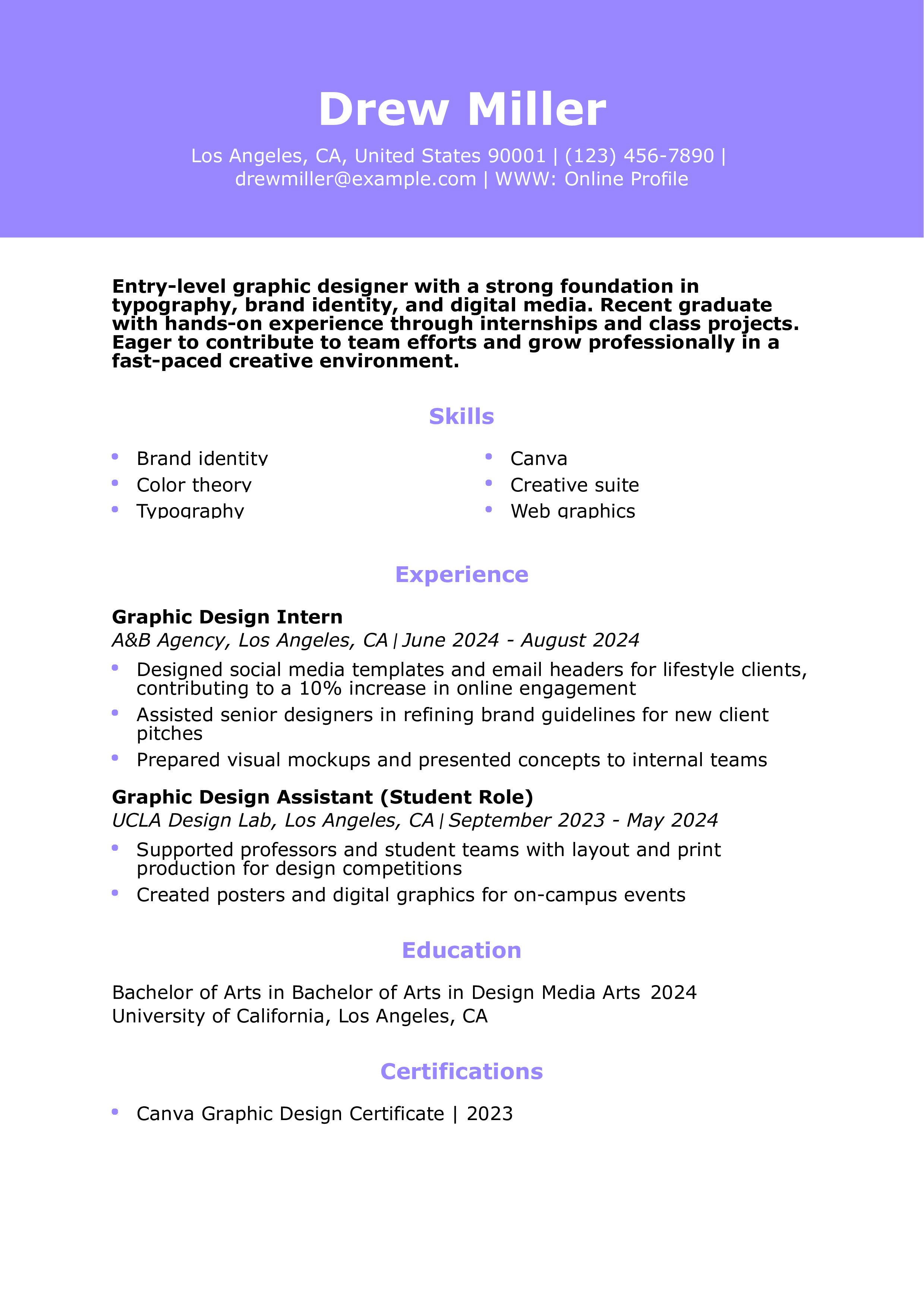
Drew Miller
(123) 456-7890
[email protected]
LinkedIn | Portfolio
Los Angeles, CA 90001
Profile
Entry-level graphic designer with a strong foundation in typography, brand identity, and digital media. Recent graduate with hands-on experience through internships and class projects. Eager to contribute to team efforts and grow professionally in a fast-paced creative environment.
Key Skills
- Brand identity
- Canva
- Color theory
- Creative suite
- Typography
- Web graphics
Professional Experience
Graphic Design Intern, A&B Agency, Los Angeles, CA
June 2024 to August 2024
- Designed social media templates and email headers for lifestyle clients, contributing to a 10% increase in online engagement
- Assisted senior designers in refining brand guidelines for new client pitches
- Prepared visual mockups and presented concepts to internal teams
Graphic Design Assistant (Student Role), UCLA Design Lab, Los Angeles, CA
September 2023 to May 2024
- Supported professors and student teams with layout and print production for design competitions
- Created posters and digital graphics for on-campus events
Education
Bachelor of Arts in Design Media Arts, University of California, Los Angeles, CA | 2024
Certifications
Canva Graphic Design Certificate | 2023
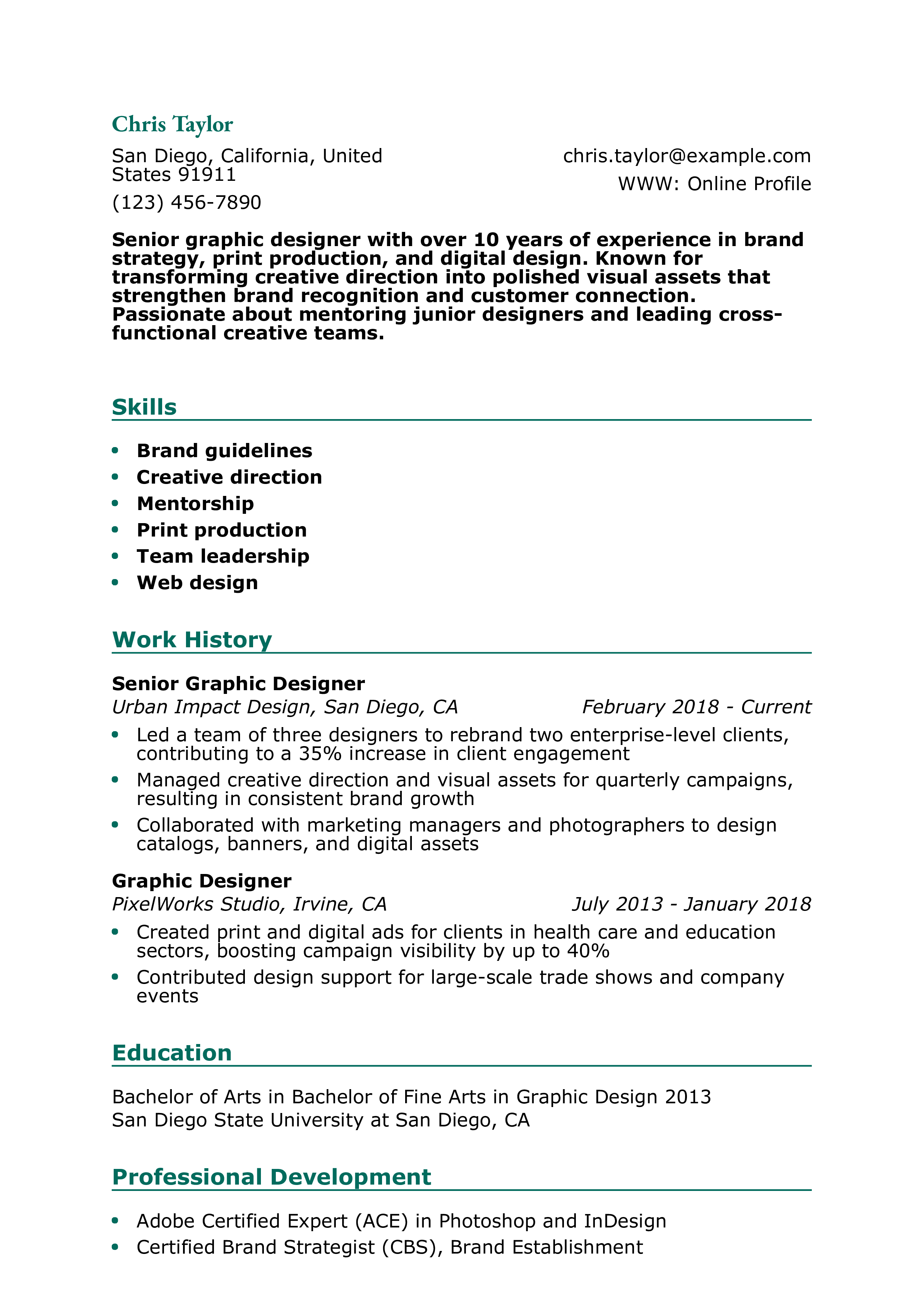
Chris Taylor
(123) 456-7890
[email protected]
LinkedIn | Portfolio
San Diego, CA 92101
Profile
Senior graphic designer with over 10 years of experience in brand strategy, print production, and digital design. Known for transforming creative direction into polished visual assets that strengthen brand recognition and customer connection. Passionate about mentoring junior designers and leading cross-functional creative teams.
Key Skills
- Brand guidelines
- Creative direction
- Mentorship
- Print production
- Team leadership
- Web design
Professional Experience
Senior Graphic Designer, Urban Impact Design, San Diego, CA
February 2018 to present
- Led a team of three designers to rebrand two enterprise-level clients, contributing to a 35% increase in client engagement
- Managed creative direction and visual assets for quarterly campaigns, resulting in consistent brand growth
- Collaborated with marketing managers and photographers to design catalogs, banners, and digital assets
Graphic Designer, PixelWorks Studio, Irvine, CA
July 2013 to January 2018
- Created print and digital ads for clients in health care and education sectors, boosting campaign visibility by up to 40%
- Contributed design support for large-scale trade shows and company events
Education
Bachelor of Fine Arts in Graphic Design, San Diego State University, San Diego, CA | 2013
Certifications
- Adobe Certified Expert (ACE) in Photoshop and InDesign
- Certified Brand Strategist (CBS), Brand Establishment
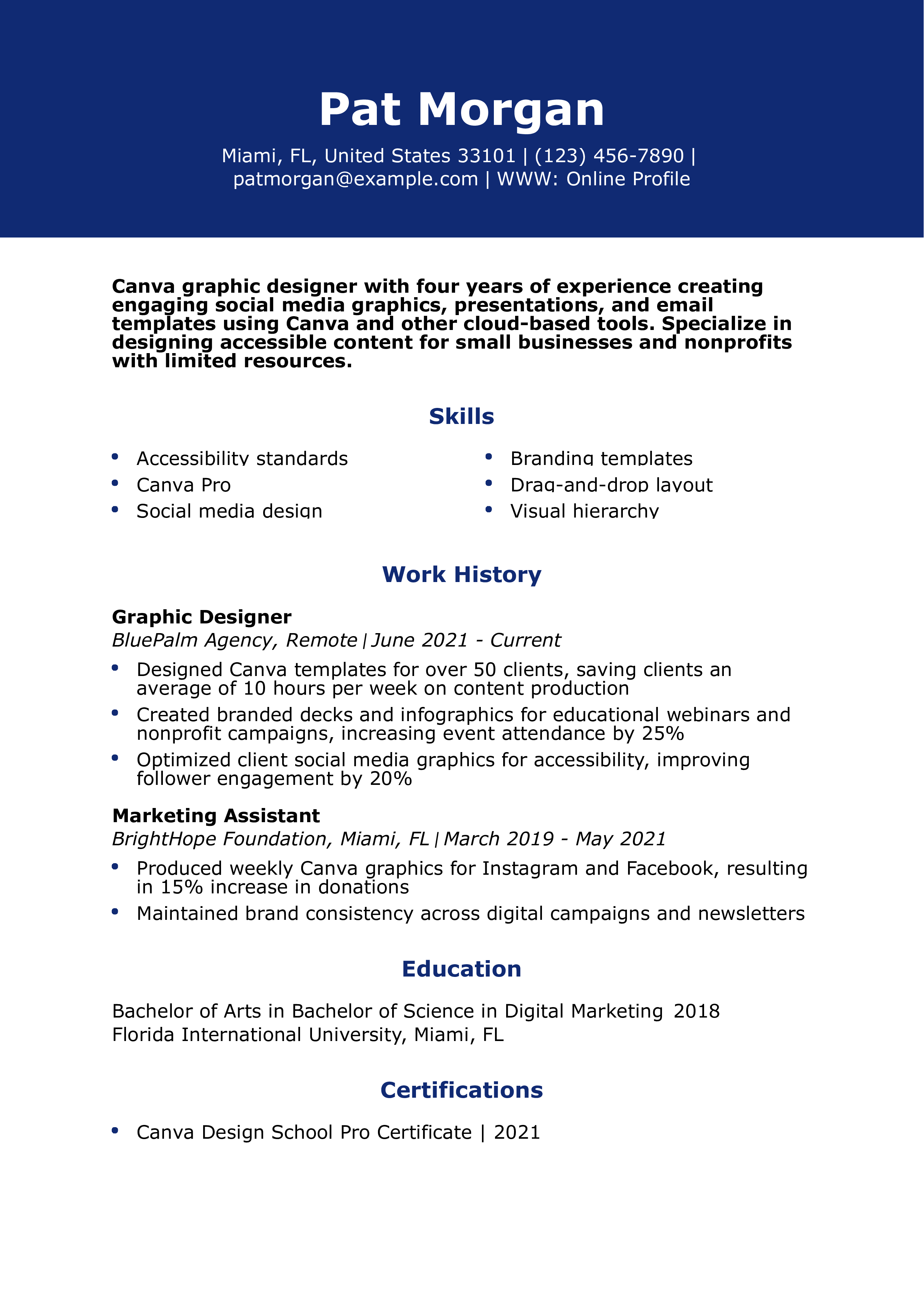
Pat Morgan
(123) 456-7890
[email protected]
LinkedIn | Portfolio
Miami, FL 33101
Profile
Canva graphic designer with four years of experience creating engaging social media graphics, presentations, and email templates using Canva and other cloud-based tools. Specialize in designing accessible content for small businesses and nonprofits with limited resources.
Key Skills
Accessibility standards
Branding templates
Canva Pro
Drag-and-drop layout
Social media design
Visual hierarchy
Professional Experience
Graphic Designer, BluePalm Agency, Remote
June 2021 to present
- Designed Canva templates for over 50 clients, saving clients an average of 10 hours per week on content production
- Created branded decks and infographics for educational webinars and nonprofit campaigns, increasing event attendance by 25%
- Optimized client social media graphics for accessibility, improving follower engagement by 20%
Marketing Assistant, BrightHope Foundation, Miami, FL
March 2019 to May 2021
- Produced weekly Canva graphics for Instagram and Facebook, resulting in 15% increase in donations
- Maintained brand consistency across digital campaigns and newsletters
Education
Bachelor of Science in Digital Marketing, Florida International University, Miami, FL | 2018
Certifications
Canva Design School Pro Certificate | 2021
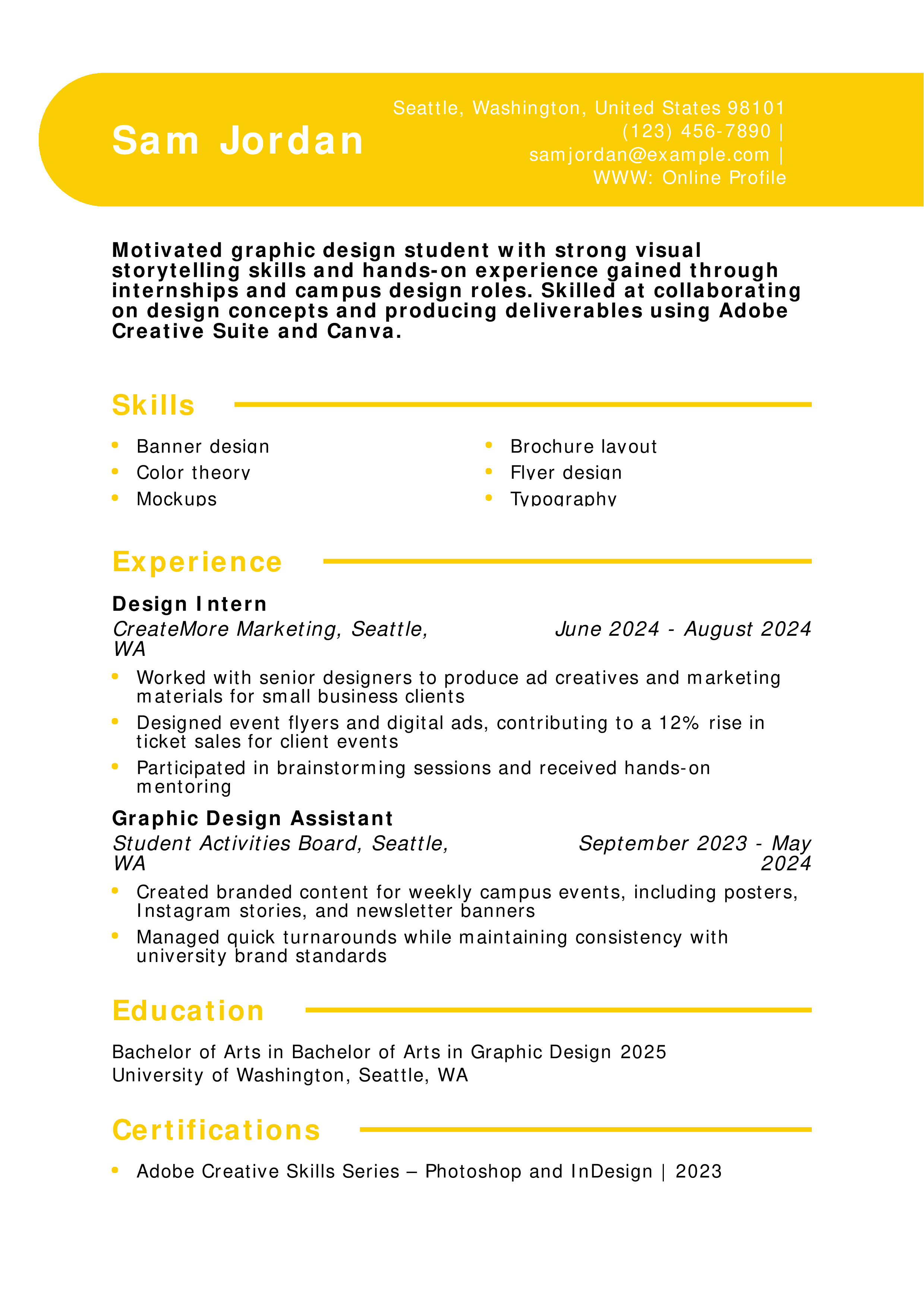
Sam Jordan
(123) 456-7890
[email protected]
LinkedIn | Portfolio
Seattle, WA 98101
Profile
Motivated graphic design student with strong visual storytelling skills and hands-on experience gained through internships and campus design roles. Skilled at collaborating on design concepts and producing deliverables using Adobe Creative Suite and Canva.
Key Skills
- Banner design
- Brochure layout
- Color theory
- Flyer design
- Mockups
- Typography
Professional Experience
Design Intern, CreateMore Marketing, Seattle, WA
June 2024 to August 2024
- Worked with senior designers to produce ad creatives and marketing materials for small business clients
- Designed event flyers and digital ads, contributing to a 12% rise in ticket sales for client events
- Participated in brainstorming sessions and received hands-on mentoring
Graphic Design Assistant, Student Activities Board, Seattle, WA
September 2023 to May 2024
- Created branded content for weekly campus events, including posters, Instagram stories, and newsletter banners
- Managed quick turnarounds while maintaining consistency with university brand standards
Education
Bachelor of Arts in Graphic Design, University of Washington, Seattle, WA | 2025
Certifications
Adobe Creative Skills Series – Photoshop and InDesign | 2023
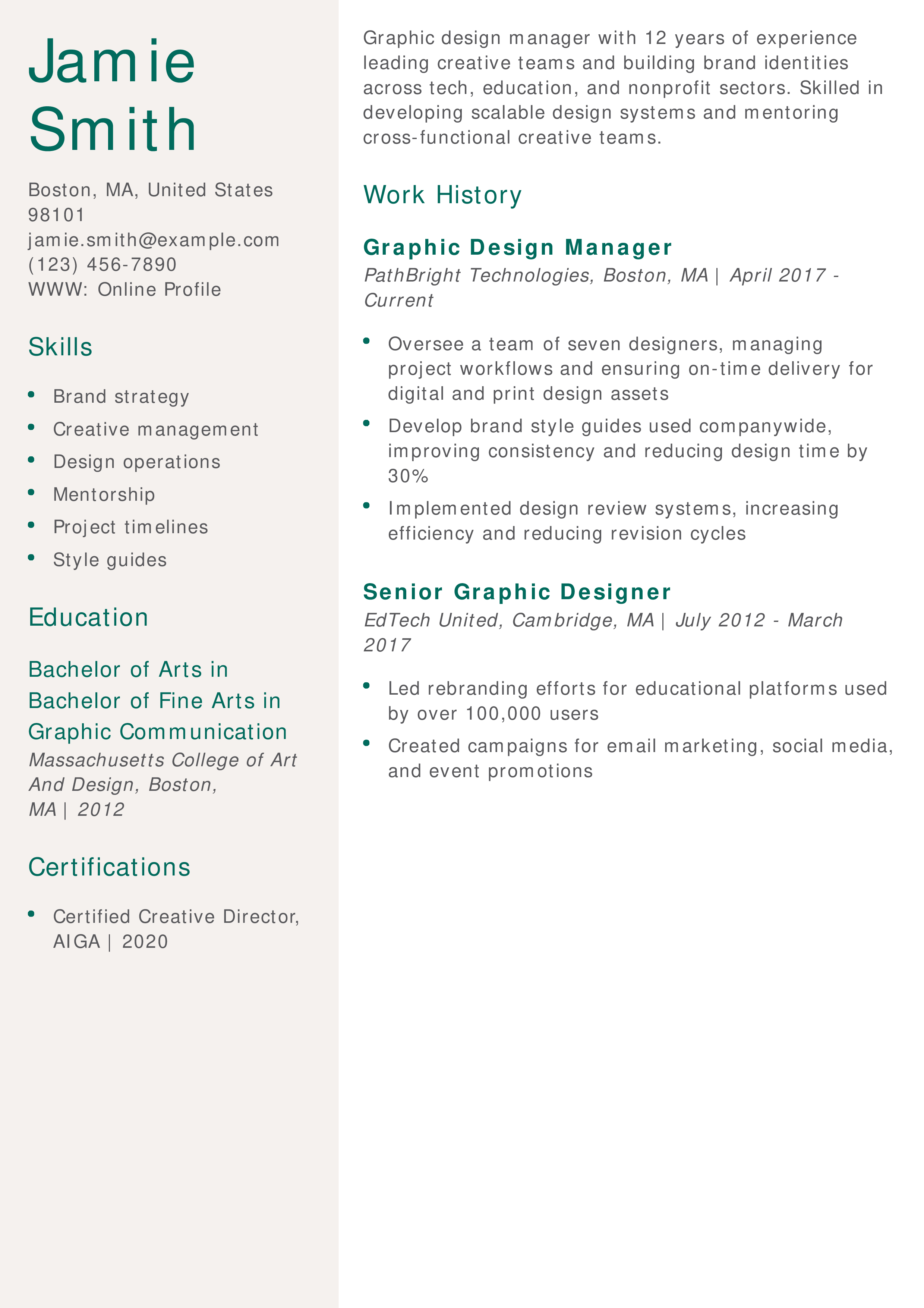
Jamie Smith
(123) 456-7890
[email protected]
LinkedIn | Portfolio
Boston, MA 02101
Profile
Graphic design manager with 12 years of experience leading creative teams and building brand identities across tech, education, and nonprofit sectors. Skilled in developing scalable design systems and mentoring cross-functional creative teams.
Key Skills
- Brand strategy
- Creative management
- Design operations
- Mentorship
- Project timelines
- Style guides
Professional Experience
Graphic Design Manager, PathBright Technologies, Boston, MA
April 2017 to present
- Oversee a team of seven designers, managing project workflows and ensuring on-time delivery for digital and print design assets
- Develop brand style guides used companywide, improving consistency and reducing design time by 30%
- Implemented design review systems, increasing efficiency and reducing revision cycles
Senior Graphic Designer, EdTech United, Cambridge, MA
July 2012 to March 2017
- Led rebranding efforts for educational platforms used by over 100,000 users
- Created campaigns for email marketing, social media, and event promotions
Education
Bachelor of Fine Arts in Graphic Communication, Massachusetts College of Art and Design, Boston, MA | 2012
Certifications
Certified Creative Director, AIGA | 2020
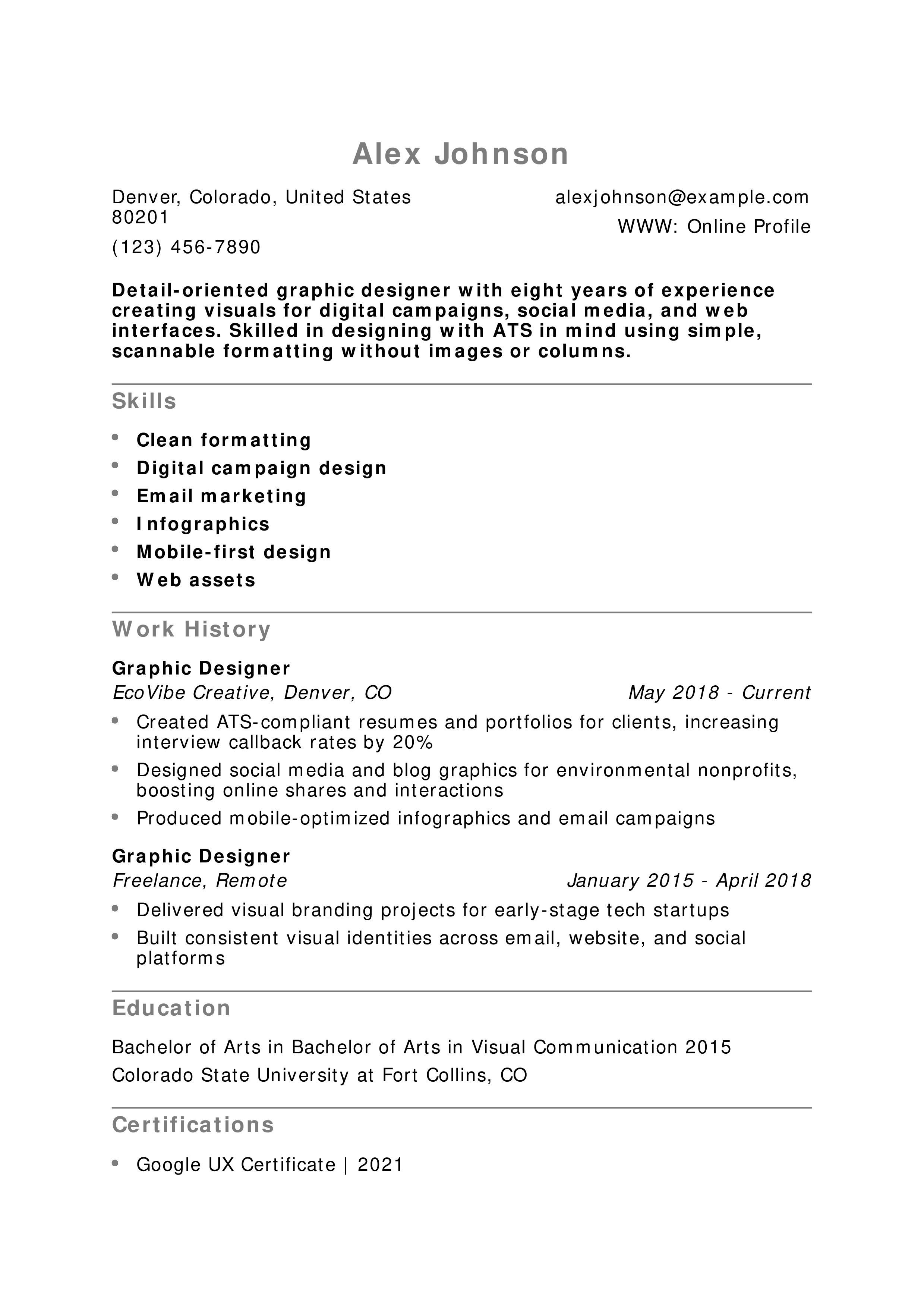
Alex Johnson
(123) 456-7890
[email protected]
LinkedIn | Portfolio
Denver, CO 80201
Profile
Detail-oriented graphic designer with eight years of experience creating visuals for digital campaigns, social media, and web interfaces. Skilled in designing with ATS in mind using simple, scannable formatting without images or columns.
Key Skills
- Clean formatting
- Digital campaign design
- Email marketing
- Infographics
- Mobile-first design
- Web assets
Professional Experience
Graphic Designer, EcoVibe Creative, Denver, CO
May 2018 to present
- Created ATS-compliant resumes and portfolios for clients, increasing interview callback rates by 20%
- Designed social media and blog graphics for environmental nonprofits, boosting online shares and interactions
- Produced mobile-optimized infographics and email campaigns
Graphic Designer, Freelance, Remote
January 2015 to April 2018
- Delivered visual branding projects for early-stage tech startups
- Built consistent visual identities across email, website, and social platforms
Education
Bachelor of Arts in Visual Communication, Colorado State University, Fort Collins, CO | 2015
Certifications
Google UX Certificate | 2021
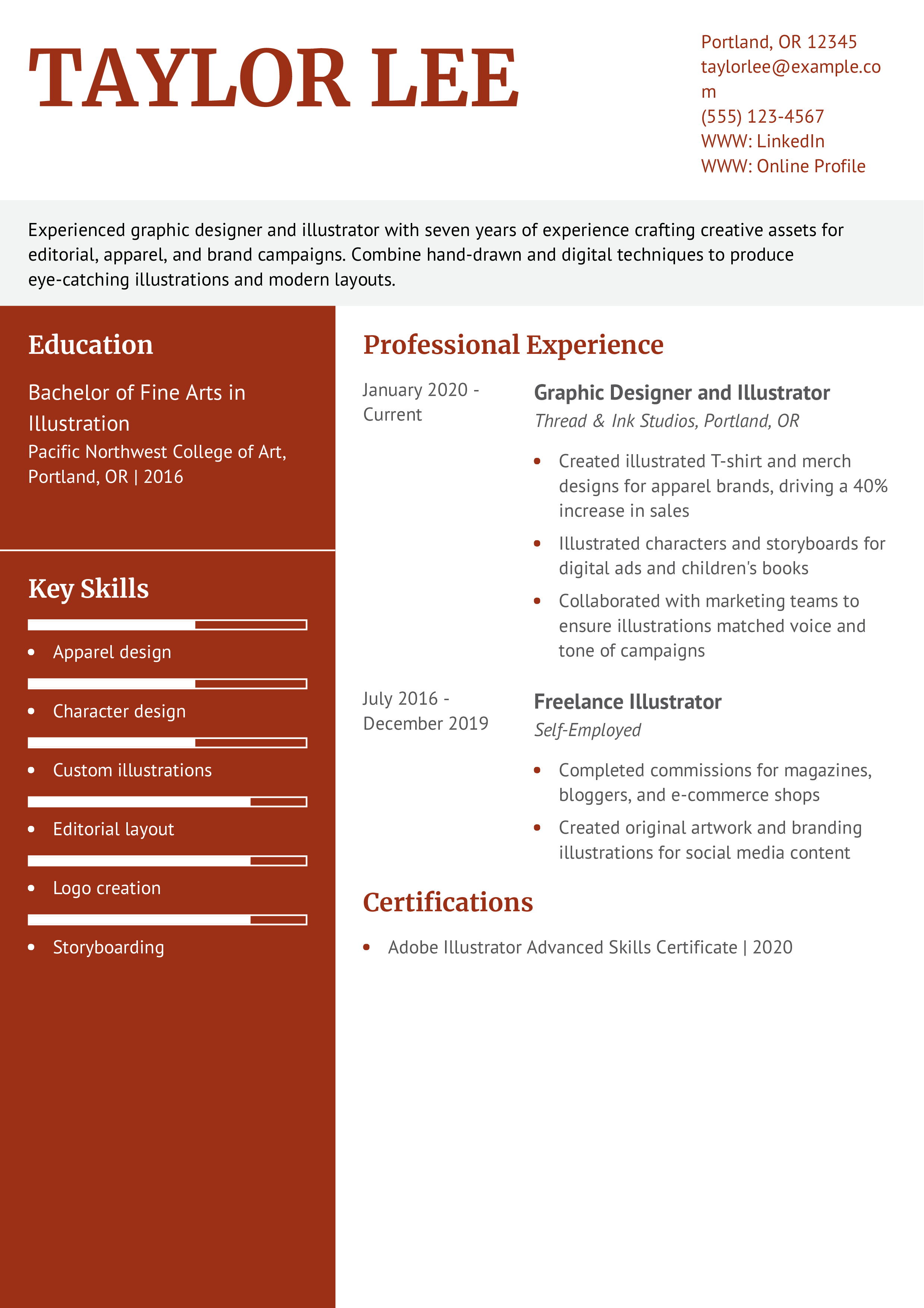
Taylor Lee
(123) 456-7890
[email protected]
LinkedIn | Portfolio
Portland, OR 97201
Profile
Experienced graphic designer and illustrator with seven years of experience crafting creative assets for editorial, apparel, and brand campaigns. Combine hand-drawn and digital techniques to produce eye-catching illustrations and modern layouts.
Key Skills
- Apparel design
- Character design
- Custom illustrations
- Editorial layout
- Logo creation
- Storyboarding
Professional Experience
Graphic Designer and Illustrator, Thread & Ink Studios, Portland, OR
January 2020 to present
- Created illustrated T-shirt and merch designs for apparel brands, driving a 40% increase in sales
- Illustrated characters and storyboards for digital ads and children’s books
- Collaborated with marketing teams to ensure illustrations matched voice and tone of campaigns
Freelance Illustrator, Self-Employed
July 2016 to December 2019
- Completed commissions for magazines, bloggers, and e-commerce shops
- Created original artwork and branding illustrations for social media content
Education
Bachelor of Fine Arts in Illustration, Pacific Northwest College of Art, Portland, OR | 2016
Certifications
Adobe Illustrator Advanced Skills Certificate | 2020
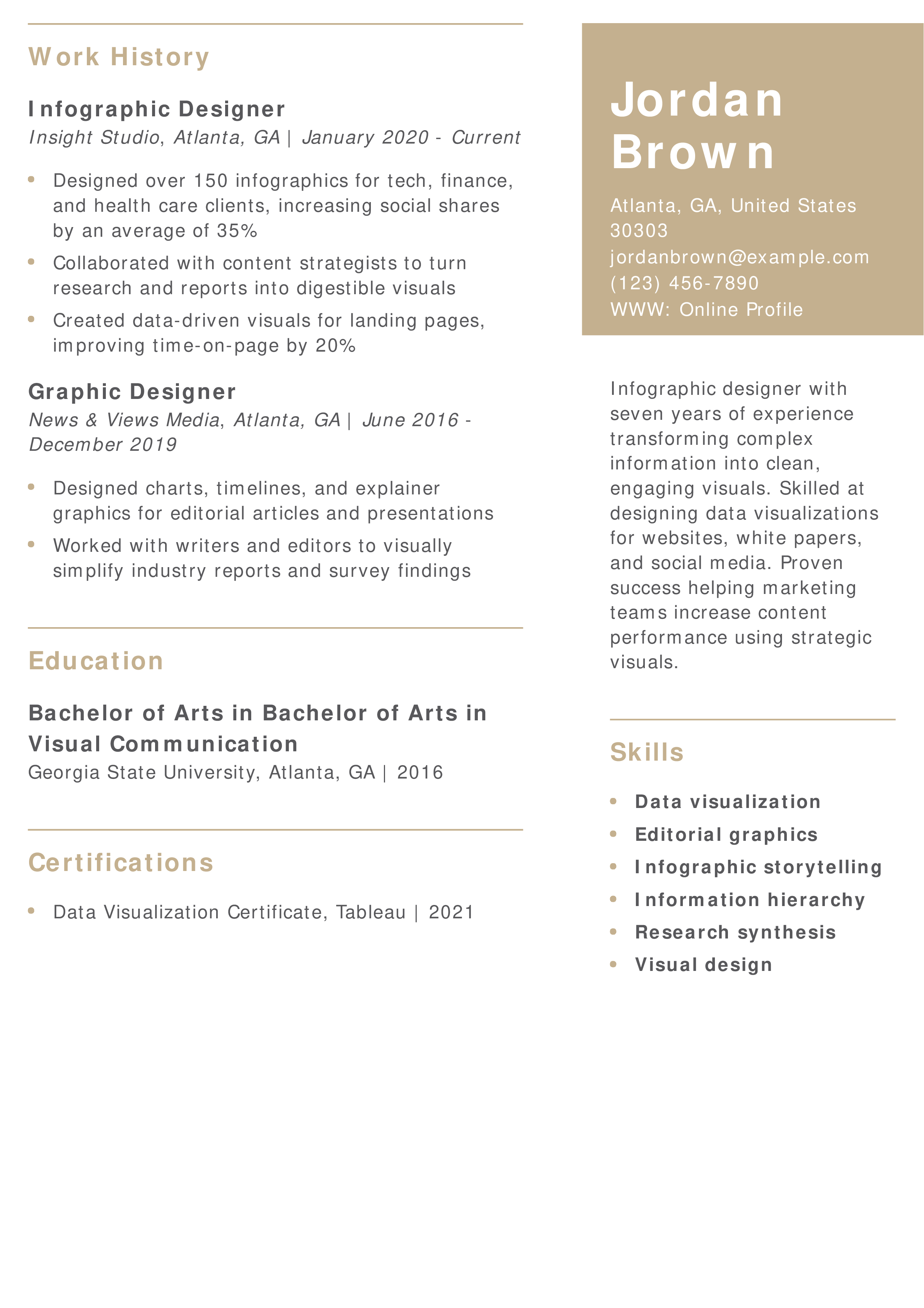
Jordan Brown
(123) 456-7890
[email protected]
LinkedIn | Portfolio
Atlanta, GA 30303
Profile
Infographic designer with seven years of experience transforming complex information into clean, engaging visuals. Skilled at designing data visualizations for websites, white papers, and social media. Proven success helping marketing teams increase content performance using strategic visuals.
Key Skills
- Data visualization
- Editorial graphics
- Infographic storytelling
- Information hierarchy
- Research synthesis
- Visual design
Professional Experience
Infographic Designer, Insight Studio, Atlanta, GA
January 2020 to present
- Designed over 150 infographics for tech, finance, and health care clients, increasing social shares by an average of 35%
- Collaborated with content strategists to turn research and reports into digestible visuals
- Created data-driven visuals for landing pages, improving time-on-page by 20%
Graphic Designer, News & Views Media, Atlanta, GA
June 2016 to December 2019
- Designed charts, timelines, and explainer graphics for editorial articles and presentations
- Worked with writers and editors to visually simplify industry reports and survey findings
Education
Bachelor of Arts in Visual Communication, Georgia State University, Atlanta, GA | 2016
Certifications
Data Visualization Certificate, Tableau | 2021
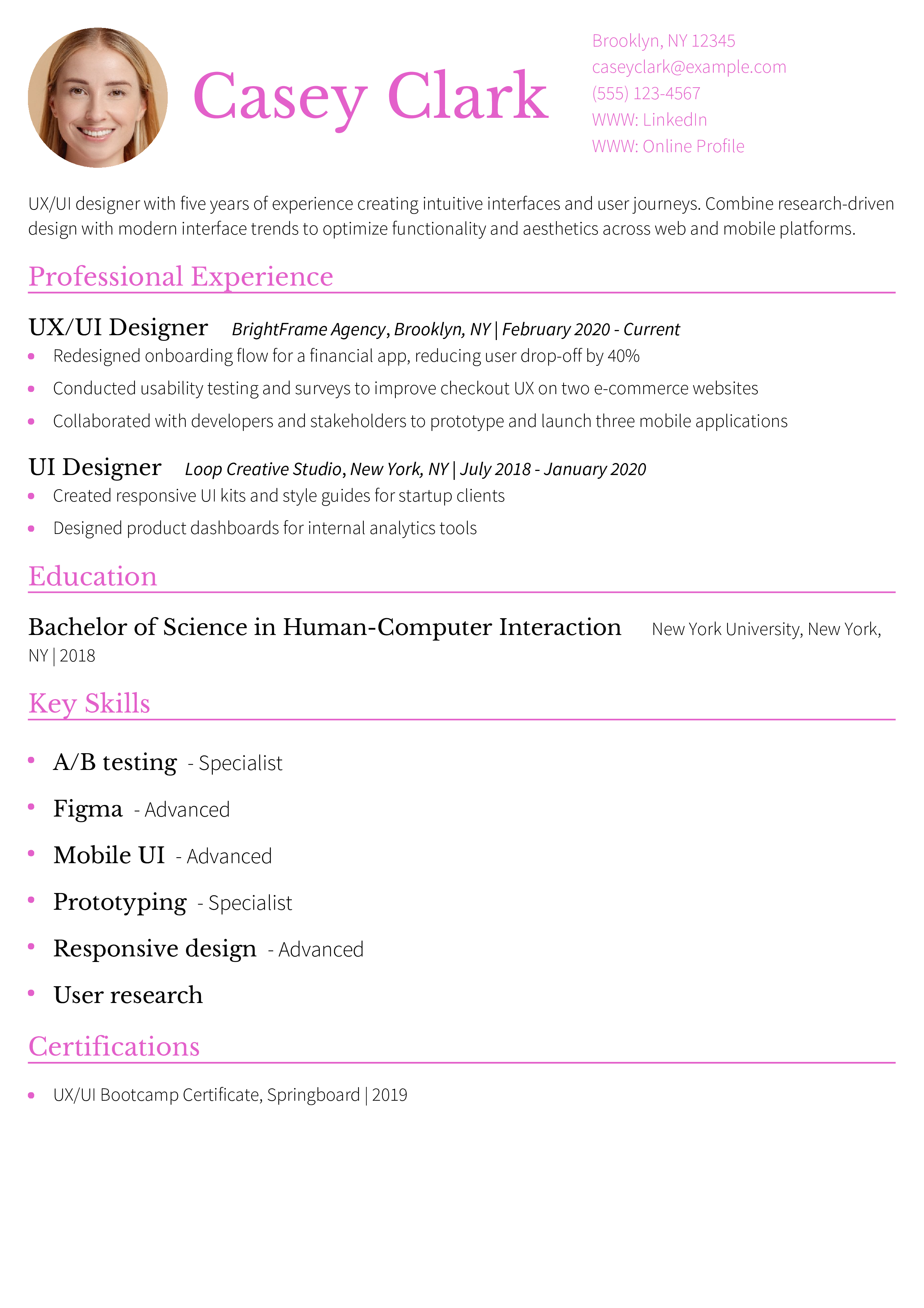
Casey Clark
(123) 456-7890
[email protected]
LinkedIn | Portfolio
Brooklyn, NY 11201
Profile
UX/UI designer with five years of experience creating intuitive interfaces and user journeys. Combine research-driven design with modern interface trends to optimize functionality and aesthetics across web and mobile platforms.
Key Skills
- A/B testing
- Figma
- Mobile UI
- Prototyping
- Responsive design
- User research
Professional Experience
UX/UI Designer, BrightFrame Agency, Brooklyn, NY
February 2020 to present
- Redesigned onboarding flow for a financial app, reducing user drop-off by 40%
- Conducted usability testing and surveys to improve checkout UX on two e-commerce websites
- Collaborated with developers and stakeholders to prototype and launch three mobile applications
UI Designer, Loop Creative Studio, New York, NY
July 2018 to January 2020
- Created responsive UI kits and style guides for startup clients
- Designed product dashboards for internal analytics tools
Education
Bachelor of Science in Human-Computer Interaction, New York University, New York, NY | 2018
Certifications
UX/UI Bootcamp Certificate, Springboard | 2019
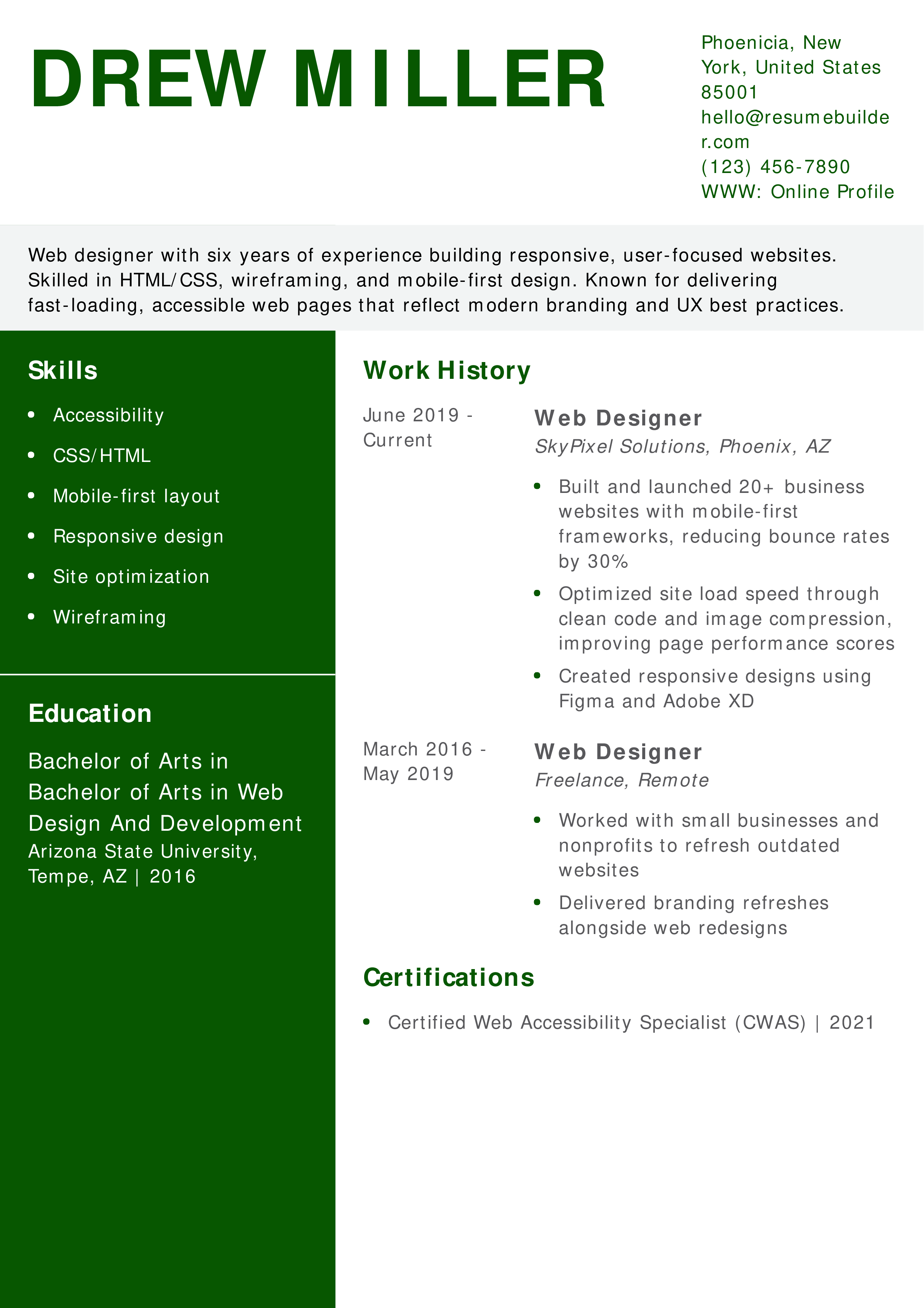
Drew Miller
(123) 456-7890
[email protected]
LinkedIn | Portfolio
Phoenix, AZ 85001
Profile
Web designer with six years of experience building responsive, user-focused websites. Skilled in HTML/CSS, wireframing, and mobile-first design. Known for delivering fast-loading, accessible web pages that reflect modern branding and UX best practices.
Key Skills
- Accessibility
- CSS/HTML
- Mobile-first layout
- Responsive design
- Site optimization
- Wireframing
Professional Experience
Web Designer, SkyPixel Solutions, Phoenix, AZ
June 2019 to present
- Built and launched 20+ business websites with mobile-first frameworks, reducing bounce rates by 30%
- Optimized site load speed through clean code and image compression, improving page performance scores
- Created responsive designs using Figma and Adobe XD
Web Designer, Freelance, Remote
March 2016 to May 2019
- Worked with small businesses and nonprofits to refresh outdated websites
- livered branding refreshes alongside web redesigns
Education
Bachelor of Arts in Web Design and Development, Arizona State University, Tempe, AZ | 2016
Certifications
Certified Web Accessibility Specialist (CWAS) | 2021
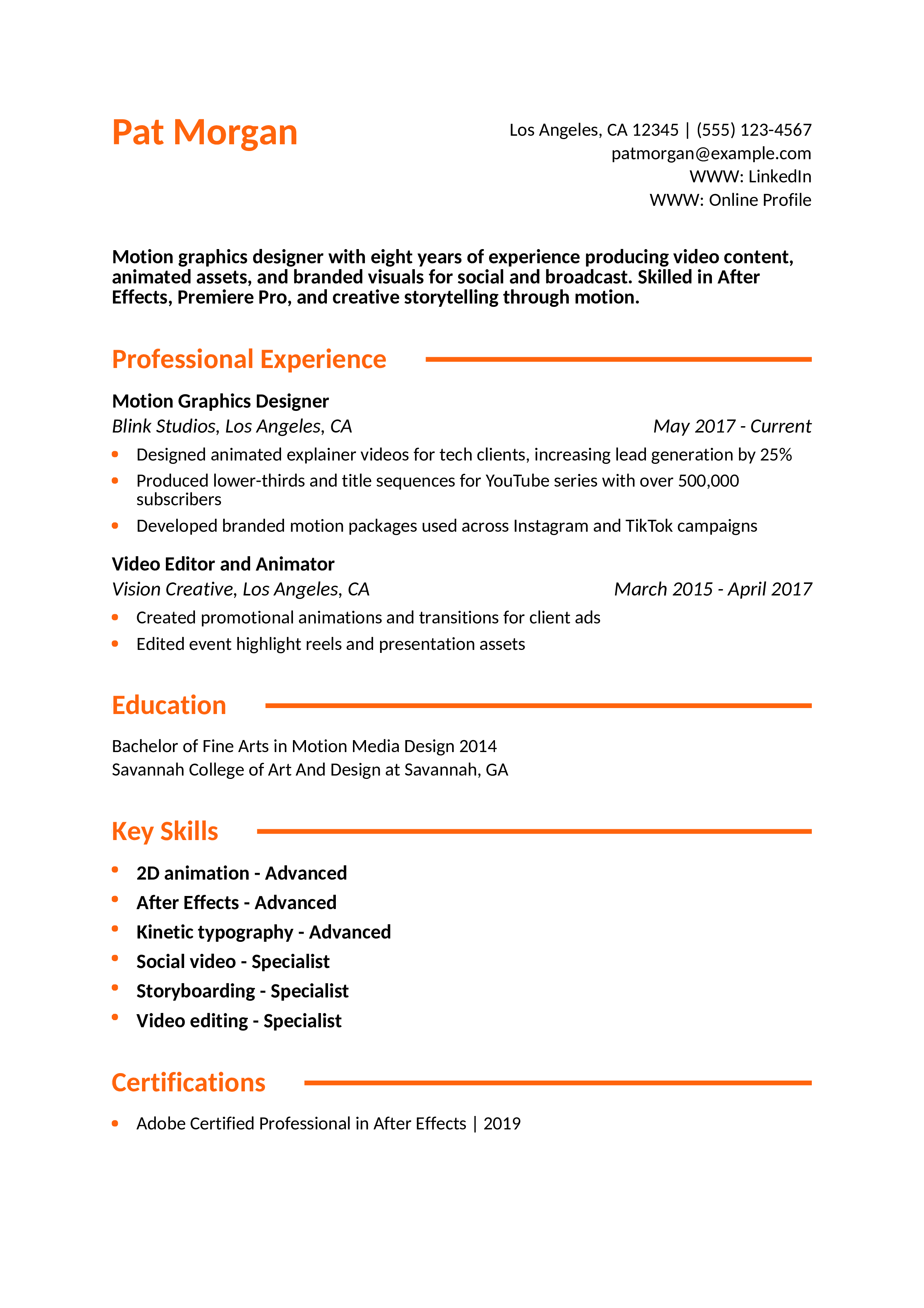
Pat Morgan
(123) 456-7890
[email protected]
LinkedIn | Portfolio
Los Angeles, CA 90012
Profile
Motion graphics designer with eight years of experience producing video content, animated assets, and branded visuals for social and broadcast. Skilled in After Effects, Premiere Pro, and creative storytelling through motion.
Key Skills
- 2D animation
- After Effects
- Kinetic typography
- Social video
- Storyboarding
- Video editing
Professional Experience
Motion Graphics Designer, Blink Studios, Los Angeles, CA
May 2017 to present
- Designed animated explainer videos for tech clients, increasing lead generation by
- Produced lower-thirds and title sequences for YouTube series with over 500,000 subscribers
- Developed branded motion packages used across Instagram and TikTok campaigns
Video Editor and Animator, Vision Creative, Los Angeles, CA
March 2015 to April 2017
- Created promotional animations and transitions for client ads
- Edited event highlight reels and presentation assets
Education
Bachelor of Fine Arts in Motion Media Design, Savannah College of Art and Design, Savannah, GA | 2014
Certifications
Adobe Certified Professional in After Effects | 2019
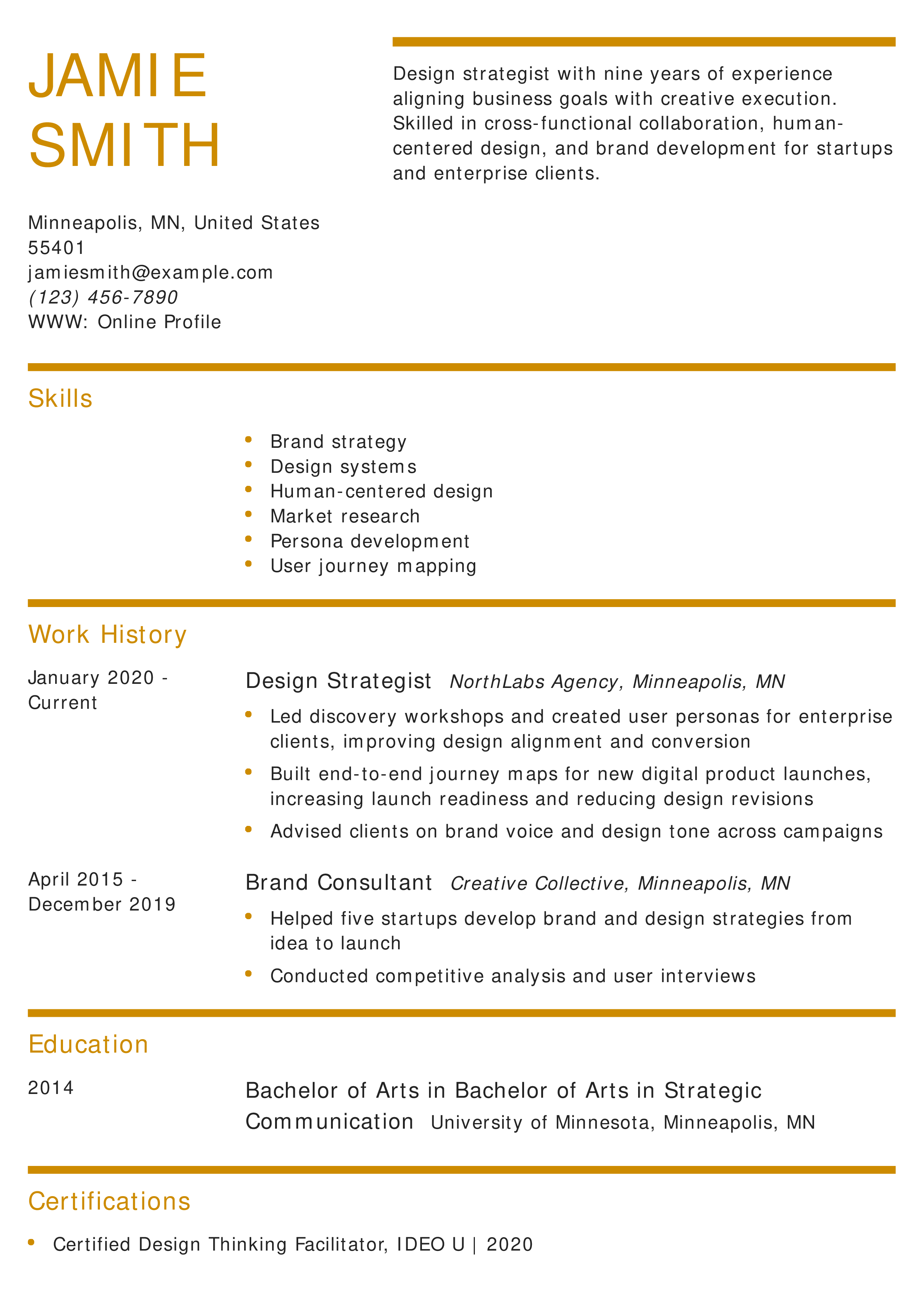
Jamie Smith
(123) 456-7890
[email protected]
LinkedIn | Portfolio
Minneapolis, MN 55401
Profile
Design strategist with nine years of experience aligning business goals with creative execution. Skilled in cross-functional collaboration, human-centered design, and brand development for startups and enterprise clients.
Key Skills
- Brand strategy
- Design systems
- Human-centered design
- Market research
- Persona development
- User journey mapping
Professional Experience
Design Strategist, NorthLabs Agency, Minneapolis, MN
January 2020 to present
- Led discovery workshops and created user personas for enterprise clients, improving design alignment and conversion
- Built end-to-end journey maps for new digital product launches, increasing launch readiness and reducing design revisions
- Advised clients on brand voice and design tone across campaigns
Brand Consultant, Creative Collective, Minneapolis, MN
April 2015 to December 2019
- Helped five startups develop brand and design strategies from idea to
- Conducted competitive analysis and user interviews
Education
Bachelor of Arts in Strategic Communication, University of Minnesota, Minneapolis, MN | 2014
Certifications
Certified Design Thinking Facilitator, IDEO U | 2020
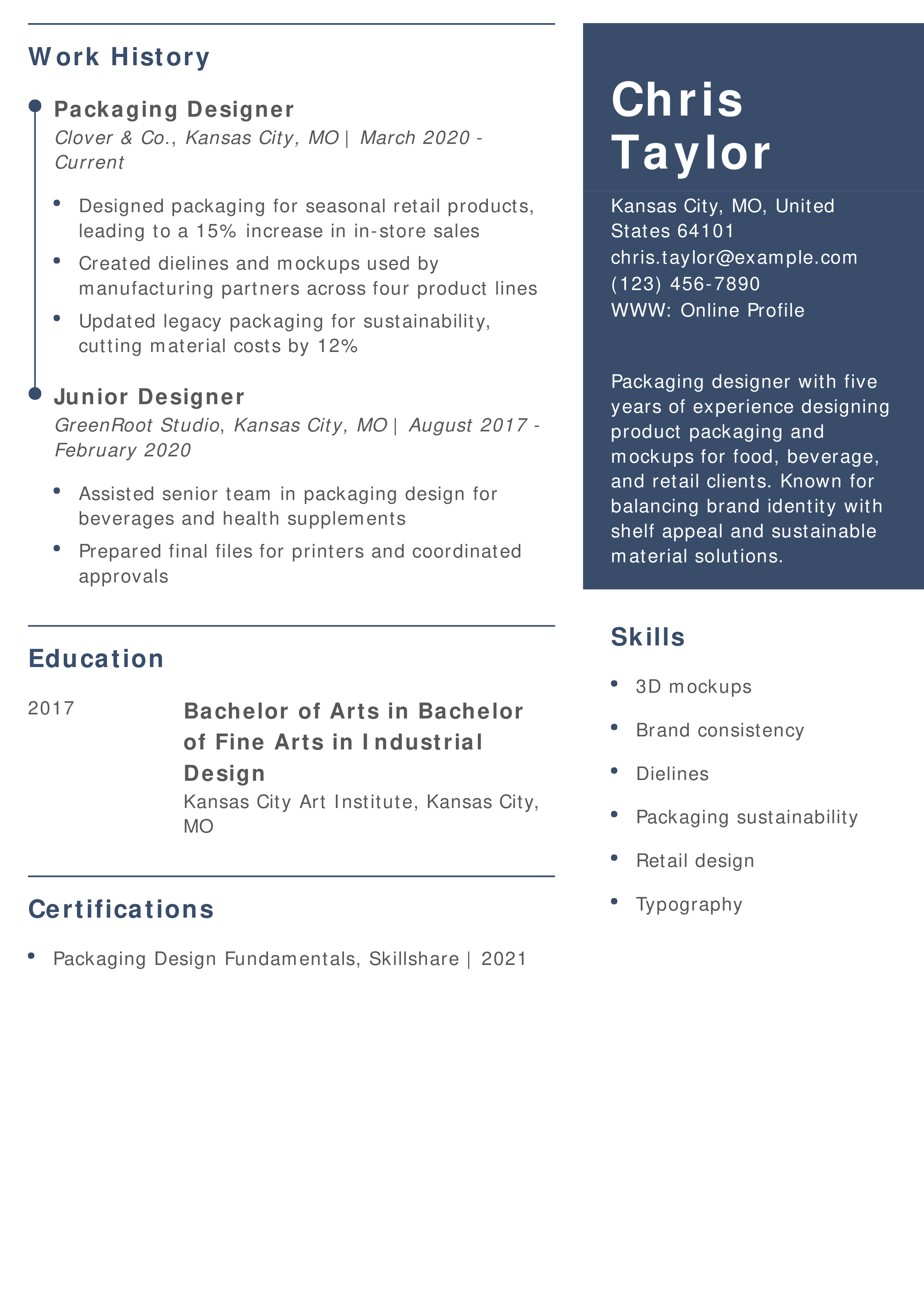
Chris Taylor
(123) 456-7890
[email protected]
LinkedIn | Portfolio
Kansas City, MO 64101
Profile
Packaging designer with five years of experience designing product packaging and mockups for food, beverage, and retail clients. Known for balancing brand identity with shelf appeal and sustainable material solutions.
Key Skills
- 3D mockups
- Brand consistency
- Dielines
- Packaging sustainability
- Retail design
- Typography
Professional Experience
Packaging Designer, Clover & Co., Kansas City, MO
March 2020 to present
- Designed packaging for seasonal retail products, leading to a 15% increase in in-store sales
- Created dielines and mockups used by manufacturing partners across four product lines
- Updated legacy packaging for sustainability, cutting material costs by 12%
Junior Designer, GreenRoot Studio, Kansas City, MO
August 2017 to February 2020
- Assisted senior team in packaging design for beverages and health supplements
- Prepared final files for printers and coordinated approvals
Education
Bachelor of Fine Arts in Industrial Design, Kansas City Art Institute, Kansas City, MO | 2017
Certifications
Packaging Design Fundamentals, Skillshare | 2021
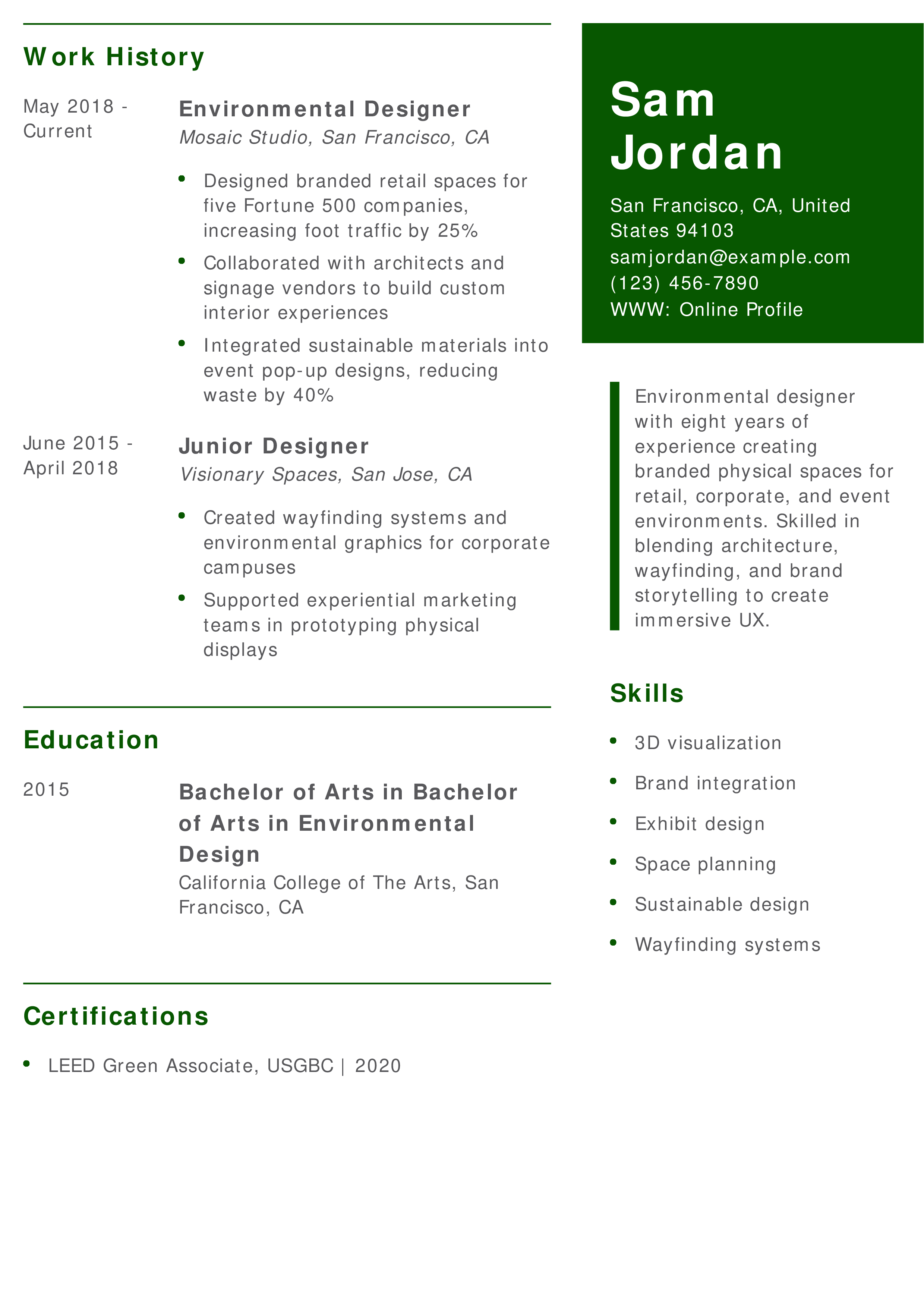
Sam Jordan
(123) 456-7890
[email protected]
LinkedIn | Portfolio
San Francisco, CA 94103
Profile
Environmental designer with eight years of experience creating branded physical spaces for retail, corporate, and event environments. Skilled in blending architecture, wayfinding, and brand storytelling to create immersive UX.
Key Skills
- 3D visualization
- Brand integration
- Exhibit design
- Space planning
- Sustainable design
- Wayfinding systems
Professional Experience
Environmental Designer, Mosaic Studio, San Francisco, CA
May 2018 to present
- Designed branded retail spaces for five Fortune 500 companies, increasing foot traffic by 25%
- Collaborated with architects and signage vendors to build custom interior experiences
- Integrated sustainable materials into event pop-up designs, reducing waste by 40%
Junior Designer, Visionary Spaces, San Jose, CA
June 2015 to April 2018
- Created wayfinding systems and environmental graphics for corporate campuses
- Supported experiential marketing teams in prototyping physical displays
Education
Bachelor of Arts in Environmental Design, California College of the Arts, San Francisco, CA | 2015
Certifications
LEED Green Associate, USGBC | 2020
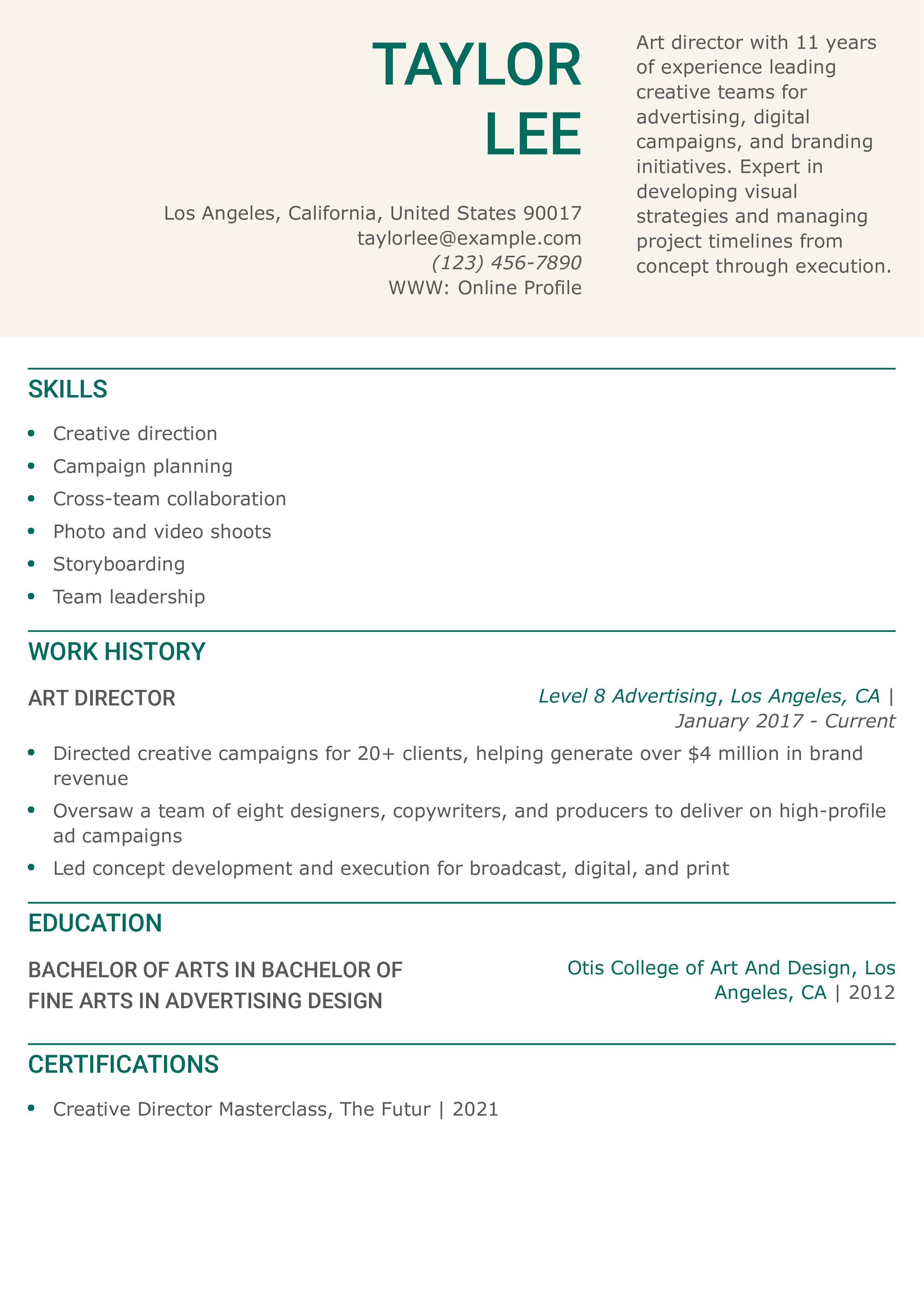
Taylor Lee
(123) 456-7890
[email protected]
LinkedIn | Portfolio
Los Angeles, CA 90017
Profile
Art director with 11 years of experience leading creative teams for advertising, digital campaigns, and branding initiatives. Expert in developing visual strategies and managing project timelines from concept through execution.
Key Skills
- Creative direction
- Campaign planning
- Cross-team collaboration
- Photo and video shoots
- Storyboarding
- Team leadership
Professional Experience
Art Director, Level 8 Advertising, Los Angeles, CA
January 2017 to present
- Directed creative campaigns for 20+ clients, helping generate over $4 million in brand revenue
- Oversaw a team of eight designers, copywriters, and producers to deliver on high-profile ad campaigns
- Led concept development and execution for broadcast, digital, and print
Senior Designer, LightLab Agency, Los Angeles, CA
August 2012 to December 2016
- Designed key visuals for digital ads, OOH campaigns, and branded content
- Mentored junior designers and helped standardize design processes
Education
Bachelor of Fine Arts in Advertising Design, Otis College of Art and Design, Los Angeles, CA | 2012
Certifications
Creative Director Masterclass, The Futur | 2021
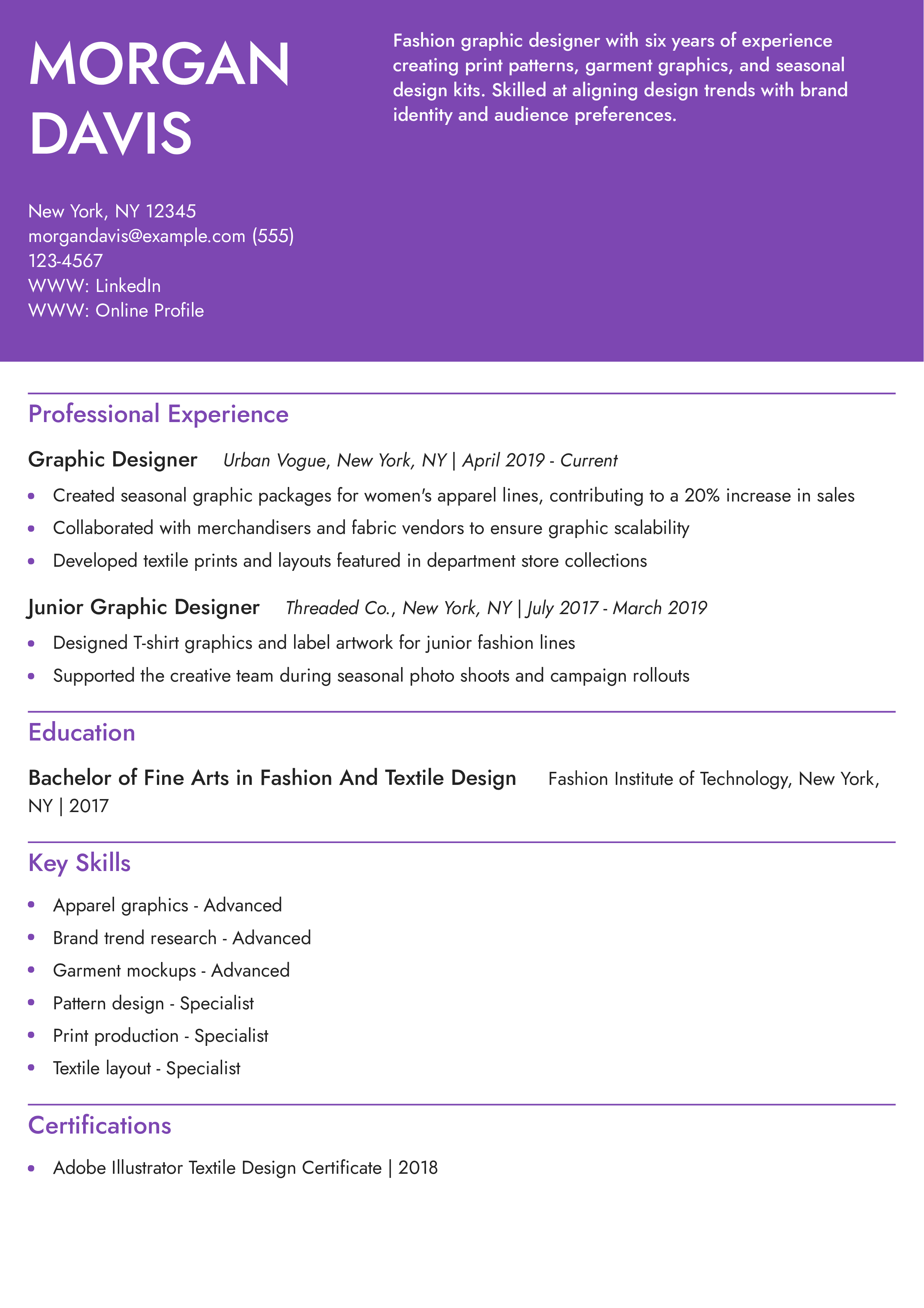
Morgan Davis
(123) 456-7890
[email protected]
LinkedIn | Portfolio
New York, NY 10018
Profile
Fashion graphic designer with six years of experience creating print patterns, garment graphics, and seasonal design kits. Skilled at aligning design trends with brand identity and audience preferences.
Key Skills
- Apparel graphics
- Brand trend research
- Garment mockups
- Pattern design
- Print production
- Textile layout
Professional Experience
Graphic Designer, Urban Vogue, New York, NY
April 2019 to present
- Created seasonal graphic packages for women’s apparel lines, contributing to a 20% increase in sales
- Collaborated with merchandisers and fabric vendors to ensure graphic scalability
- Developed textile prints and layouts featured in department store collections
Junior Graphic Designer, Threaded Co., New York, NY
July 2017 to March 2019
- Designed T-shirt graphics and label artwork for junior fashion lines
- Supported the creative team during seasonal photo shoots and campaign rollouts
Education
Bachelor of Fine Arts in Fashion and Textile Design, Fashion Institute of Technology, New York, NY | 2017
Certifications
Adobe Illustrator Textile Design Certificate | 2018
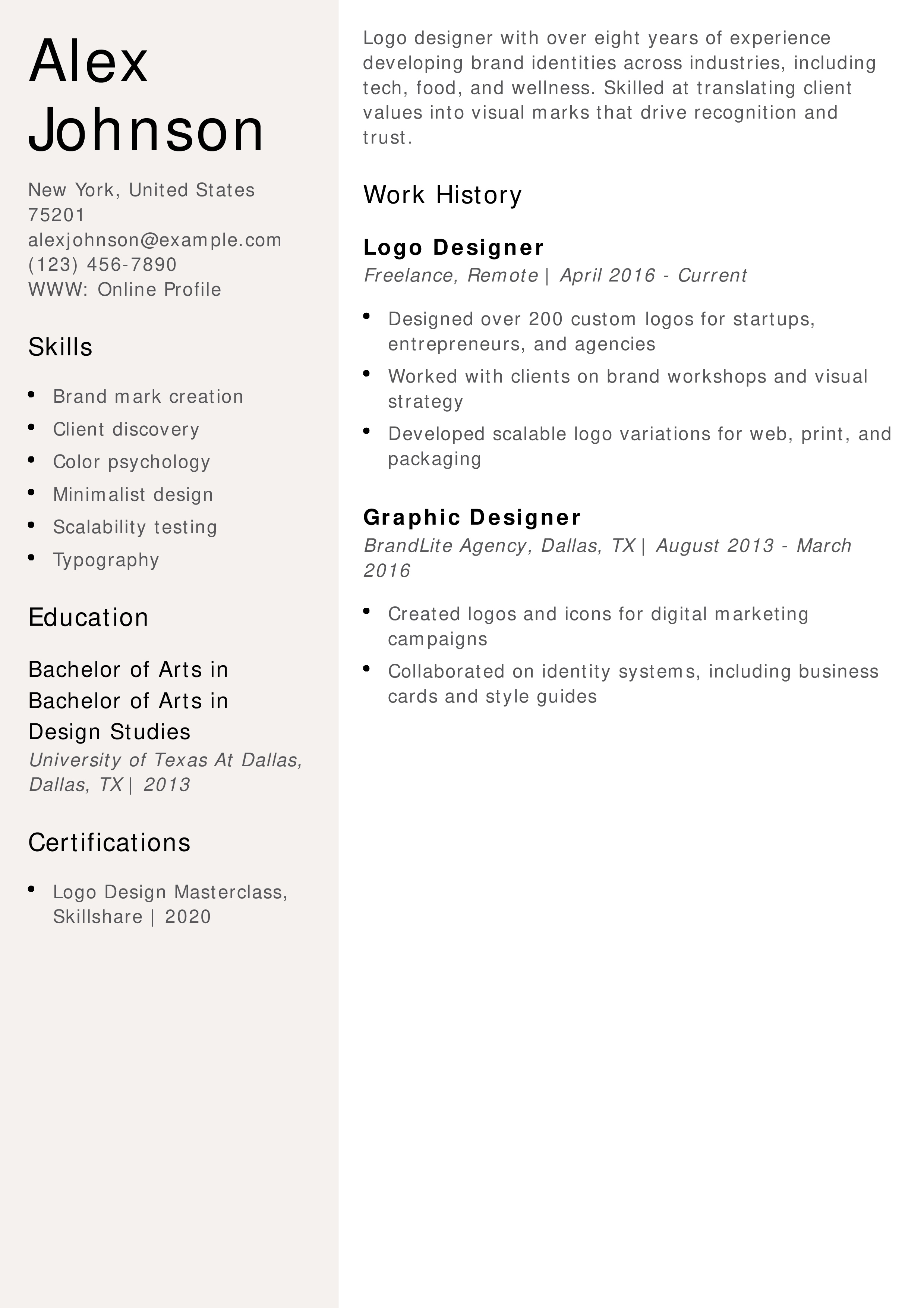
Alex Johnson
(123) 456-7890
[email protected]
LinkedIn | Portfolio
Dallas, TX 75201
Profile
Logo designer with over eight years of experience developing brand identities across industries, including tech, food, and wellness. Skilled at translating client values into visual marks that drive recognition and trust.
Key Skills
- Brand mark creation
- Client discovery
- Color psychology
- Minimalist design
- Scalability testing
- Typography
Professional Experience
Logo Designer, Freelance, Remote
April 2016 to present
- Designed over 200 custom logos for startups, entrepreneurs, and agencies
- Worked with clients on brand workshops and visual strategy
- Developed scalable logo variations for web, print, and packaging
Graphic Designer, BrandLite Agency, Dallas, TX
August 2013 to March 2016
- Created logos and icons for digital marketing campaigns
- Collaborated on identity systems, including business cards and style guides
Education
Bachelor of Arts in Design Studies, University of Texas at Dallas, Dallas, TX | 2013
Certifications
Logo Design Masterclass, Skillshare | 2020
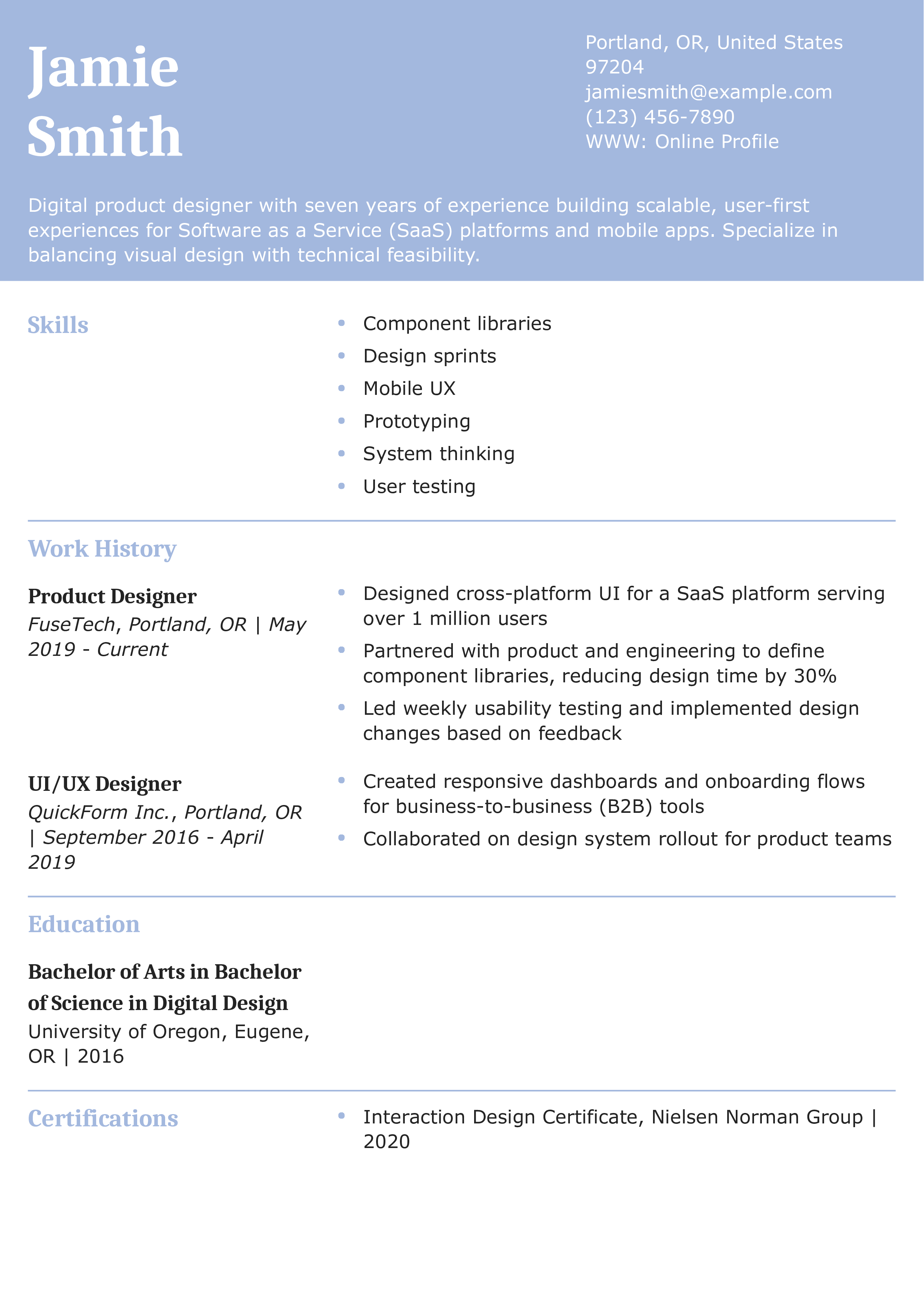
Jamie Smith
(123) 456-7890
[email protected]
LinkedIn | Portfolio
Portland, OR 97204
Profile
Digital product designer with seven years of experience building scalable, user-first experiences for Software as a Service (SaaS) platforms and mobile apps. Specialize in balancing visual design with technical feasibility.
Key Skills
- Component libraries
- Design sprints
- Mobile UX
- Prototyping
- System thinking
- User testing
Professional Experience
Product Designer, FuseTech, Portland, OR
May 2019 to present
- Designed cross-platform UI for a SaaS platform serving over 1 million users
- Partnered with product and engineering to define component libraries, reducing design time by 30%
- Led weekly usability testing and implemented design changes based on feedback
UI/UX Designer, QuickForm Inc., Portland, OR
September 2016 to April 2019
- Created responsive dashboards and onboarding flows for business-to-business (B2B) tools
- Collaborated on design system rollout for product teams
Education
Bachelor of Science in Digital Design, University of Oregon, Eugene, OR | 2016
Certifications
Interaction Design Certificate, Nielsen Norman Group | 2020
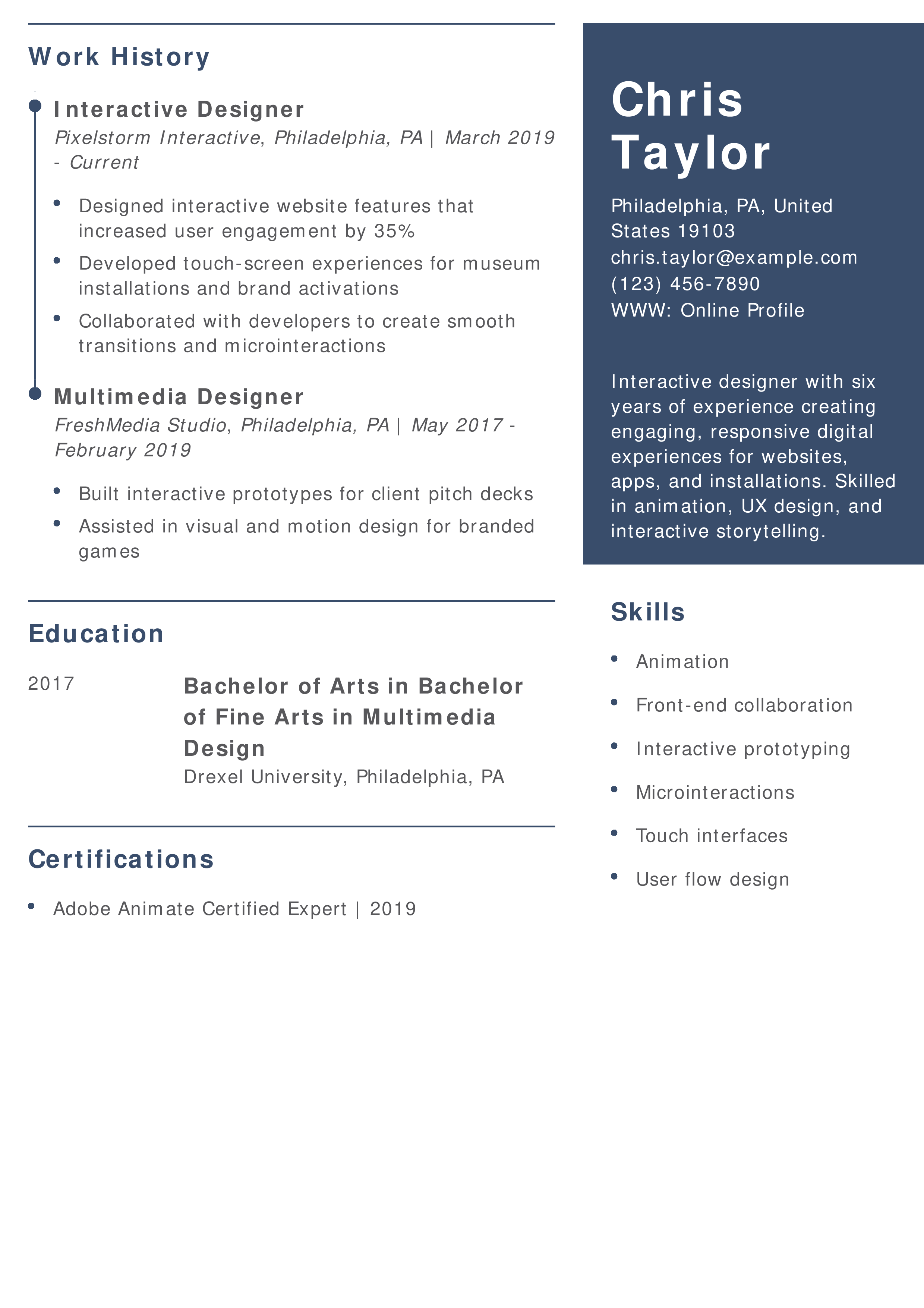
Chris Taylor
(123) 456-7890
[email protected]
LinkedIn | Portfolio
Philadelphia, PA 19103
Profile
Interactive designer with six years of experience creating engaging, responsive digital experiences for websites, apps, and installations. Skilled in animation, UX design, and interactive storytelling.
Key Skills
- Animation
- Front-end collaboration
- Interactive prototyping
- Microinteractions
- Touch interfaces
- User flow design
Professional Experience
Interactive Designer, Pixelstorm Interactive, Philadelphia, PA
March 2019 to present
- Designed interactive website features that increased user engagement by 35%
- Developed touch-screen experiences for museum installations and brand activations
- Collaborated with developers to create smooth transitions and microinteractions
Multimedia Designer, FreshMedia Studio, Philadelphia, PA
May 2017 to February 2019
- Built interactive prototypes for client pitch decks
- Assisted in visual and motion design for branded games
Education
Bachelor of Fine Arts in Multimedia Design, Drexel University, Philadelphia, PA | 2017
Certifications
Adobe Animate Certified Expert | 2019