
Accepting a new job is a major career decision, but for some workers, the role they ultimately step into falls short of what they were promised.
New research from ResumeBuilder.com’s Bait-and-Switch Hiring Report explores the gap between what workers are promised and what they experience on the job, including the clarity of their day-to-day responsibilities, conversations about career growth, and whether they feel their contributions are valued.
Based on a survey of over 1,000 U.S. employees, the report examines how these factors can shape workers’ experiences after taking a new job.
Key Findings
- The bait-and-switch: 18% of workers say their job has changed significantly or is completely different from what they were hired for.
- Unclear expectations: 20% report that their daily role expectations are often unclear or completely unpredictable.
- Ghosted on growth: Nearly three-quarters of workers (74%) say conversations are inconsistent, delayed, or addressed only after an issue arises; just 26% say they happen proactively.
- A lack of appreciation: 30% of workers feel undervalued or completely overlooked based on their workplace contributions.
Hiring Bait & Switch
For some workers, a new job brings the unwelcome surprise that day-to-day job duties changed after hiring. When asked how closely their current roles reflect what they were promised when they were hired:
- 18% say their current role has changed significantly or is completely different.
- 56% say their role mostly or somewhat matches, with a few changes over time.
- 26% say their current role completely matches what they expected.
What this means: For some workers, the reality of a new job can diverge substantially from the opportunity they thought they were accepting. When the role changes after the hire, workers question whether their current position still aligns with the career path they originally chose.
Hired Into a Moving Target
This disconnect extends beyond the job description, with employees navigating unclear or shifting expectations.
- 20% say role expectations are often unclear or completely unpredictable.
- 37% say expectations are mostly clear, with occasional ambiguity.
- 43% say expectations are very clear and well-defined.
What this means: A role can become a moving target when the job description doesn’t match the actual job, and employees can’t pin down what’s expected of them. Ambiguity and unpredictability can force employees to spend more time adapting to shifting demands than focusing on their work and building consistency in their roles.
Ghosted on Growth: The Promotion Evasion
Workers are also encountering uncertainty around career progression. When asked how often these conversations are delayed or avoided:
- 24% say career conversations are frequently delayed or avoided entirely.
- 25% say delays are rare and generally addressed.
- 25% say these conversations are sometimes inconsistent.
- 26% say these conversations happen proactively.
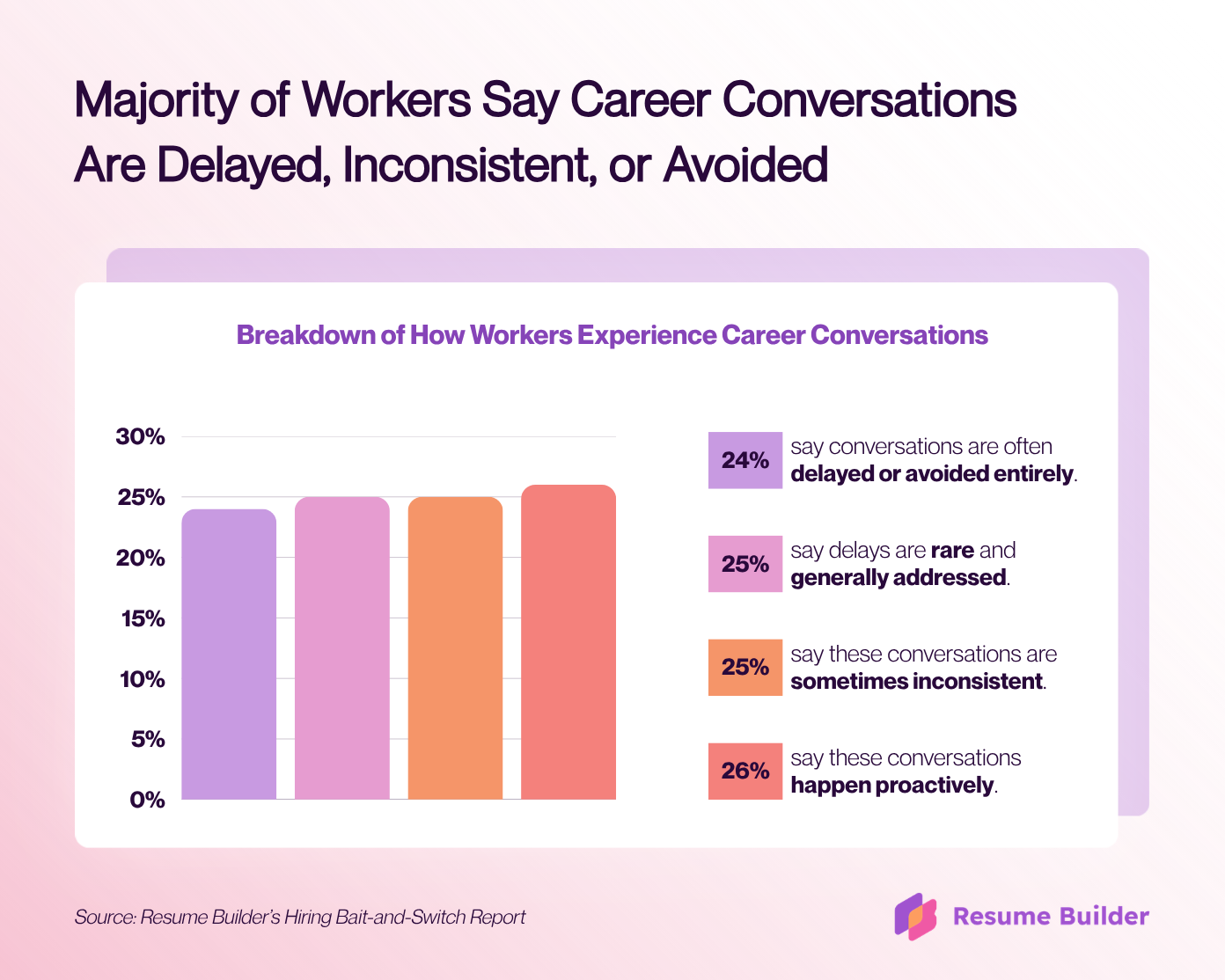
What this means: Employees aren’t just receiving mixed signals about their current role; many also face uncertainty about their next step on the career ladder. When conversations about advancement are inconsistent or avoided, employees may feel unsure how they can grow with the organization.
When a Job Isn’t What You Were Promised
A hiring bait-and-switch can leave workers discouraged and professionally unfulfilled, contributing to stress and potential burnout. Recognizing these issues early can help workers clarify whether the role can be brought back in line with what was promised or make informed decisions about what comes next.
For press inquiries, please contact Alex Murphy at [email protected].
Methodology
The findings presented are based on a nationally representative survey conducted by ResumeBuilder.com using Pollfish on August 11, 2026. The survey collected responses from 1,023 U.S. employees and examined their perceptions of hiring promises, daily role expectations, career advancement, and overall workplace value. Respondents answered different types of questions, including yes/no questions, scale-based questions where they indicated their level of agreement with statements, and multiple-choice questions where they could select from a list of options. The sample consisted of 53% female, 46% male, and 1% nonbinary respondents, with 19% Gen Z, 27% millennials, 27% Gen X, and 27% baby boomers.