The film industry is one of the most competitive fields in the job market. You’ll need to build an engaging portfolio and a strong resume to differentiate yourself from the applicant pool during your job search. Major production companies will be most interested in seeing specific projects you worked on, especially if the film or television show is widely recognized. This guide provides expert tips to build an accomplishment-driven resume that compliments a professional portfolio and provides deeper insights into your projects and writing methodology.
Most Popular Screenwriter Resumes
Aspiring Screenwriter Resume
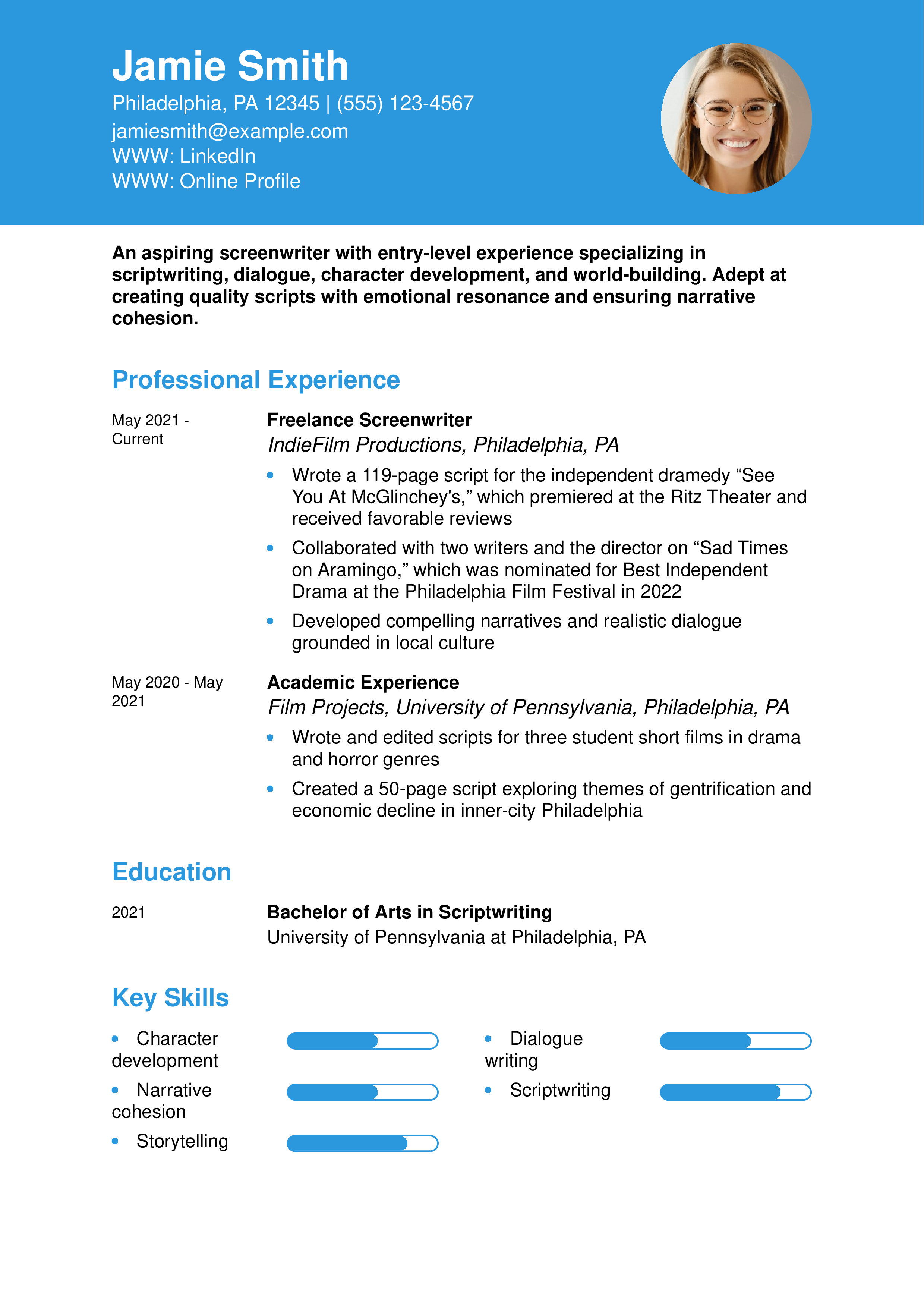
Why This Resume Stands Out
This resume is good because it highlights meaningful academic and freelance projects while showing early recognition through a festival nomination. It also demonstrates collaboration and originality.
Television Screenwriter Resume
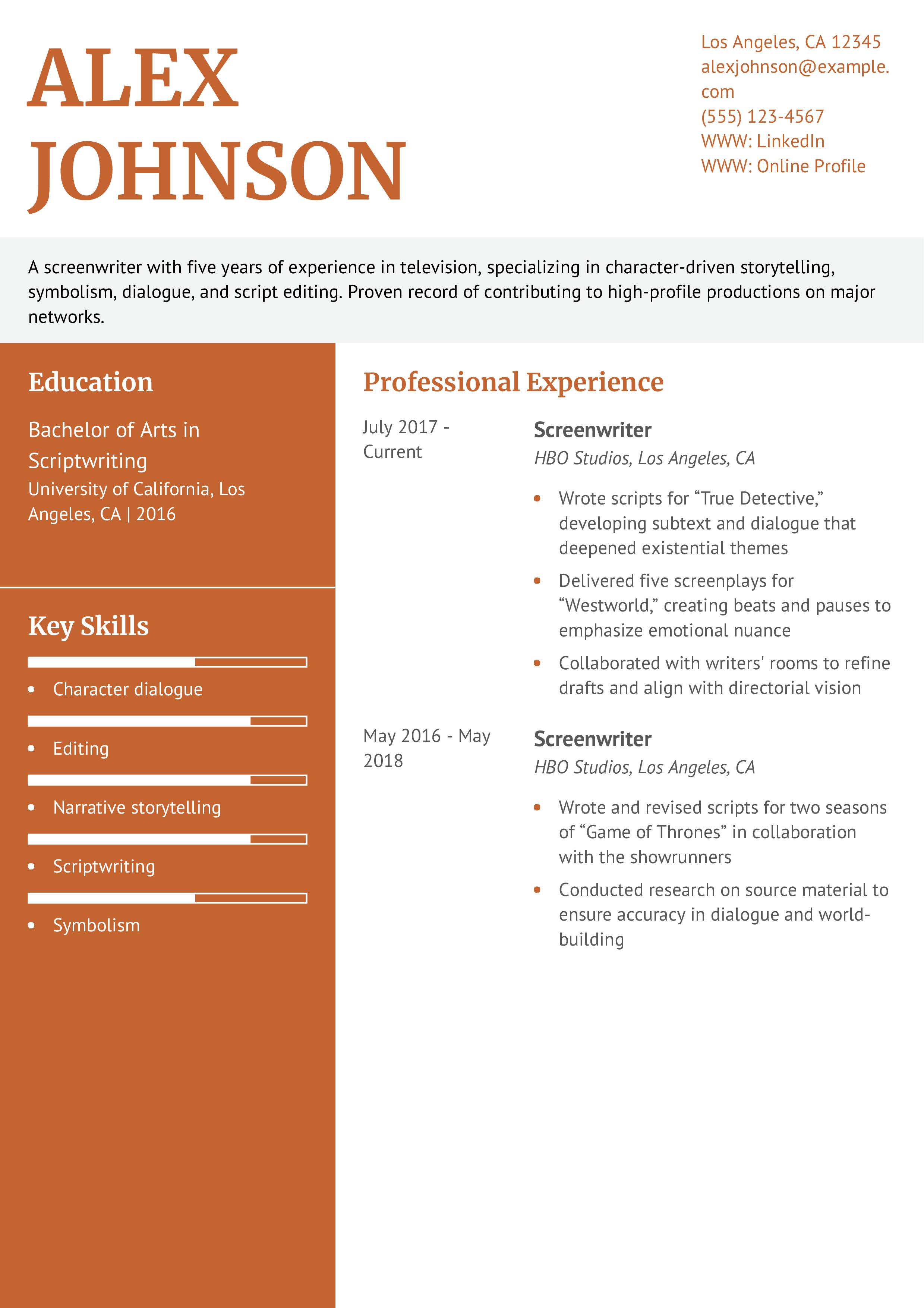
Why This Resume Stands Out
This resume is good because it emphasizes recognizable projects, demonstrating credibility and industry experience. It also shows the candidate’s ability to integrate research into creative storytelling.
Senior Screenwriter Resume
Why This Resume Stands Out
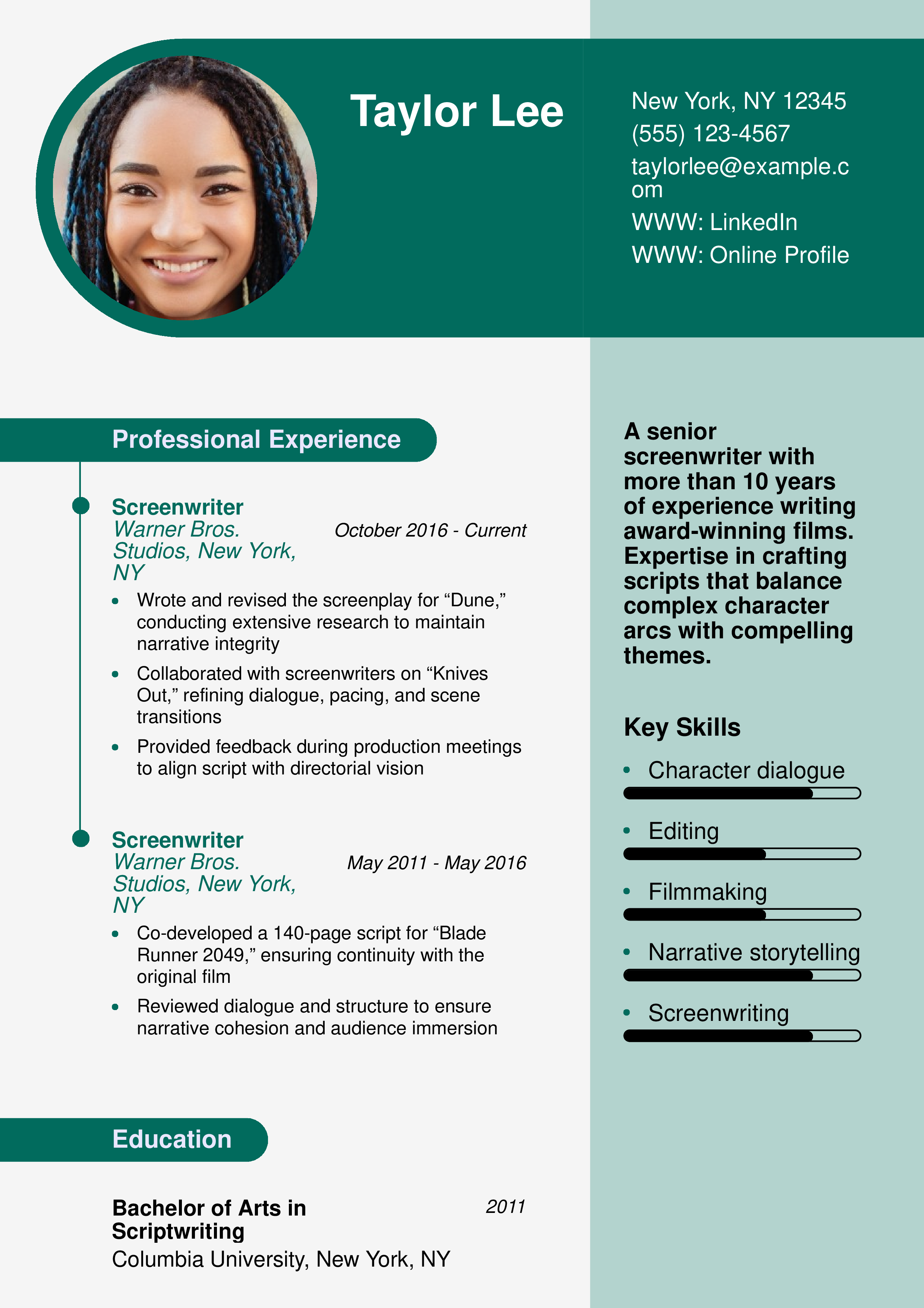
This resume is good because it demonstrates long-term industry success with high-profile projects. It clearly illustrates a history of collaboration and creative leadership.
Entry-Level Screenwriter Resume
Why This Resume Stands Out
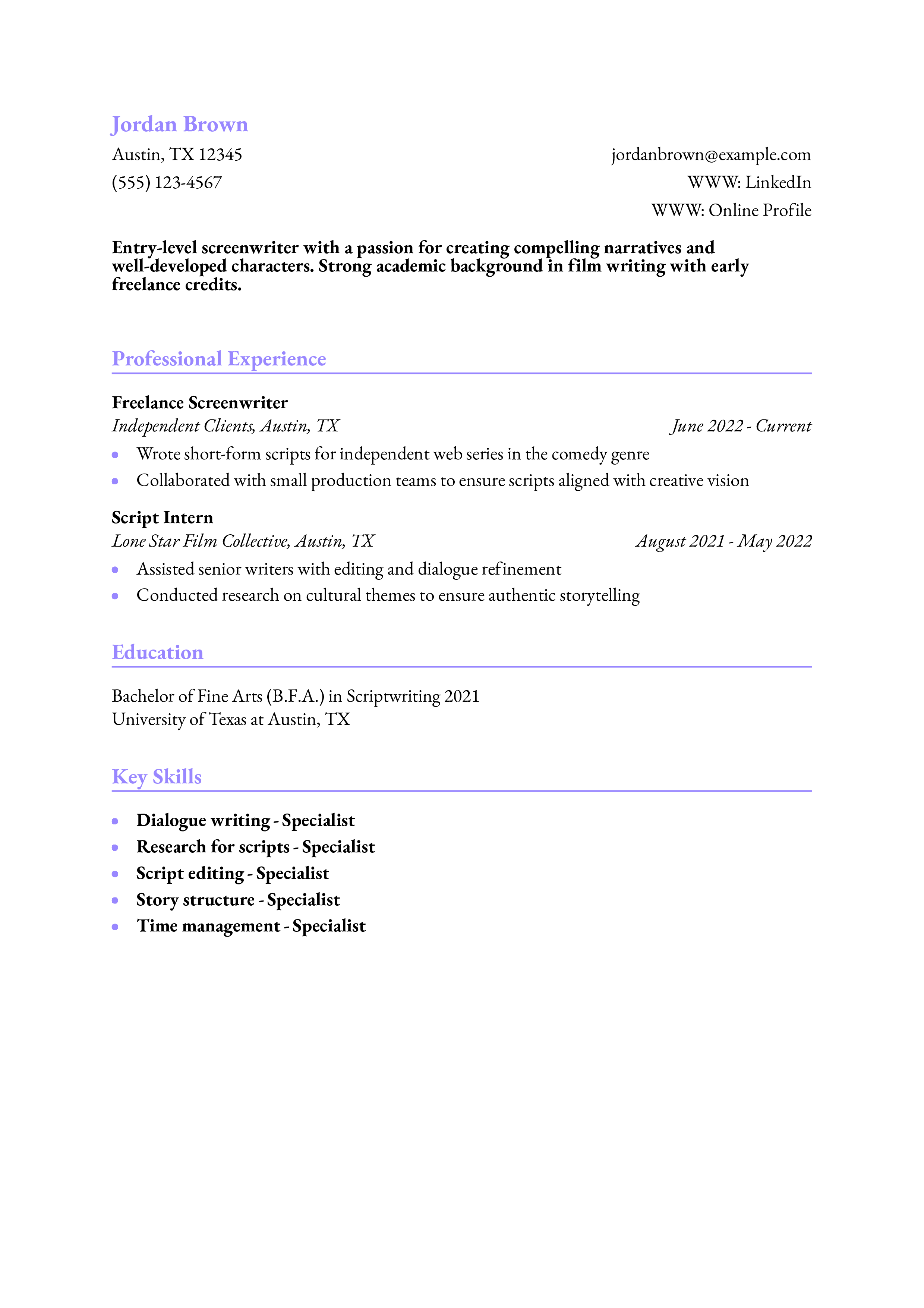
This resume is good because it shows a clear academic foundation supported by relevant internships and freelance work. It also demonstrates collaboration with independent teams.
Beginner Screenwriter Resume
Why This Resume Stands Out
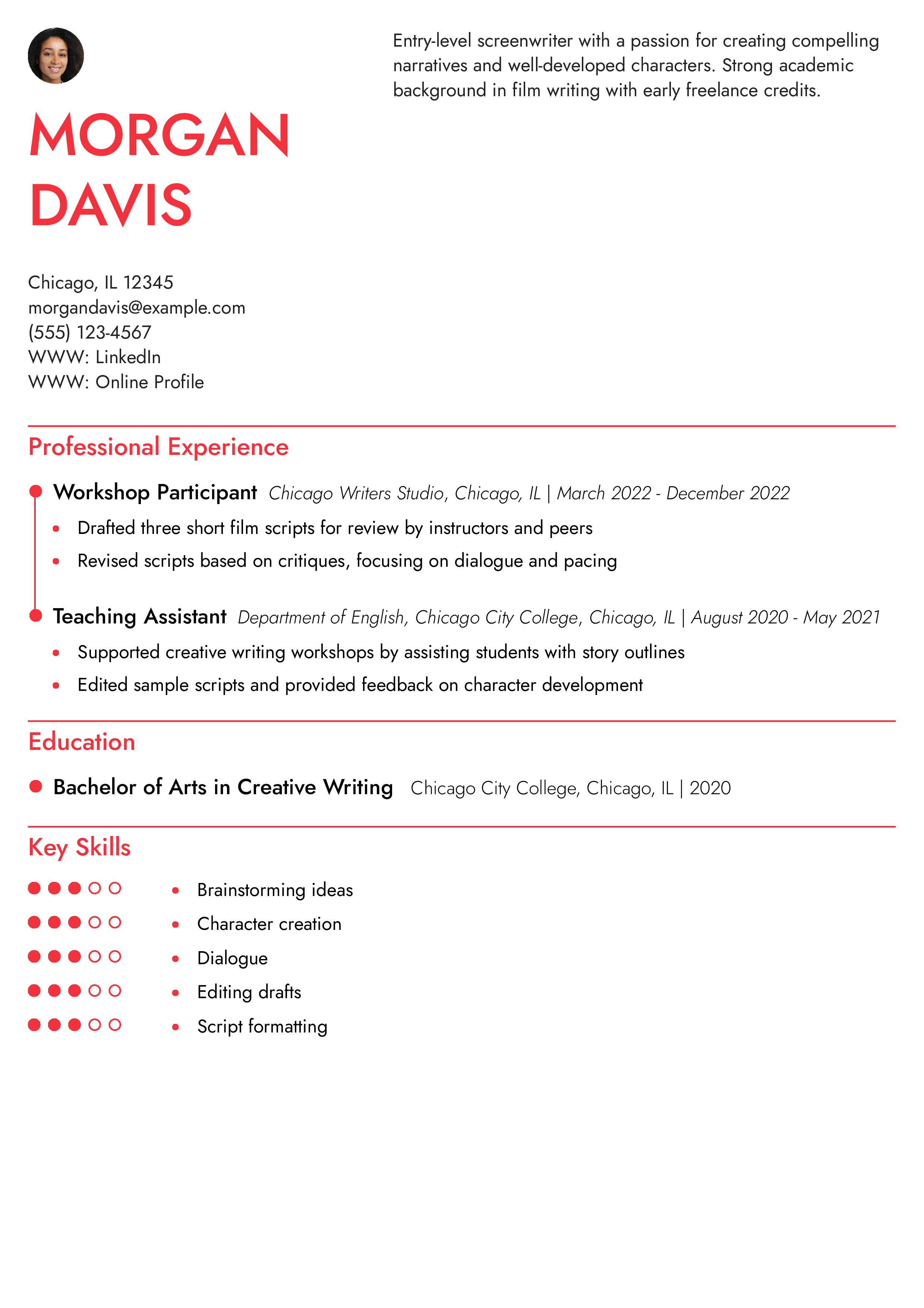
This resume is good because it demonstrates transferable academic and workshop experiences. It shows a candidate ready to grow and learn while emphasizing creativity.
Freelance Screenwriter Resume
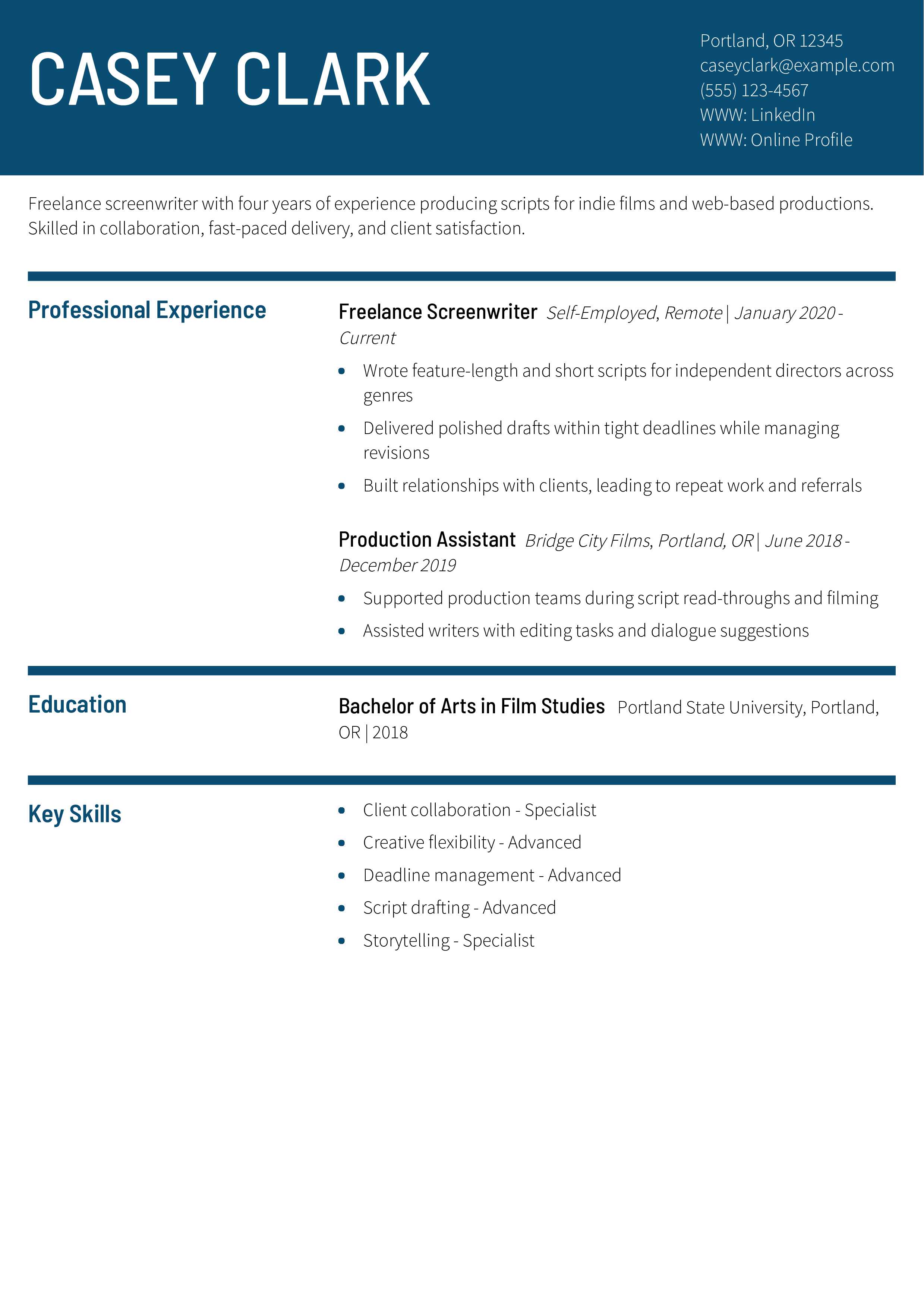
Why This Resume Stands Out
This resume is good because it highlights freelancing success with measurable client satisfaction. It also shows adaptability across different types of productions.
Screenwriting Graduate Resume
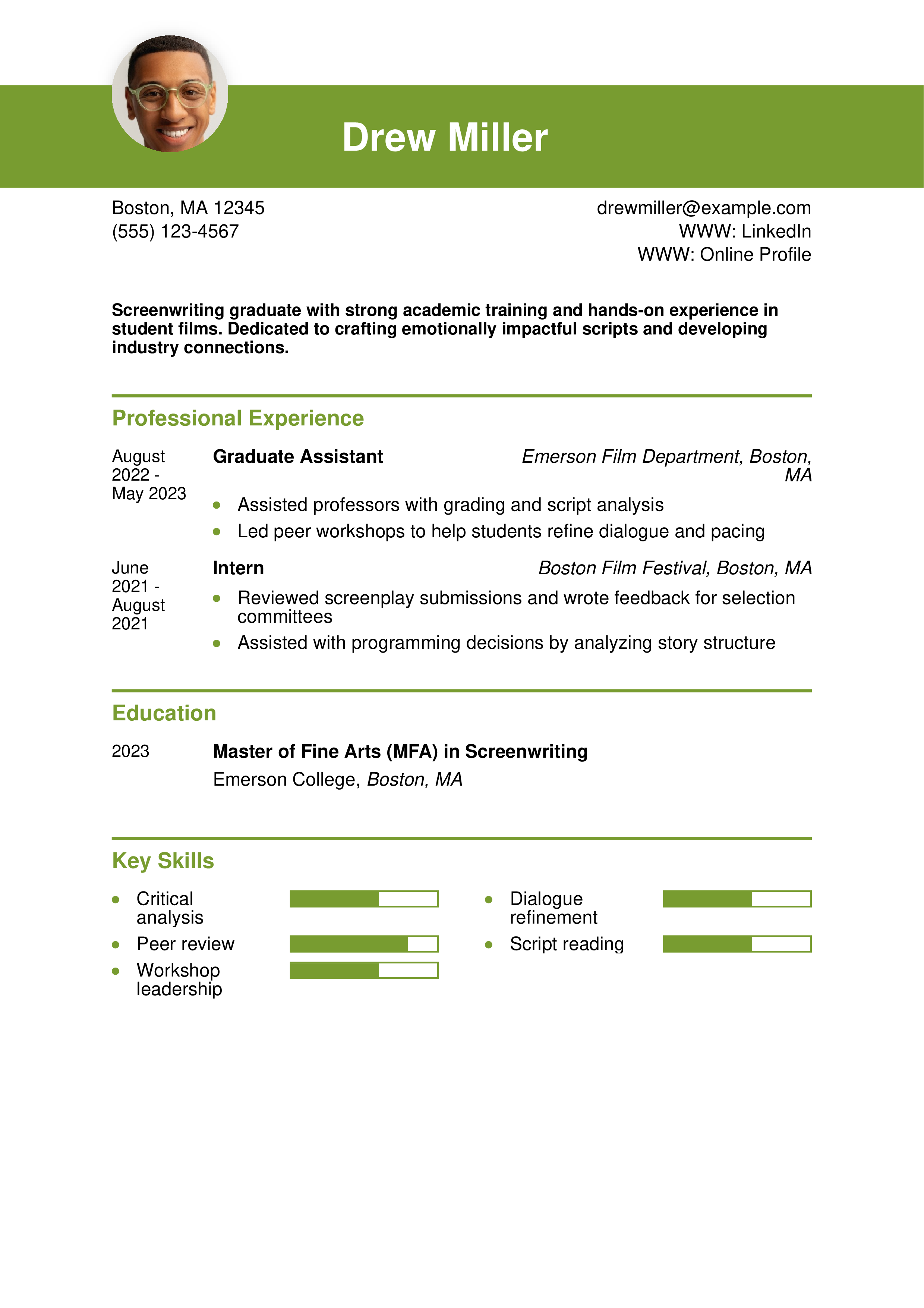
Why This Resume Stands Out
This resume is good because it combines graduate-level education with relevant assistantship and festival experience, showcasing both academic and industry exposure.
Screenwriting MFA Resume
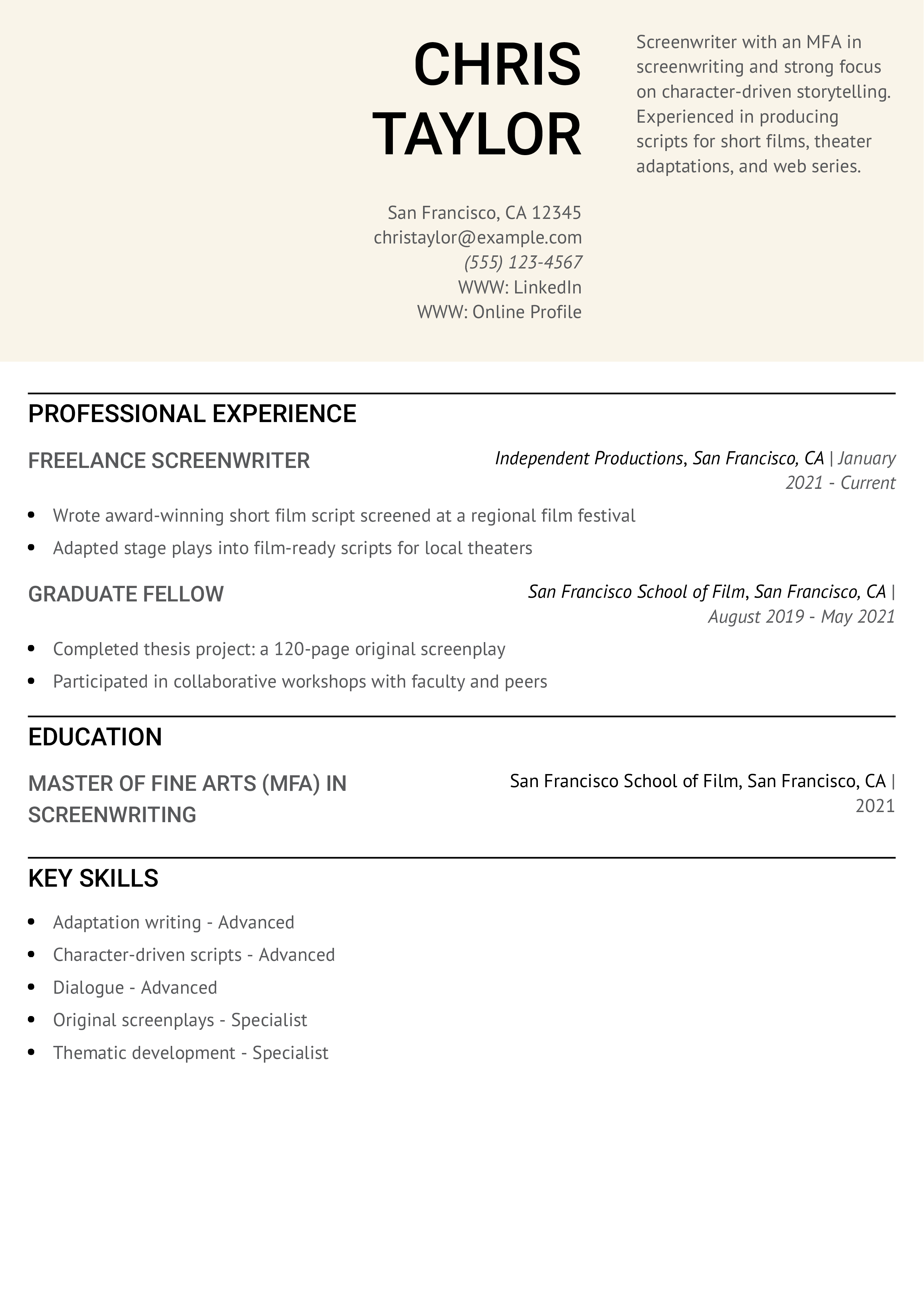
Why This Resume Stands Out
This resume is good because it highlights advanced education and festival recognition, showcasing academic and practical strengths.
Screenwriting Lecturer Resume
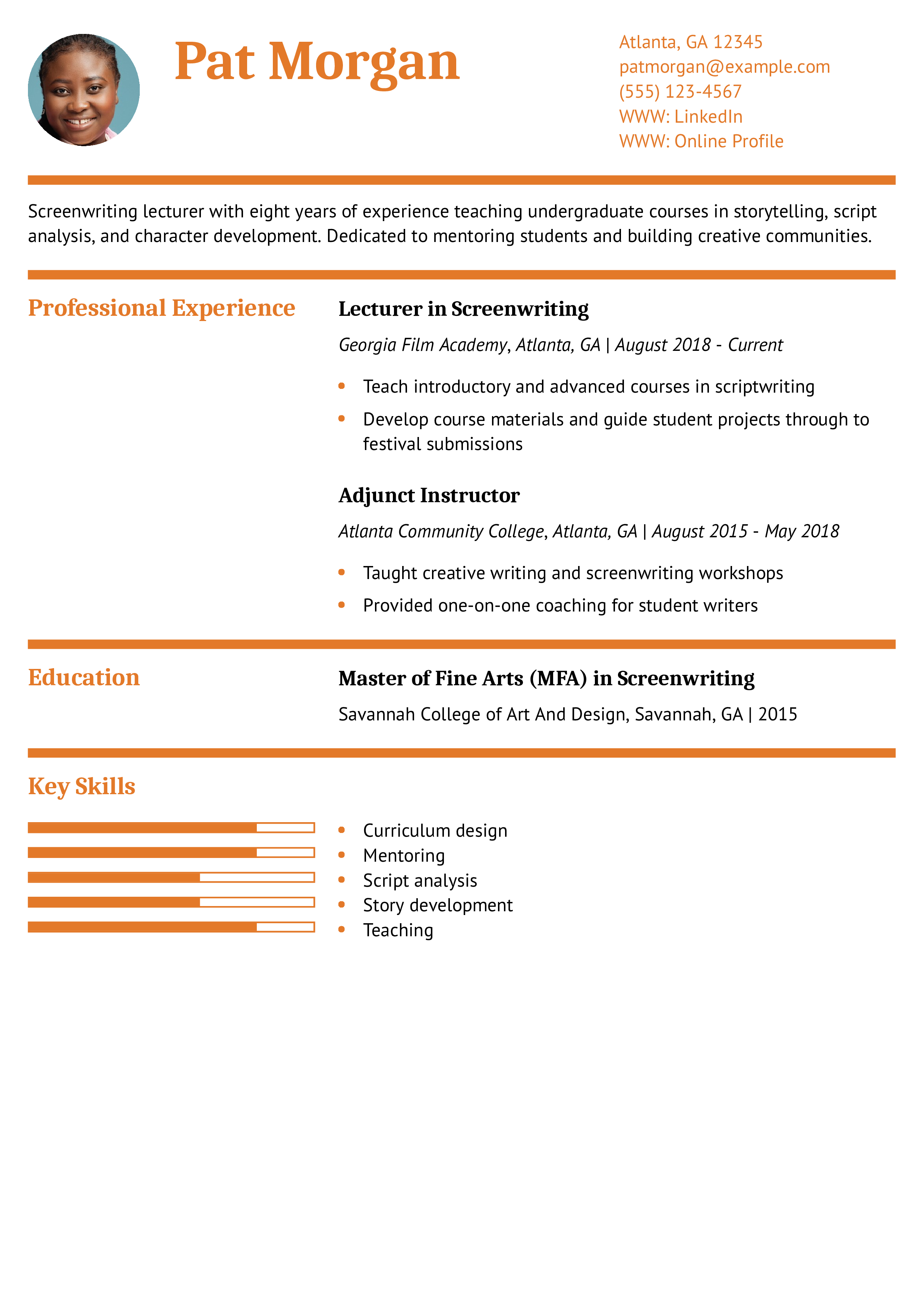
Why This Resume Stands Out
This resume is good because it demonstrates teaching expertise, mentorship, and course creation, making it suitable for academic institutions.
Screenwriting Professor Resume
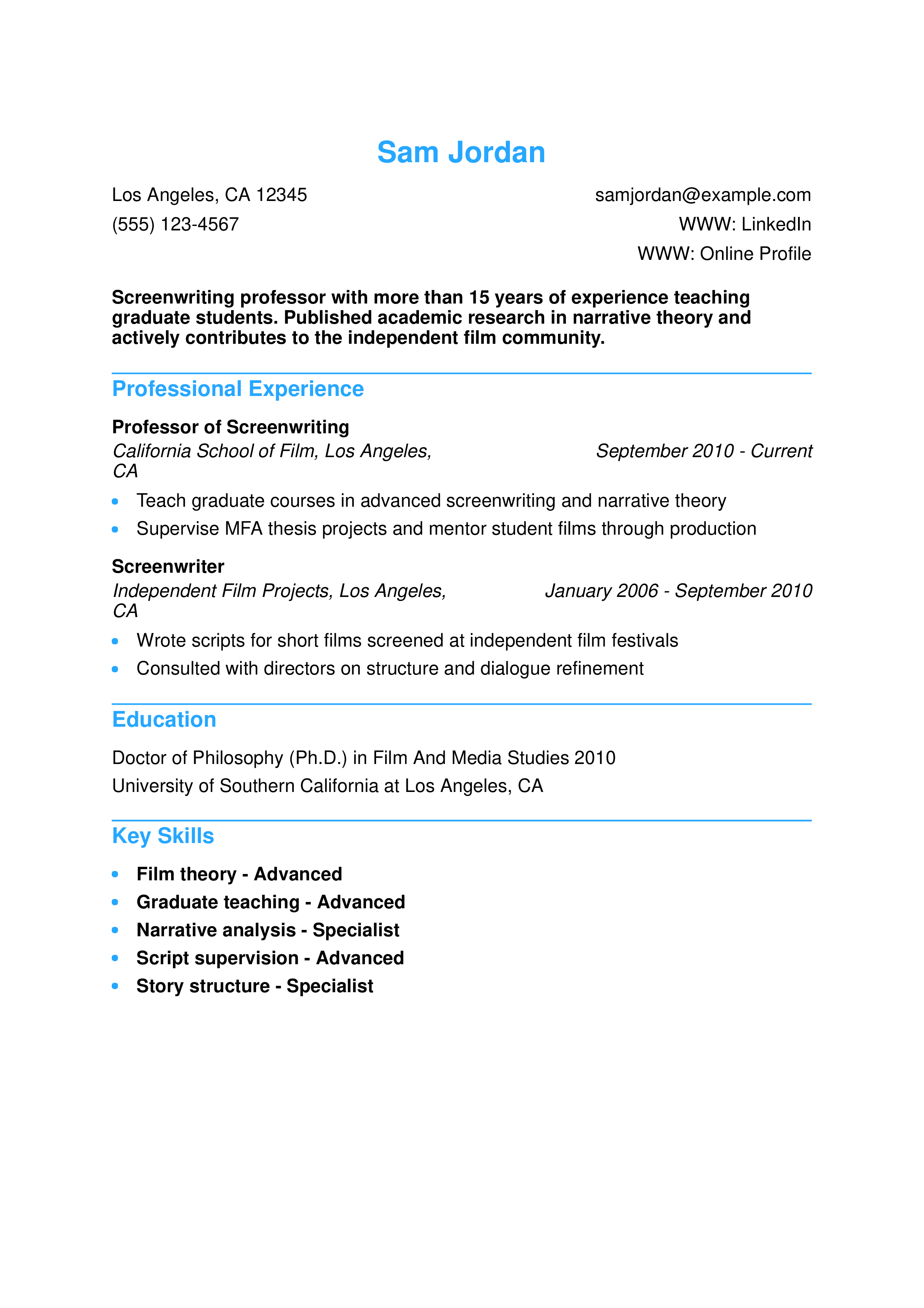
Why This Resume Stands Out
This resume is good because it shows academic leadership, published research, and mentorship of graduate-level projects. It balances teaching and creative practice.
Screenwriting With No Experience Resume
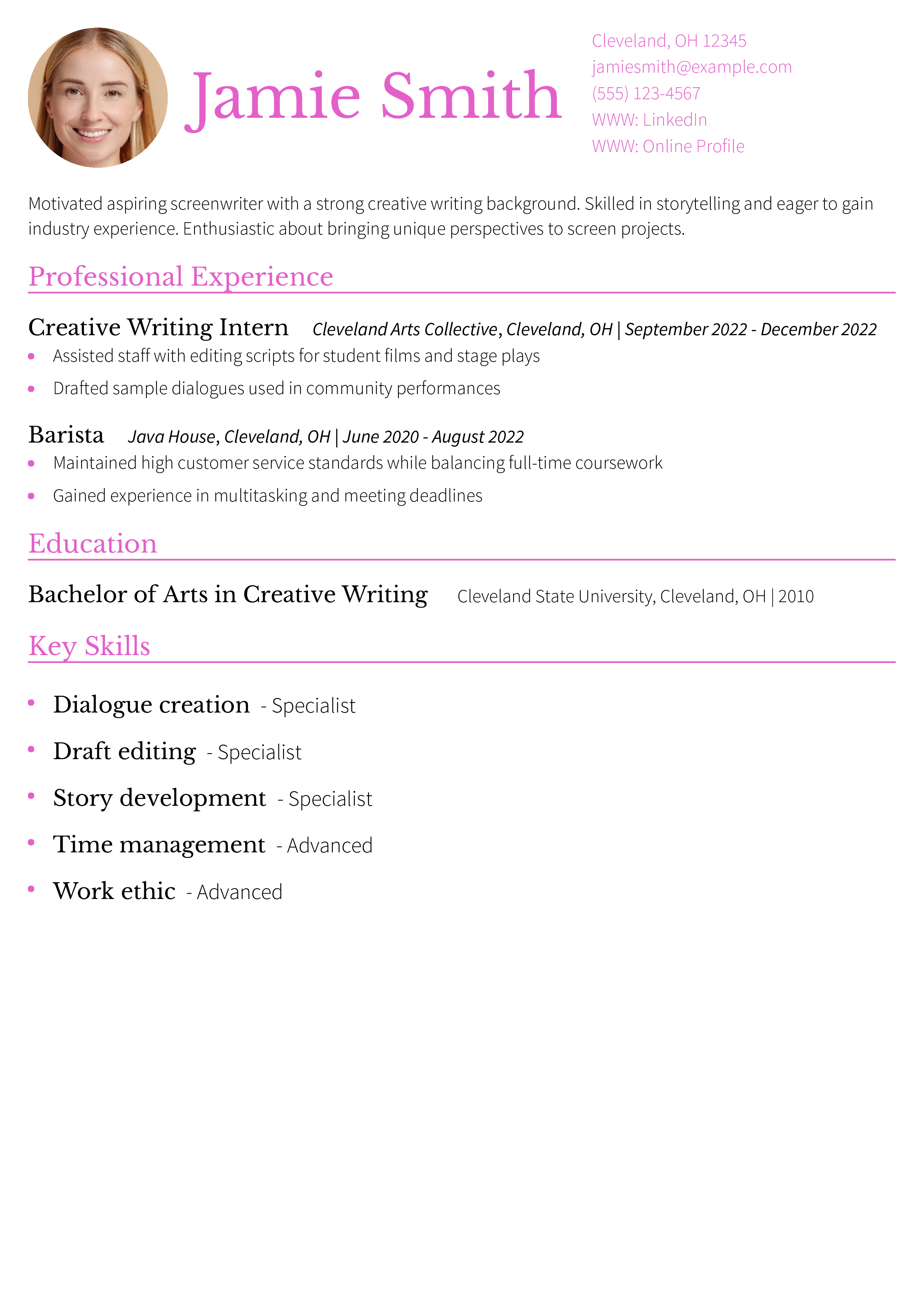
Why This Resume Stands Out
This resume is good because it demonstrates transferable skills and shows enthusiasm for screenwriting despite limited professional experience. It emphasizes writing ability and dedication.
Screenwriting Slugline Resume
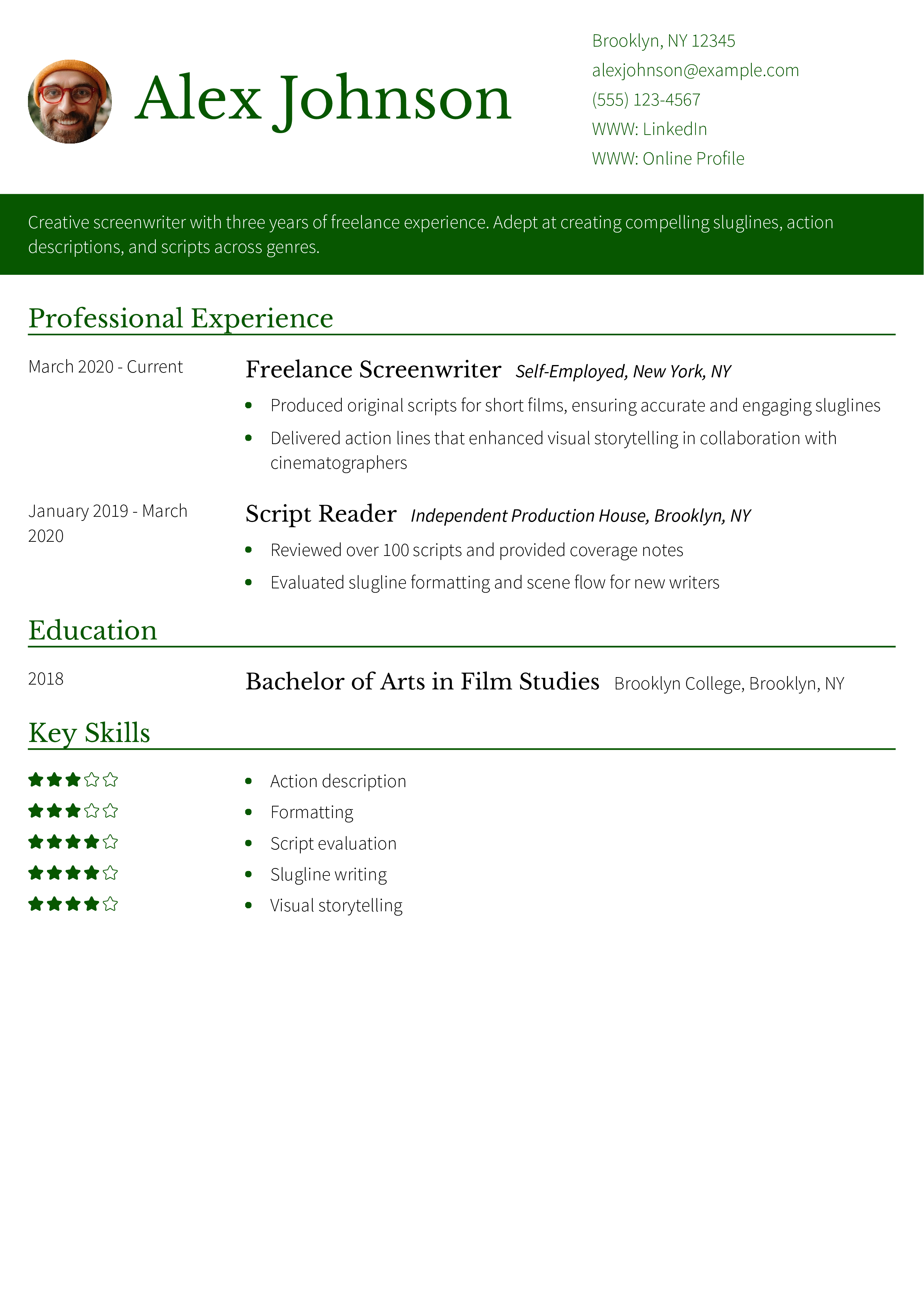
Why This Resume Stands Out
This resume is good because it emphasizes technical screenwriting skills like slugline writing, which are often overlooked but essential. It balances creative and analytical roles.
Independent Film Screenwriter Resume
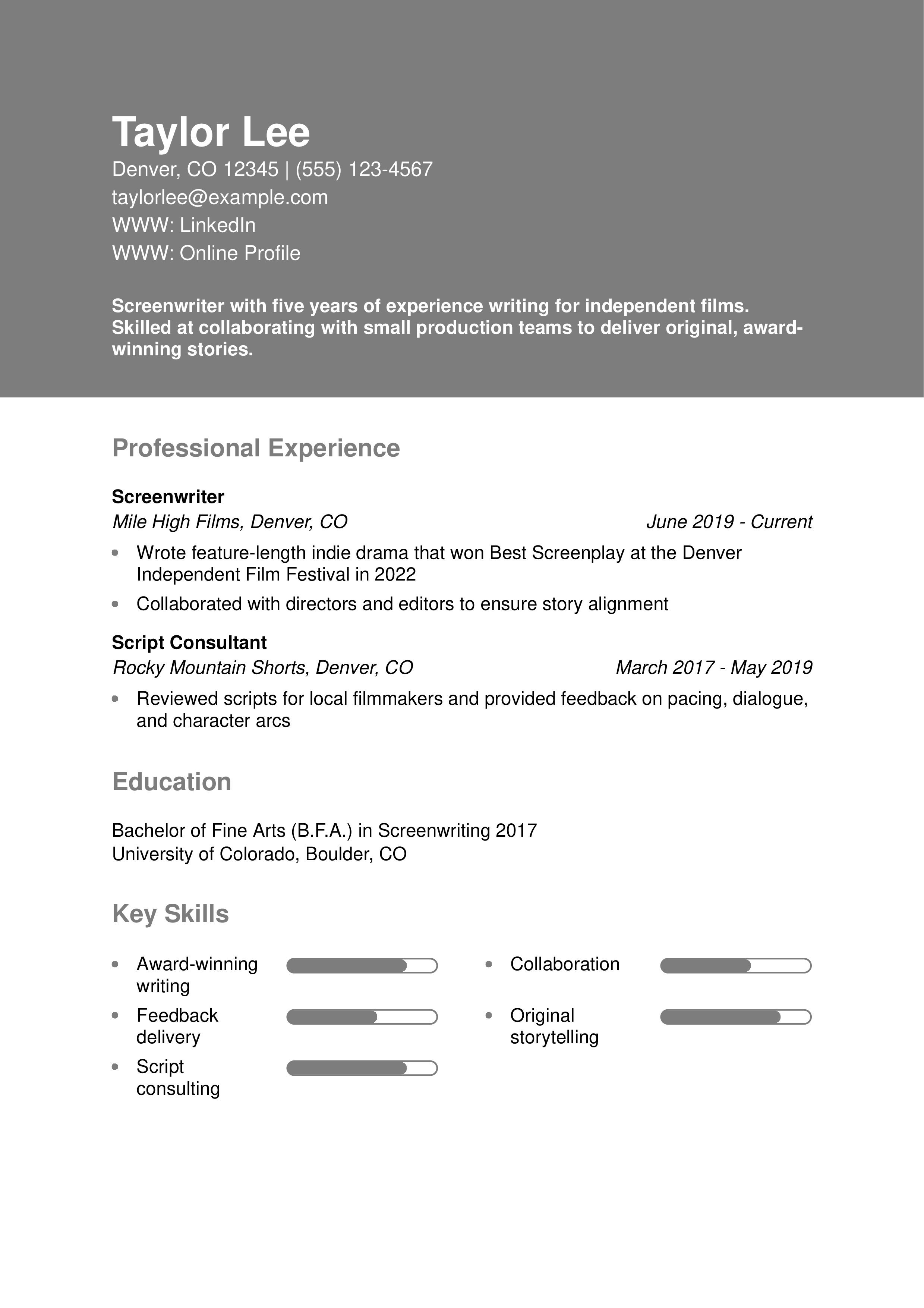
Why This Resume Stands Out
This resume is good because it highlights independent film achievements, which show creativity and initiative. It uses awards to build credibility.
Comedy Screenwriter Resume
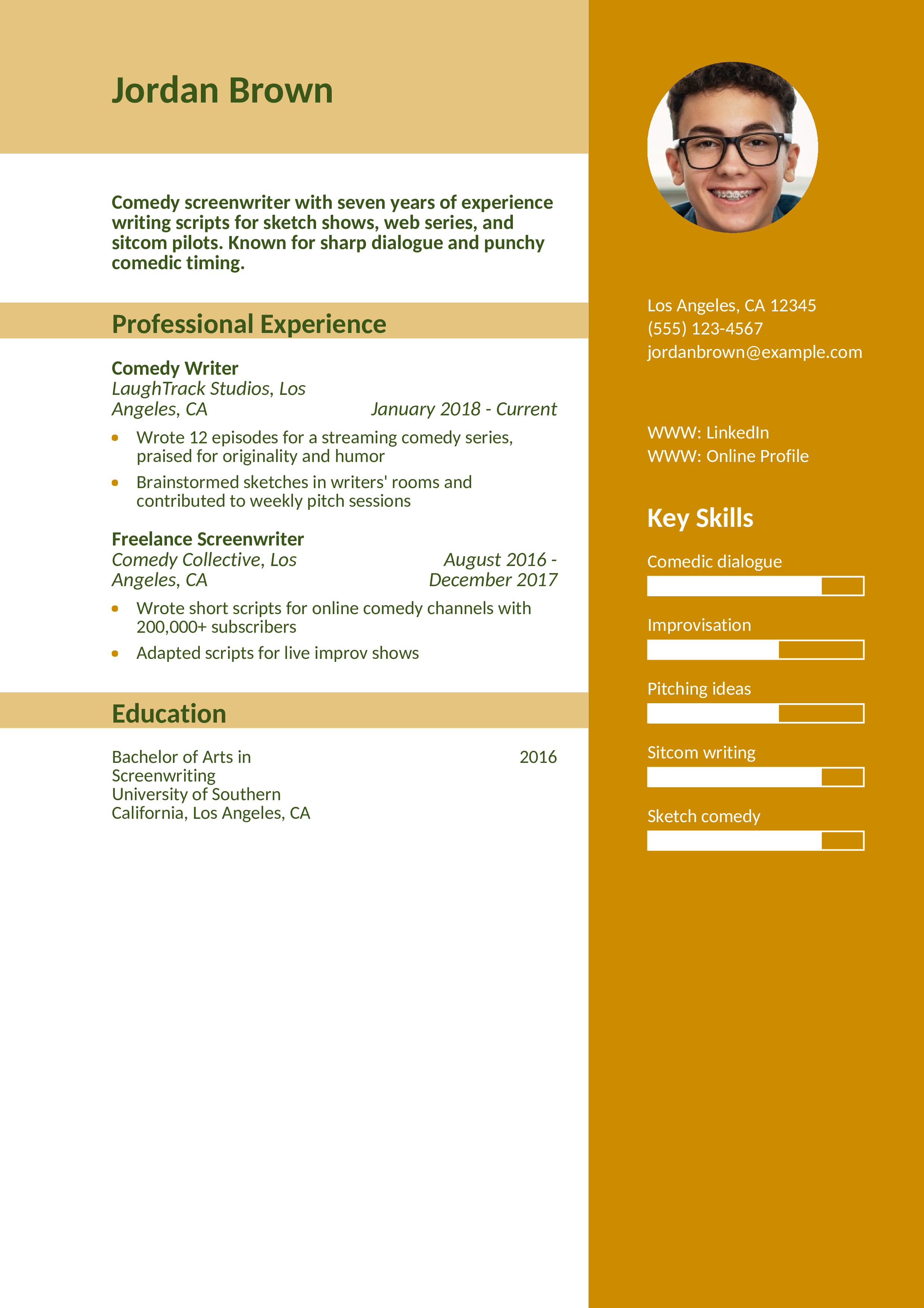
Why This Resume Stands Out
This resume is good because it highlights a clear genre specialty and measurable success through audience reach. It shows creativity while also demonstrating teamwork.
Drama Screenwriter Resume
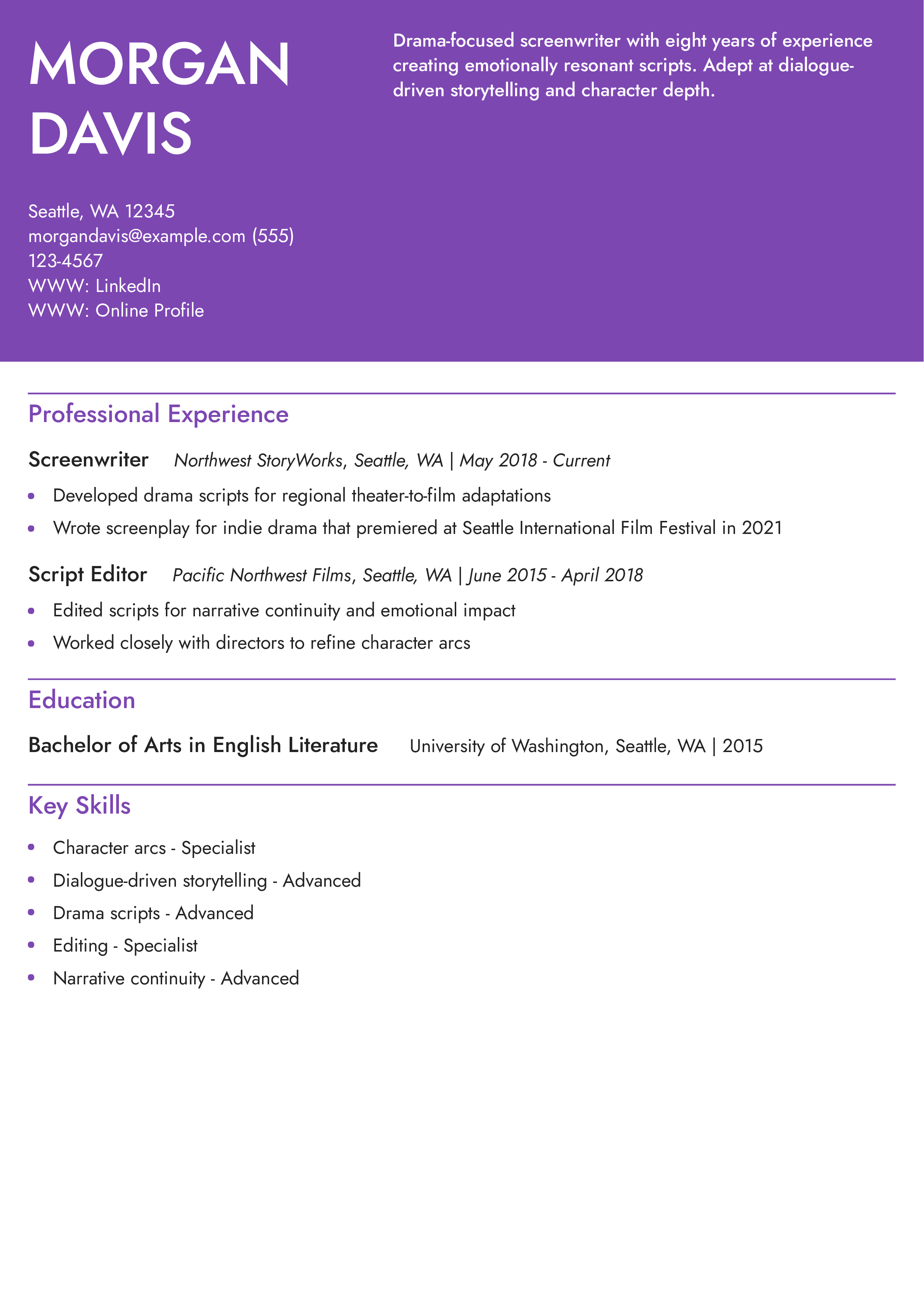
Why This Resume Stands Out
This resume is good because it focuses on a specific genre, drama, and provides proof of success with festival screenings. It demonstrates editing and writing abilities.
Horror Screenwriter Resume
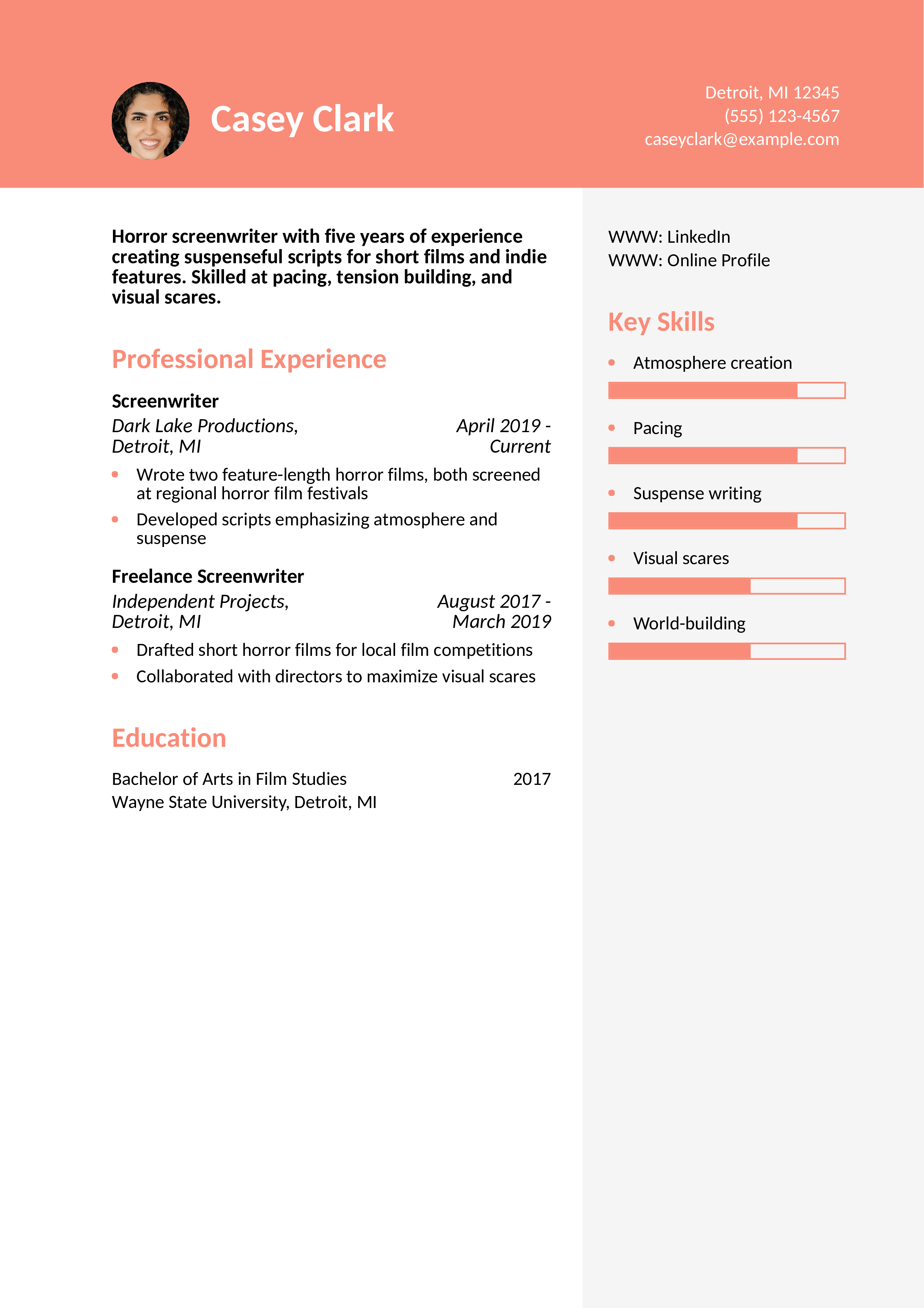
Why This Resume Stands Out
This resume is good because it highlights niche expertise in horror, a genre that values distinct skills like pacing and atmosphere. Festival screenings validate its impact.
Animation Screenwriter Resume
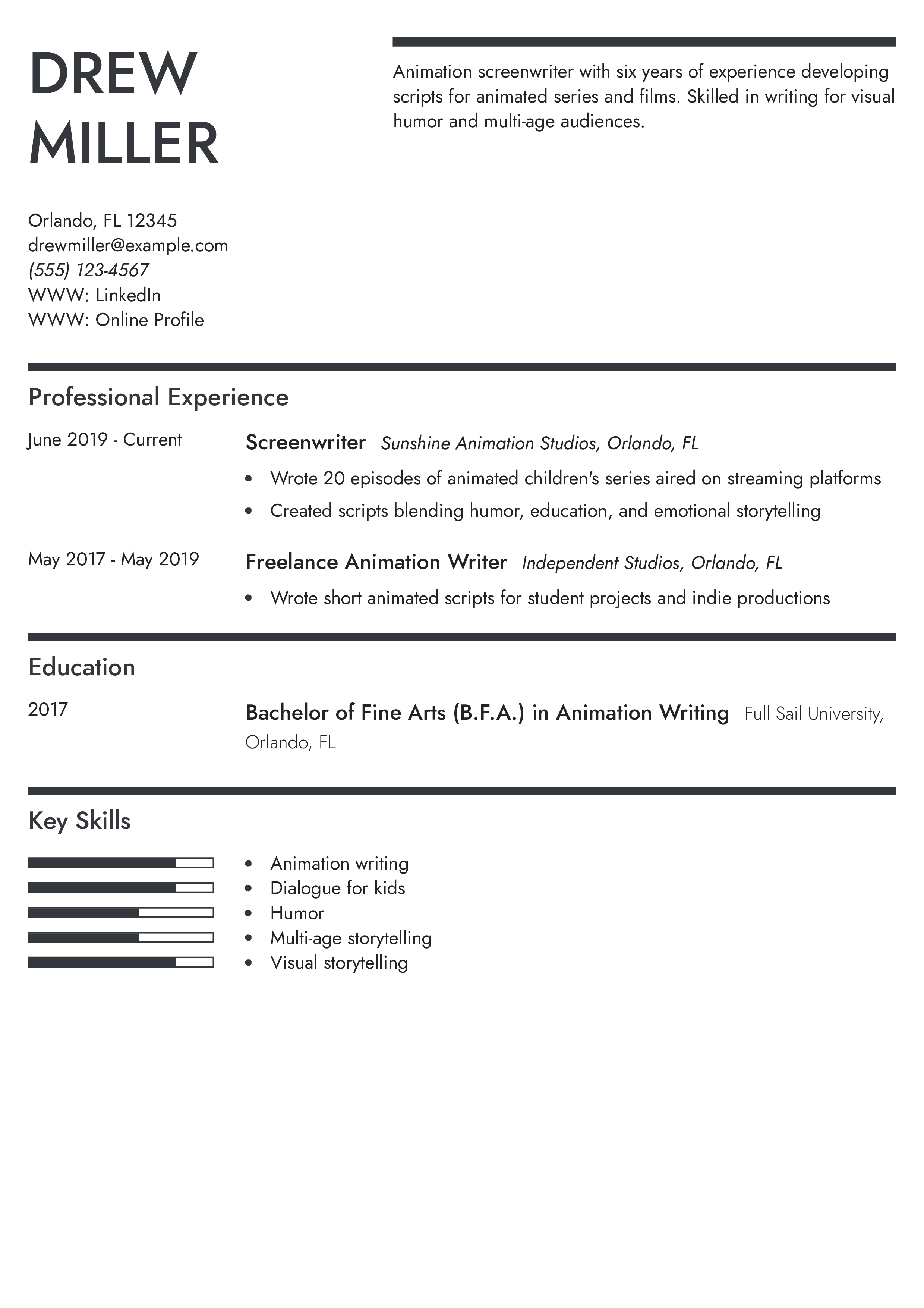
Why This Resume Stands Out
This resume is good because it highlights a specialized skill set in animation, with measurable production outcomes like episode counts.
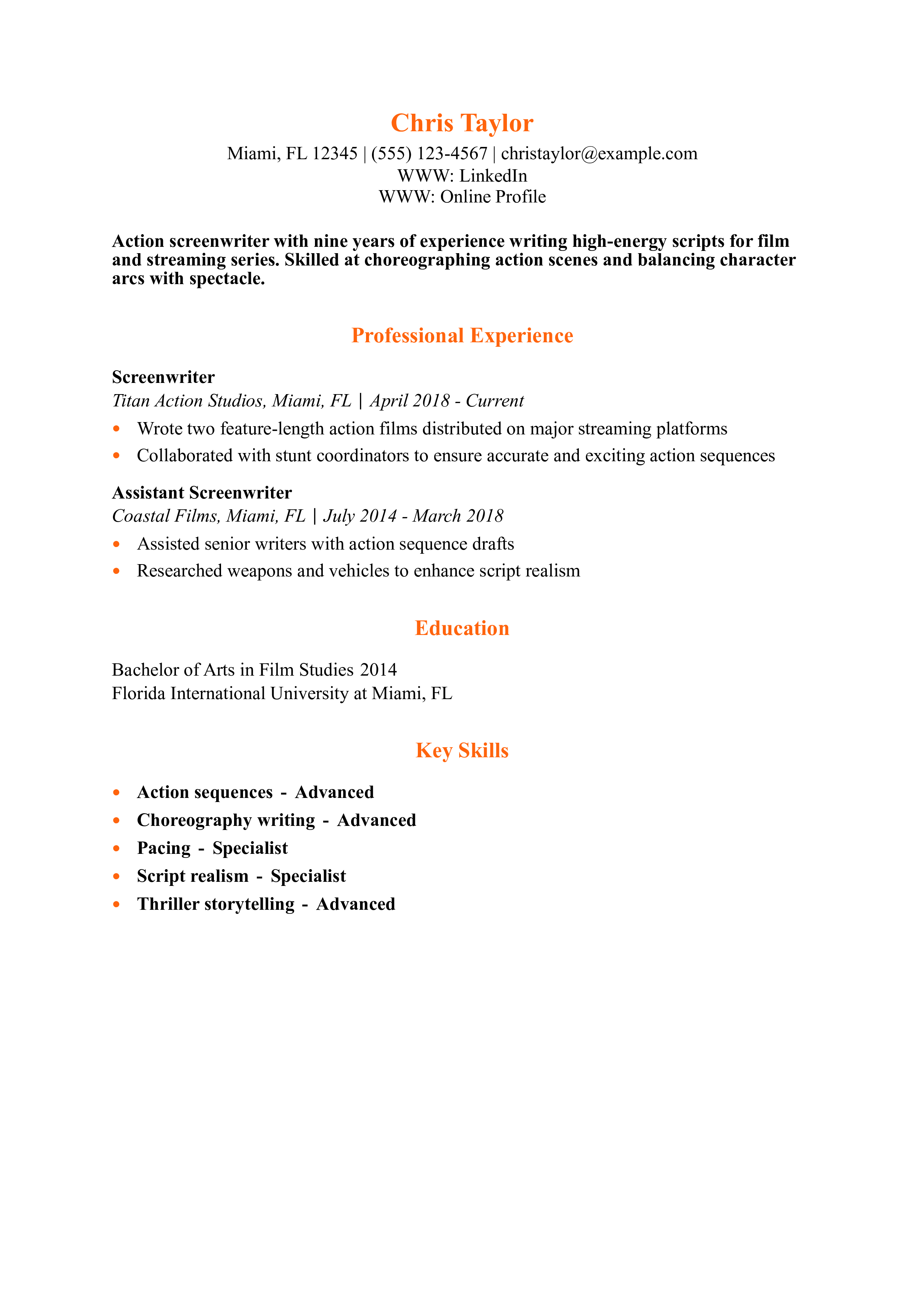
Action Screenwriter Resume
Why This Resume Stands Out
This resume is good because it shows how technical knowledge and creative storytelling come together for action films. It emphasizes both research and collaboration.
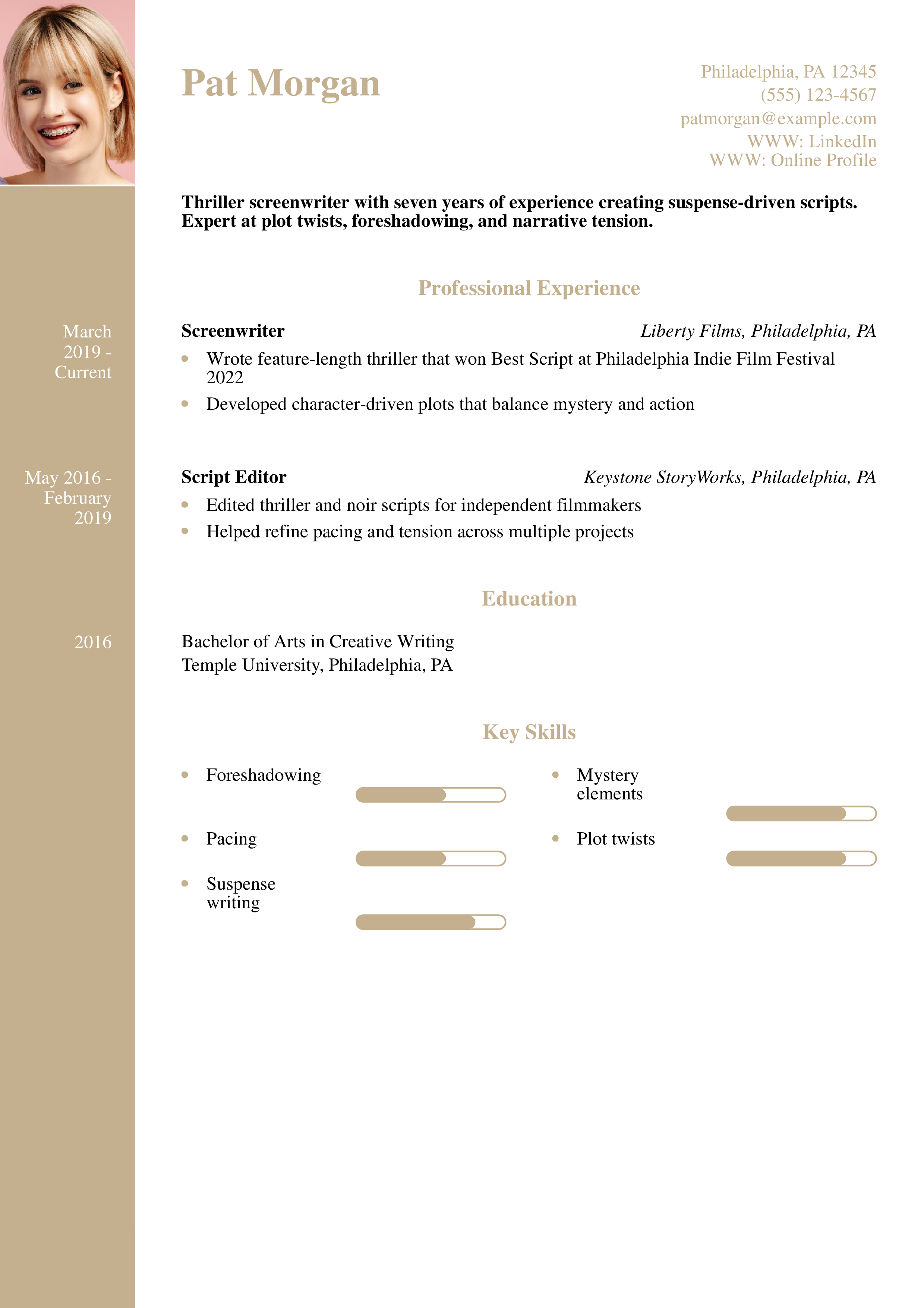
Thriller Screenwriter Resume
Why This Resume Stands Out
This resume is good because it highlights a genre specialty, supported by awards and editing experience. It shows mastery in creating suspense and engaging readers.
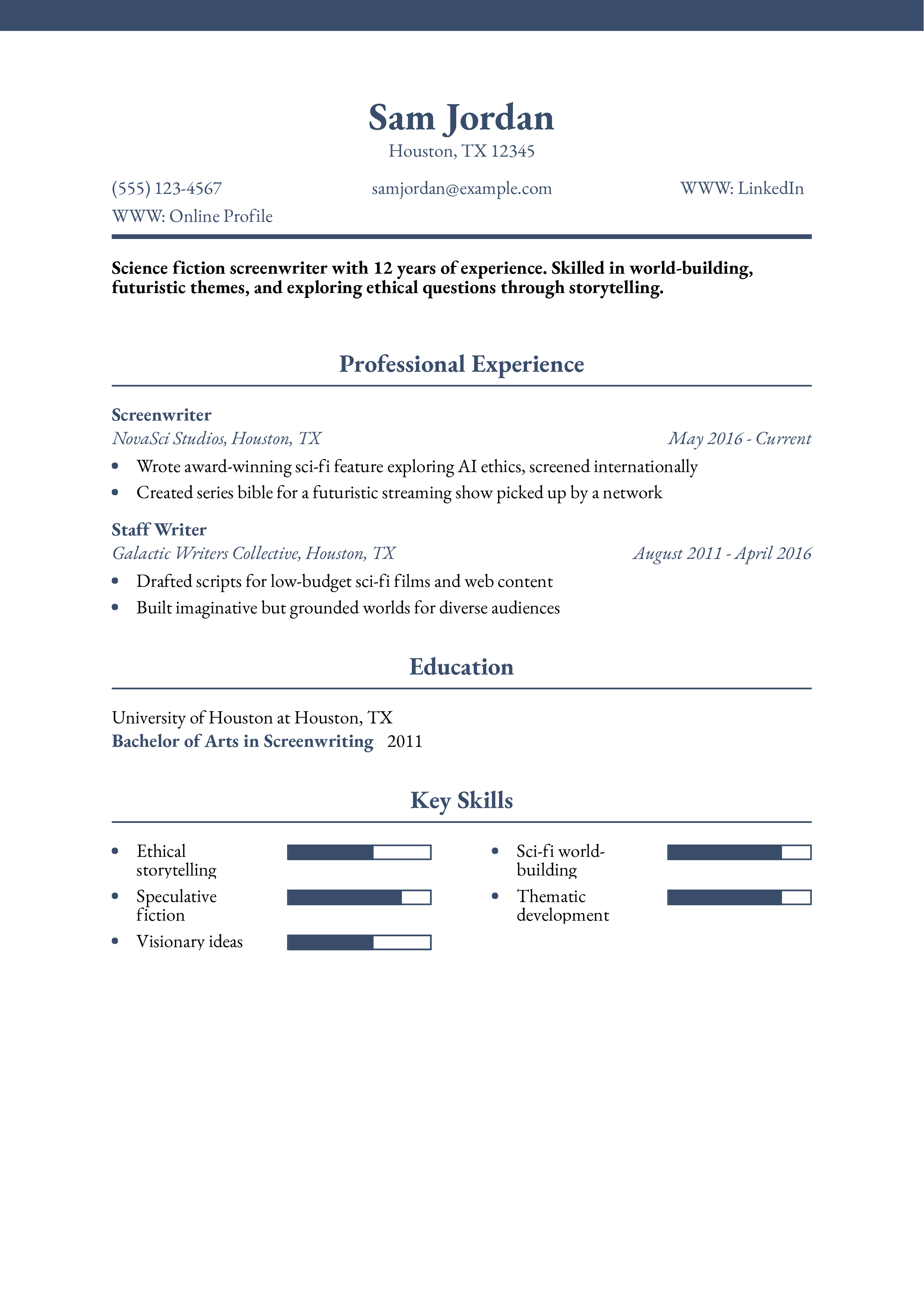
Science Fiction Screenwriter Resume
Why This Resume Stands Out
This resume is good because it shows deep specialization in sci-fi with both independent and larger-scale projects. It highlights awards and creative development skills.
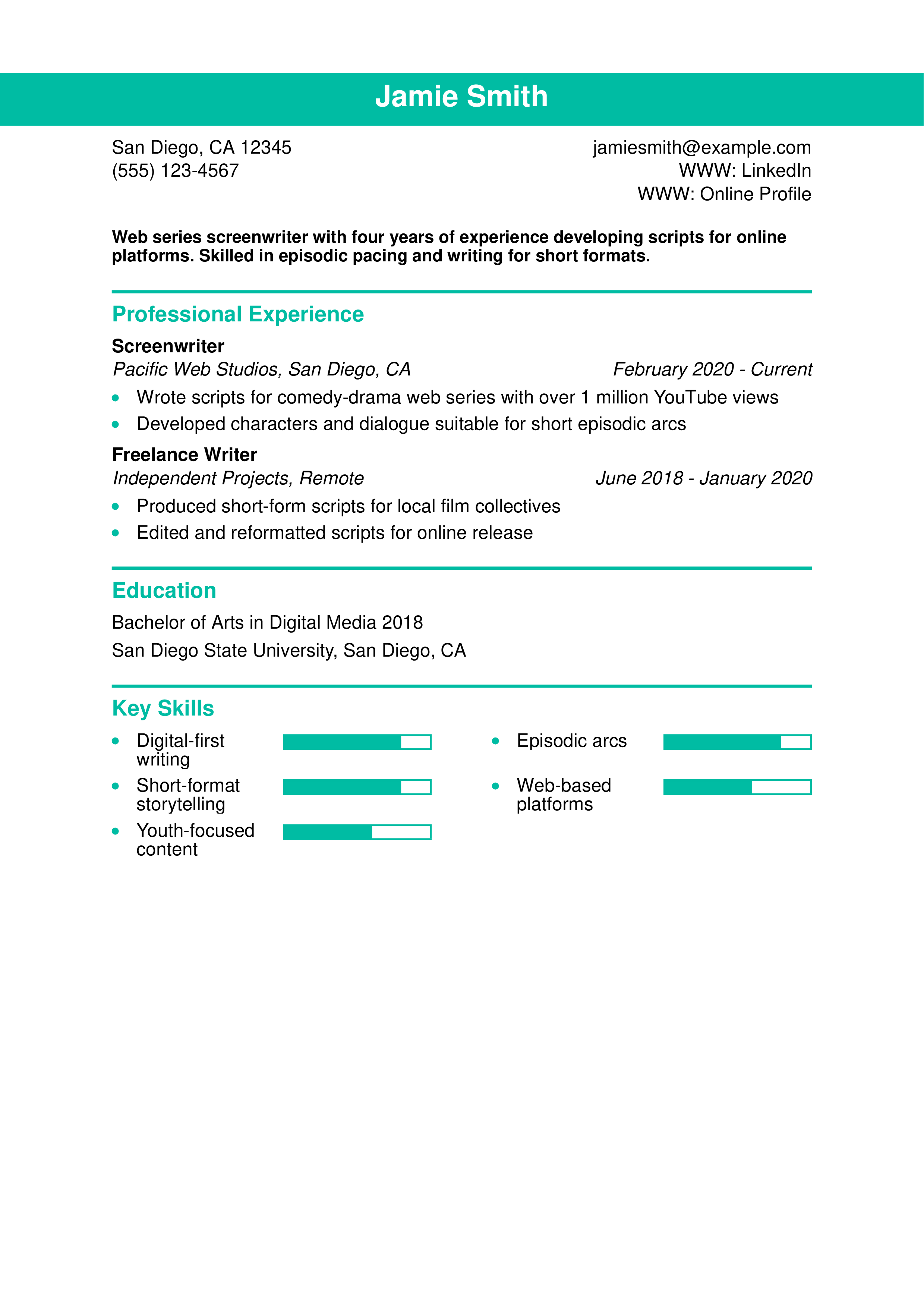
Web Series Screenwriter Resume
Why This Resume Stands Out
This resume is good because it shows experience adapting to digital-first platforms, a fast-growing area in media. It provides measurable outcomes through viewership numbers.
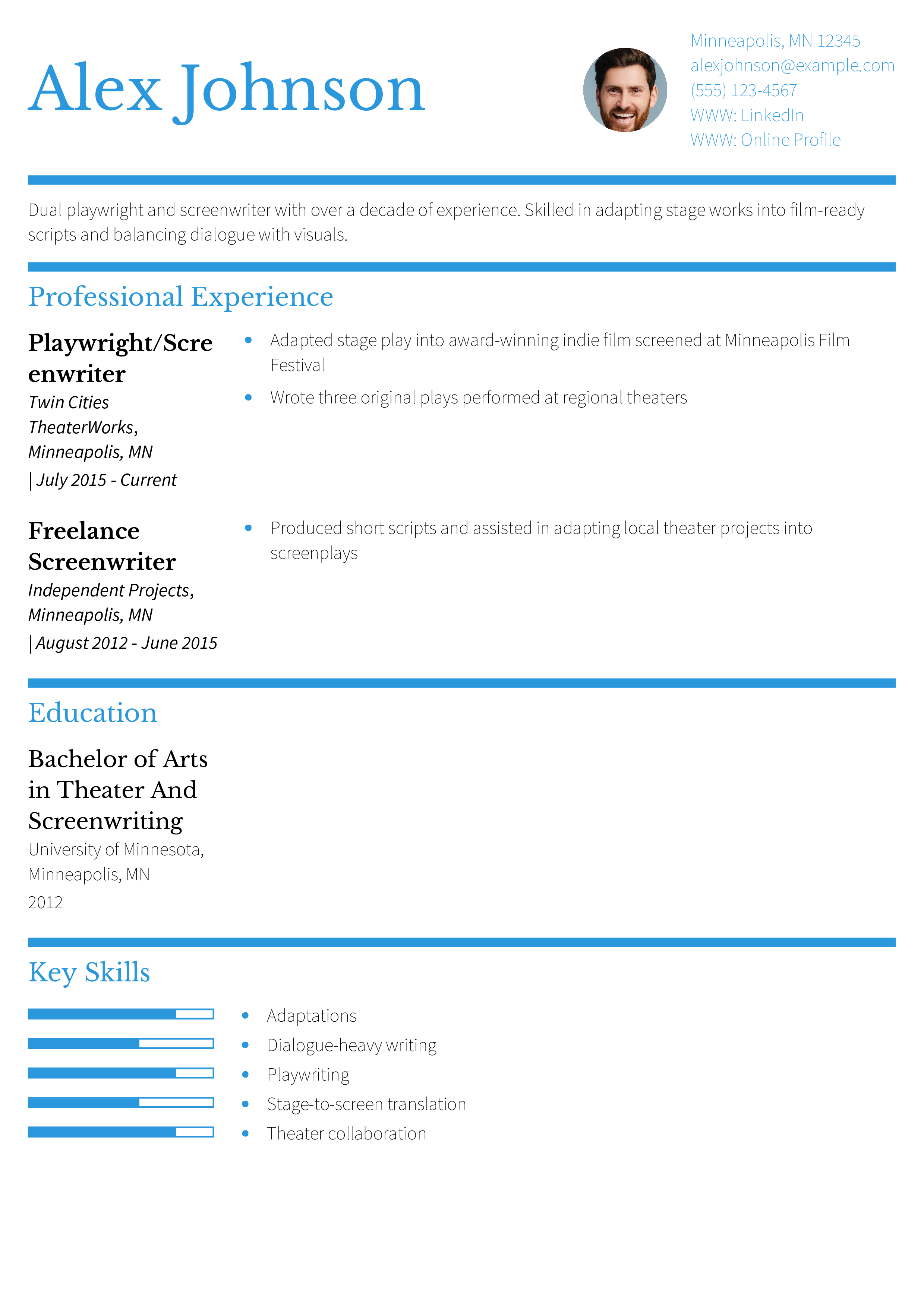
Playwright and Screenwriter Resume
Why This Resume Stands Out
This resume is good because it emphasizes versatility between theater and film. It highlights awards, adaptations, and long-term writing practice.
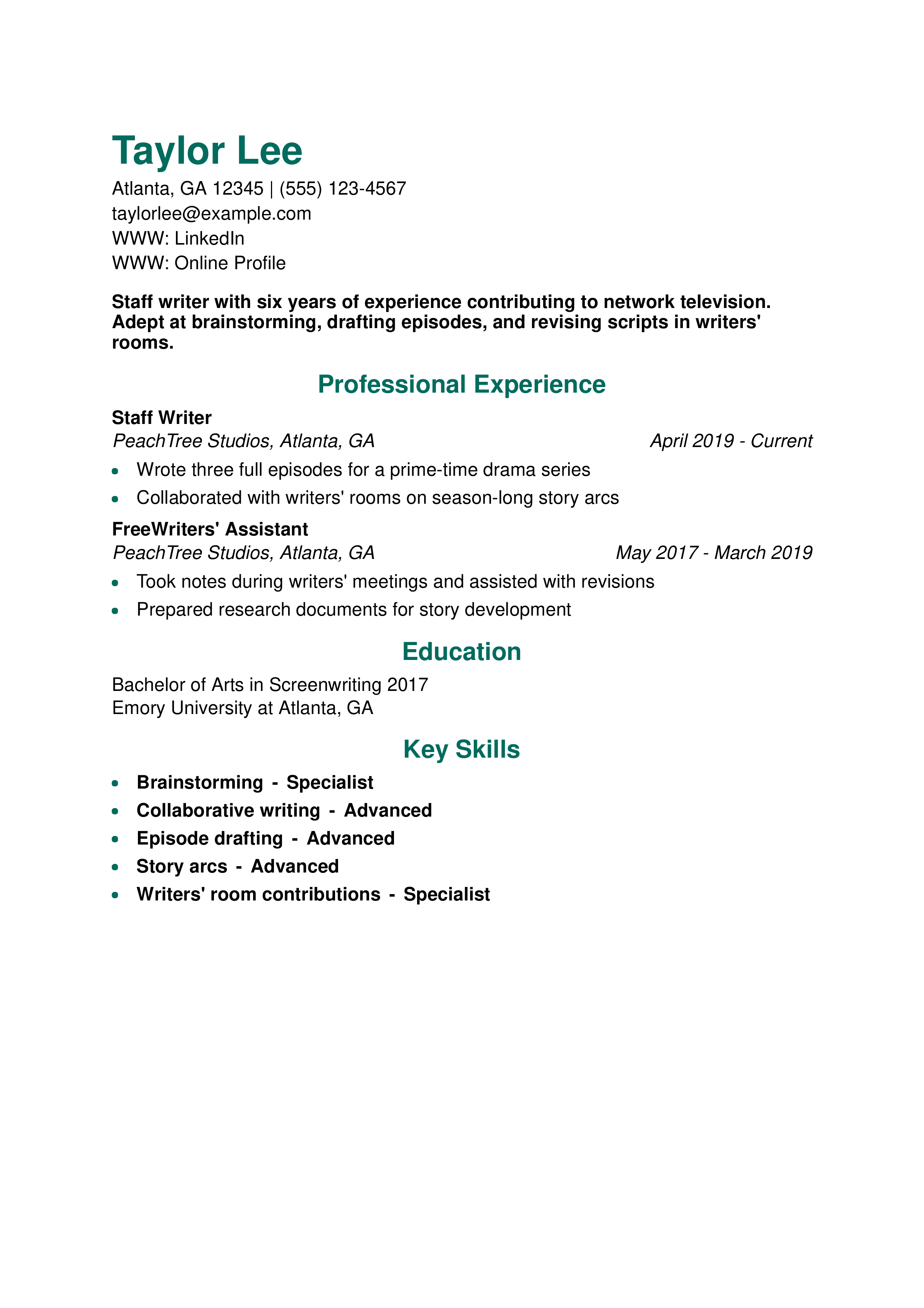
Staff Writer Resume
Why This Resume Stands Out
This resume is good because it shows clear progression from assistant to staff writer. It demonstrates teamwork in professional writers’ rooms.
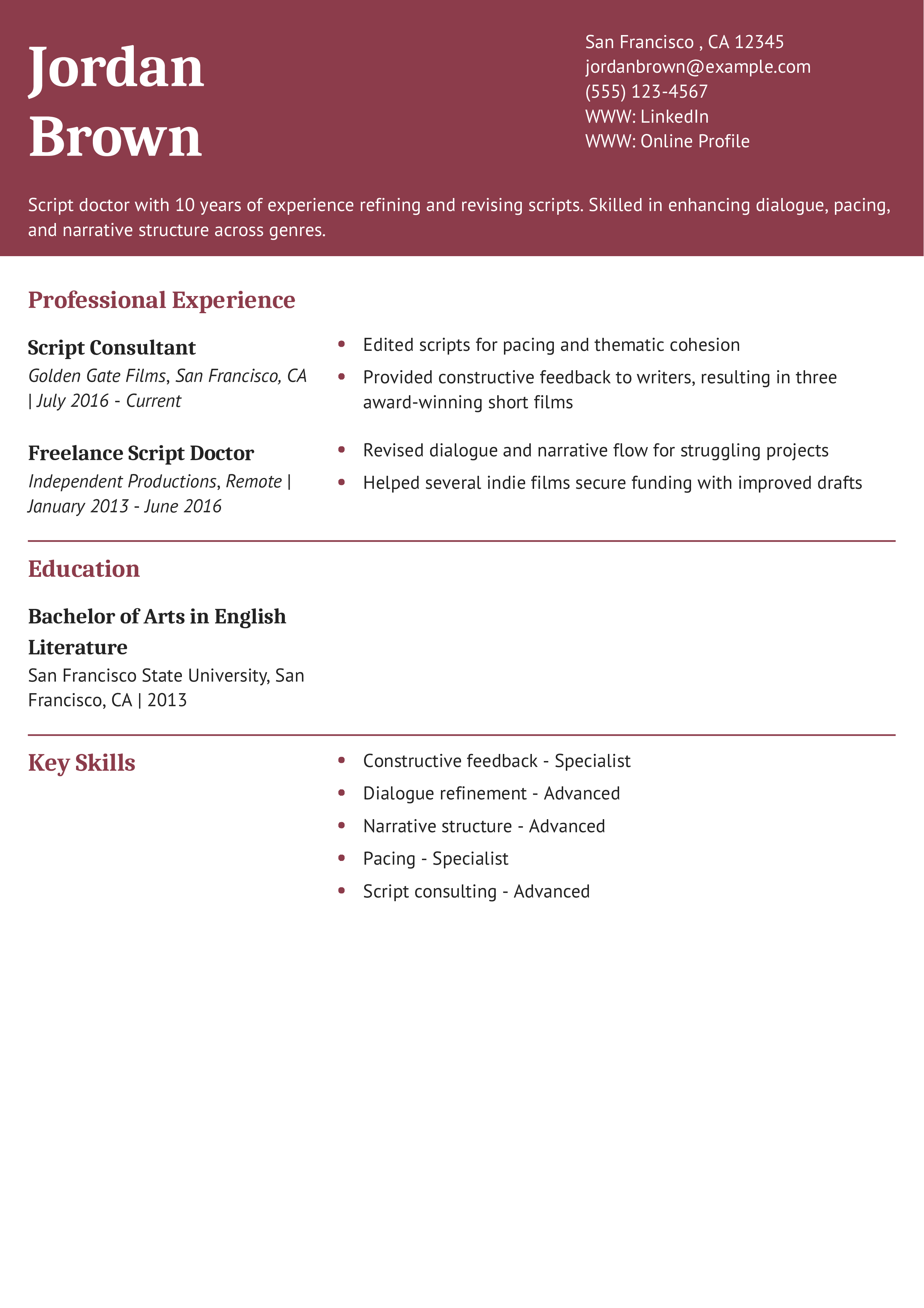
Script Doctor Resume
Why This Resume Stands Out
This resume is good because it highlights consulting experience that strengthens struggling projects. It shows measurable contributions to award-winning outcomes.
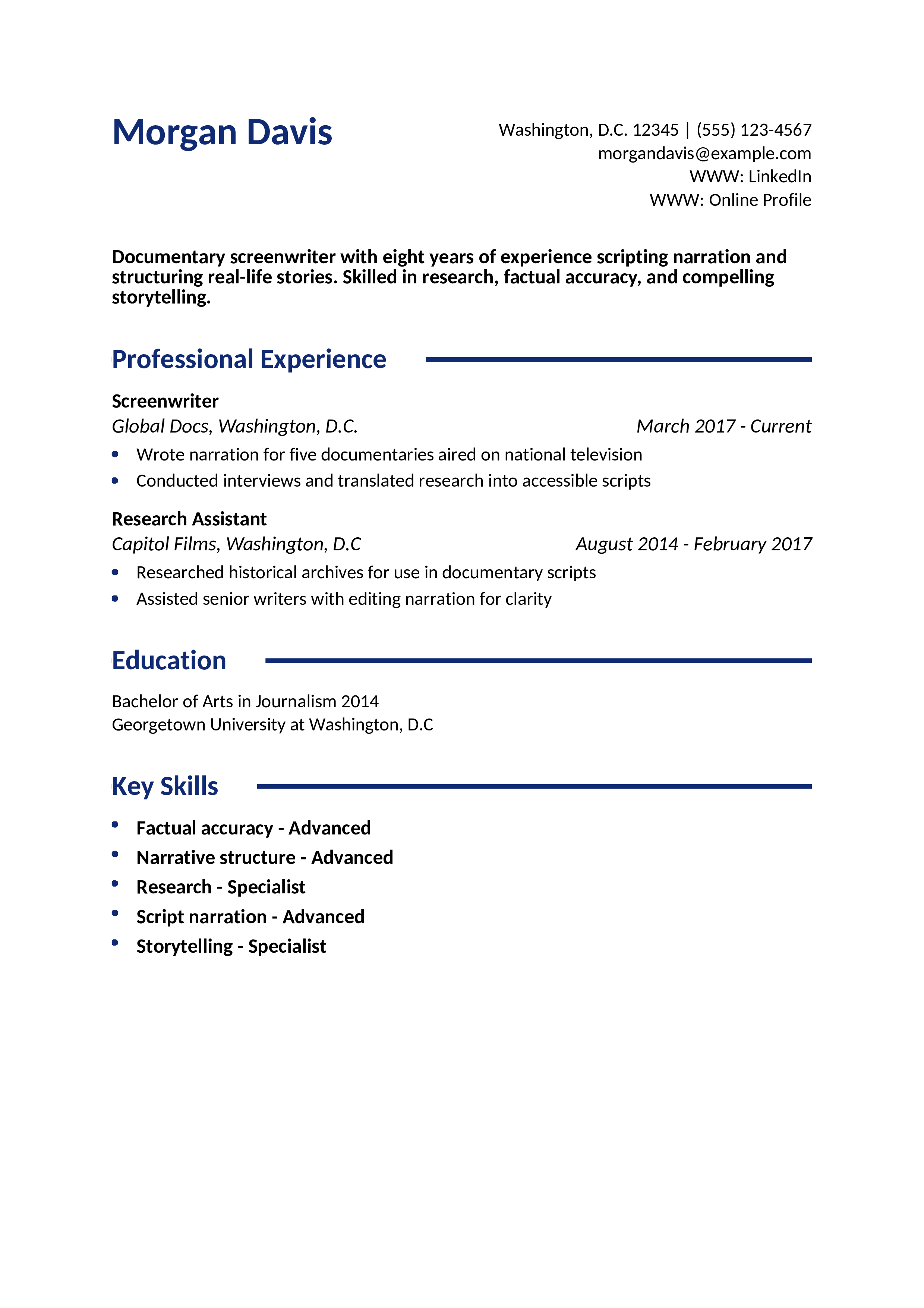
Documentary Screenwriter Resume
Why This Resume Stands Out
This resume is good because it blends research and creative writing skills, showing how factual stories can be told with narrative depth. It emphasizes both accuracy and creativity.
Our templates are crafted by professional resume writers to make creating your resume quick, easy, and effective.
- Professional resume template downloads
- Customized cover letter generation
- AI resume writing support
- Career-building resources and advice
Screenwriter Text-Only Resume Templates and Examples
How To Write a Screenwriter Resume
Screenwriter resumes should start with major credits, genre strengths, and measurable engagement wins such as audience growth or award recognition. Opening with strong narrative achievements positions you quickly as a high-impact writer.

1. Summarize your screenwriter qualifications in a dynamic profile
Draw in hiring managers by creating a compelling picture of your screenwriting career and how you stand out as a creative professional. Start by listing your job title, years of experience, and three to four specializations that align with the job posting. This is key because your resume must be customized to the role and resonate with production studios. In the subsequent sentences, establish yourself as an expert in your space.
For example, if you wrote a 150-page script for an independent film that garnered numerous awards, explain the script’s complexity, such as intersecting storylines or fast-moving narratives. Highlight collaborative experiences like working with a screenwriting team in editorial meetings to edit and elevate screenplays based on director feedback. Be specific, concise, and descriptive.
Entry-Level Profile Example
An aspiring Screenwriter with entry-level experience specializing in script writing, dialogue, character development, and world-building. Adept at creating quality scripts with emotional resonance and ensuring narrative cohesion.
Senior-Level Profile Example
A Senior Screenwriter with 10+ years of experience delivering screenplays for award-winning films, including Dune, Blade Runner 2049, and Knives Out. A proven history of creating dynamic scripts to capture complex character personalities and emotional thematic elements.
2. Outline your screenwriter experience in a compelling list
Go beyond job responsibilities and create an accomplishment-driven professional experience section by crafting bullet points that showcase your career achievements. Companies are interested in results and how you deliver value as a screenwriter. Draw attention to your projects, writing style, and positive reviews for your film or television productions.
For example, show that you coordinated with a director to write, edit, and refine a script that won a film festival award nomination. Emphasize your ability to collaborate and accept and act on constructive criticism.
Entry-Level Professional Experience Example
Freelance Screenwriter, IndieFilm Productions, Philadelphia, PA
May 2021 – Present
- Wrote a 119-page script for the independent dramedy film, See You At McGlinchey’s, following a set of seven intersecting stories of patrons in a local Philadelphia dive bar, which premiered at the Ritz Theater and garnered positive reviews from local critics
- Coordinated with two scriptwriters and the director to write, edit, and refine the script for an independent drama film, Sad Times on Aramingo, which achieved a nomination for the Best Independent Drama Award at the Philadelphia Film Festival in 2022
- Developed compelling narratives, created realistic dialogue incorporating local accents and cadences to ground scripts in realism, and ensured plot continuity
Senior-Level Professional Experience Example
Screenwriter, Warner Bros. Studios, New York, NY
October 2016 – Present
- Write, edit, and revise screenplay for Denis Villeneuve’s science fiction epic, Dune, in collaboration with the director, screenwriters, and production teams, and perform background research on the novel and world to bring directorial vision to life
- Coordinate with a team of screenwriters to edit and revise the screenplay for Knives Out and attend meetings with the director and production teams to analyze dialogue, scene transitions, and pacing throughout the film
3. Include your education and certifications relevant to screenwriters
Aside from education, feature relevant certifications you’ve achieved throughout your screenwriter career. Most employers are interested in your professional experience, but certifications show your motivation to learn and excel in the field. Plus, these extras could improve your chances of landing an interview.
For instance, having an Advanced Screenwriter’s Workshop Certificate from the American Film Institute (AFI) sends a clear message that you belong to a group of top-notch writers who are constantly sharpening their craft. A Screenwriting Certification from the Writers Guild of America (WGA) in conjunction with your college education demonstrates a drive for continuous improvement.
Education
Template
- [Degree Name]
- [School Name], [City, State Abbreviation] | [Graduation Year]
Example
- Bachelor of Arts (B.A.) Screenwriting
- City College of San Francisco | San Francisco, CA | 2017
Certifications
Template
- [Certification Name], [Awarding Organization], [Completion Year]
Example
- Script Writing Certificate | Academy of Motion Picture Arts and Sciences | 2014
- Advanced Screenwriter’s Workshop Certificate | AFI | 2017
4. List your key screenwriter skills and proficiencies
Most organizations rely on some form of applicant tracking system (ATS) to identify qualified candidates for job openings. To get your resume through the initial screening process and into the hiring manager’s hands, incorporate keywords from the job description directly into your profile, professional experience, and skills section. Below, you’ll find a list of key terms and skills that you may encounter while applying for screenwriter positions:
| Key Skills and Proficiencies | |
|---|---|
| Celtx | Character development |
| Character dialogue | Copy editing |
| Copywriting | Creative writing |
| Editing | Film production |
| Narrative storytelling | Pacing |
| Plot development | Proofreading |
| Screenwriting | Scriptwriting |
| Scrivener | Storyist storytelling |
| StudioBinder | WriterDuet |
| Writing | |
5. Name drop key projects
In the entertainment industry, you have a limited window to make your pitch. A resume is no different, so create a professional profile that immediately grabs the reader’s attention. One way to achieve this result is by dropping names of key projects you’ve worked on in the past, especially if they’re recognizable. In the example below, the job seeker highlights their experience working on several major television shows for HBO, which speaks to their experience and credibility as a screenwriter:
Profile
A screenwriter with five years of experience within the television industry, specializing in narrative storytelling, character dialogue, symbolism, and editing. A strong history of writing compelling screenplays for major television productions such as “True Detective,” “Game of Thrones,” and “Westworld.”
6. Showcase your writing style
Your portfolio will demonstrate the end results of your writing efforts, but it won’t provide insights into your decision-making process or writing methodology. This is especially important for projects where you might adapt source material from a novel or previously existing film.
In the example below, the job seeker draws attention to the research they conducted prior to writing the script to drive effective world-building through character dialogue:
- Wrote, edited, and refined screenplays for two seasons of “Game of Thrones” in collaboration with showrunners, screenwriters, and directors
- Conducted research on background material from novels and author notes to accurately capture character personalities and drive holistic world-building through dialogue, which included crafting dynamic character interactions to avoid exposition
7. Highlight your ability to collaborate with creative teams
Screenwriting is often a collaborative effort, especially for larger film and television productions, and it’s important to highlight your ability to coordinate with creative teams and directors during the writing process. Screenplays undergo a number of revisions before the final product is delivered. Demonstrating your experience working in fast-paced team environments will be valuable to prospective employers. In the example below, the job seeker does an effective job of providing tangible examples of collaborations with diverse teams during large-scale productions:
- Write, edit, and revise screenplay for Denis Villeneuve’s science fiction epic, “Dune,” in collaboration with the director, screenwriters, and production teams, and perform background research on the novel and world to bring directorial vision to life
- Coordinate with a team of screenwriters to edit and revise the screenplay for “Knives Out” and attend meetings with the director and production teams to analyze dialogue, scene transitions, and pacing throughout the film
How To Pick the Best Screenwriter Resume Template
When selecting your screenwriter resume template, prioritize structure and readability over visual appeal. Overbearing colors and graphics create noise that detracts from what’s most important: your experience and accomplishments. Also, as a screenwriter, the words on your resume and how the content is constructed reflect your writing skills. Overall, keep in mind that hiring managers are more interested in your qualifications than your template.
Frequently Asked Questions: Screenwriter Resume Examples and Advice
What makes a Screenwriter CV stand out to recruiters?-
A Screenwriter CV stands out by clearly demonstrating your expertise and achievements in the field. Be sure to use measurable outcomes and include quantifiable results wherever possible. Show how your contributions directly impacted the company, whether it’s through cost savings, operational efficiency, or revenue growth. Keep the layout clean and easy to navigate, focusing on relevant experience.
What are common action verbs for screenwriter resumes?-
We know it’s easy to get stuck when writing the experience section of a resume. You might start to run out of action verbs to describe your work. To help you with this challenge, we put together the below list of common action verbs that can describe screenwriter roles.
| Action Verbs | |
|---|---|
| Analyzed | Collaborated |
| Coordinated | Crafted |
| Created | Developed |
| Edited | Enhanced |
| Evaluated | Identified |
| Implemented | Improved |
| Led | Managed |
| Oversaw | Performed |
| Proofread | Provided |
| Refined | Revised |
| Supported | Wrote |
How do you align your resume with a screenwriter job description?-
According to the Bureau of Labor Statistics, jobs for writers and authors are projected to grow an average of 4%, on pace with other occupations across industries. As for the future, the current WGA strike will not last forever, but it is putting a damper on growth for the time being.
Aligning your resume with the job posting can give you a significant edge over the competition in most instances, but screenwriter positions require a different approach from more traditional openings. Most likely, there will not be a complete job description toward which you can tailor your document. When it comes to finding work in the entertainment industry or hiring an agent, networking and connecting with other artists have a much larger impact.
Instead of tailoring your resume toward job descriptions, align your document with your writing portfolio to provide production companies with additional context and insights into your writing style, methodology, and career achievements. The quality of your writing will always be the determining factor, but the resume can be another helpful tool to get your foot in the door in a highly competitive field.
What is the best screenwriter resume format?-
Reverse chronological format is ideal for screenwriter resumes. This approach ensures that your most recent and relevant experience is featured at the top of your document. Even at the entry level, it’s best to avoid functional resume formats. If you lack hands-on experience, you’d still be much better served by illustrating your writing projects than only listing your skill sets.
How long should I make my screenwriter resume?-
A one-page screenwriter resume is the best option for most candidates, as it ensures clarity and brevity. If you have significant achievements or over 10 years of experience, extending to two pages is fine—but only if the content is tailored and directly supports your application. Focus on impactful accomplishments and key skills that relate to the job.
Include your most recent 10 to 15 years of work experience. Older roles should only appear if they provide unique insights or align closely with the job requirements. Keeping your resume concise and relevant will maximize its impact.
Craft your perfect resume in minutes
Get 2x more interviews with Resume Builder. Access Pro Plan features for a limited time!

Crafting a strong cover letter helps your chances of landing an interview during a job search. The key to creating a compelling cover letter is to customize your document for the organization you’re applying to. Read our editor cover letter guide to learn how. For other related cover letter examples, see our production assistant and marketing cover letter guides.