
To write a compelling lab assistant resume, you must create an accomplishment-driven document highlighting the research initiatives you supported and your individual contributions to the studies. Even a seemingly mundane task can be framed as an achievement if you highlight how it helped the project’s success. This guide provides expert tips and insights to help you create an eye-catching resume.
“Lab assistant resumes should reflect precision, lab safety, data collection, and support for experiments. Show how you contribute to successful scientific work.”

AI and the Modern Lab Assistant
AI has become part of how labs run, from specimen tracking systems that flag processing delays to documentation tools that catch data entry inconsistencies before they reach supervisors. Lab managers reviewing resumes now look for candidates who’ve worked alongside these systems rather than around them. The shift isn’t dramatic, but it’s real enough that candidates with hands-on AI tool experience get evaluated differently. Here’s what to pull from your experience:
- Logging specimen data through AI-assisted tracking or inventory systems, including how it changed your daily workflow.
- Labeling errors or processing bottlenecks caught through LIMS AI flagging in real time.
Most Popular Lab Assistant Resumes
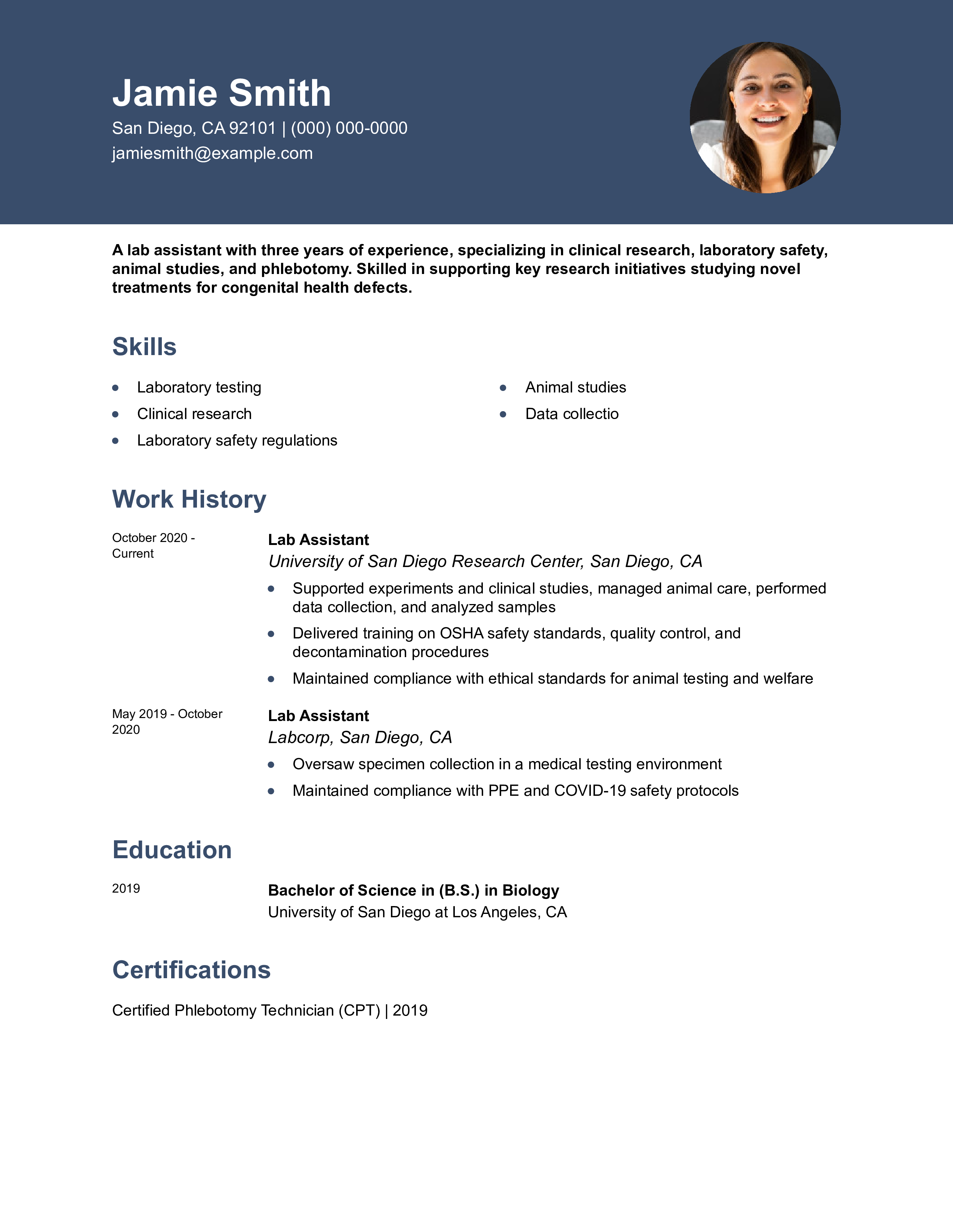
Clinical Lab Assistant Resume Example
Why This Resume Stands Out
This resume is good because it highlights lab safety, clinical compliance, and technical research skills. It clearly shows career progression and training responsibilities.
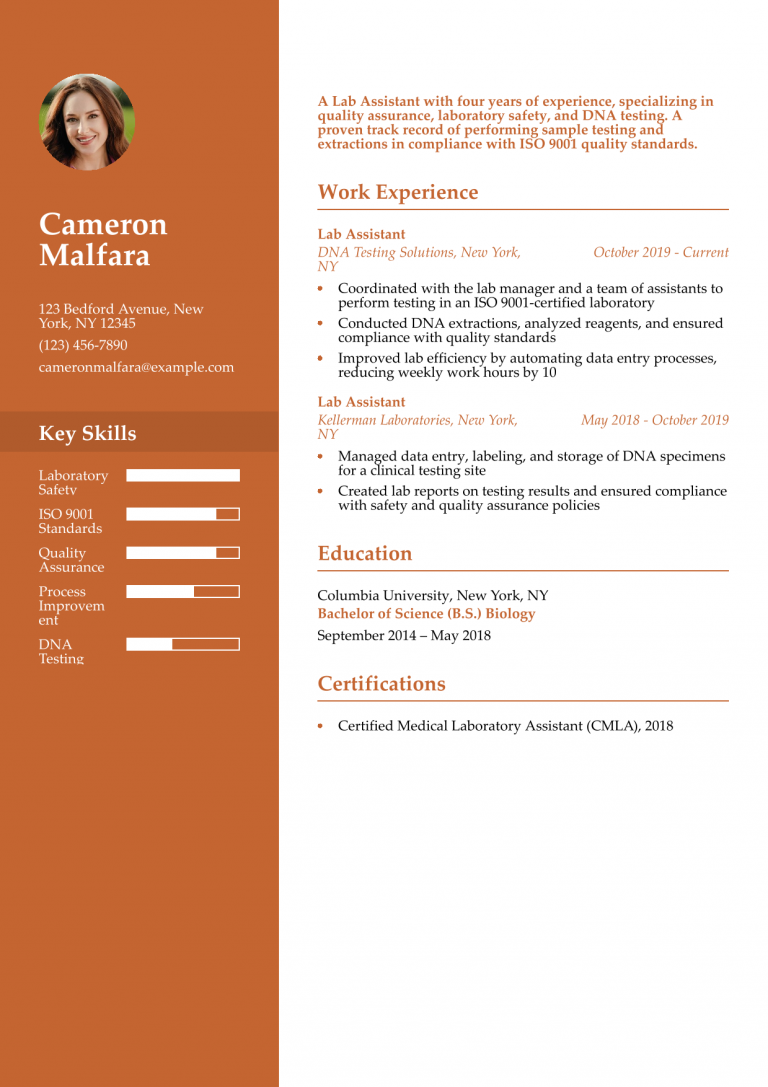
DNA Lab Assistant Resume Example
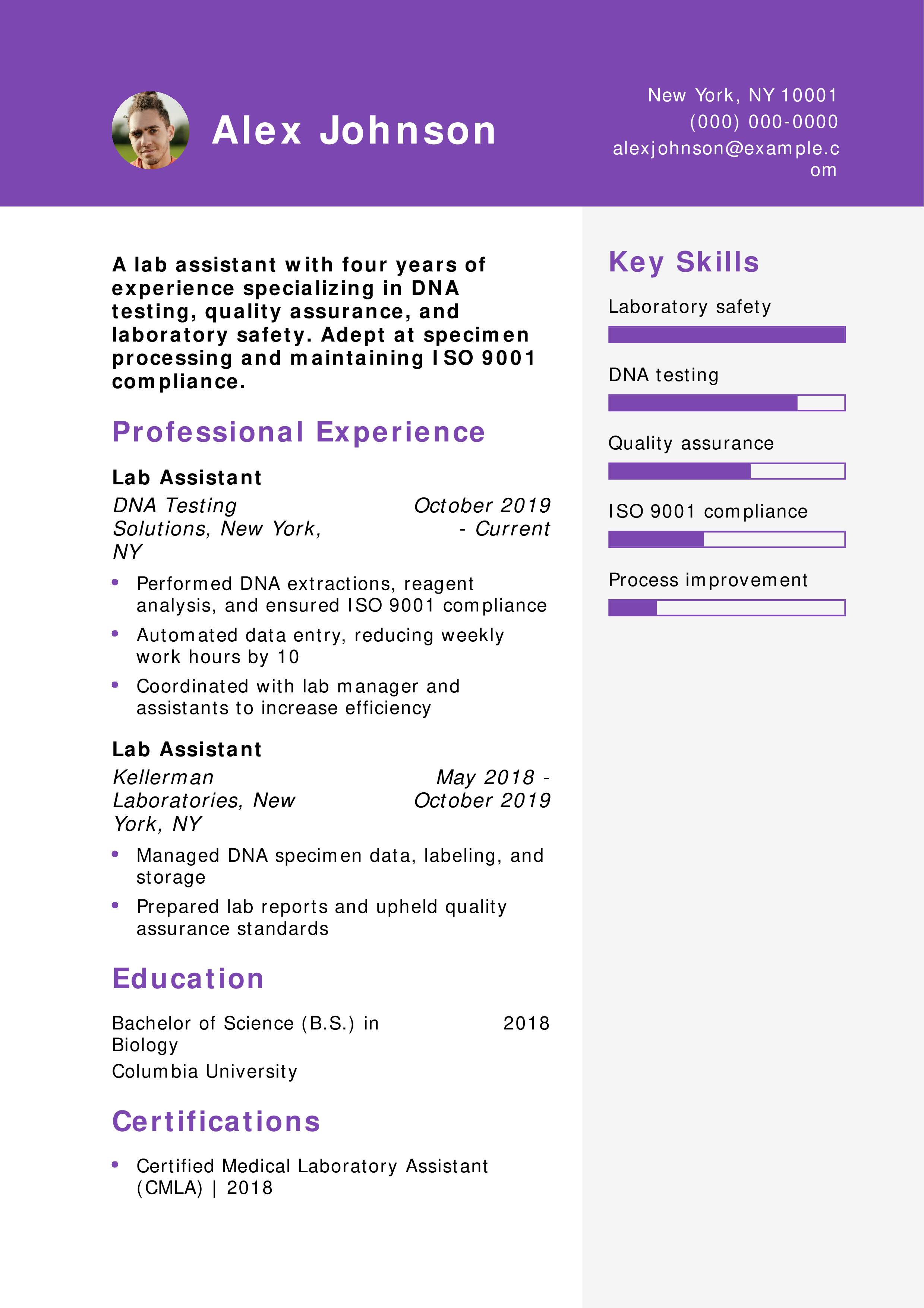
Why This Resume Stands Out
This resume is strong because it demonstrates technical lab expertise while showing measurable efficiency improvements. It balances compliance with innovation.
Engineering Lab Assistant Resume Example
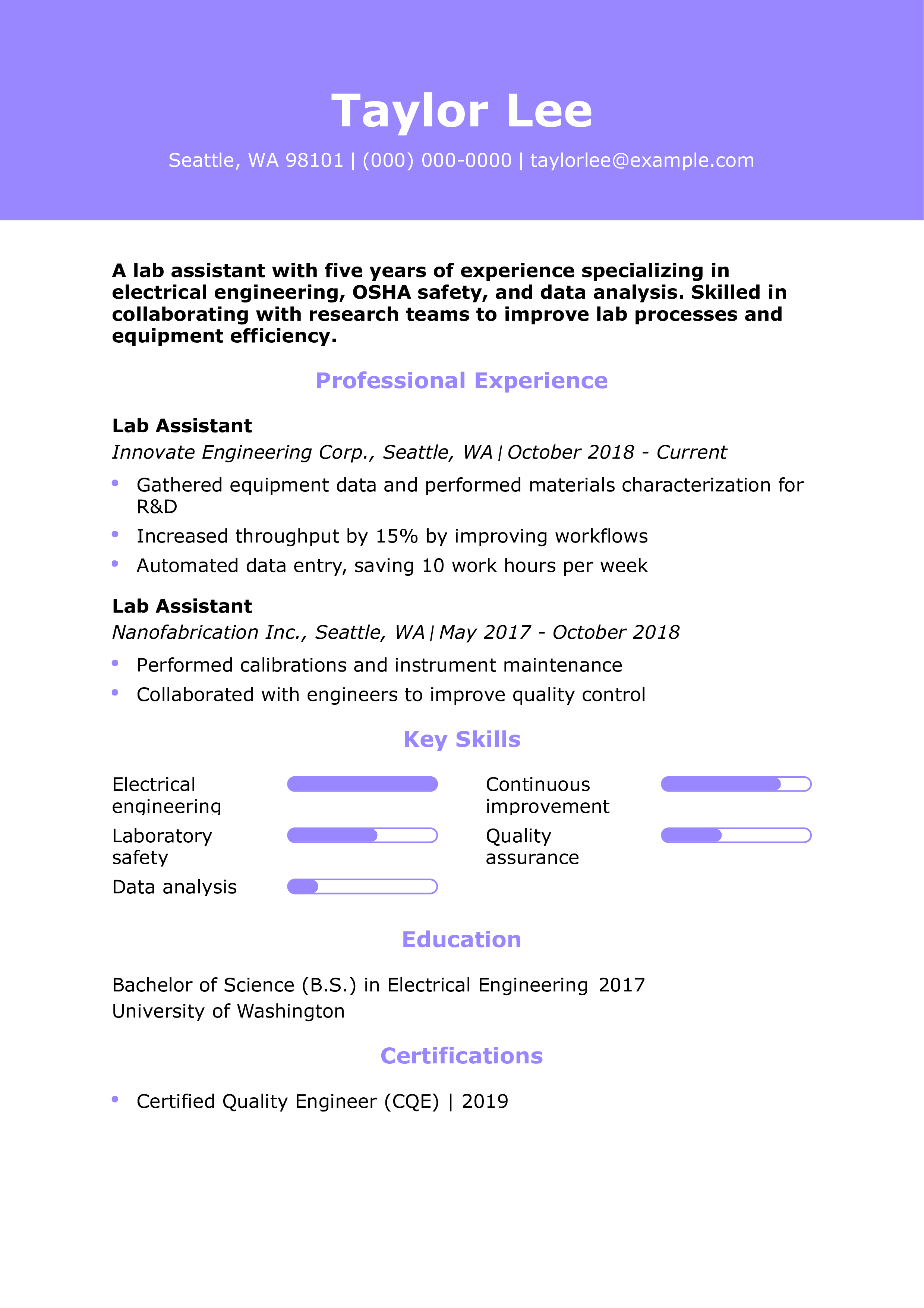
Why This Resume Stands Out
This resume is good because it emphasizes engineering skills and quantifies results like throughput improvements. It also showcases leadership in workflow optimization.
Chemistry Lab Assistant Resume Example
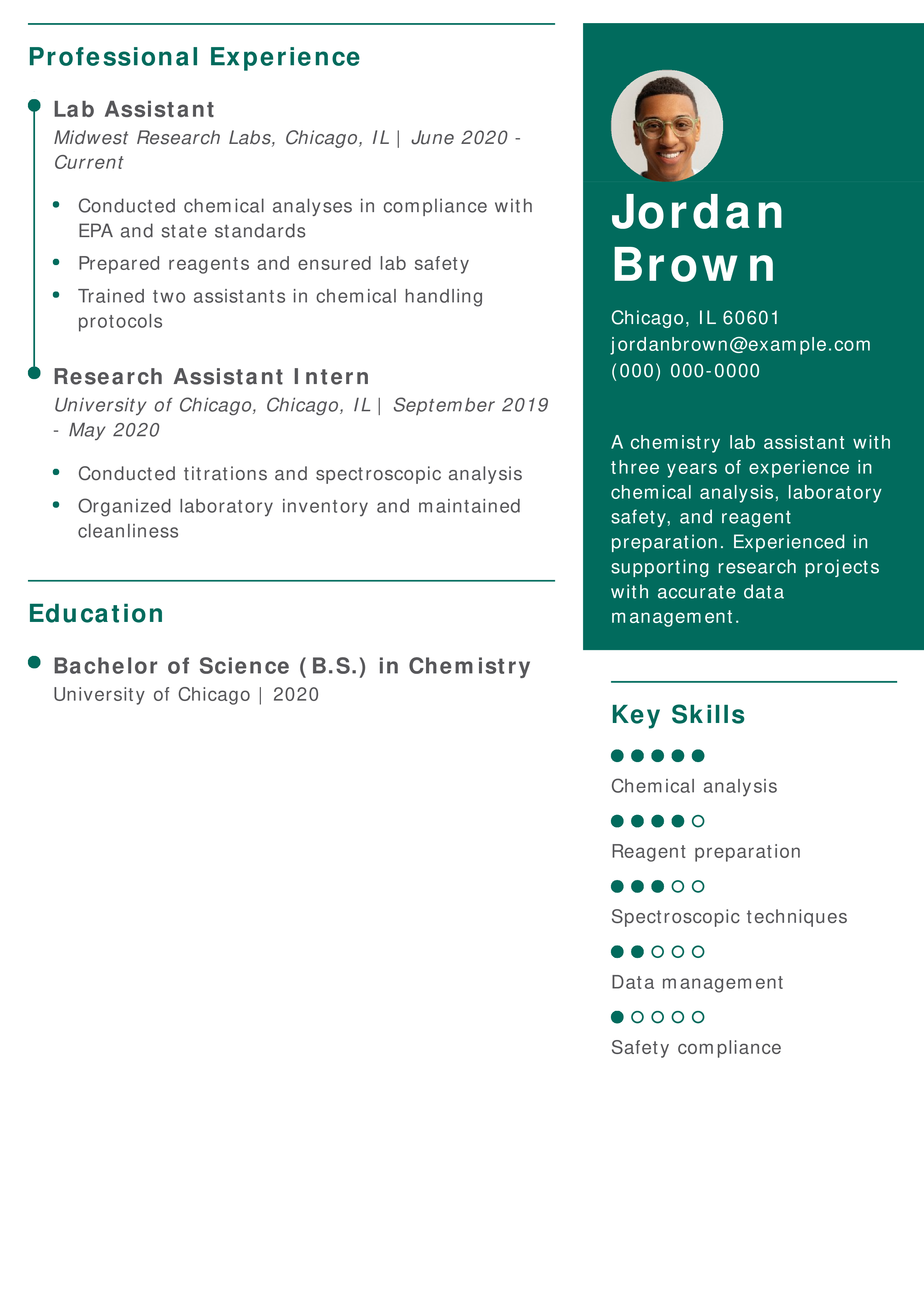
Why This Resume Stands Out
This resume is strong because it demonstrates technical chemistry expertise with measurable contributions in lab safety and training.
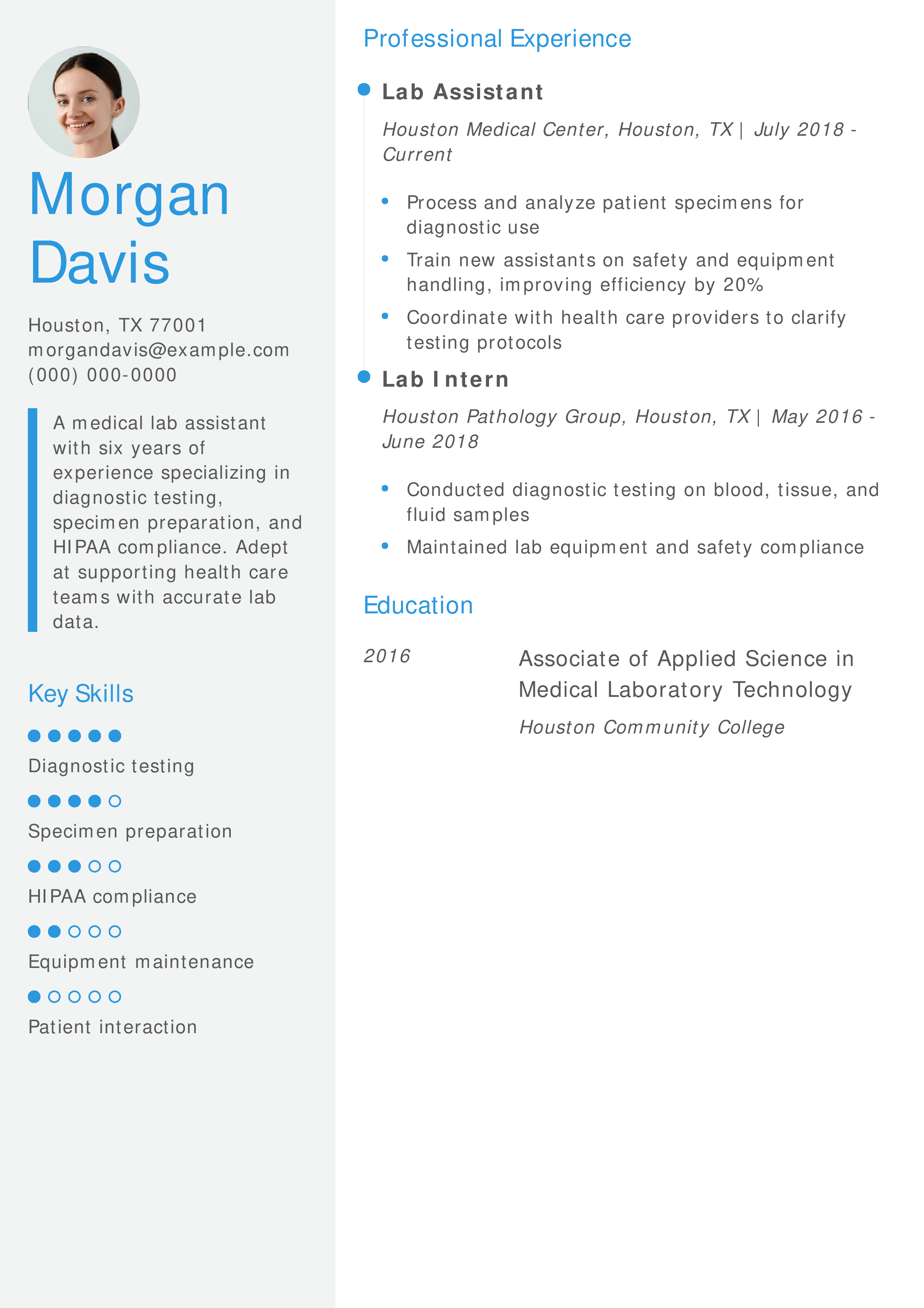
Medical Lab Assistant Resume Example
Why This Resume Stands Out
This resume is effective because it shows practical health care knowledge and regulatory compliance, making it suitable for clinical roles.
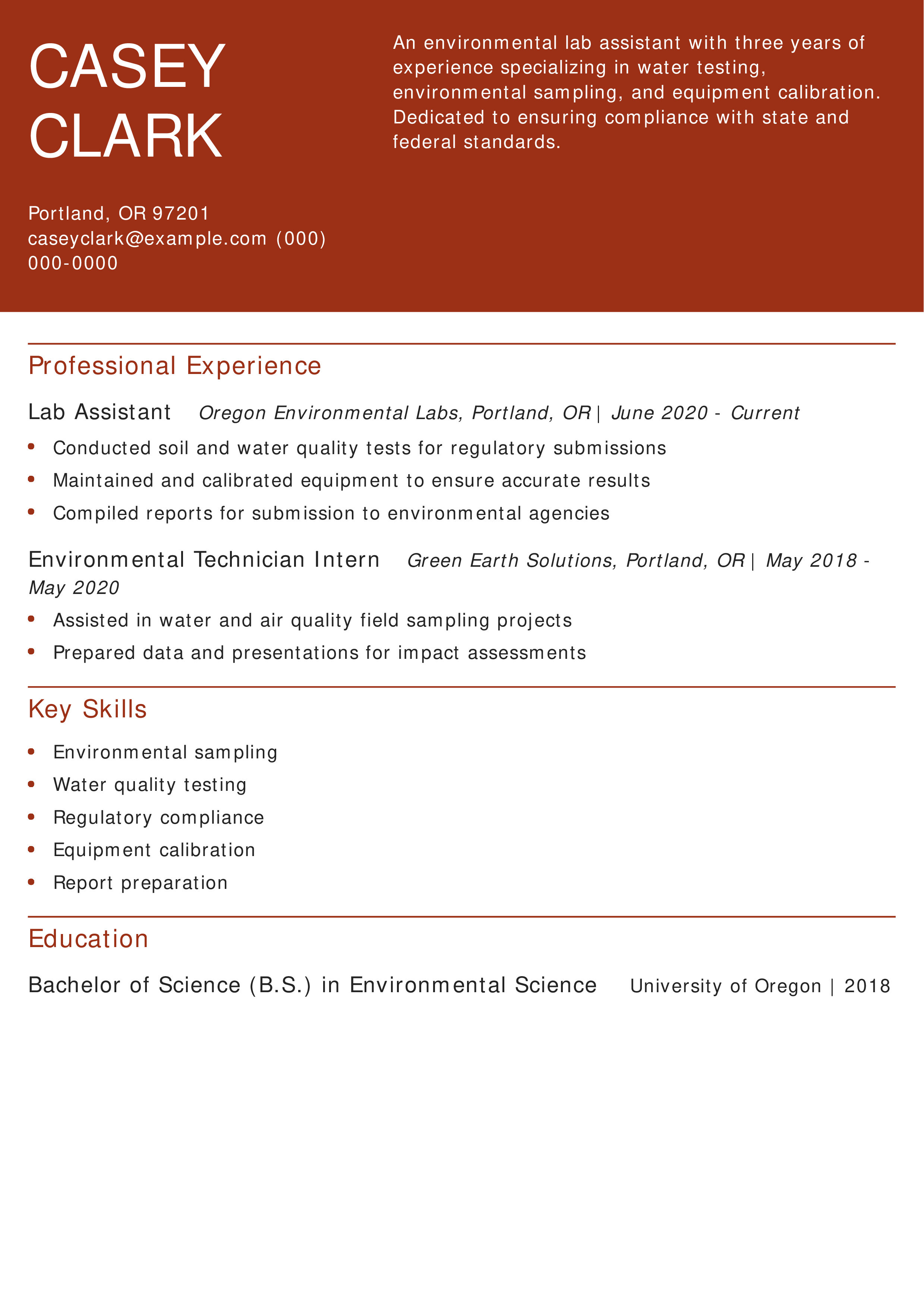
Environmental Lab Assistant Resume Example
Why This Resume Stands Out
This resume is strong because it balances lab testing with fieldwork and compliance documentation. It shows real-world impact.
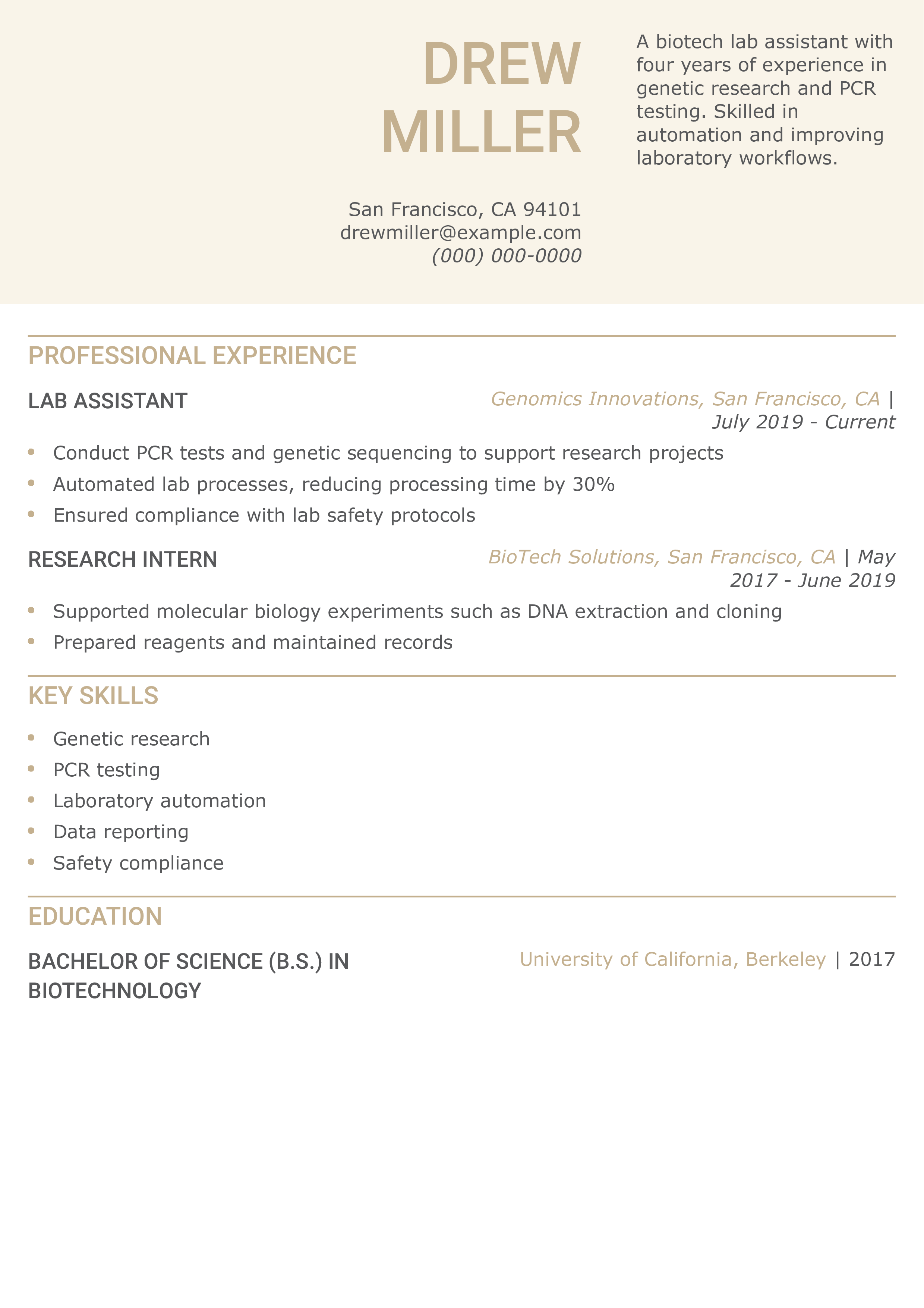
Biotech Lab Assistant Resume Example
Why This Resume Stands Out
This resume is good because it highlights technical expertise while showing how efficiency improvements contributed to research.
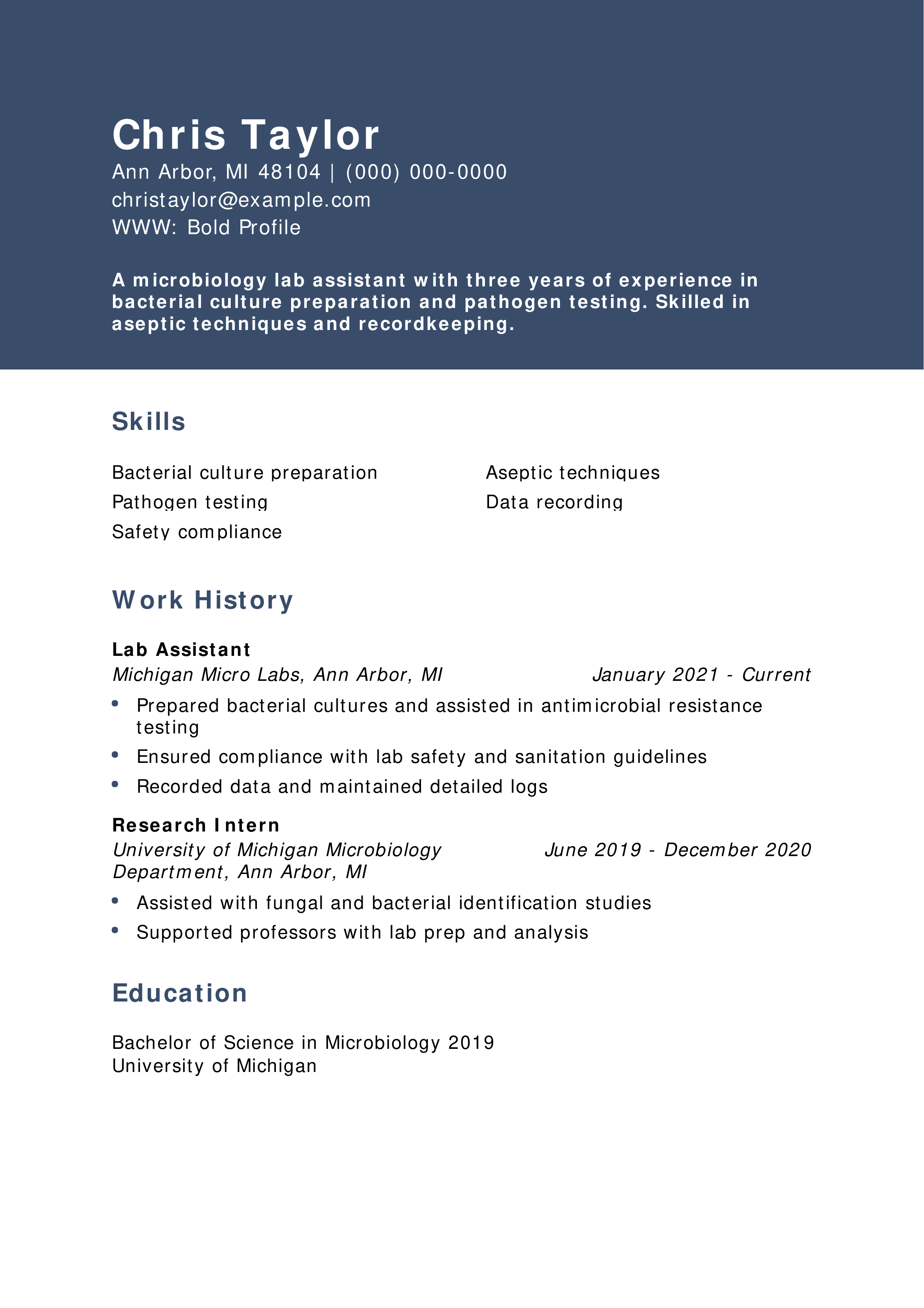
Microbiology Lab Assistant Resume Example
Why This Resume Stands Out
This resume is strong because it shows specialized skills in microbiology and demonstrates academic to professional progression.
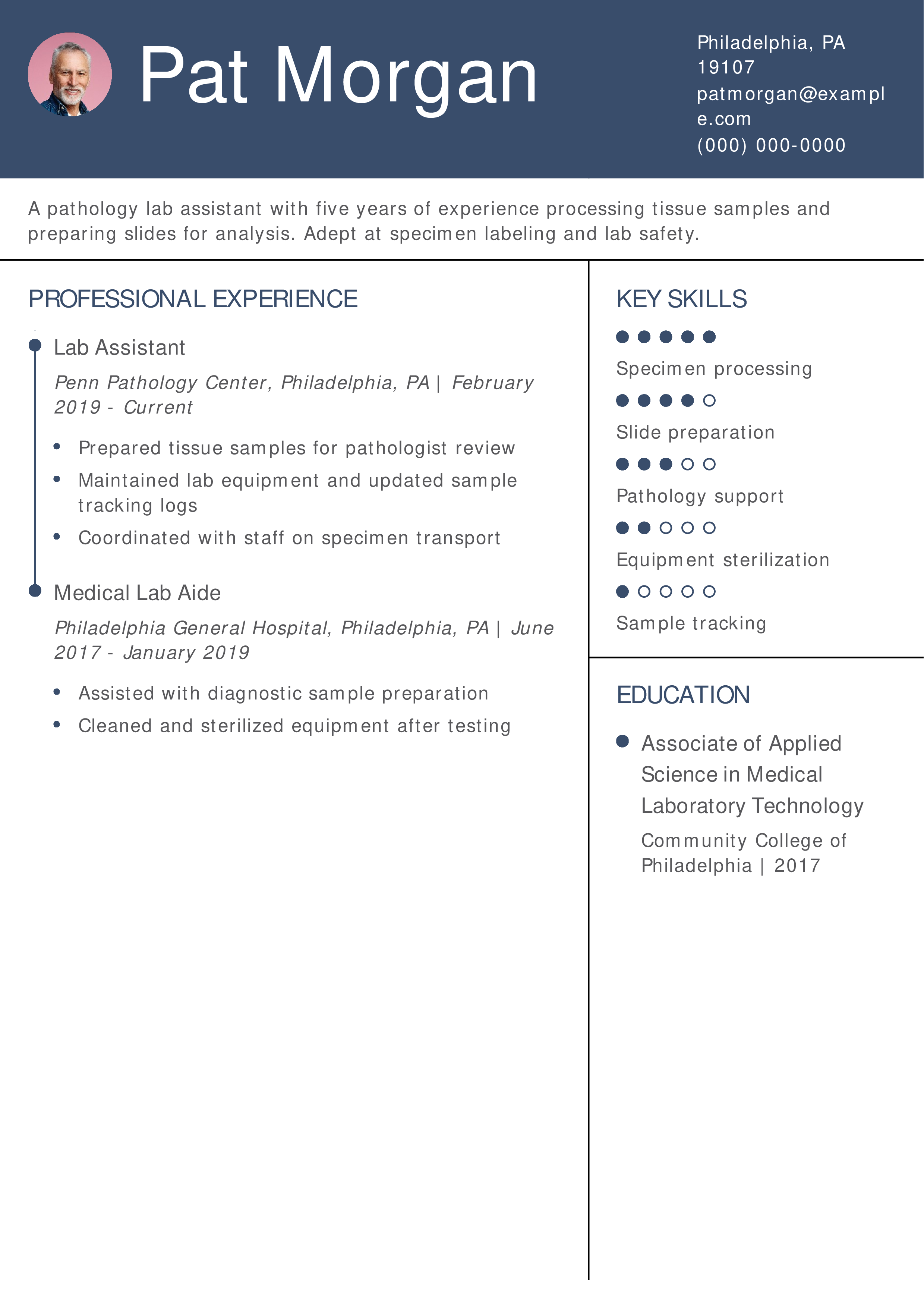
Pathology Lab Assistant Resume Example
Why This Resume Stands Out
This resume is good because it demonstrates specialized skills in pathology while showing progression from aide to assistant.
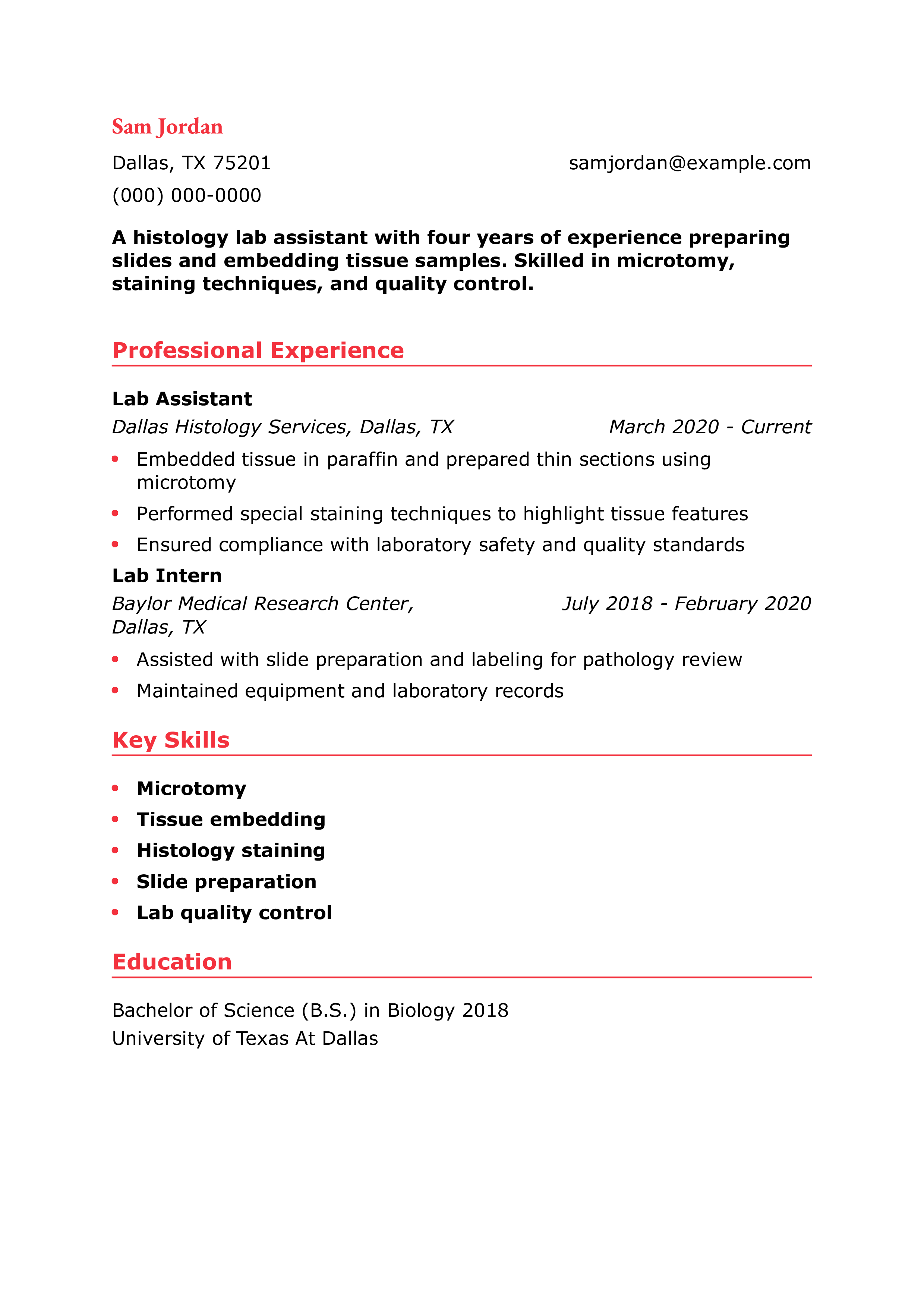
Histology Lab Assistant Resume Example
Why This Resume Stands Out
This resume is strong because it focuses on technical histology procedures while highlighting regulatory compliance.
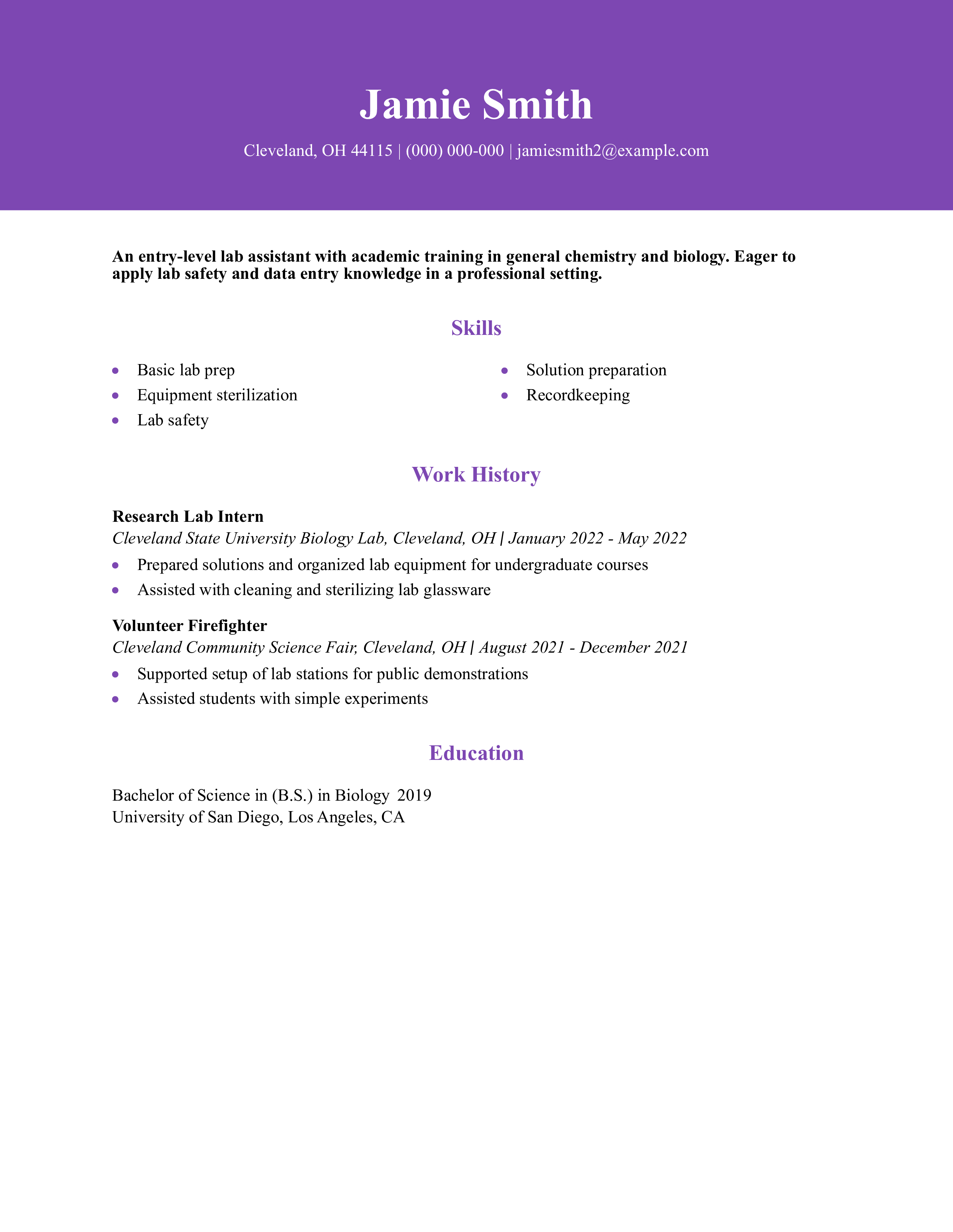
Entry-Level Lab Assistant Resume Example
Why This Resume Stands Out
This resume is good because it demonstrates enthusiasm, academic knowledge, and volunteer experience, making it ideal for entry-level roles.
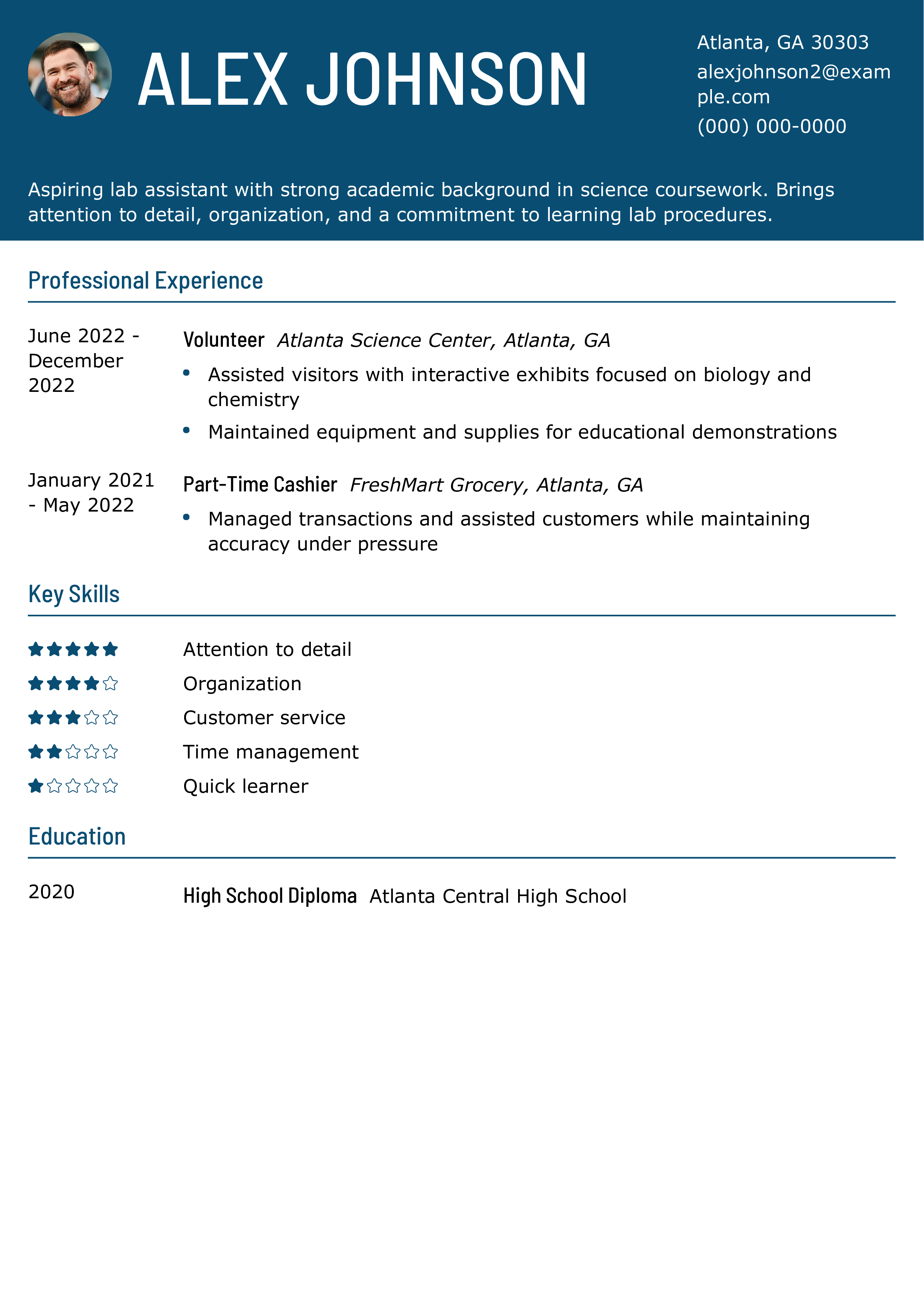
Lab Assistant Resume With No Experience
Why This Resume Stands Out
This resume is effective because it highlights transferable skills like organization and accuracy, even without direct lab experience.
Computer Lab Assistant Resume Example
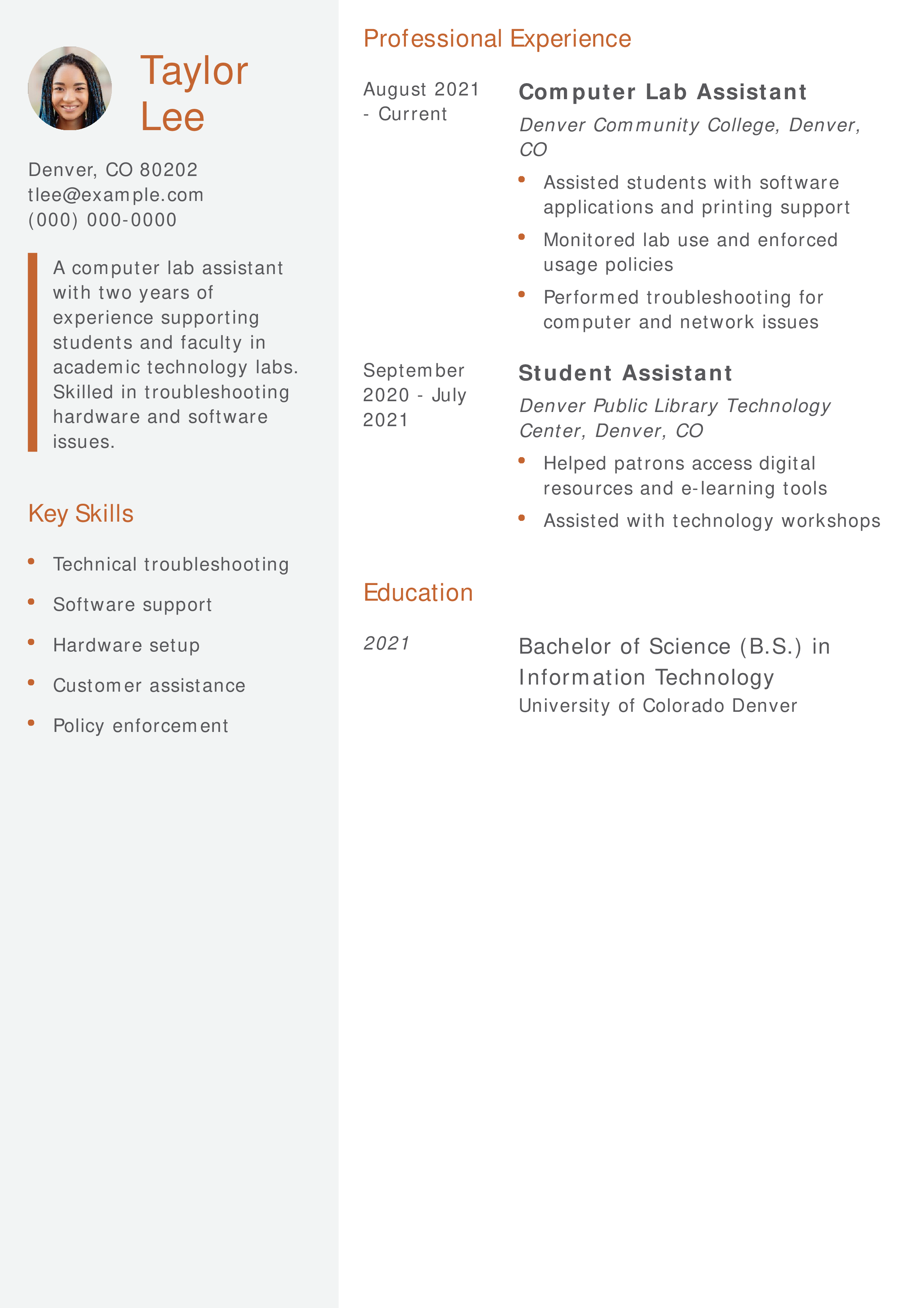
Why This Resume Stands Out
This resume is good because it highlights customer service and technical support in an academic setting.
Biology Lab Assistant Resume Example
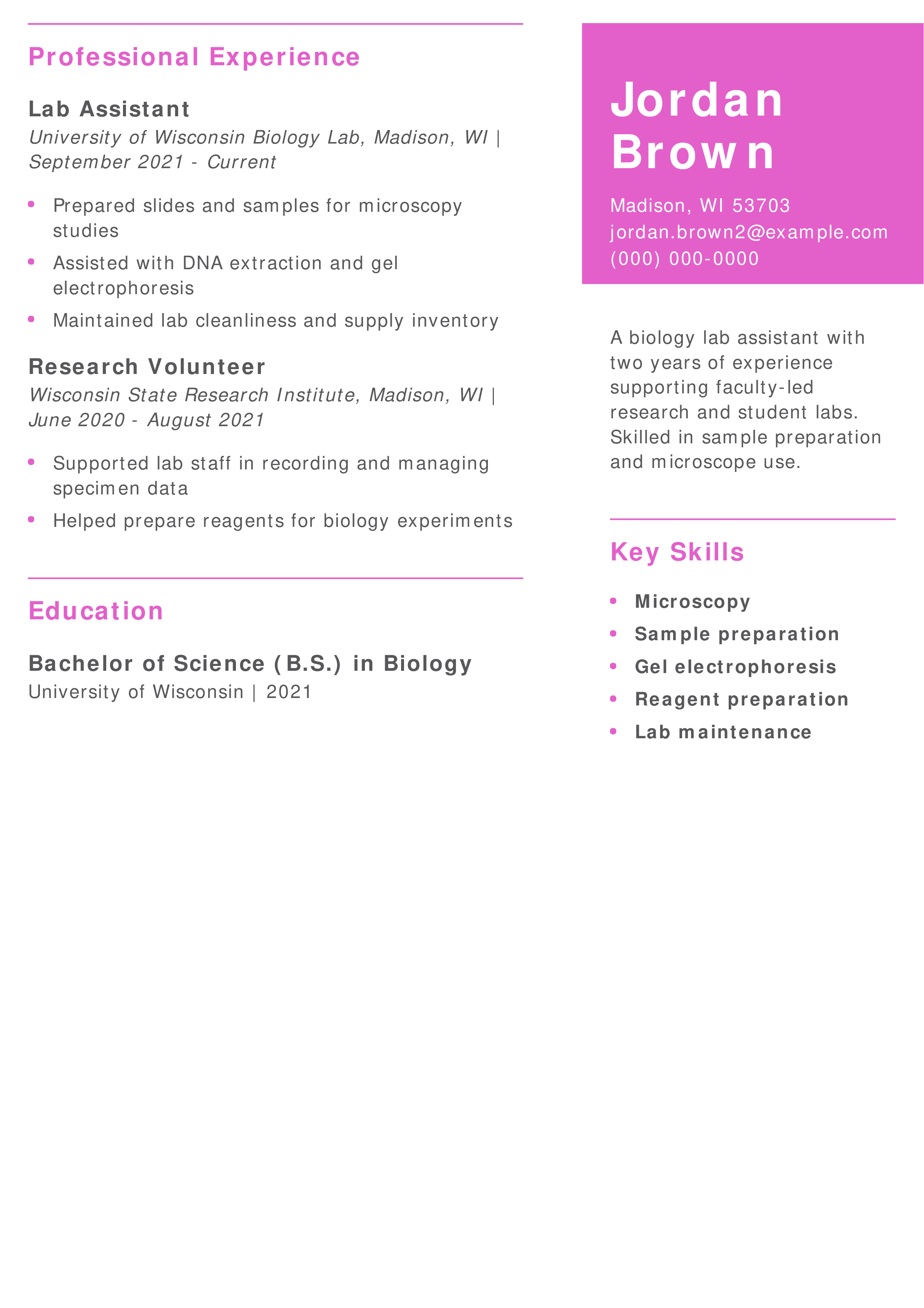
Why This Resume Stands Out
This resume is strong because it emphasizes biology-specific lab techniques and connects academic experience to lab assistant roles.
Medical Research Lab Assistant Resume Example
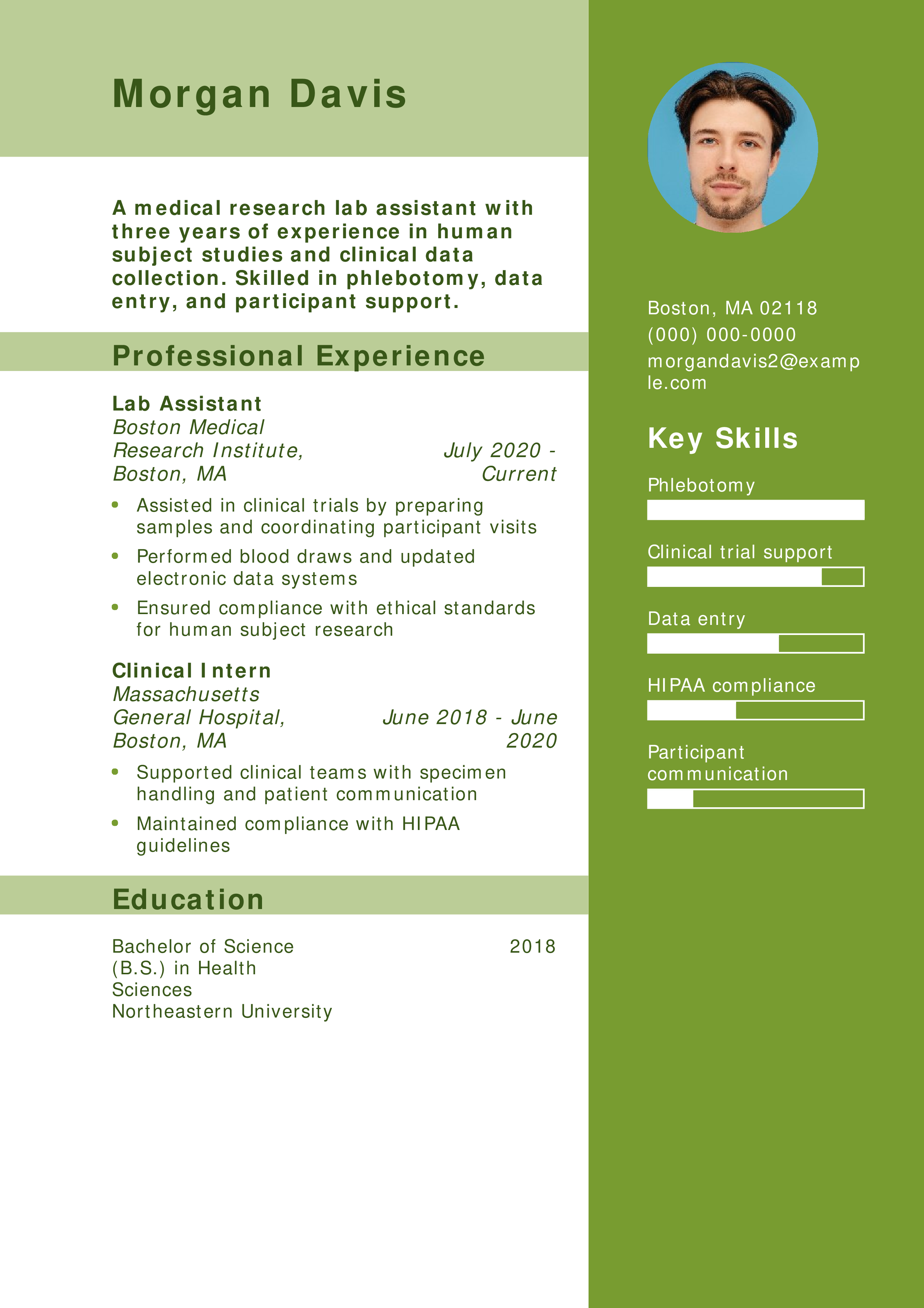
Why This Resume Stands Out
This resume is good because it demonstrates applied research and patient care support while highlighting compliance with ethics and HIPAA.
Forensic Lab Assistant Resume Example
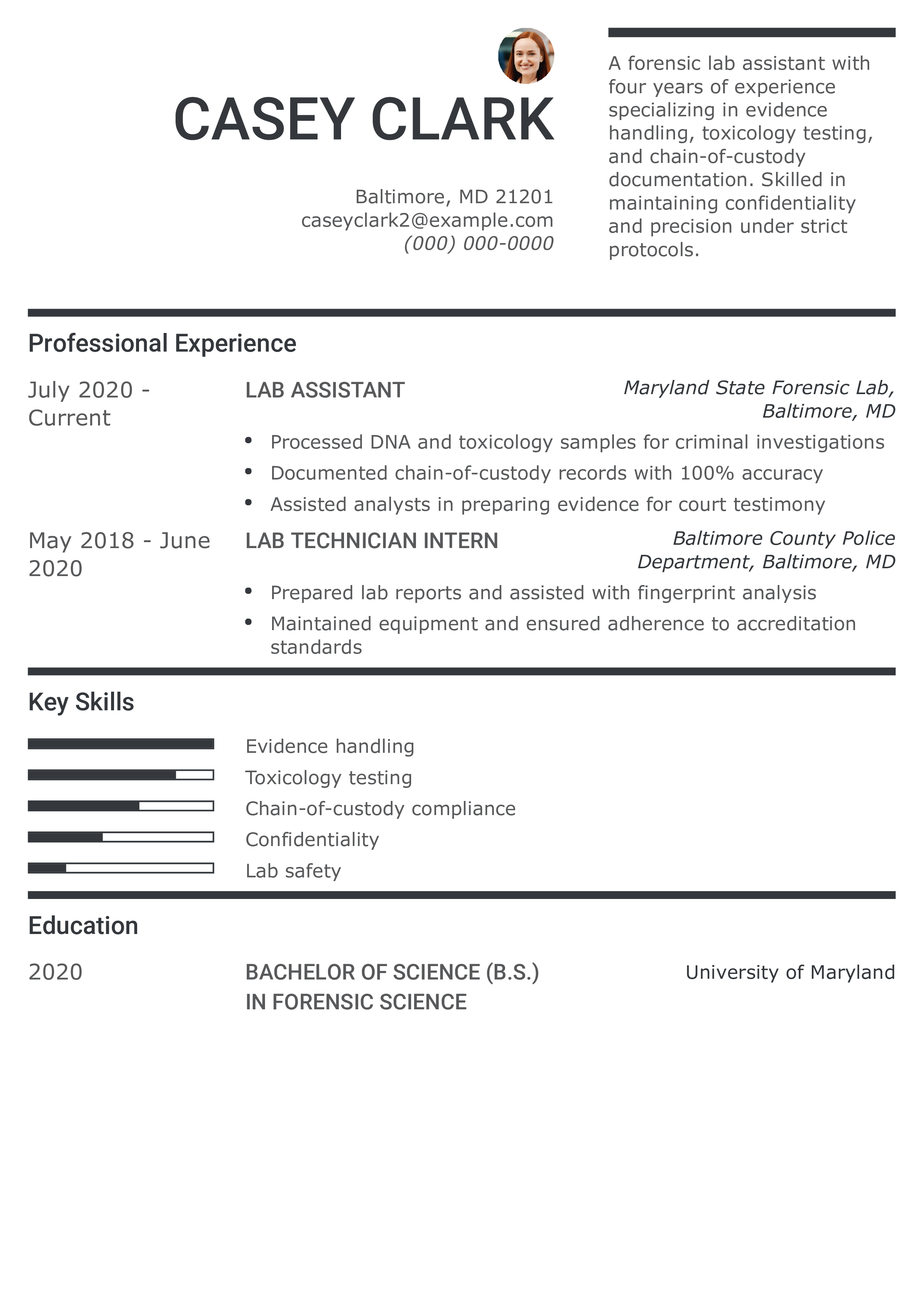
Why This Resume Stands Out
This resume is strong because it highlights forensic-specific lab skills and shows responsibility in sensitive environments.
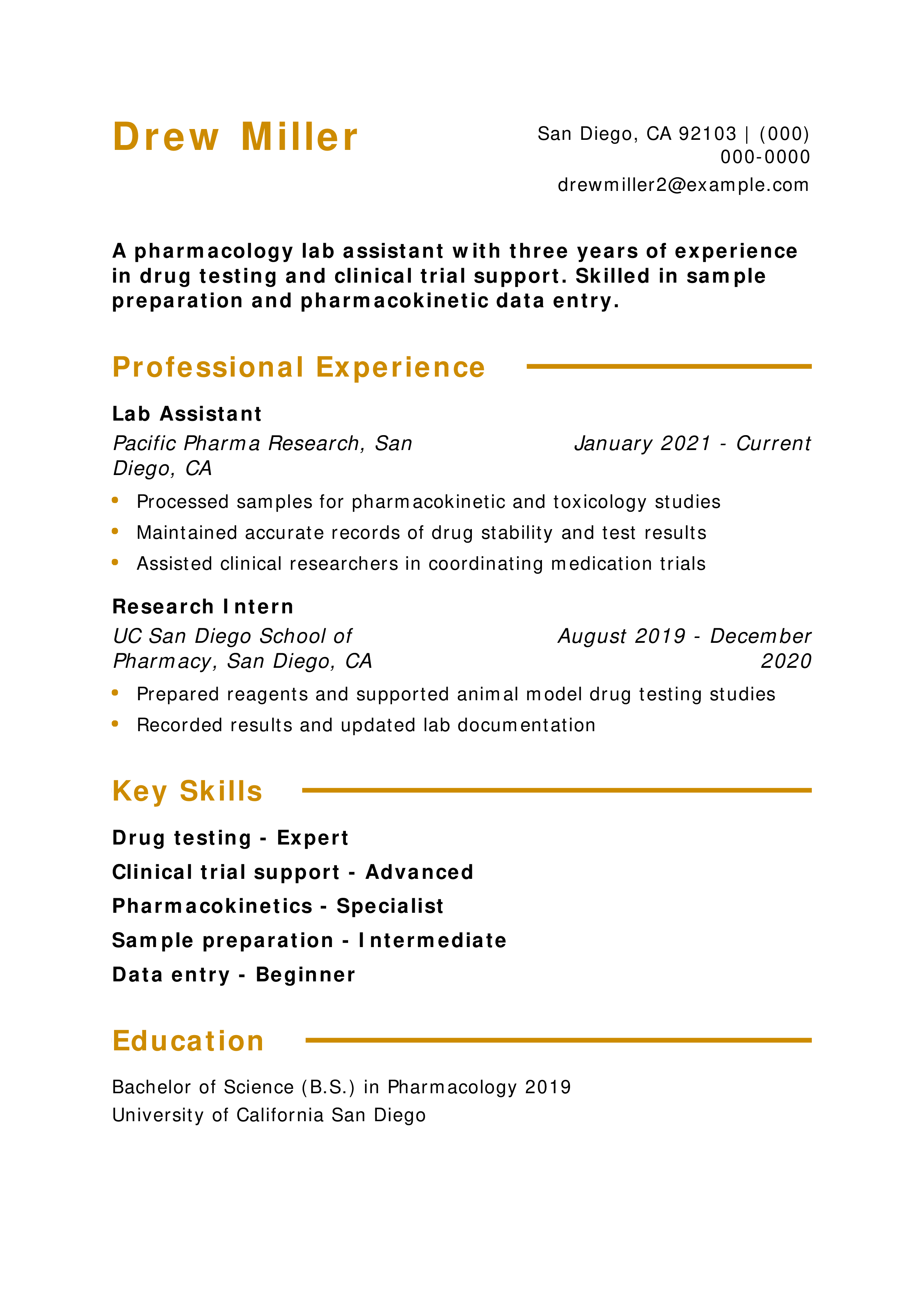
Pharmacology Lab Assistant Resume Example
Why This Resume Stands Out
This resume is effective because it directly connects lab skills to pharmaceutical research and clinical testing.
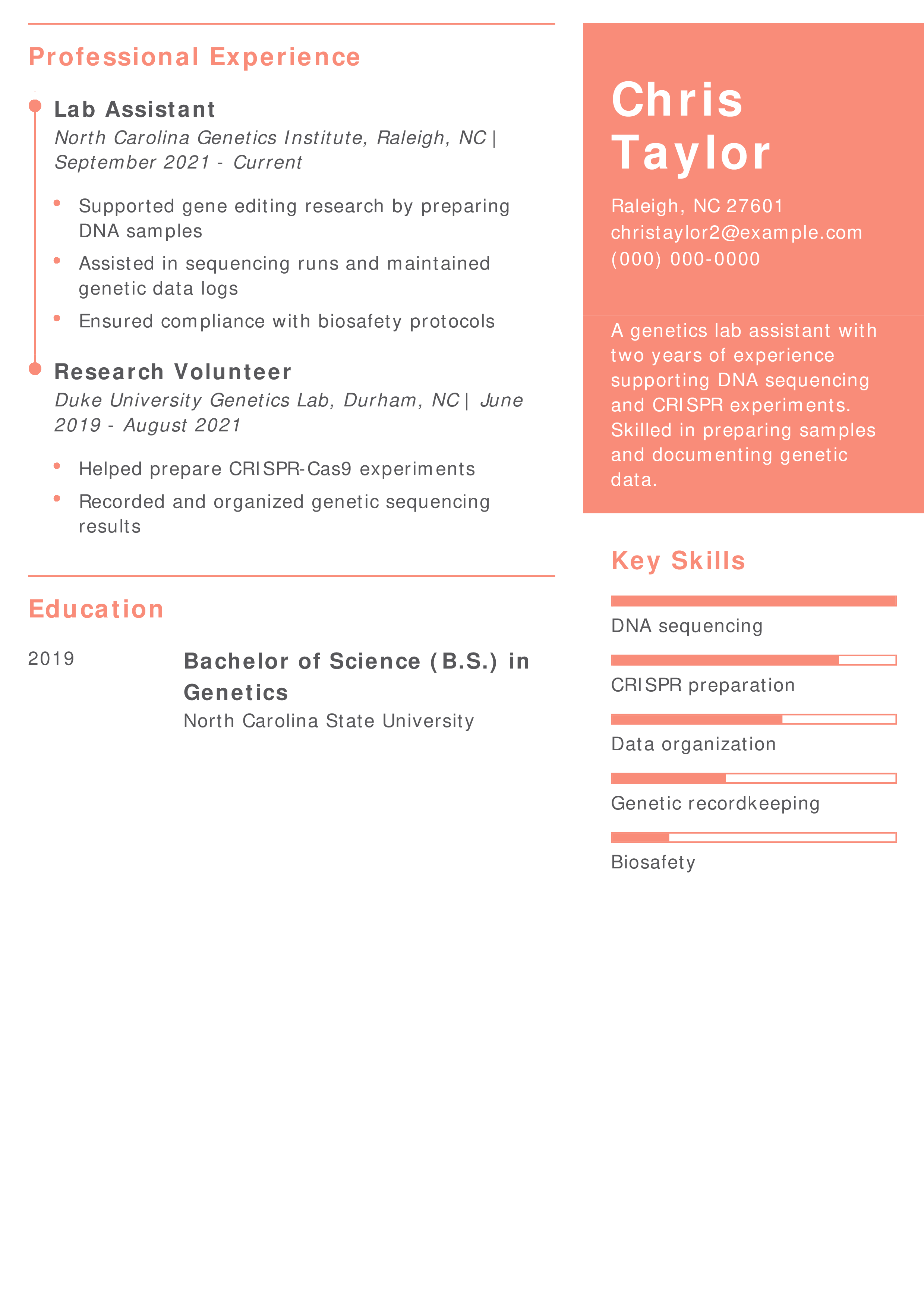
Genetics Lab Assistant Resume Example
Why This Resume Stands Out
This resume is good because it highlights genetics-specific research skills while demonstrating compliance with safety protocols.
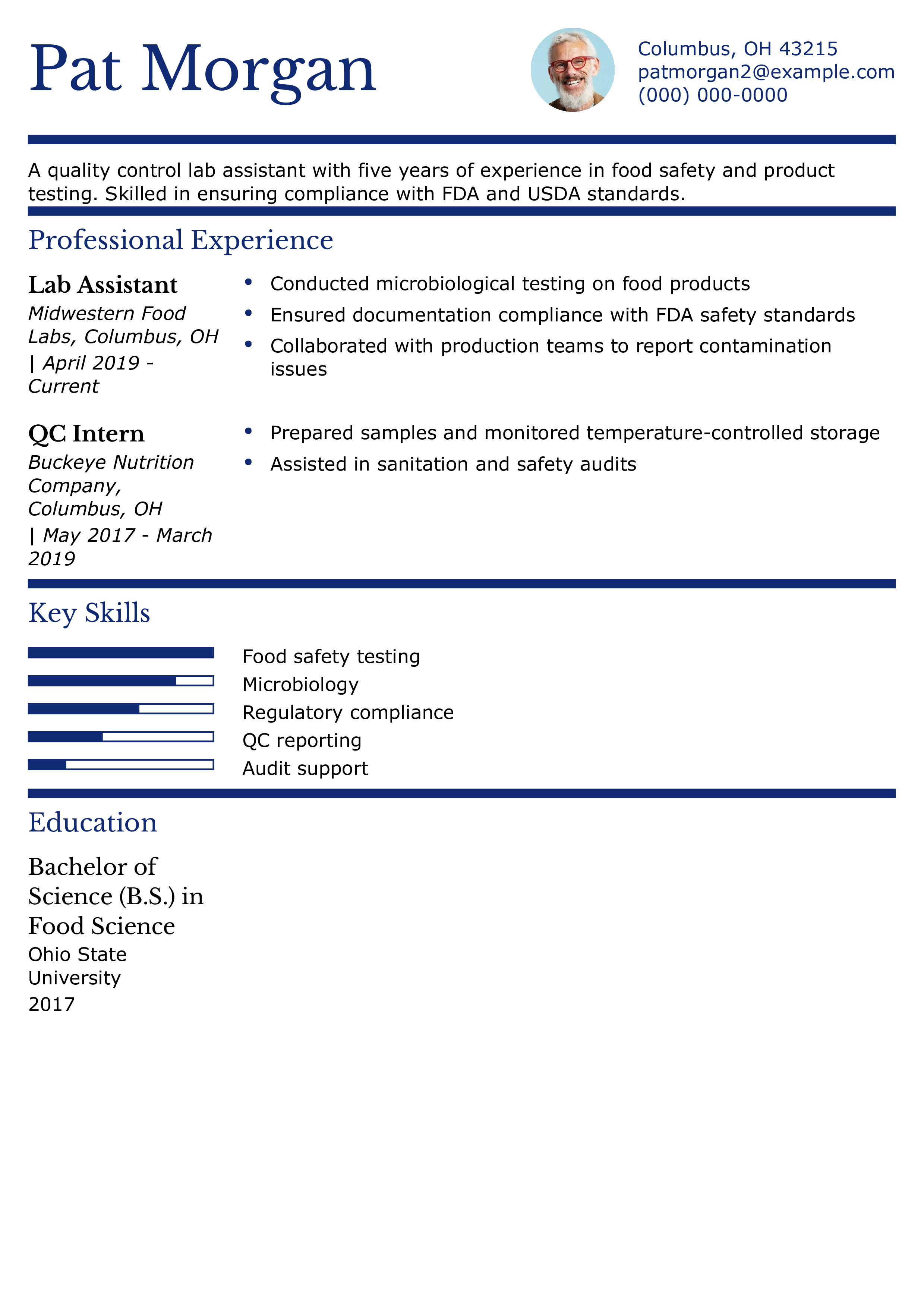
Quality Control Lab Assistant Resume Example
Why This Resume Stands Out
This resume is strong because it demonstrates applied lab testing with regulatory compliance, making it ideal for food safety labs.
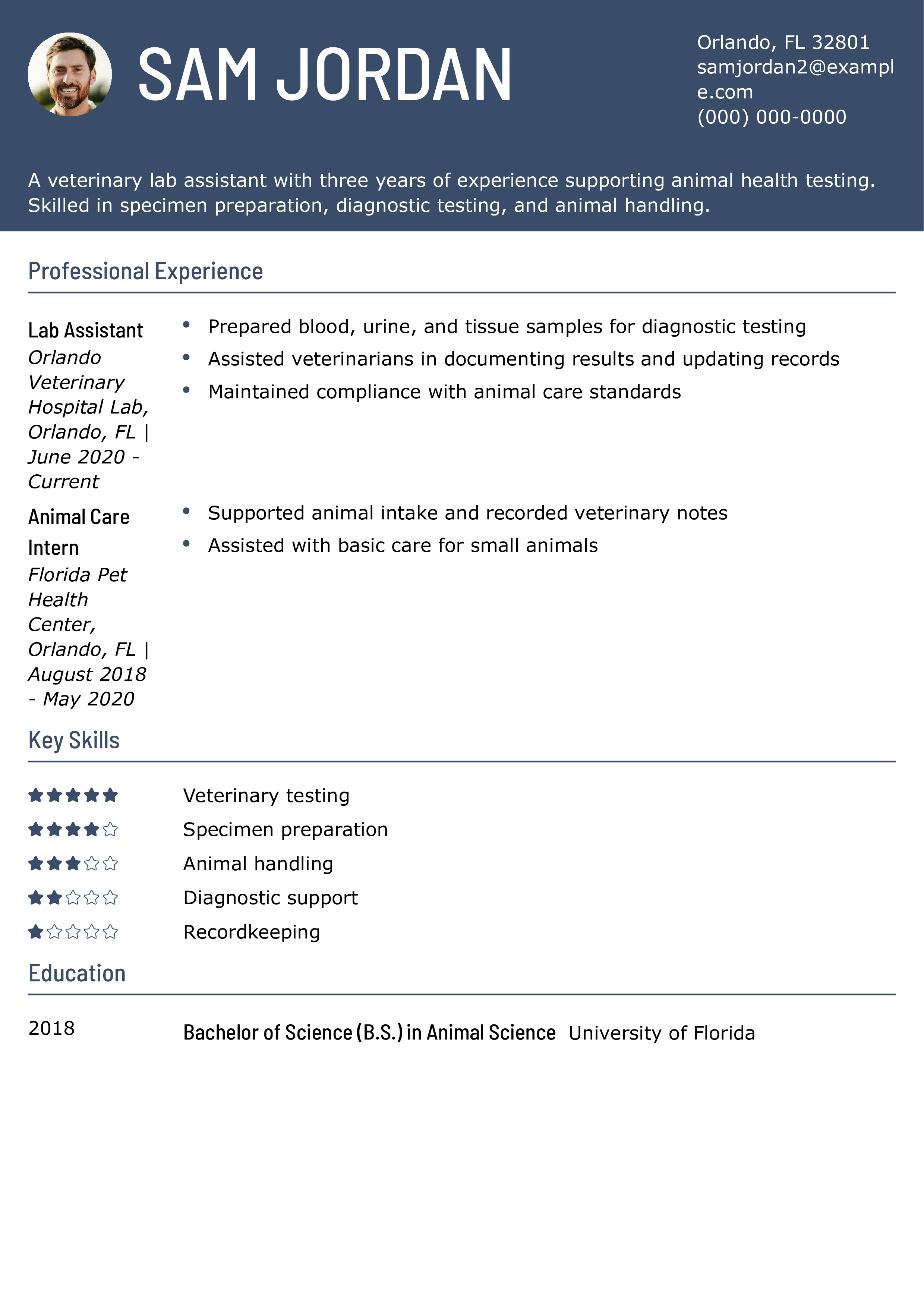
Veterinary Lab Assistant Resume Example
Why This Resume Stands Out
This resume is good because it ties laboratory testing to veterinary settings and demonstrates a passion for animal health.
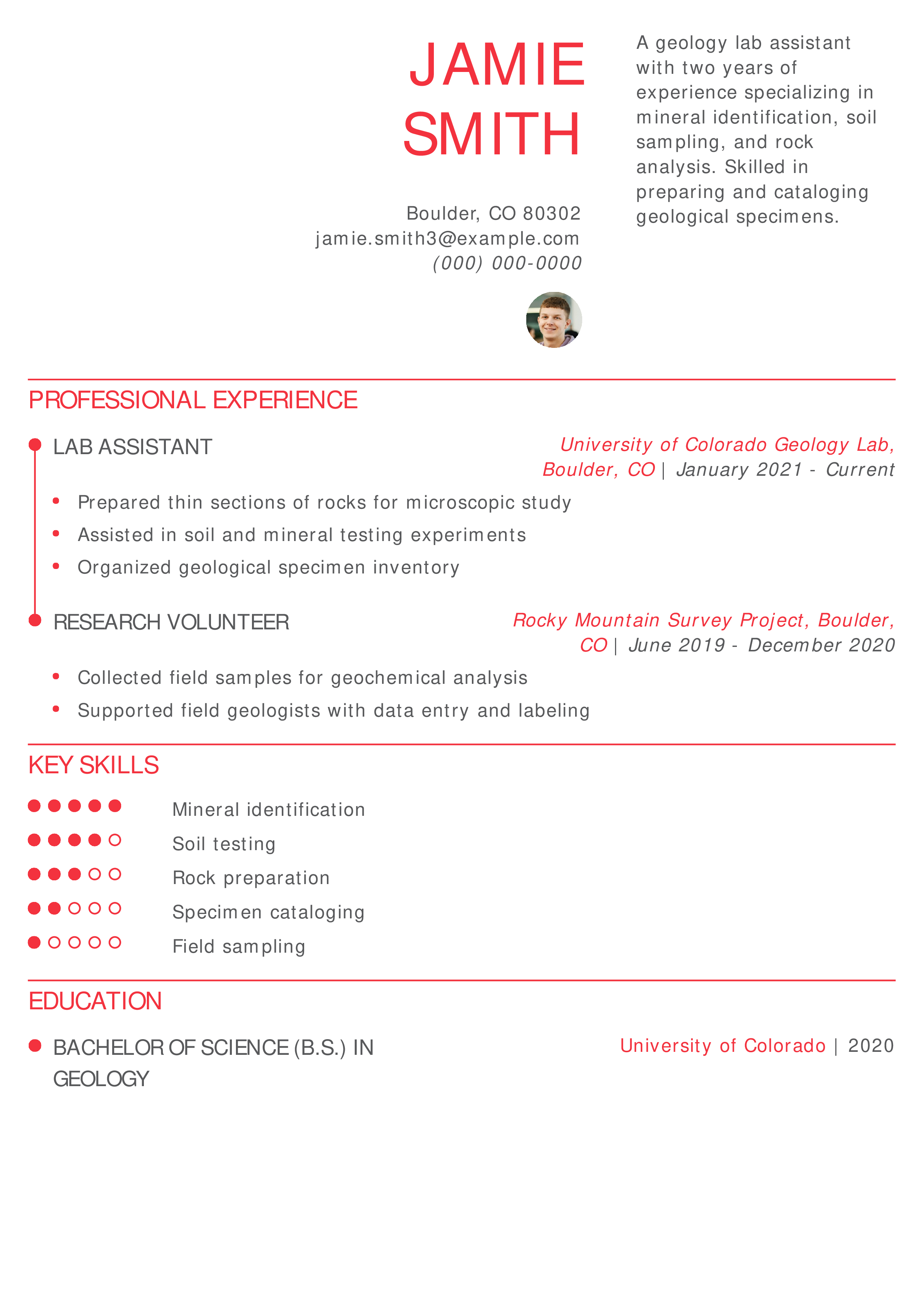
Geology Lab Assistant Resume Example
Why This Resume Stands Out
This resume is strong because it highlights both lab and field geology experience.
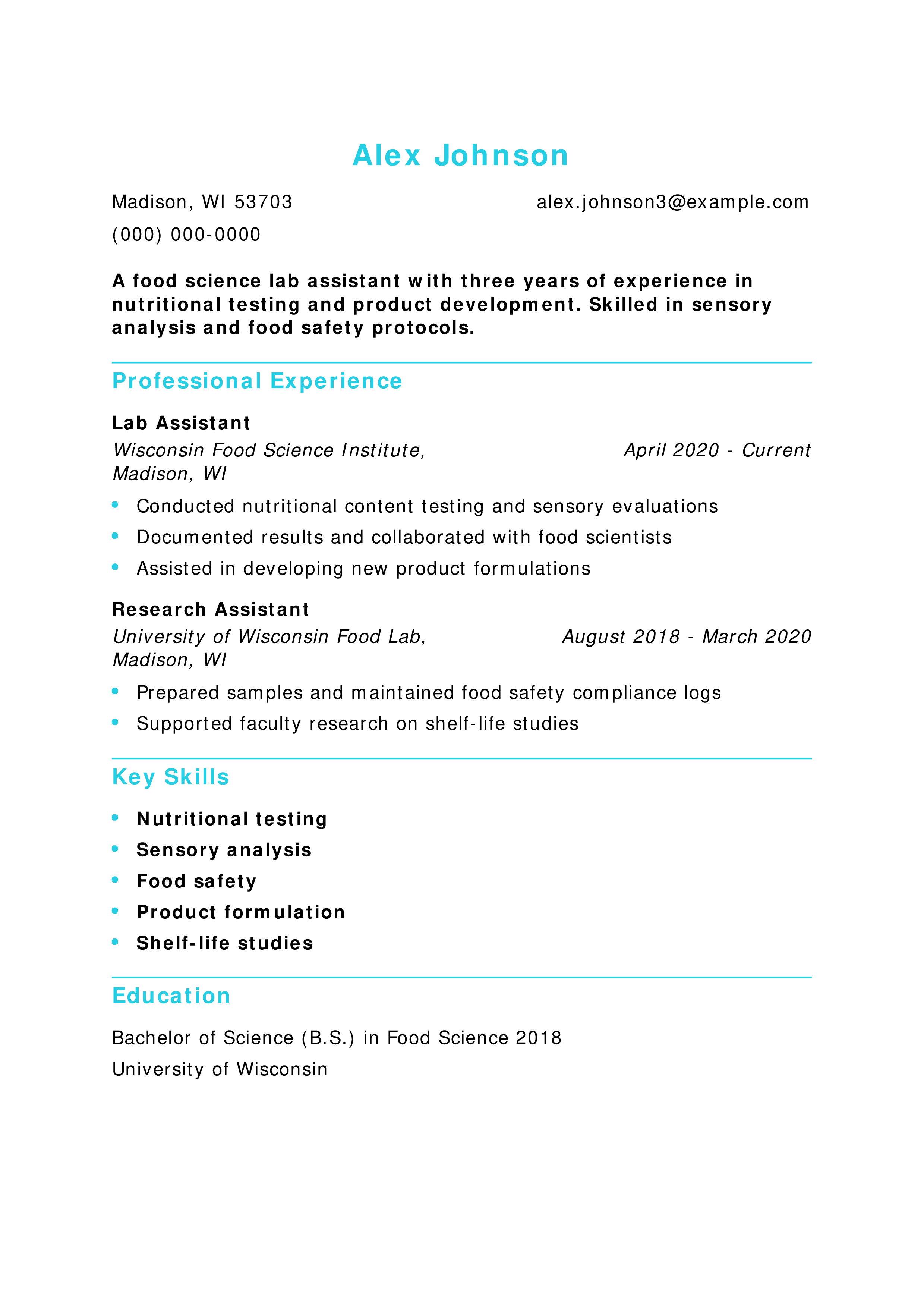
Food Science Lab Assistant Resume Example
Why This Resume Stands Out
This resume is good because it highlights applied testing and research, making it relevant for food labs.
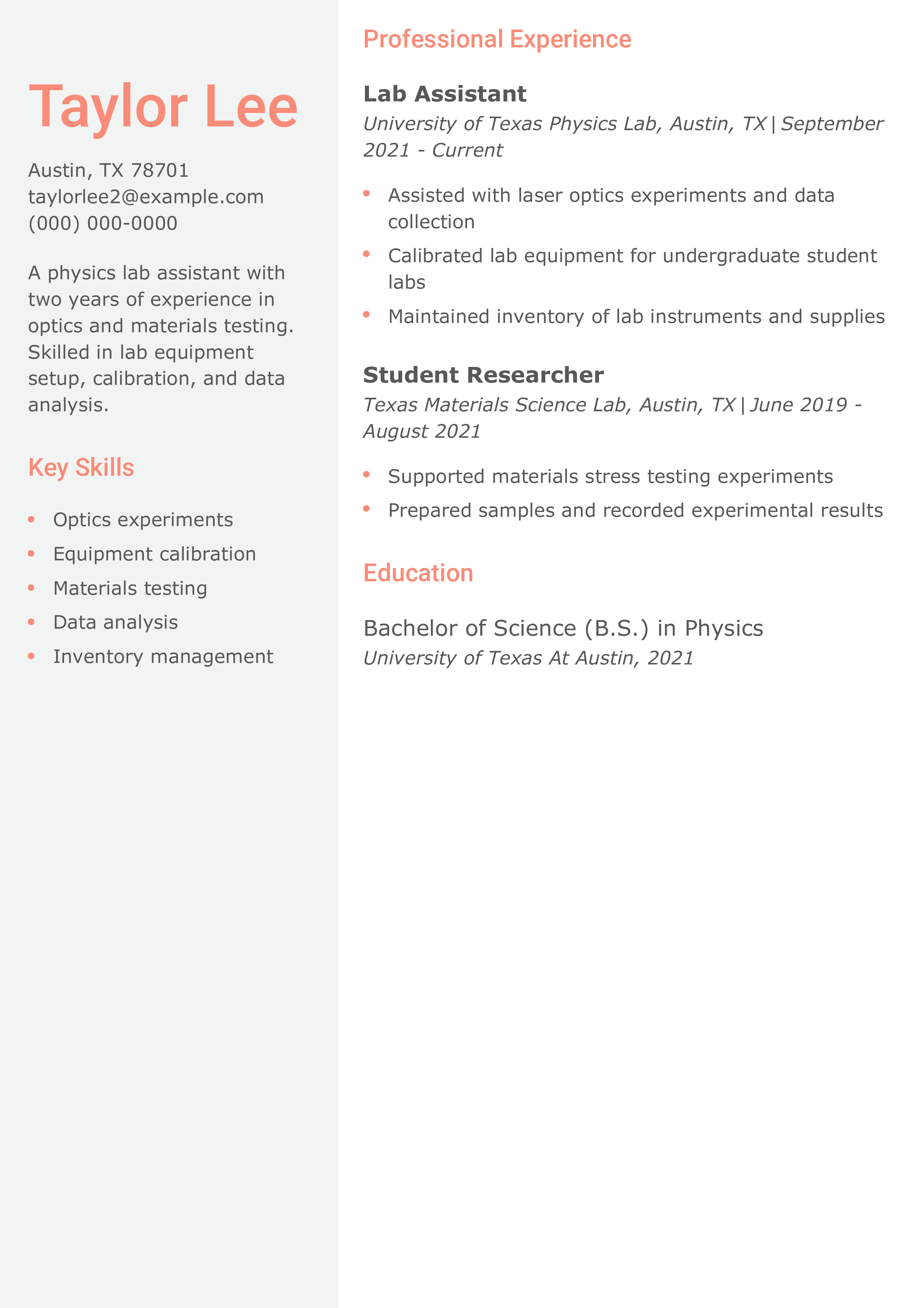
Physics Lab Assistant Resume Example
Why This Resume Stands Out
This resume is strong because it demonstrates hands-on lab skills and connects academic research to applied physics experiments.
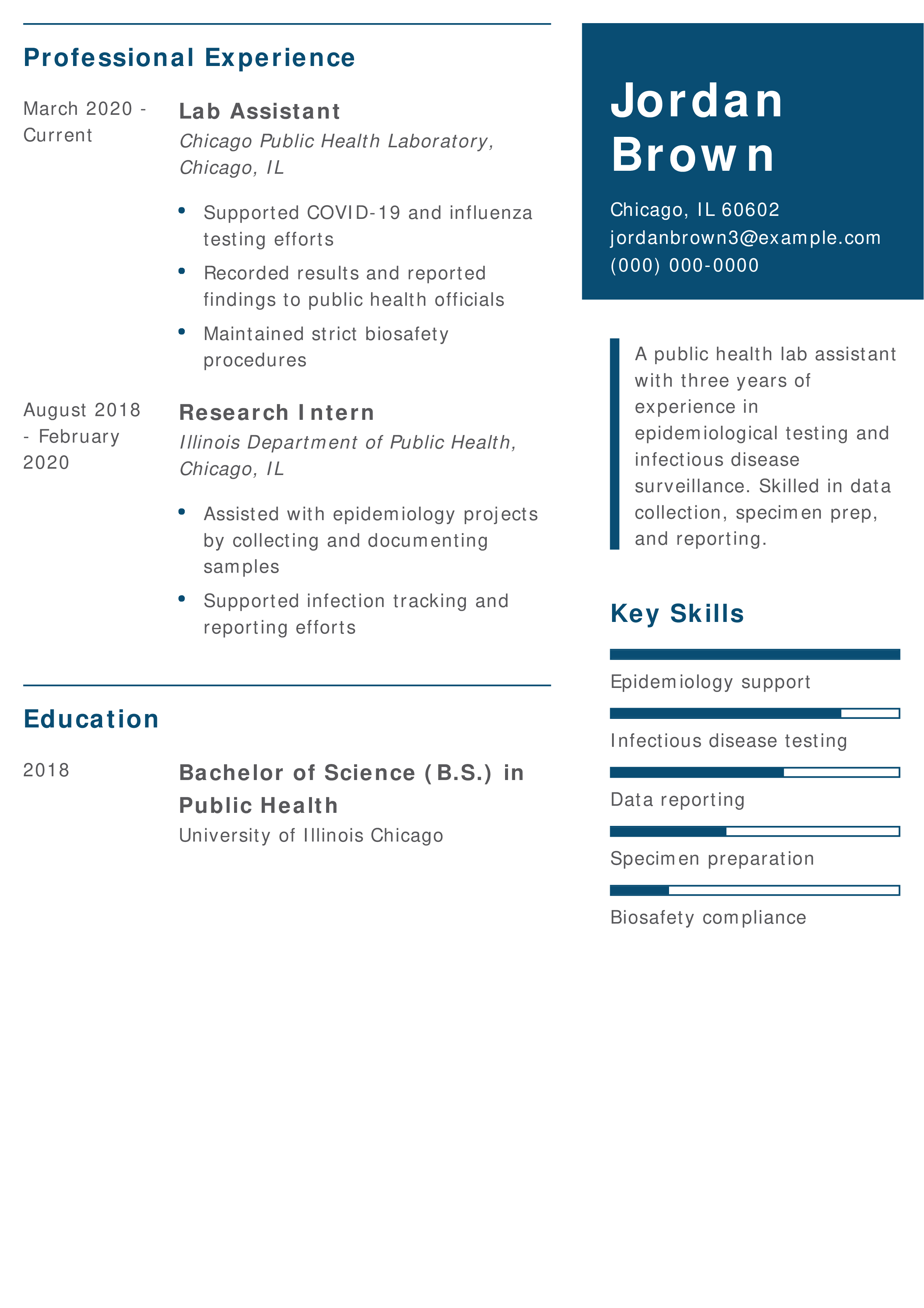
Public Health Lab Assistant Resume Example
Why This Resume Stands Out
This resume effectively shows how lab support connects to broader public health goals.
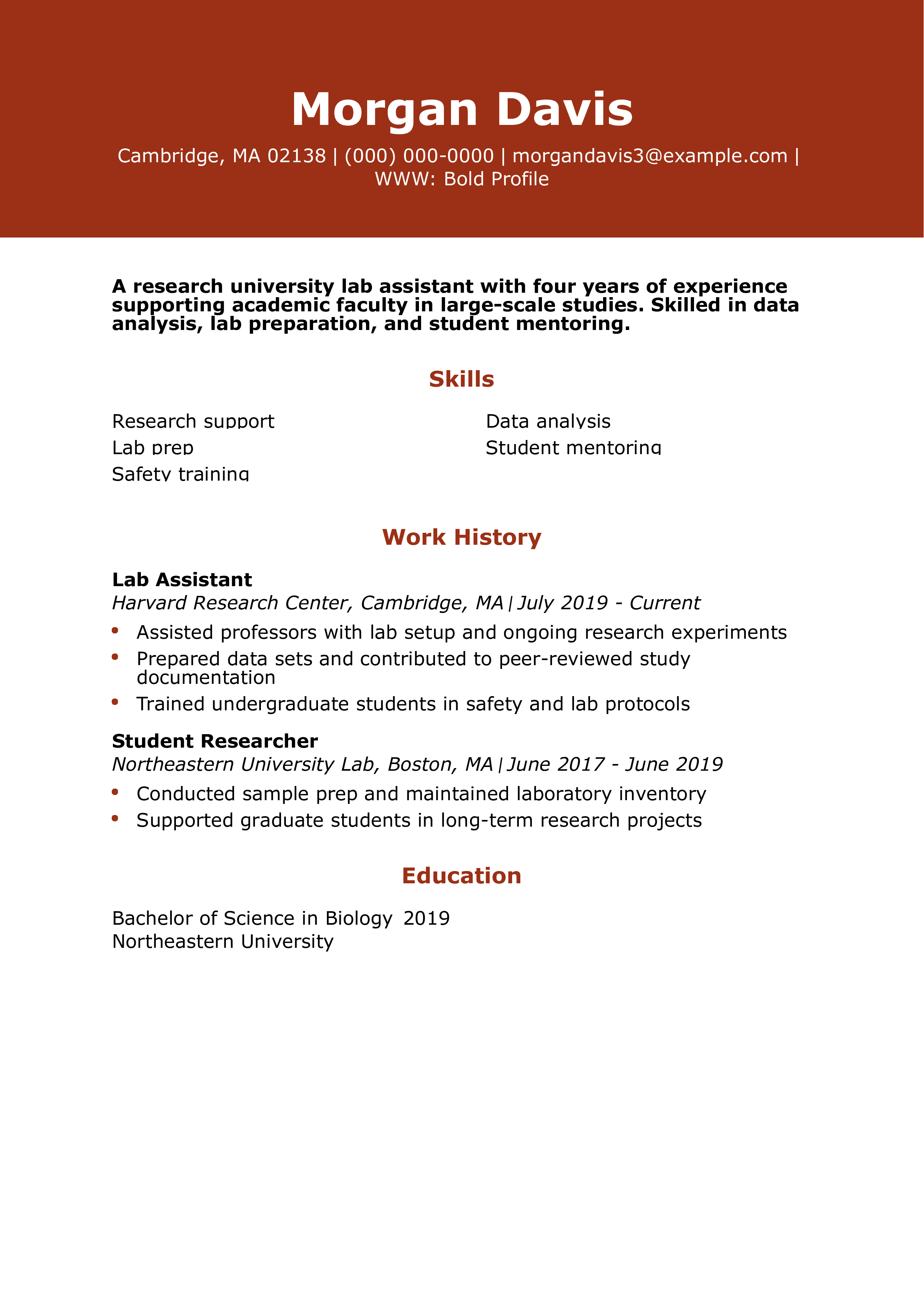
Research University Lab Assistant Resume Example
Why This Resume Stands Out
This resume is strong because it ties academic research support to teaching and mentoring experience, which is valued in university labs.
Our templates are crafted by professional resume writers to make creating your resume quick, easy, and effective.
- Professional resume template downloads
- Customized cover letter generation
- AI resume writing support
- Career-building resources and advice
Lab Assistant Text-Only Resume Templates and Examples
How To Write a Lab Assistant Resume
Lab assistant resumes should open with lab type and throughput. Put your diagnostic or research setting, daily sample volume, and mention of key procedures and protocol adherence at the top so hiring managers know you can keep a high volume lab running cleanly.

1. Summarize your lab assistant qualifications in a dynamic profile
To make a strong first impression on the hiring manager, lead with a powerful opening summary that encapsulates the most compelling aspects of your experience as a laboratory assistant. Start by detailing your job title, years of experience, and three to four specializations that match the job description. Showcase your expertise in laboratory testing techniques, safety, and specimen handling. Highlight a notable research project you supported and emphasize your ability to collaborate in fast-paced clinical environments.
Professional Profile - Example #1
A lab assistant with five years of experience specializing in electrical engineering, chemistry, OSHA safety standards, and data analysis. A strong history of collaborating with diverse teams to drive process improvements to enhance lab efficiency and throughput.
Professional Profile - Example #2
A lab assistant with three years of experience specializing in clinical research, laboratory safety, animal studies, and phlebotomy. A strong history of supporting key research initiatives to study novel approaches and treatments for congenital health defects.
2. Add your lab assistant experience with compelling examples
To generate interviews, you must craft a professional experience section that illustrates your most eye-catching achievements and qualifications. Provide examples of the types of research projects you worked on. Emphasize your expertise in laboratory safety and quality control.
Carefully review the job posting and tactically integrate keywords into your bullet points.
Enhance the impact of your bullet points by incorporating numbers and metrics into your lab assistant resume. Although this can be difficult in some instances, there are various methods for evaluating the quality and efficiency of your laboratory. One way is by measuring throughput and turnaround times for sample testing. Another might be showcasing a reduction in uncertainty analysis. Even customer satisfaction ratings can be leveraged here, as this metric also speaks to your lab’s performance quality.
Professional Experience - Example #1
Lab Assistant, Innovate Engineering Corp., Seattle, WA | October 2018 – present
- Gather equipment data for researchers in a fabrication laboratory, including materials characterization, to support research and development initiatives and product development activities
- Coordinate with engineering teams to increase laboratory throughput by 15% and improve turnaround time for sample testing from five days to three
- Identify opportunities to improve lab efficiency by automating data entry and pre-analytical processes, resulting in a reduction of 10 work hours per week
Professional Experience - Example #2
Lab Assistant, University of San Diego, San Diego, CA | October 2020 – present
- Provided support for a variety of laboratory experiments and clinical studies, including managing animal care, performing data collection, sample storage, and analysis
- Deliver training to three lab assistants on quality control standards, OSHA safety, and decontamination procedures for laboratory equipment
- Ensure compliance with ethical standards for animal testing and welfare
3. Include education and certifications relevant to lab assistants
In addition to your education, feature any relevant certifications to emphasize your qualifications. Some of these credentials will often be required as a lab assistant depending on your industry. For example, if you were pursuing a career in electrical engineering, you might consider obtaining a Certified Quality Engineer credential. If you’re working in the medical field, you may need a Certified Medical Laboratory Assistant (CMLA) or Certified Phlebotomy Technician (CPT) credential.
Education
Template
- [Degree Name]
- [School Name], [City, State Abbreviation] | [Graduation Year]
Example
- Bachelor of Science (B.S.) Biology
- Columbia University, New York, NY | 2018
Certifications
Template
- [Certification Name], [Awarding Organization], [Completion Year]
Example
- Certified Quality Engineer, NCCA, 2019
- CMLA, 2018
4. Include a list of skills and proficiencies related to lab assistants
Employers often rely on Applicant Tracking Systems (ATS) to identify qualified candidates during the hiring process. If your document fails to meet specific benchmarks during the initial ATS scan, your application may be rejected before it reaches the hiring manager. To mitigate this risk, incorporate as many relevant keywords as possible into your resume. Be sure to provide a mix of laboratory safety, industry terminology, and interpersonal skills to show prospective employers that you’re a versatile candidate. Below, you’ll find a list of key terms that you may encounter in your job search:
| Key Skills and Proficiencies | |
|---|---|
| Animal testing | Animal welfare |
| Bacteriology | Biology |
| Blood chemistry | Chemical analysis |
| Chemical engineering | Clinical research |
| Data analysis | Data collection |
| Electrical engineering | Equipment calibration |
| Microbiology | Microscopic image capturing software |
| Lab safety | Laboratory testing |
| OSHA compliance | Phlebotomy |
| Process improvement | Quality assurance |
| Quality control | Scientific investigation |
| Specimen analysis | Urinalysis |
5. Feature your laboratory safety expertise
Featuring your lab safety expertise usage is important when applying for laboratory assistant jobs. Employers want candidates who can provide valuable contributions to their safety culture. This includes decontamination procedures, personal protective equipment (PPE) usage, and knowledge of OSHA standards. In the example below, the candidate showcases their laboratory safety experience and draws attention to their compliance with ethical standards during animal testing. This is important for the job seeker to feature here, as balancing the pain and suffering of the animal with the medical benefits of research is an important aspect of this type of role.
- Deliver training to three lab assistants on quality control standards, OSHA safety, and decontamination procedures for laboratory equipment
- Provide support for a variety of laboratory experiments and clinical studies, including managing animal care, performing data collection, sample storage, and analysis
- Ensure compliance with ethical standards for animal testing and welfare
How To Pick the Best Lab Assistant Resume Template
When selecting your resume template, prioritize readability, layout, and organization.
Choose a format that allows the hiring manager to easily scan your resume for key qualifications and experience. Opt for a straightforward, single-column template to present your information in a clear and intentional sequence. Avoid overly decorative fonts, flashy colors, and graphics, as strong visual elements may distract the reader from your content.
Frequently Asked Questions: Lab Assistant Resume Examples and Advice
Can I adjust a Lab Assistant resume example for different roles or industries?
Yes, you can easily adjust a Lab Assistant resume example by aligning your profile summary and key skills with the job description. If you are applying to different industries, emphasize transferable skills and any industry-specific experience. For example, if you’re applying to a finance role after working in tech, highlight your data analysis and financial reporting skills as relevant to both fields.
What are common action verbs for lab assistant resumes?
When building your professional experience section, you may overuse the same action verbs throughout your bullet points. That being said, differentiating your usage of action verbs can help keep your content fresh and improve the overall readability of your document. Below, you’ll find a list of strong verbs you can use to describe your work experience as you craft your document:
| Action Verbs | |
|---|---|
| Analyzed | Audited |
| Collaborated | Conducted |
| Coordinated | Delivered |
| Developed | Diagnosed |
| Evaluated | Executed |
| Identified | Implemented |
| Improved | Led |
| Managed | Oversaw |
| Performed | Provided |
| Supported | Tested |
How do you align your resume with a lab assistant job description?
According to the Bureau of Labor Statistics, the average annual salary for lab assistants was $57,800 in 2023, with a projected growth rate of 7% over the next decade. Many of these positions will be clinical, but opportunities are available in other industries, such as the electrical engineering field. Despite these positive growth indicators, you’ll still need to align your resume with the job description to maximize your chances of landing the interview.
Before crafting your bullet points, research the company you’re applying to and learn about the organization’s culture and mission. For example, suppose you have a background in clinical research and are applying for a laboratory position with a biomedical company. In that case, you may want to draw attention to how your prior research initiatives are projected to improve the quality of life for patients. Tailoring your resume to each individual job application will give you a competitive edge in a crowded job market.
What is the best lab assistant resume format?
Reverse chronological is the ideal format for lab assistants. This approach places your most recent and relevant work history at the forefront of your document while showcasing your career progression. If you’re at the entry-level or making a career transition, place your skills and academic projects above your professional experience. Be sure to avoid functional resumes, as you still need to craft detailed bullet points to grab the attention of prospective employers.
Should my lab assistant resume be one or two pages?
Your lab assistant resume should ideally be one page, especially if you have fewer than 10 years of experience. A two-page resume can be effective for seasoned professionals with a longer track record if it highlights accomplishments and skills directly relevant to the job. Every detail should add value and strengthen your candidacy.
Limit your work experience to the past 10 to 15 years, unless earlier positions are highly relevant. Keeping your resume concise and targeted will make a strong and memorable impression on potential employers.

Craft your perfect resume in minutes
Get 2x more interviews with Resume Builder. Access Pro Plan features for a limited time!