
In interior design, a meticulously crafted resume serves as the blueprint for a successful career. Your resume is a canvas to showcase your unique vision, skills, and passion for transforming spaces into masterpieces. We will take you through building an impressive interior designer’s resume that reflects your creative flair and highlights your technical prowess and ability to turn dream designs into reality.
Whether you’re creating residential homes or commercial spaces or pursuing a niche specialization, this guide will help you create a resume that captures the essence of your design journey and opens doors to exciting opportunities in interior design.
Prove Your Design AI Experience, Don’t Just List It
Interior design hiring has shifted toward candidates who can show how they’ve actually used AI tools in client work, not just list software names. Firms reviewing portfolios now look for evidence that you’ve integrated rendering tools, space planning assistants, or material sourcing platforms into real projects with real constraints. The difference between listing a tool and describing how you used it is what separates competitive candidates from the rest. Here’s where specificity pays off:
- Client presentation work using Midjourney or comparable AI imagery tools, beyond internal exploration, is worth calling out by name.
- Client approval cycles shortened by AI rendering tools in settings where revisions mattered is the interior design proof point firms want.
Most Popular Interior Design Resumes
Entry-Level Interior Designer Resume Example
Why This Resume Stands Out
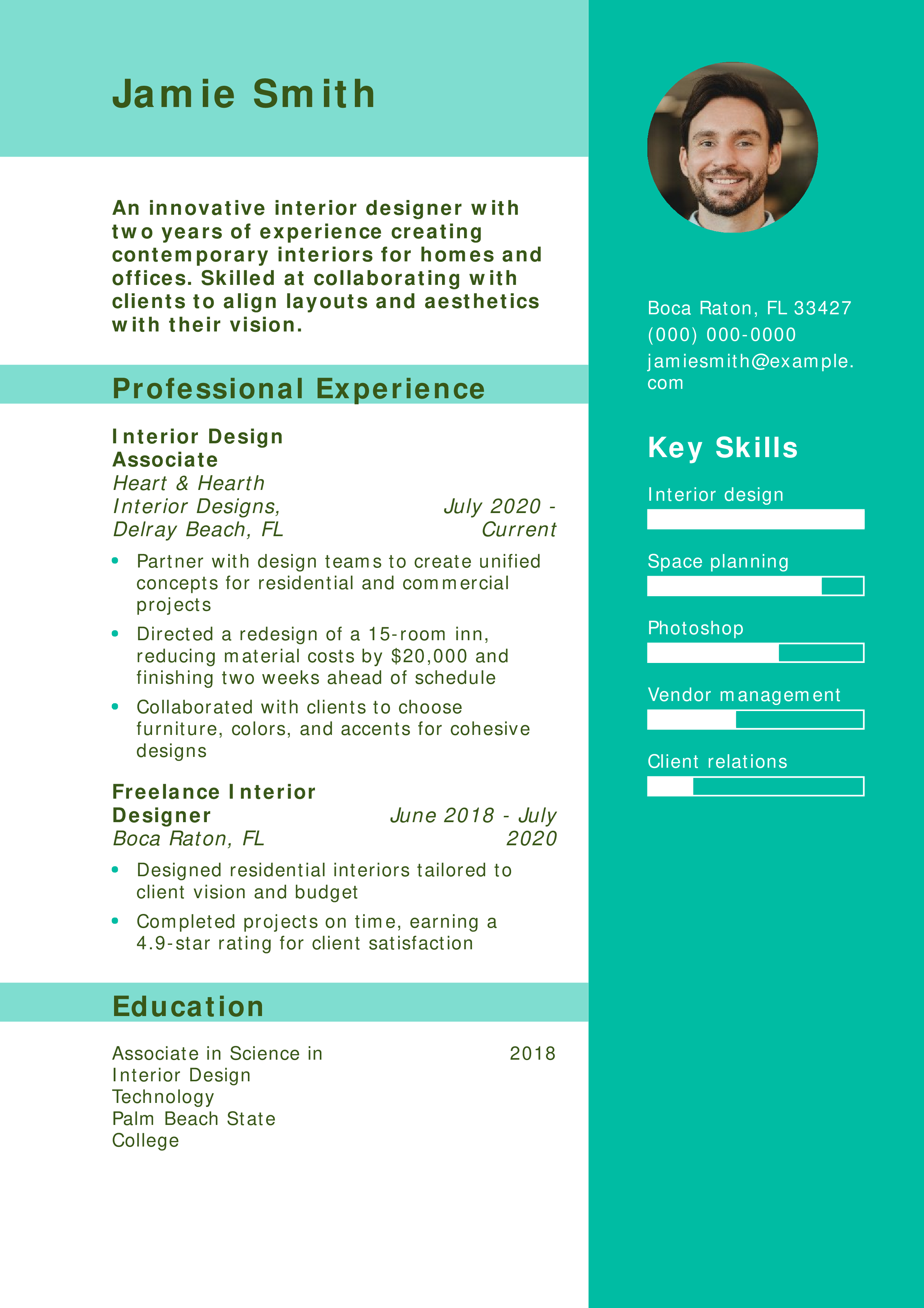
This resume is good because it highlights measurable project success and client satisfaction at the entry level.
Mid-Level Interior Designer Resume Example
Why This Resume Stands Out
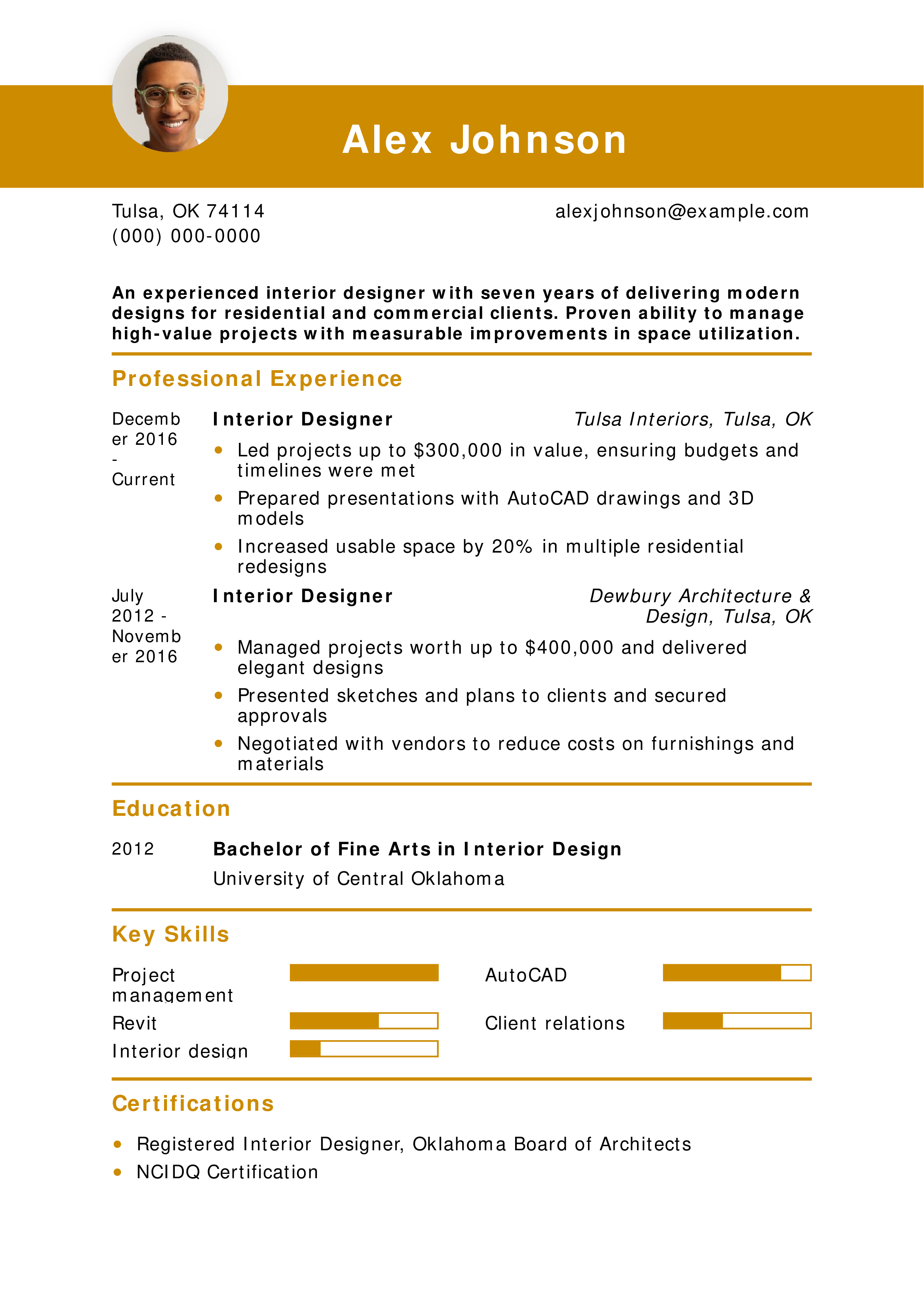
This resume is effective because it shows clear career progression with quantifiable achievements.
Senior Interior Designer Resume Example
Why This Resume Stands Out
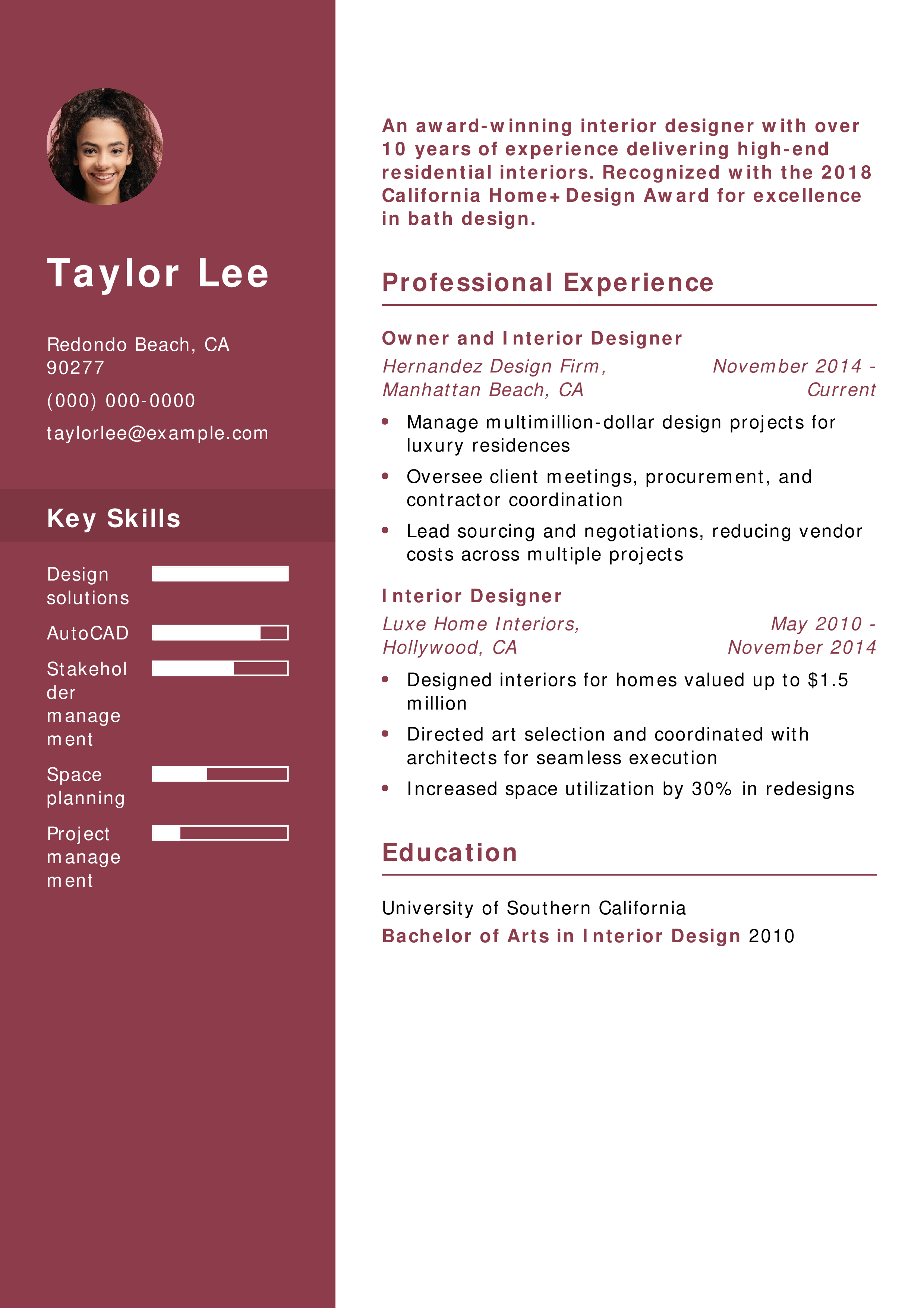
This resume is strong because it combines leadership with creative achievements, including award recognition.
Interior Design Assistant Resume Example
Why This Resume Stands Out
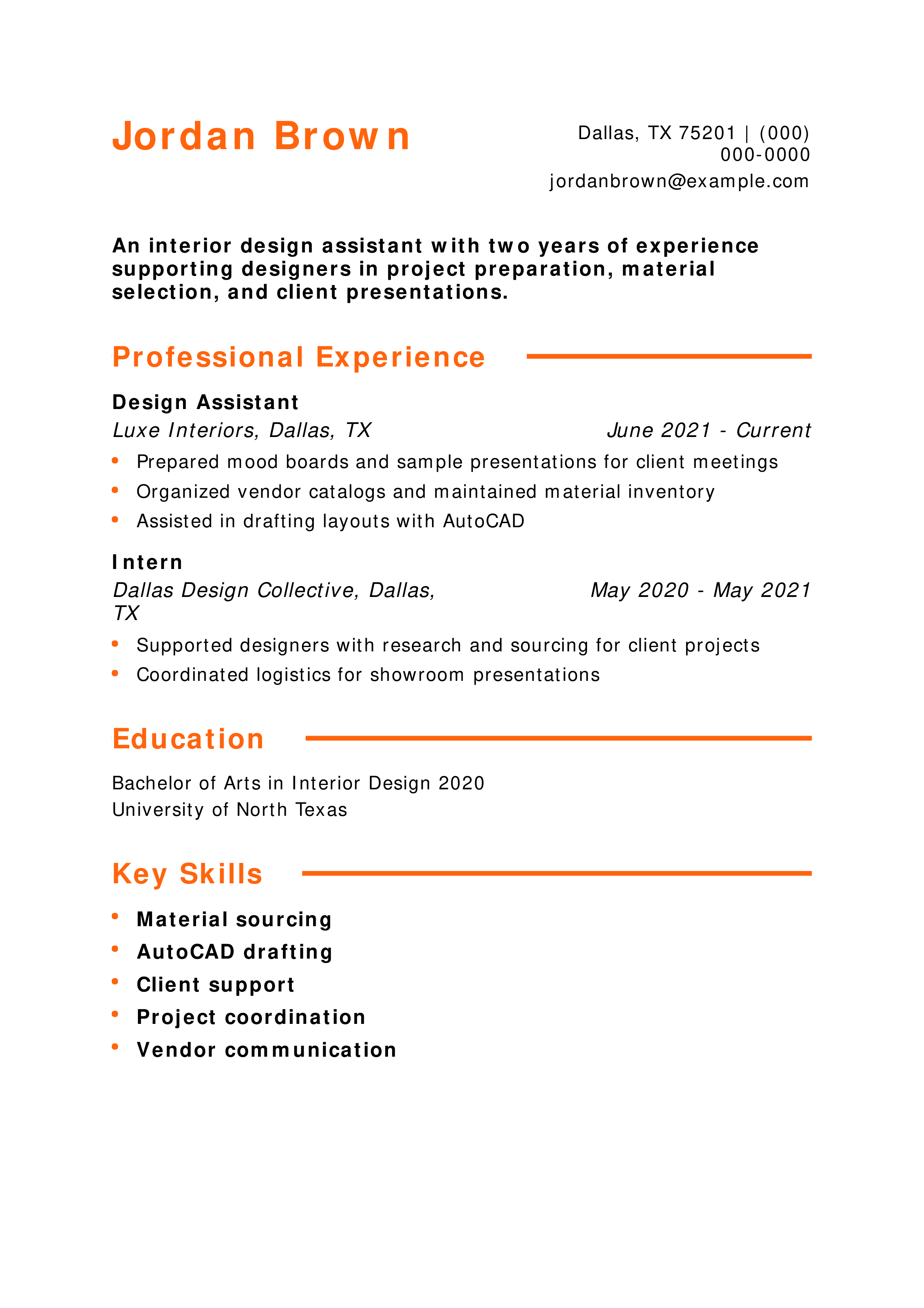
This resume is good because it shows strong foundational skills and support experience.
Freelance Interior Designer Resume Example
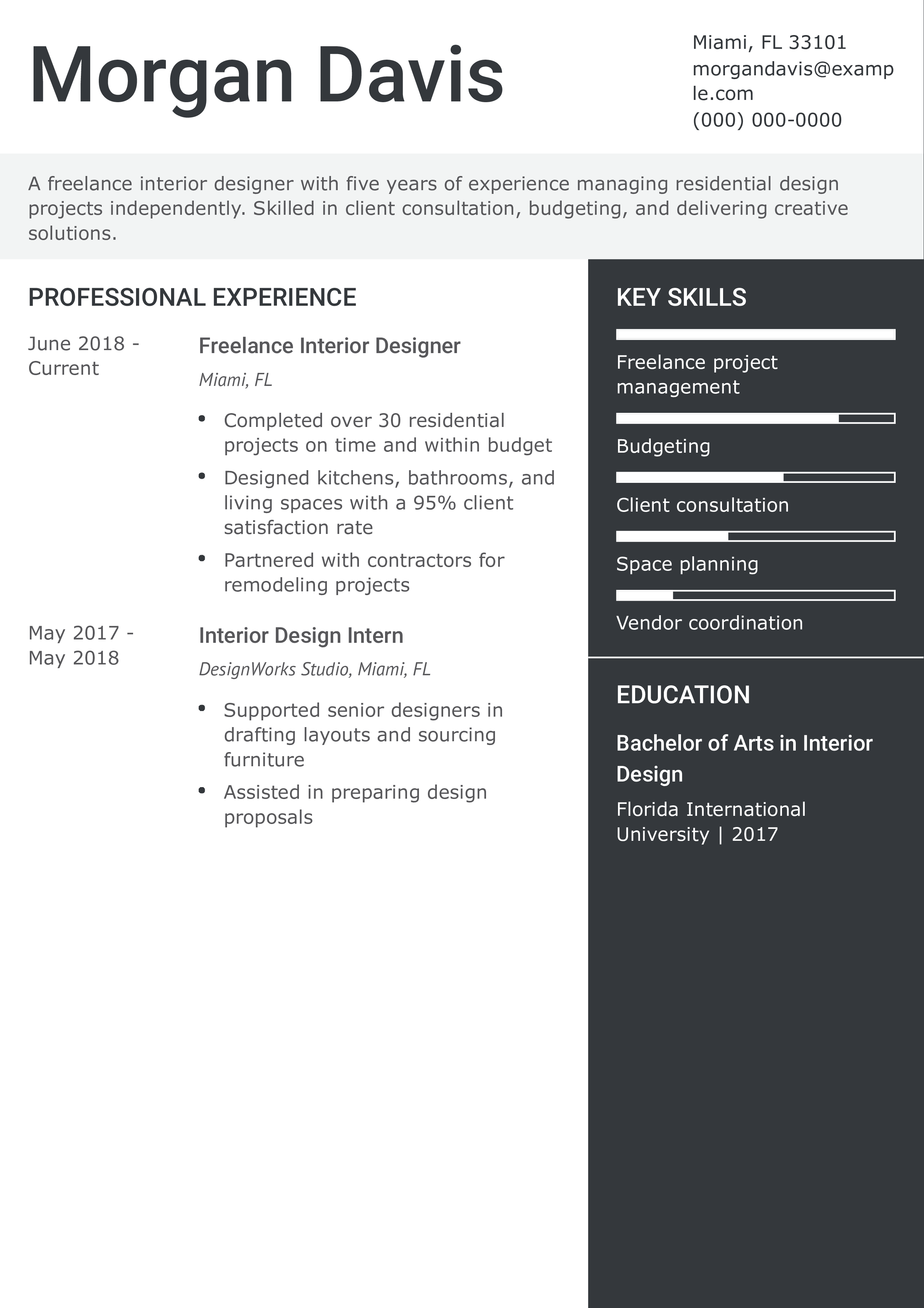
Why This Resume Stands Out
This resume is effective because it shows independence and client-focused success.
Junior Interior Designer Resume Example
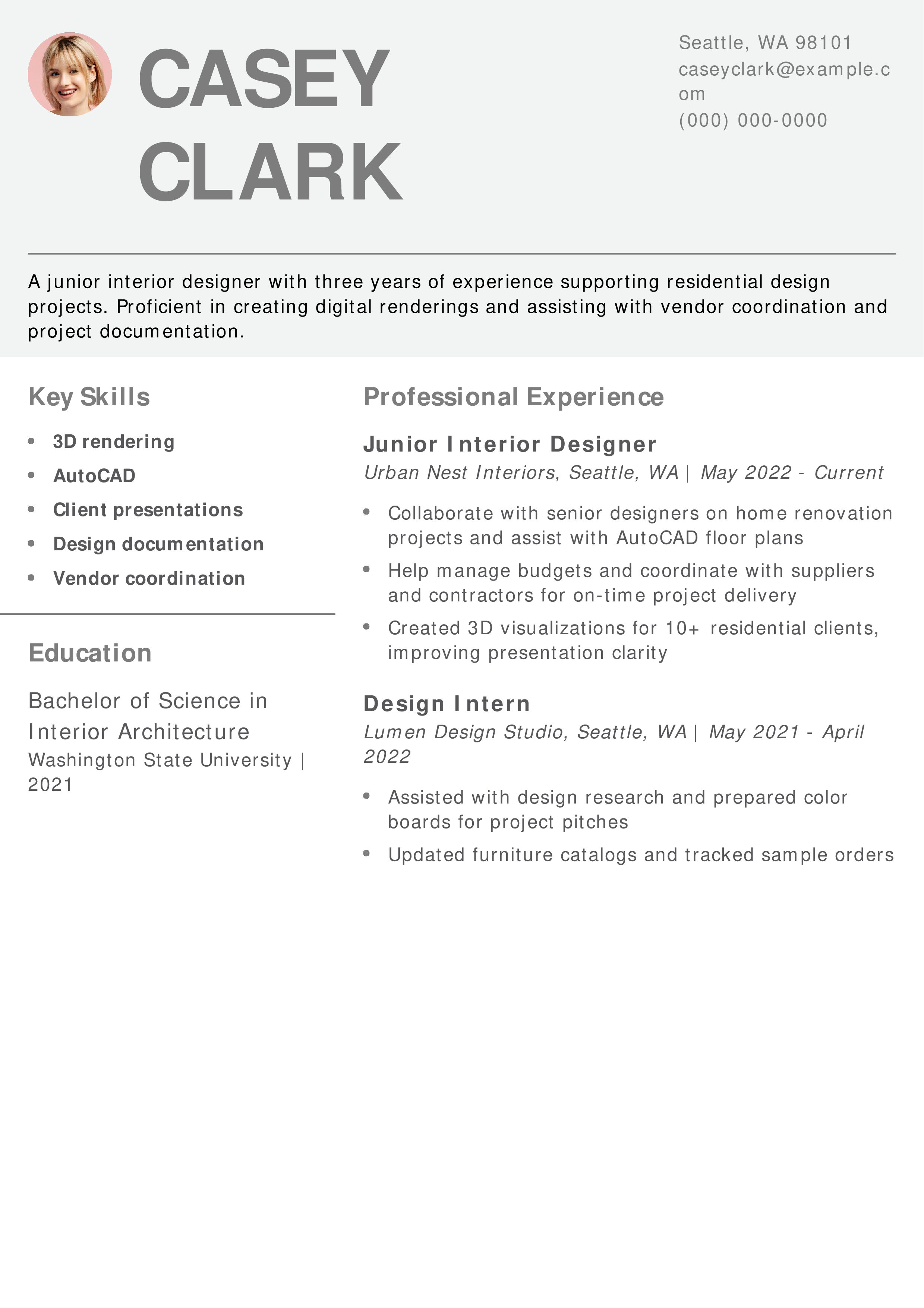
Why This Resume Stands Out
This resume is strong because it clearly shows growth from intern to junior designer while emphasizing software skills.
Creative Interior Designer Resume Example
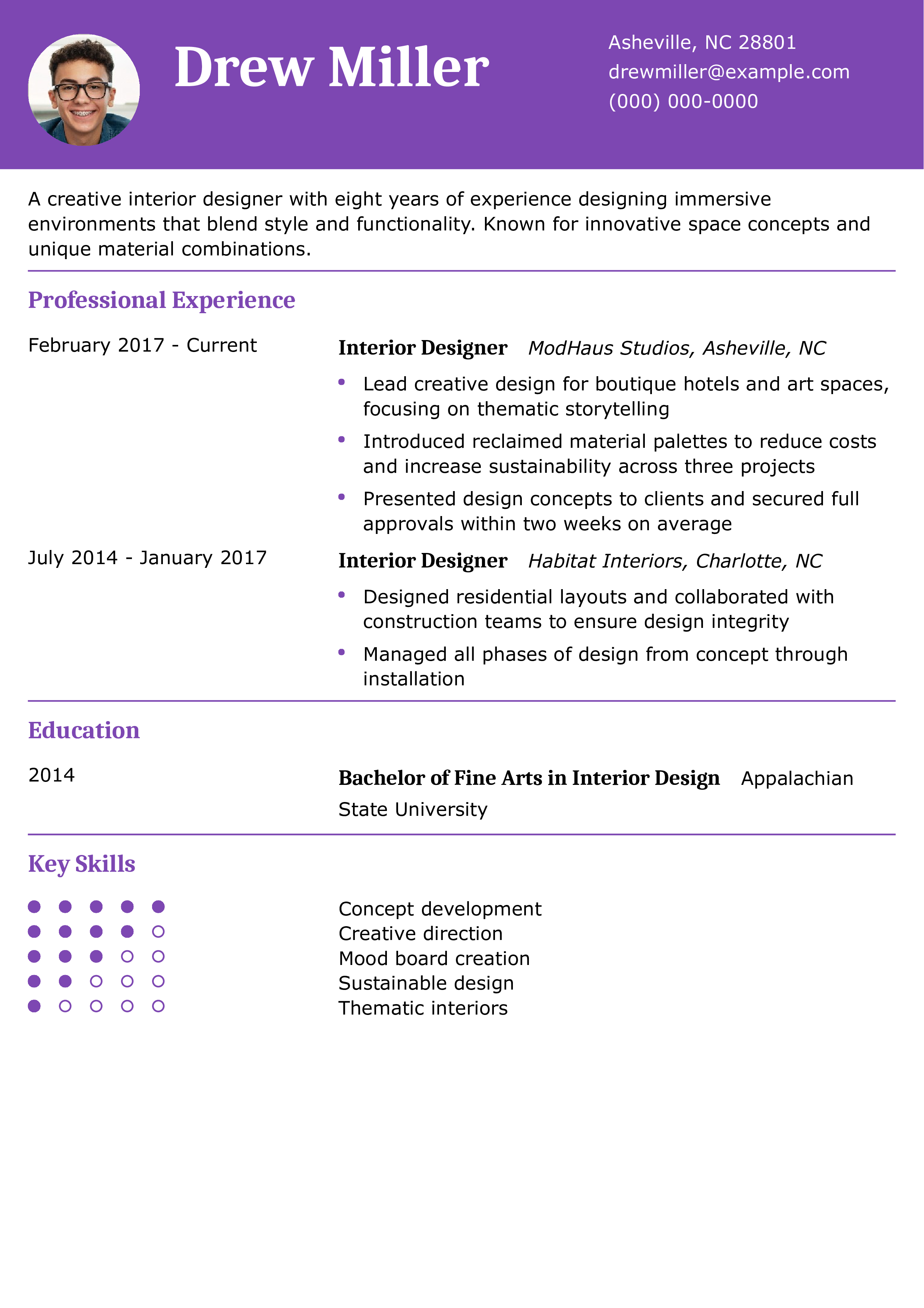
Why This Resume Stands Out
This resume is good because it shows creativity and environmental awareness while presenting a consistent design career path.
Interior Design Consultant Resume Example
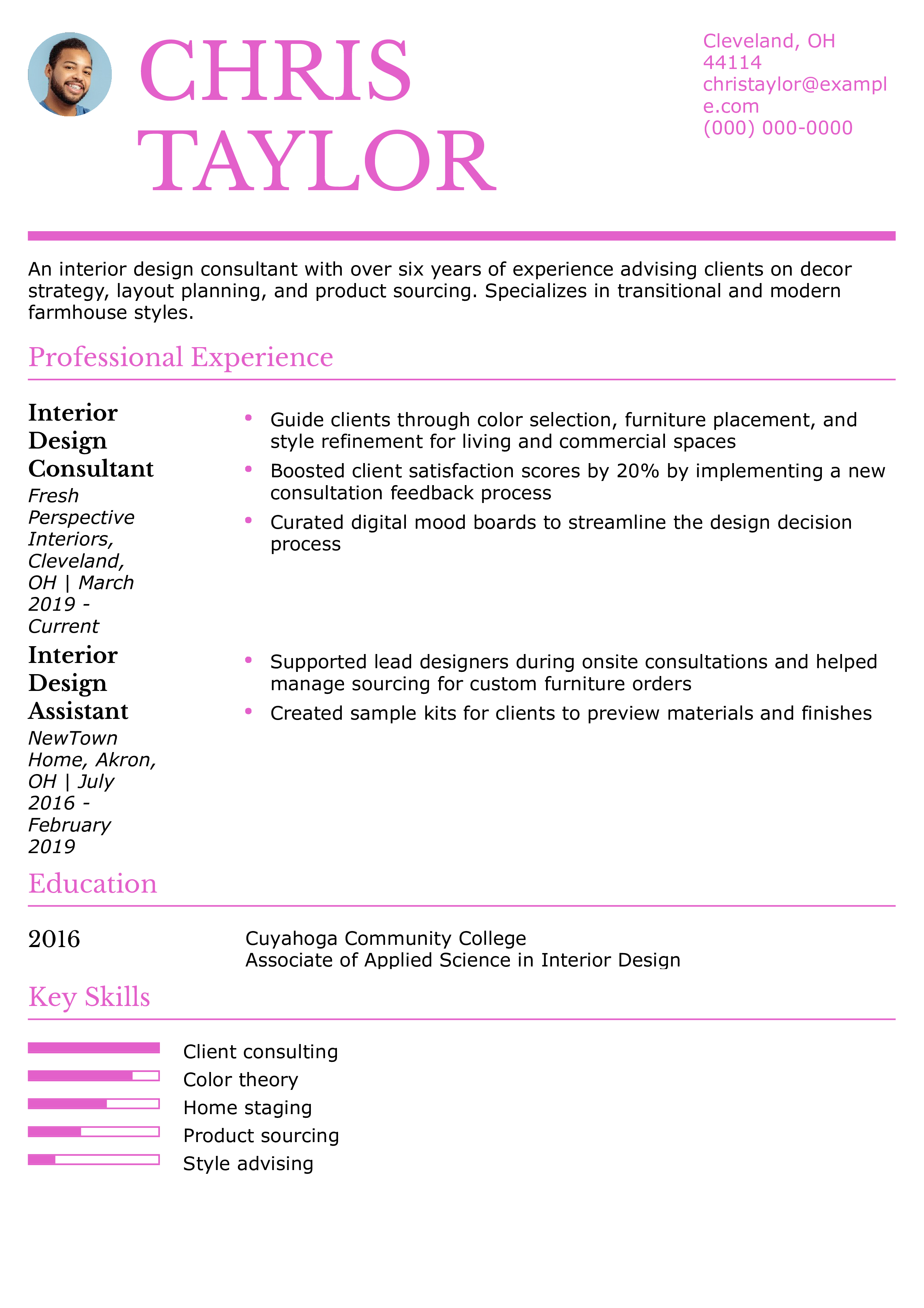
Why This Resume Stands Out
This resume effectively highlights consulting success with real results and client-focused strategies.
Automotive Interior Design Engineer Resume Example
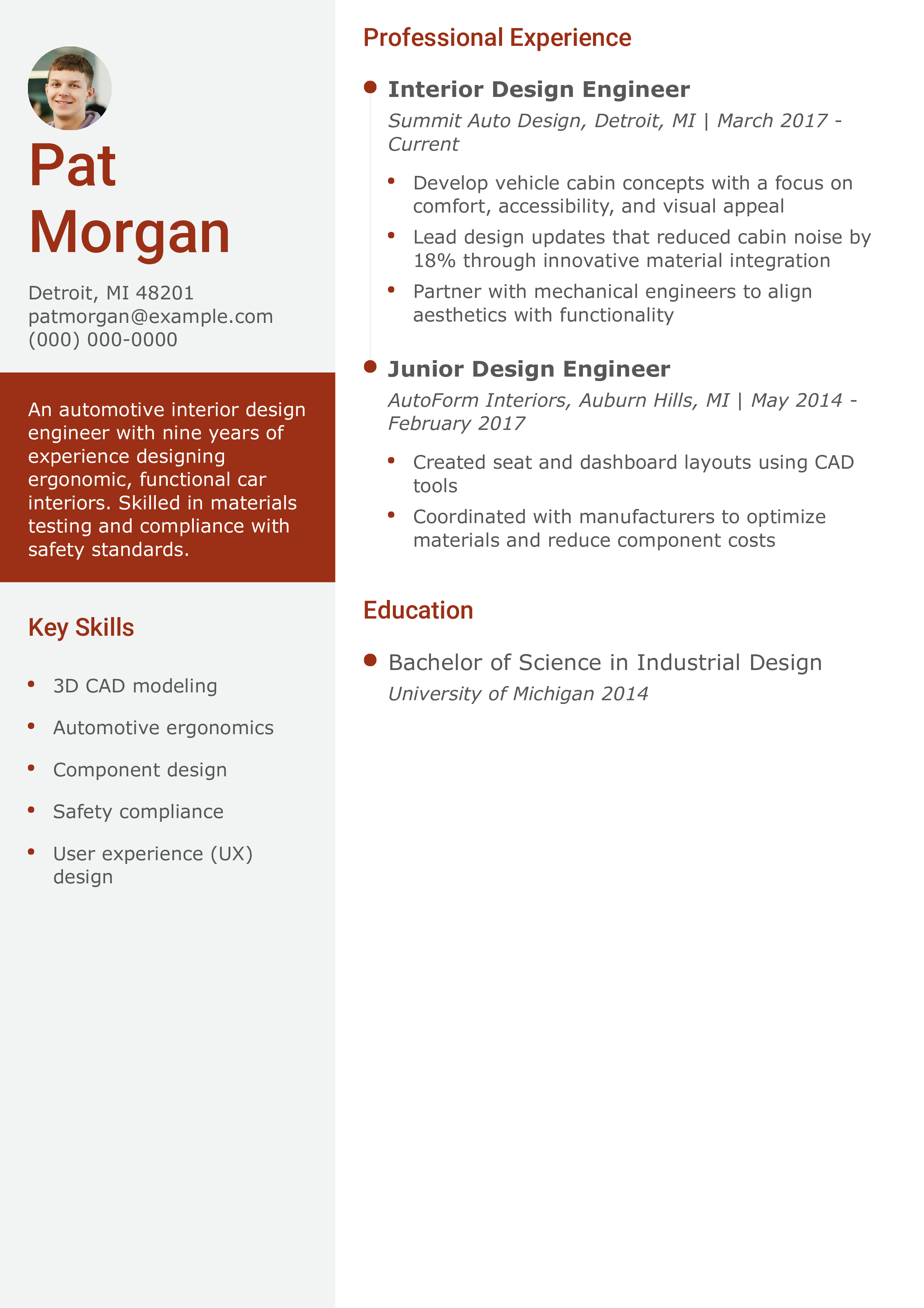
Why This Resume Stands Out
This resume is strong because it blends engineering expertise with interior design principles and shows quantifiable performance impact.
Interior Design Internship Resume Example
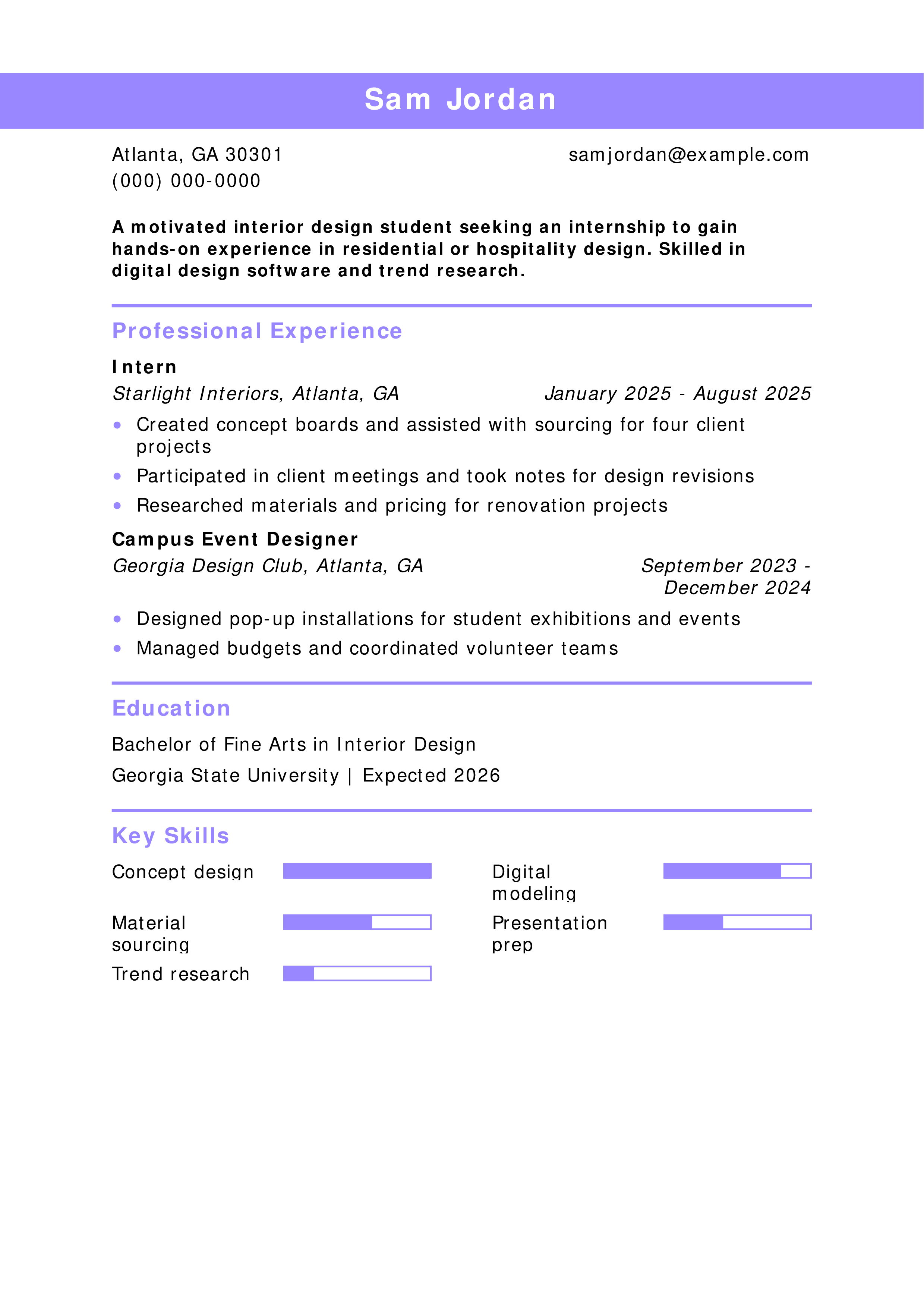
Why This Resume Stands Out
This resume is good because it shows relevant hands-on experience even before graduation and includes extracurricular leadership.
Commercial Interior Designer Resume Example
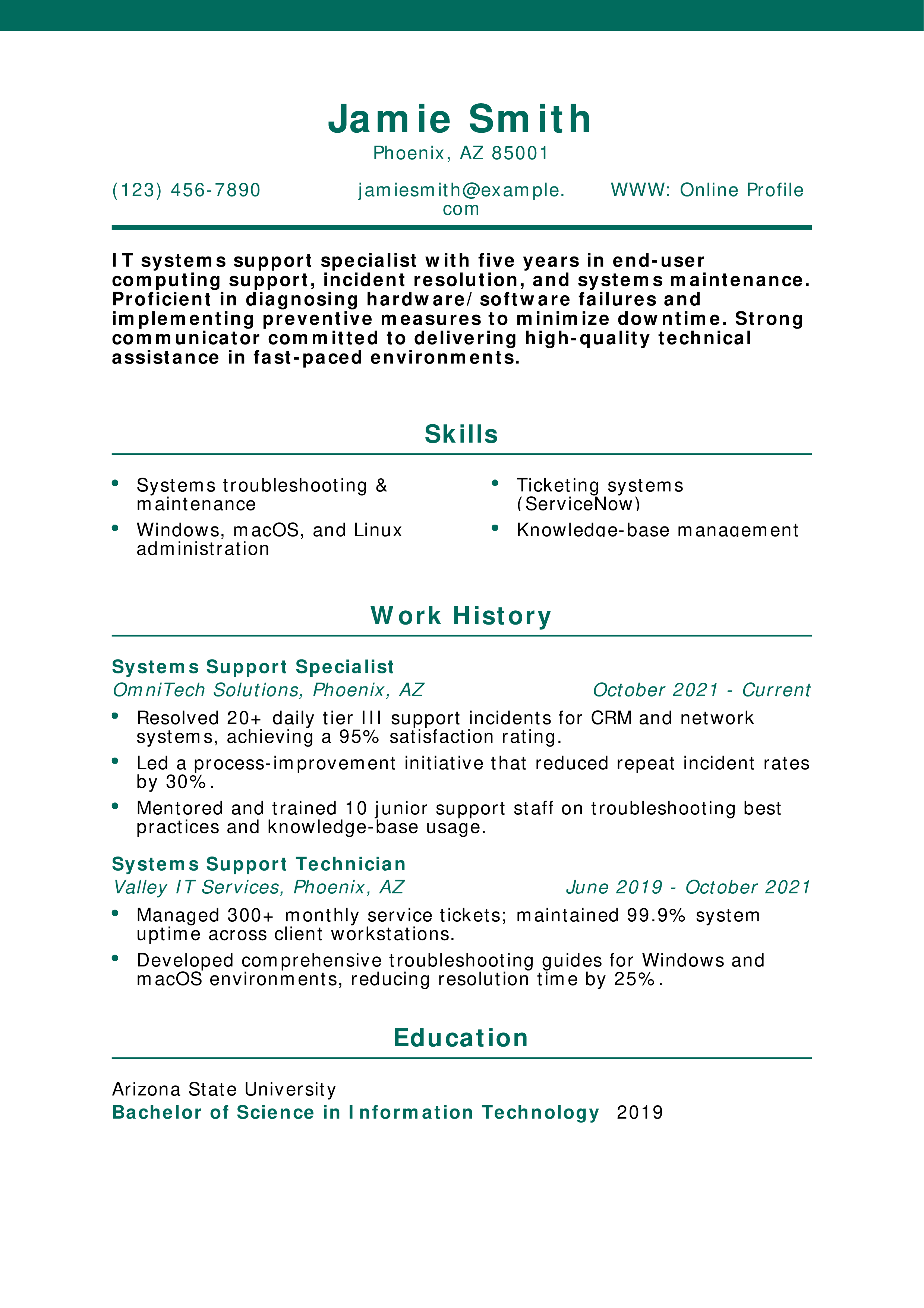
Why This Resume Stands Out
This resume is strong because it demonstrates commercial project experience and shows design as a strategic business tool.
Residential Interior Designer Resume Example
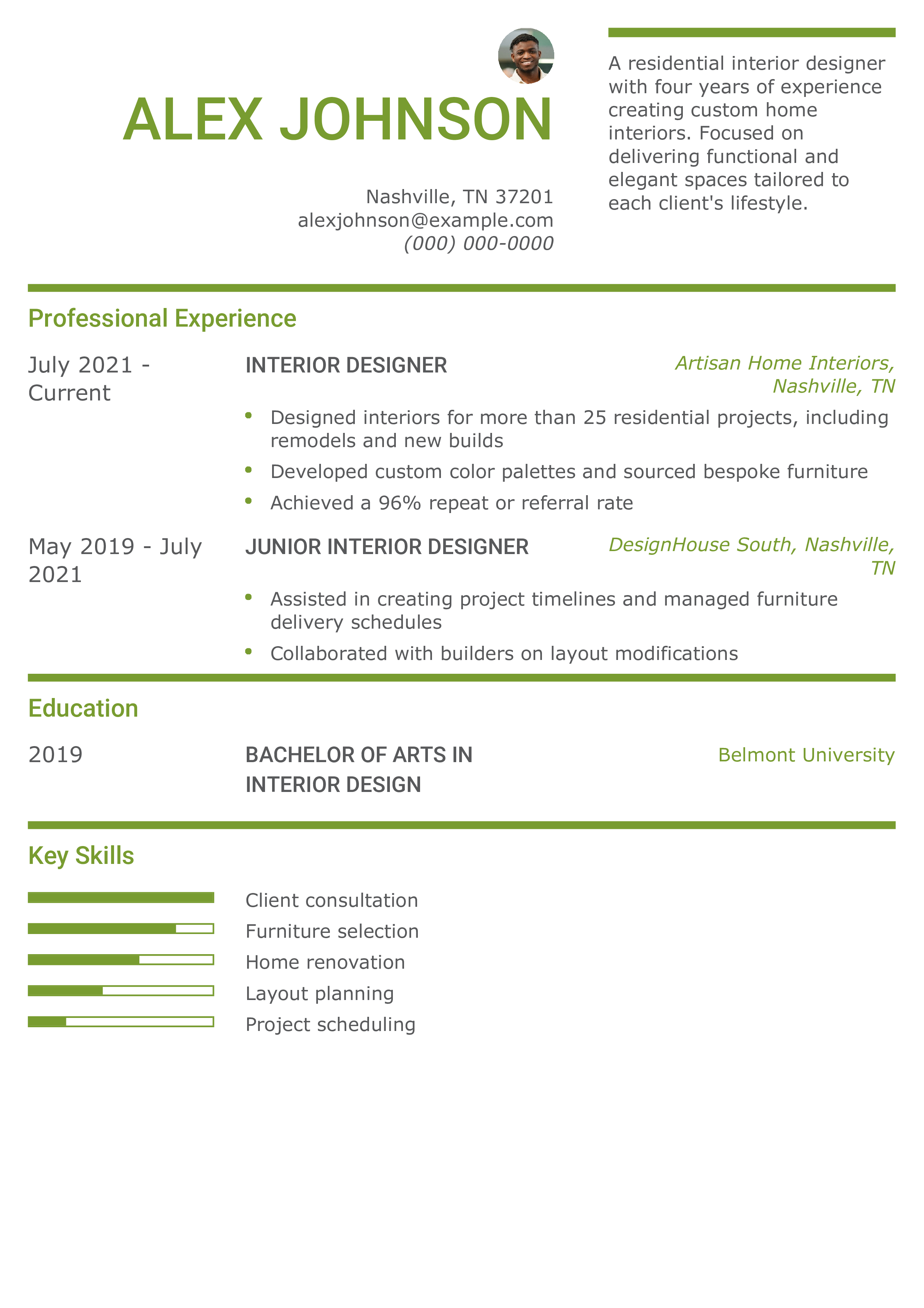
Why This Resume Stands Out
This resume is good because it demonstrates a strong understanding of client needs and design continuity.
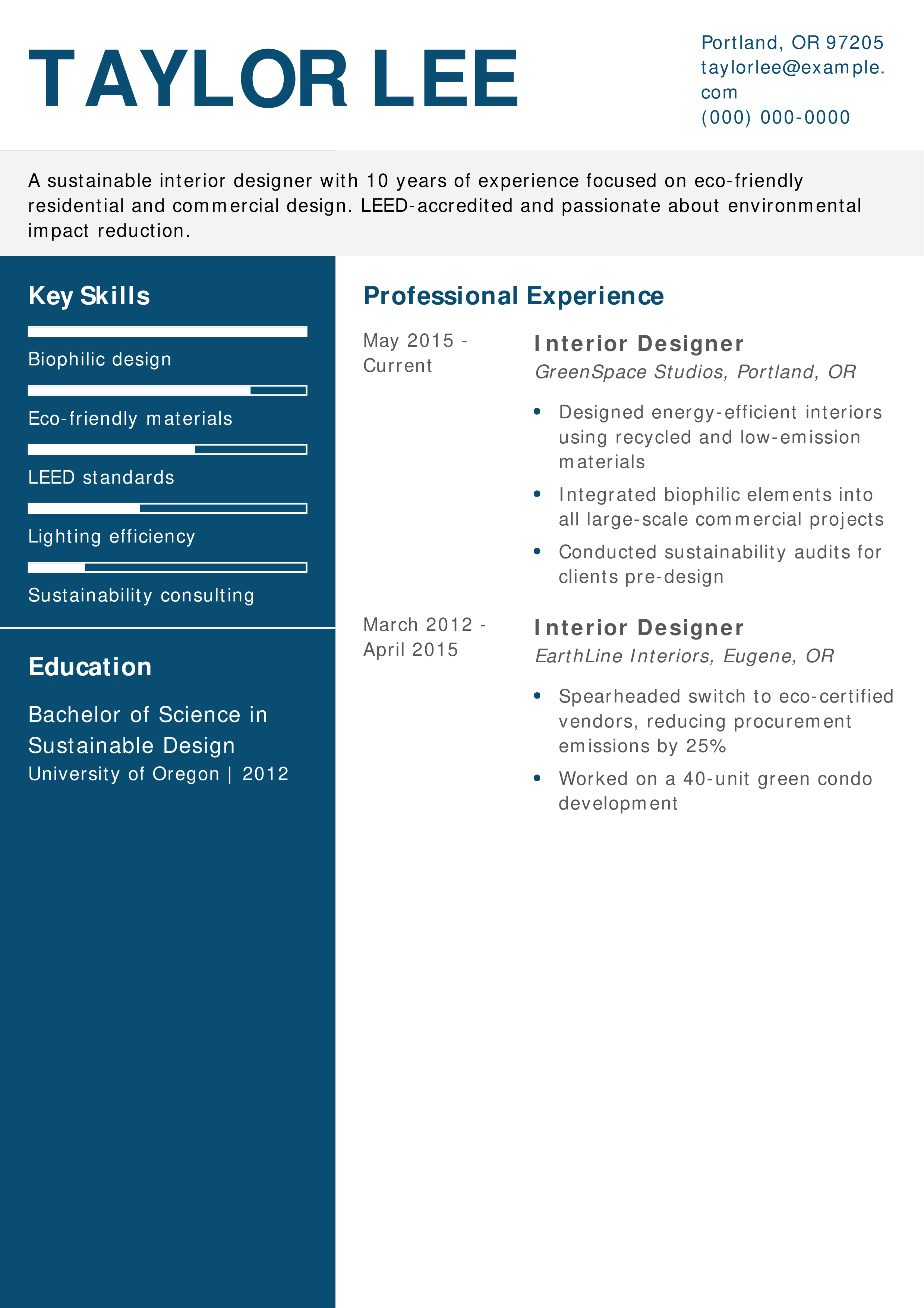
Sustainable Interior Designer Resume Example
Why This Resume Stands Out
This resume effectively blends industry-recognized sustainability knowledge with actionable project results.
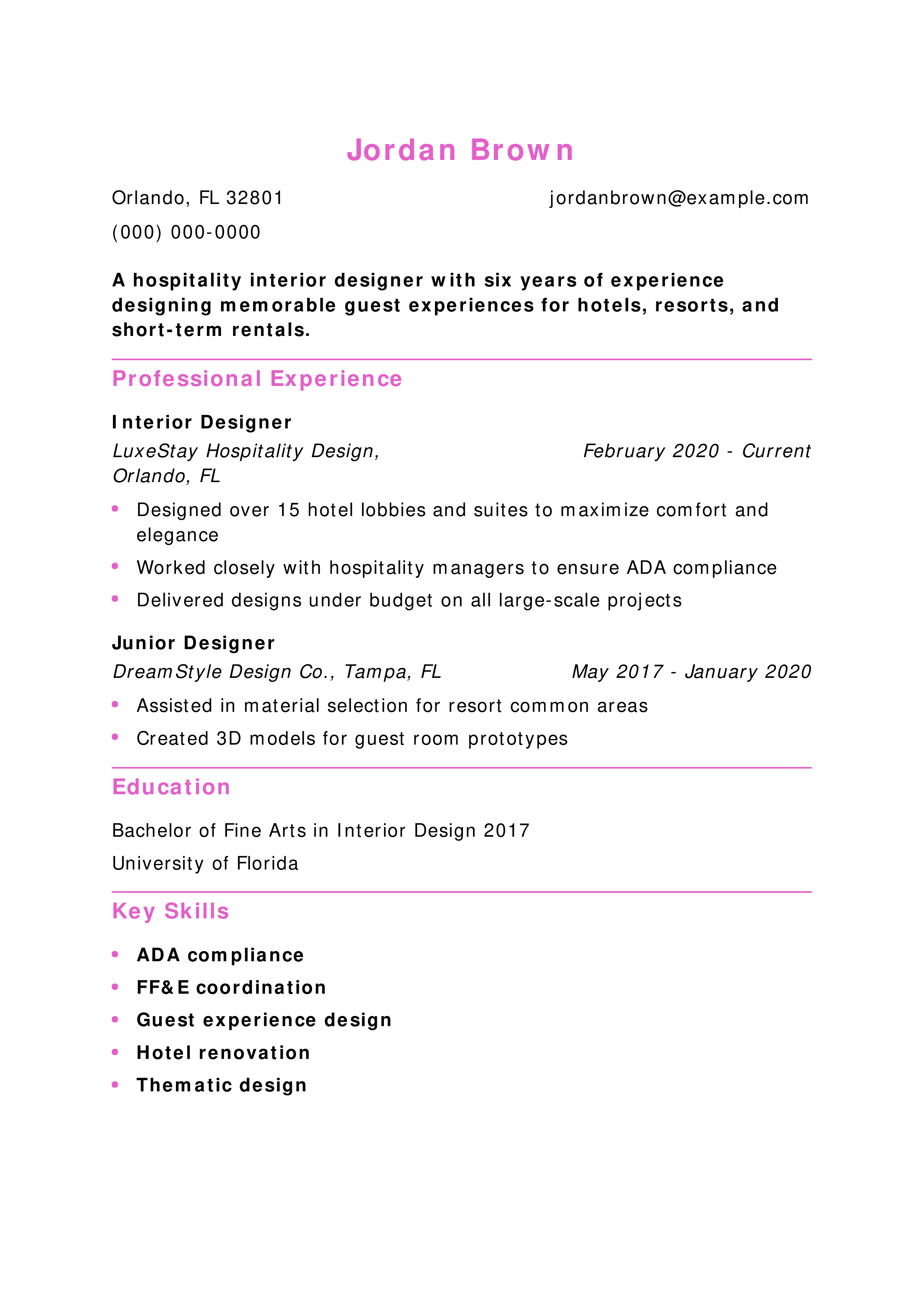
Hospitality Interior Designer Resume Example
Why This Resume Stands Out
This resume is strong because it focuses on a specialized niche with specific metrics and collaborative success.
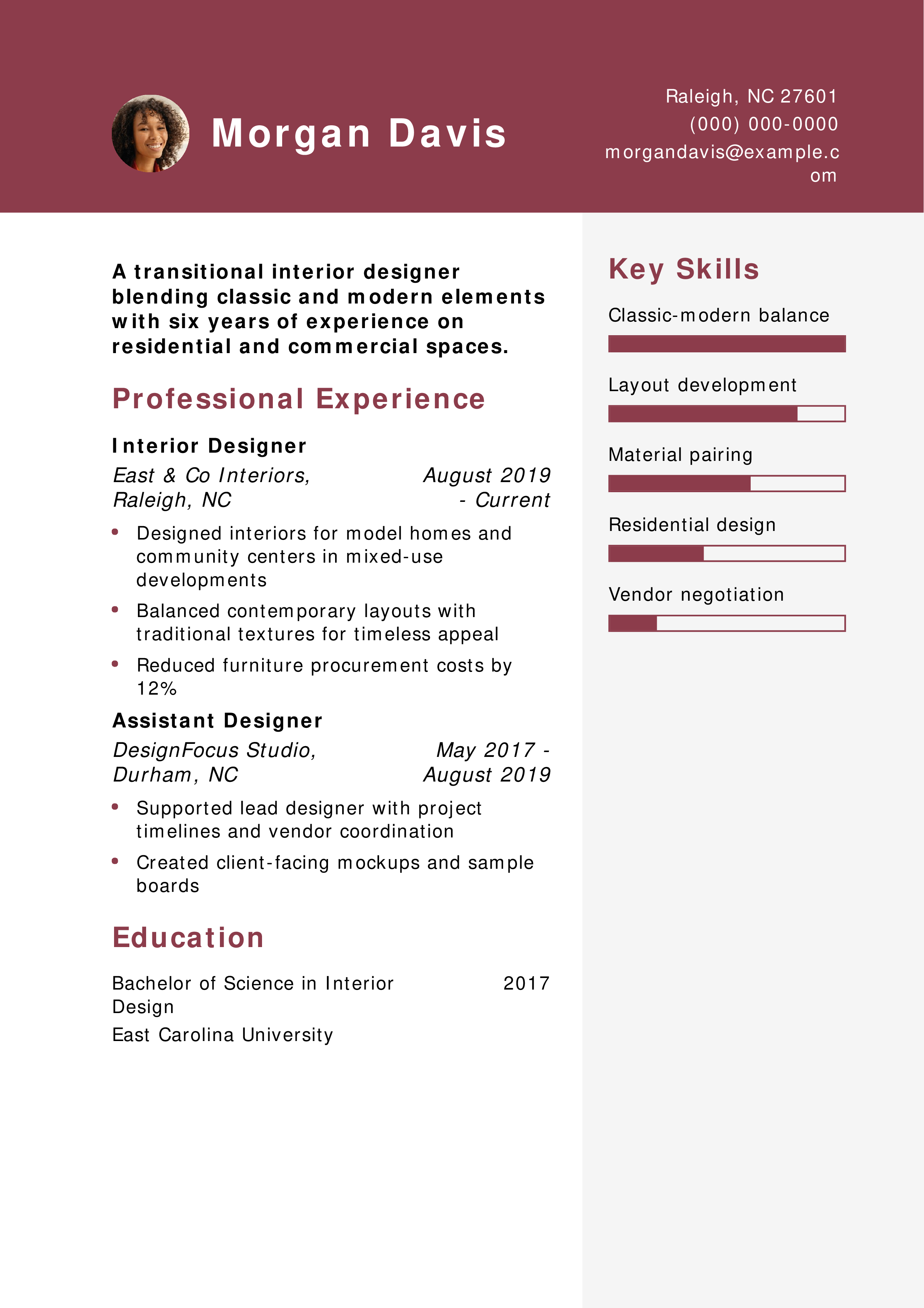
Transitional Interior Designer Resume Example
Why This Resume Stands Out
This resume is good because it defines a stylistic niche while showing practical impact on project budgets.
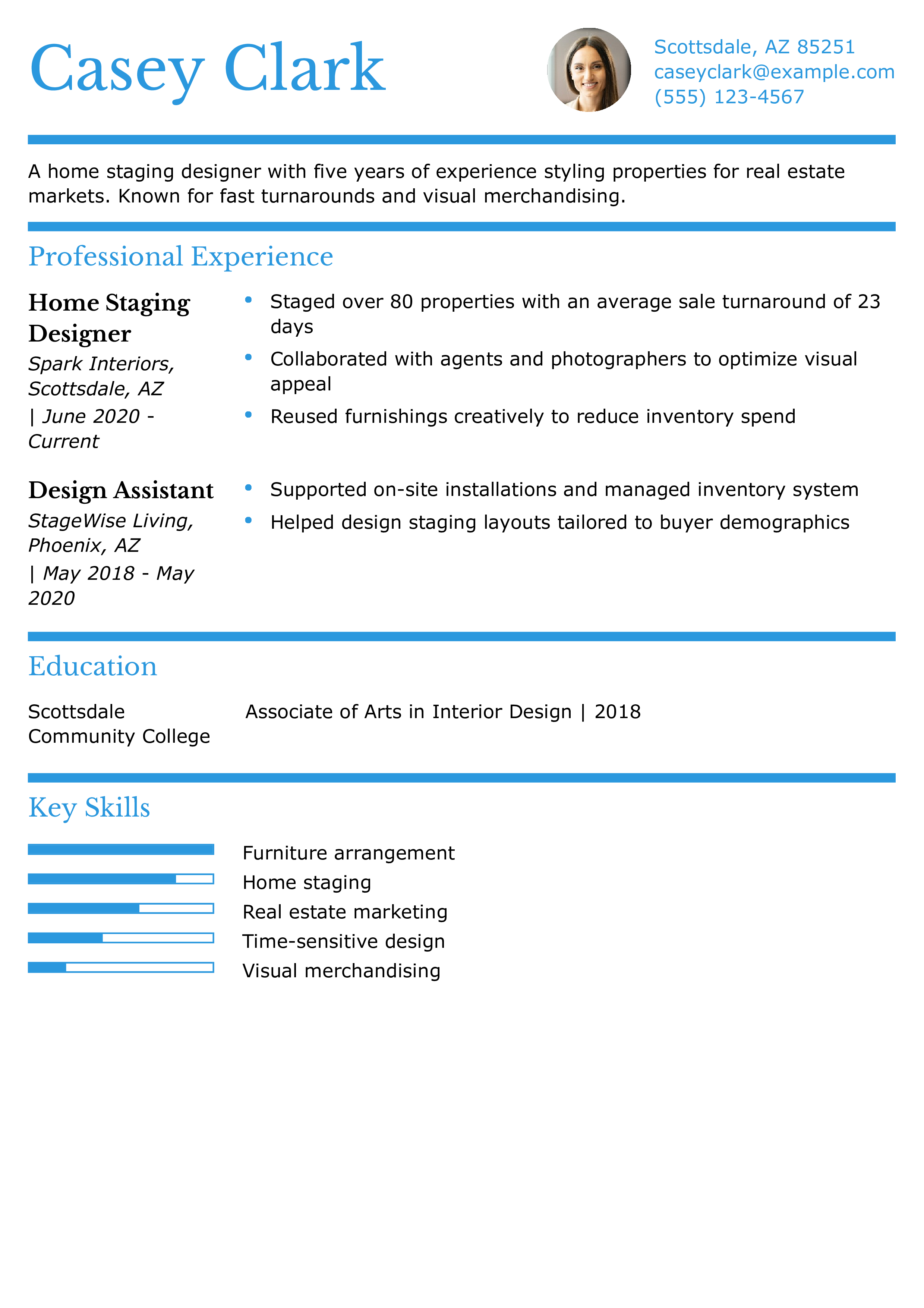
Home Staging Designer Resume Example
Why This Resume Stands Out
This resume is strong because it includes clear metrics that connect design choices to business outcomes.
High-End Residential Interior Designer Resume Example
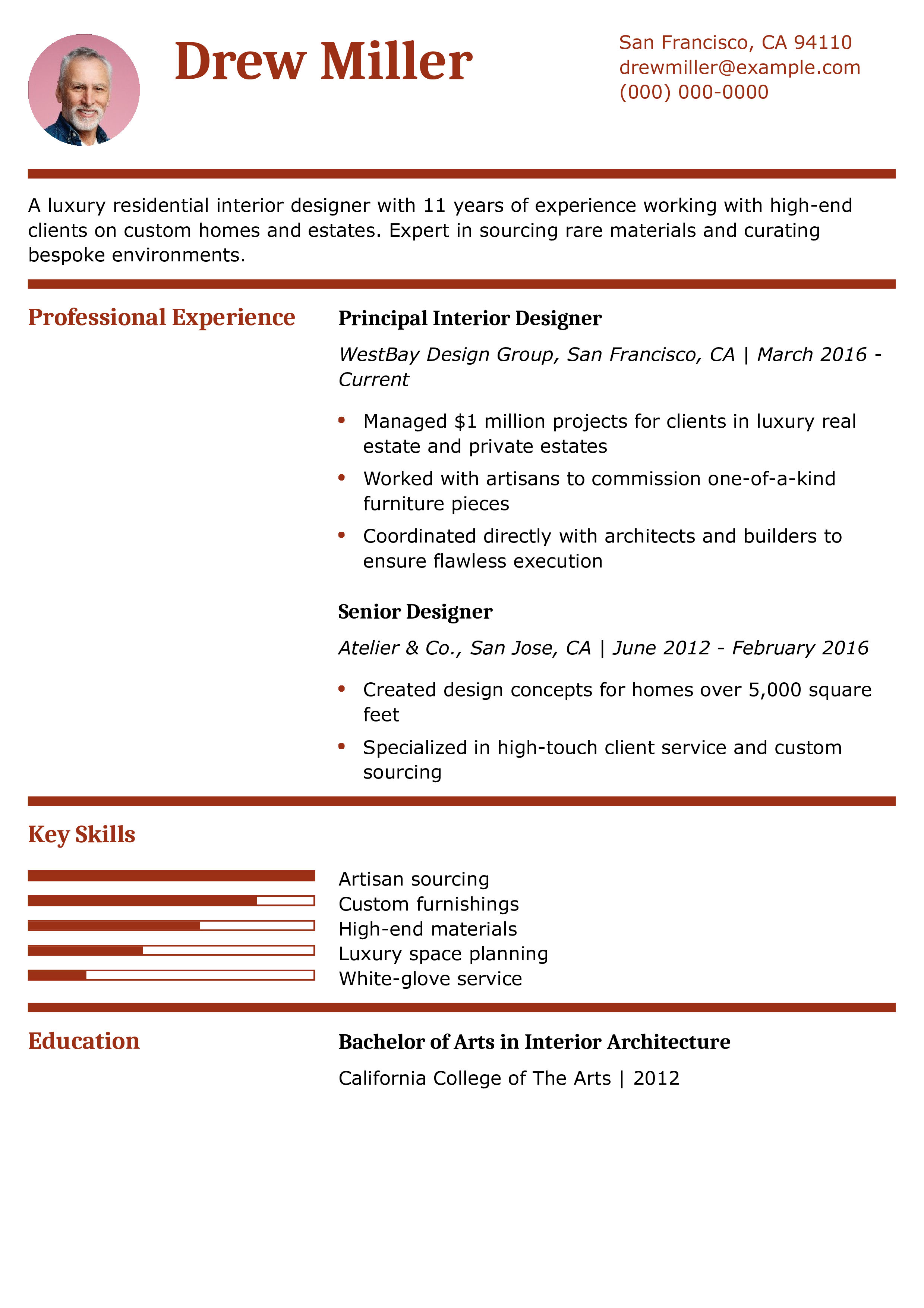
Why This Resume Stands Out
This resume is strong because it communicates luxury industry experience with clarity and depth.
Interior Design Project Coordinator Resume Example
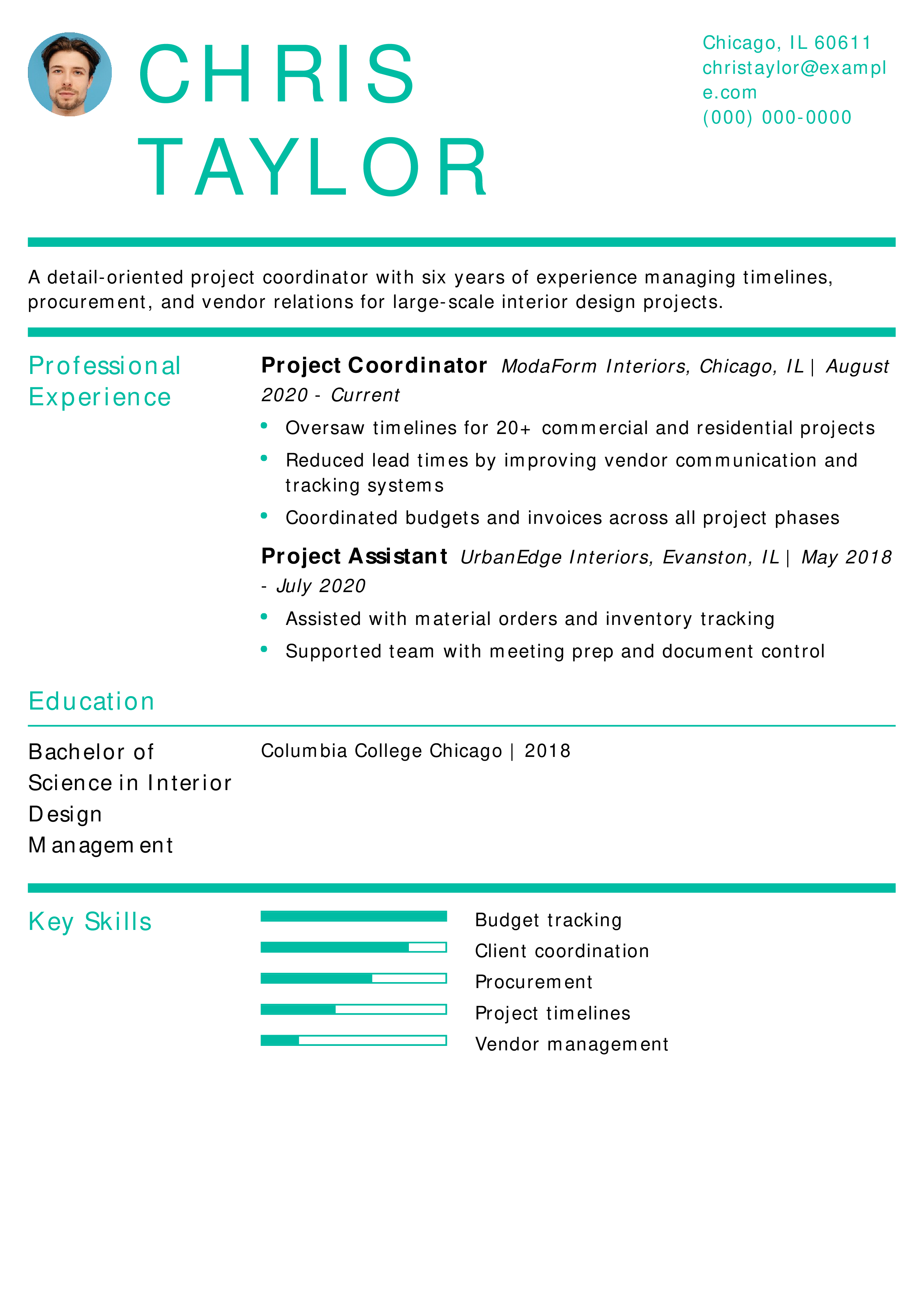
Why This Resume Stands Out
This resume is effective because it shows logistical strength behind the design, a crucial support role.
Set and Exhibition Designer Resume Example
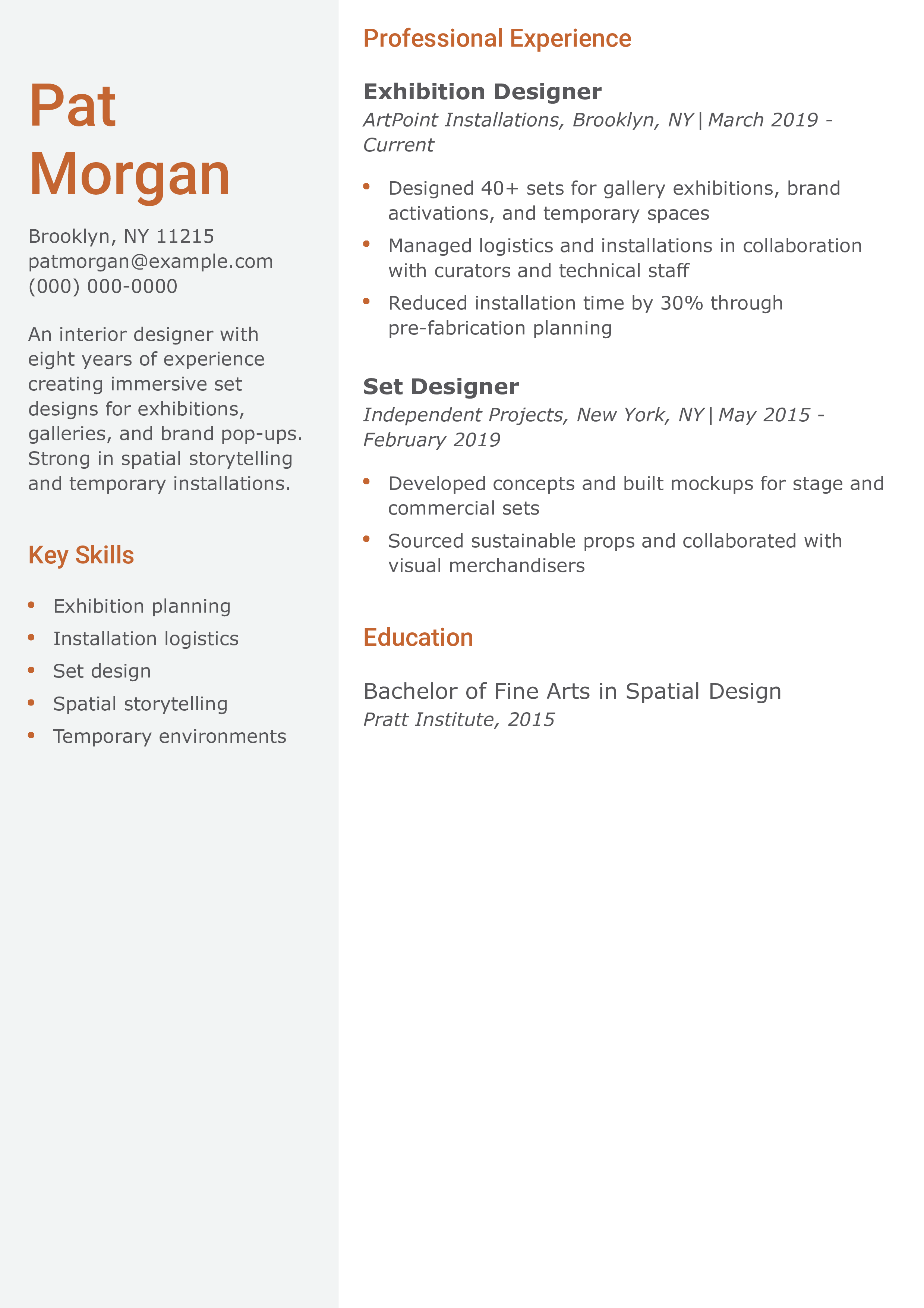
Why This Resume Stands Out
This resume is good because it speaks directly to a niche within interior design and demonstrates versatility.
Interior Lighting Designer Resume Example
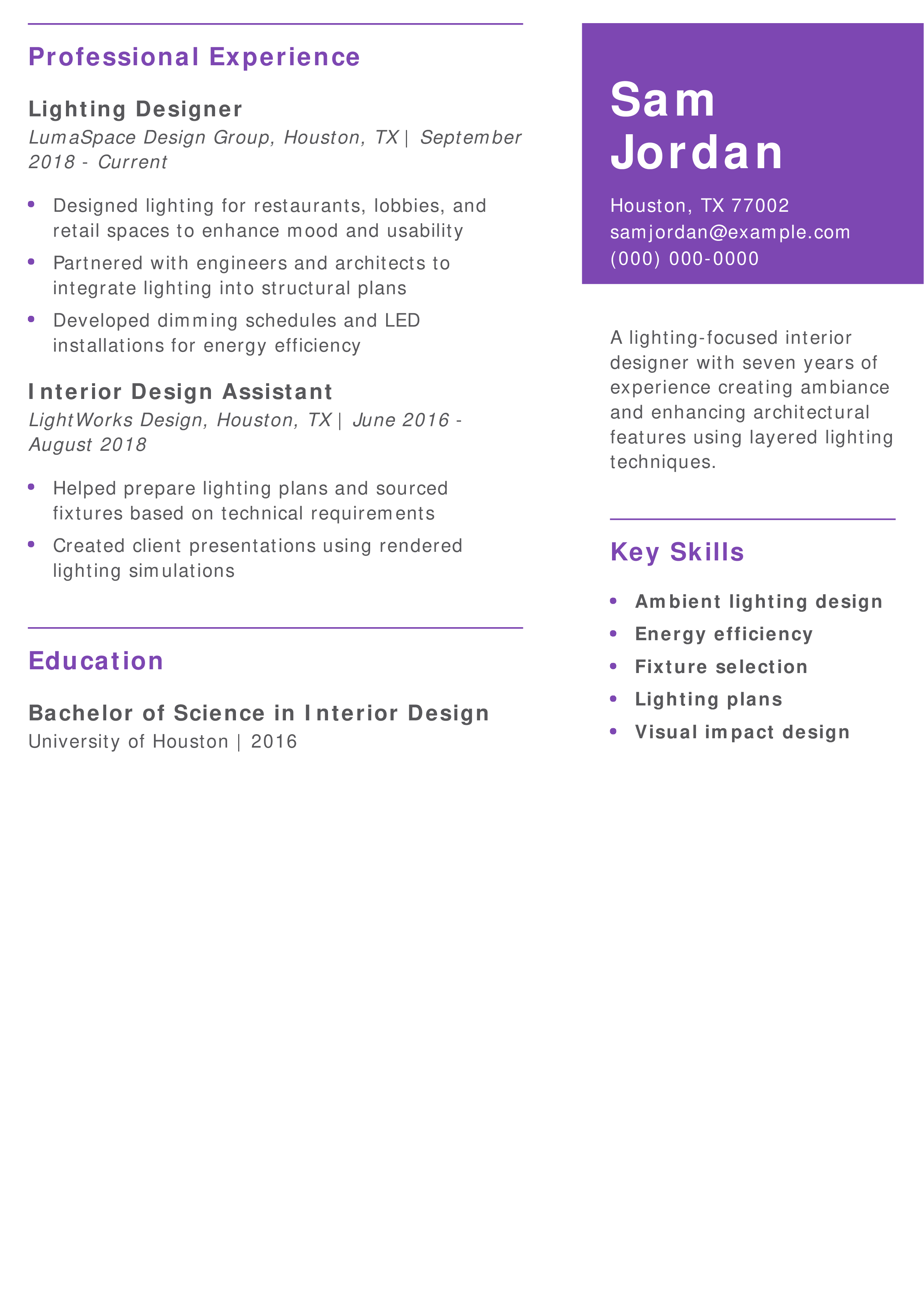
Why This Resume Stands Out
This resume stands out by focusing on a single design discipline and proving its importance in multiple environments.
Interior Design Educator Resume Example
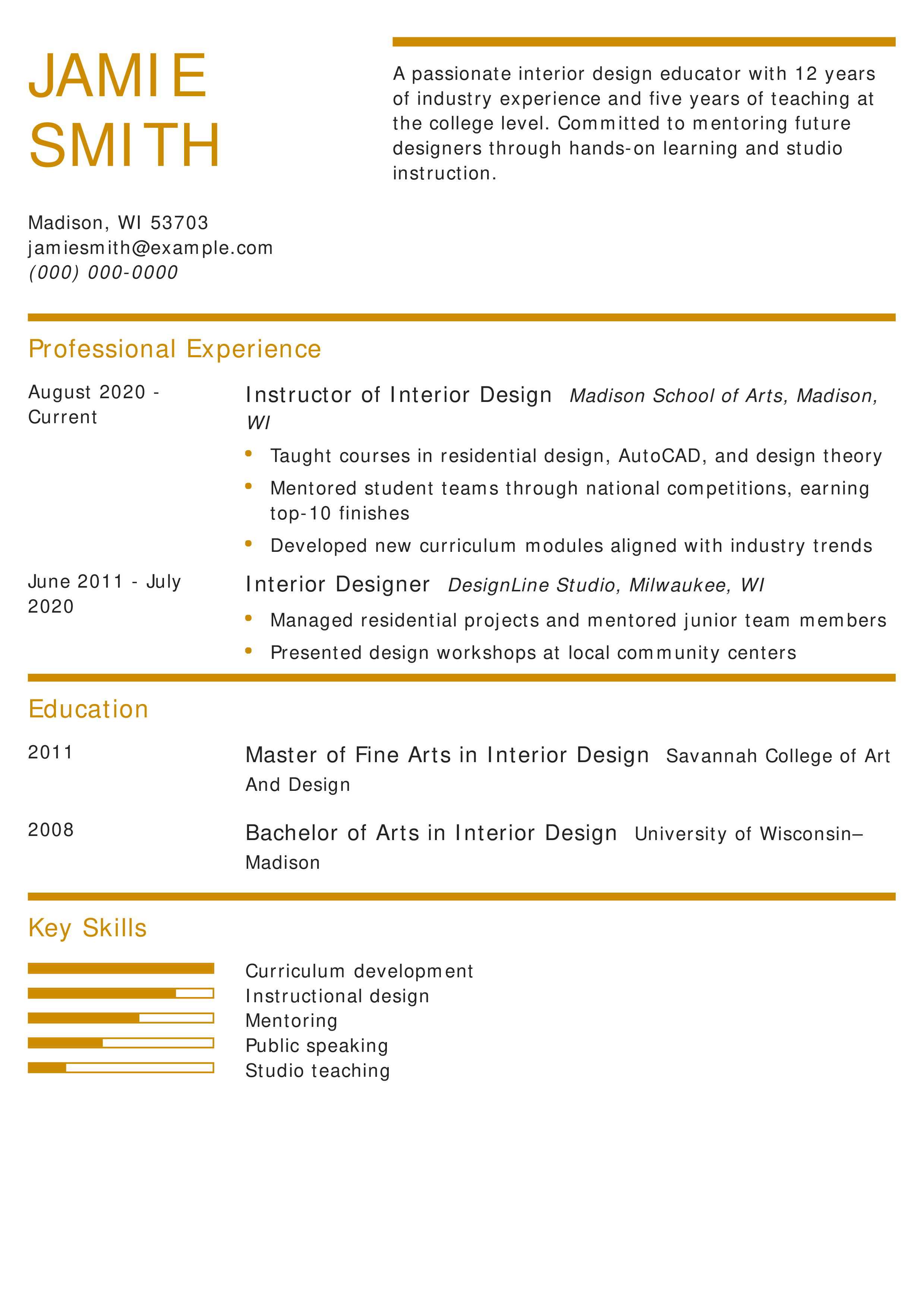
Why This Resume Stands Out
This resume is strong because it blends industry practice with academic leadership.
Health Care Interior Designer Resume Example
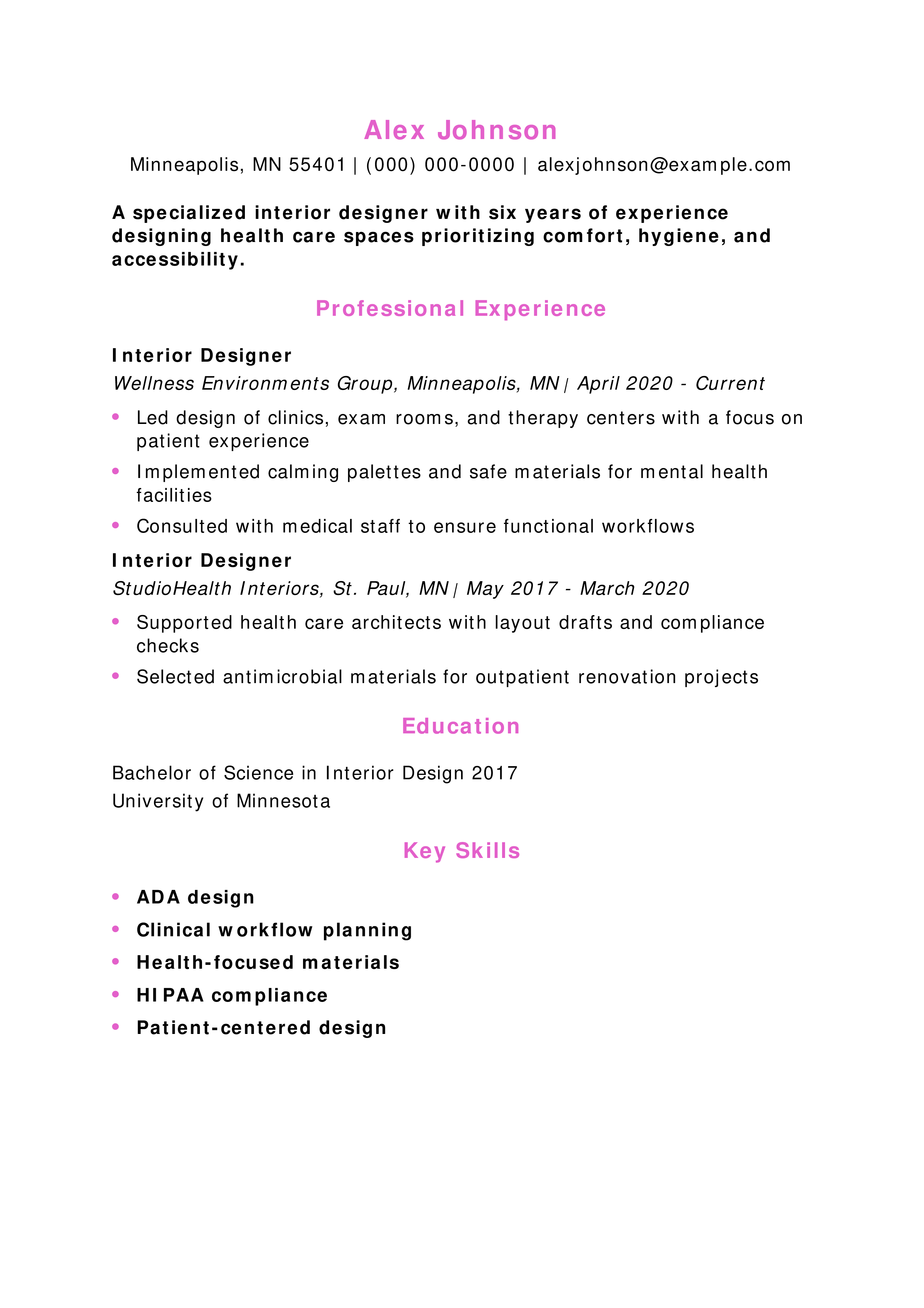
Why This Resume Stands Out
This resume is effective because it shows alignment with regulatory and emotional aspects of health care design.
Retail Interior Designer Resume Example
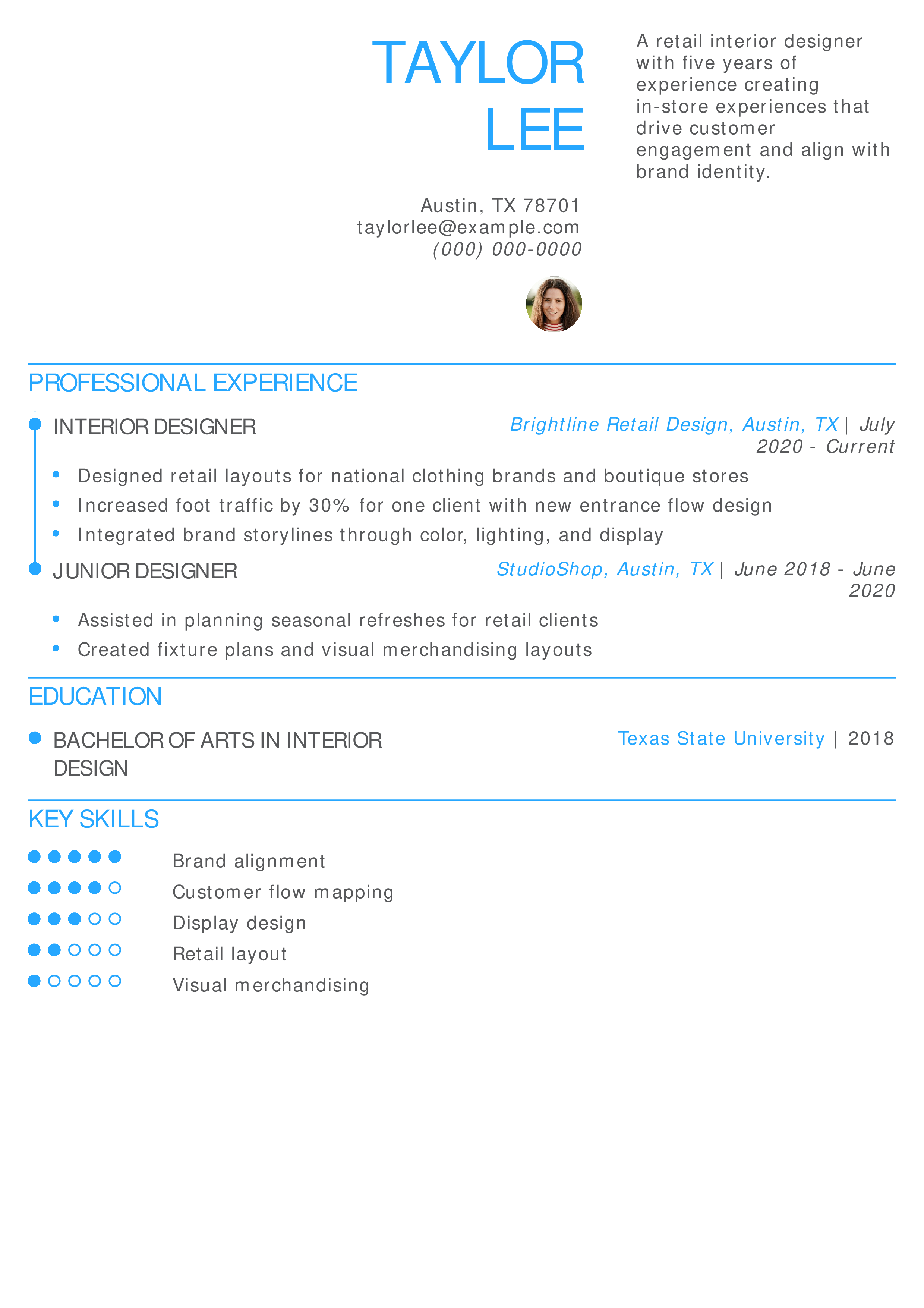
Why This Resume Stands Out
This resume is strong because it demonstrates both creative and business value.
Virtual Interior Designer Resume Example
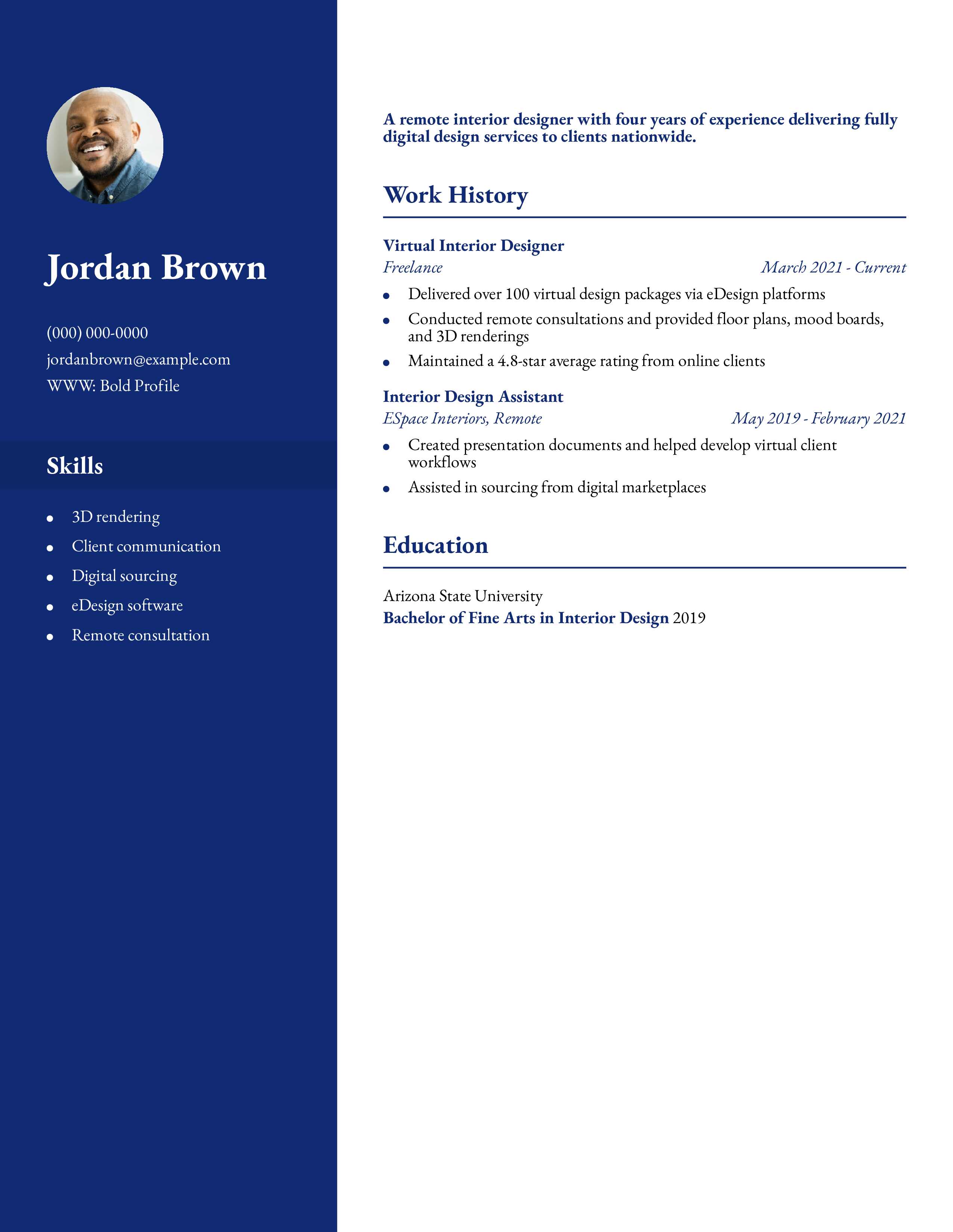
Why This Resume Stands Out
This resume is strong because it reflects a growing industry segment and emphasizes adaptability.
Transitional Career Interior Designer Resume Example
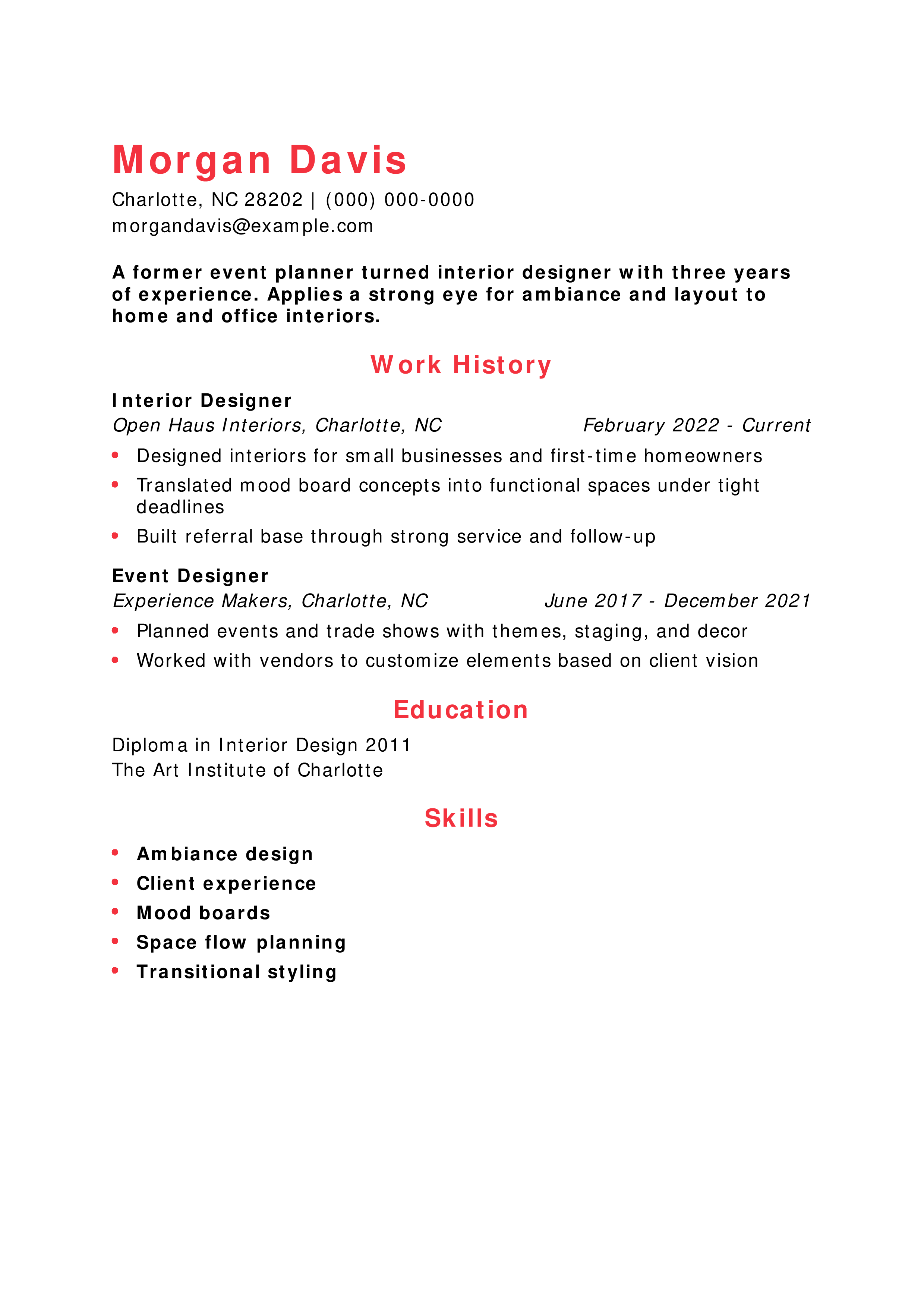
Why This Resume Stands Out
This resume is good because it reframes past experience into a new career direction.
Our templates are crafted by professional resume writers to make creating your resume quick, easy, and effective.
- Professional resume template downloads
- Customized cover letter generation
- AI resume writing support
- Career-building resources and advice
Interior Design Text-Only Resume Templates and Examples
How To Write an Interior Design Resume
For interior designers, the first five seconds should showcase your project scale and style. State whether you work residential, commercial, or both, the budget ranges you manage, and a quick win in occupancy, sales, or repeat clients so your aesthetic feels tied to real business value.

1. Create a profile by summarizing your interior design qualifications
A resume profile summary for an interior designer should briefly display your professional experience, skills, and achievements. Tailor it to the job description of the open position and emphasize your professional competencies to impress employers and secure employment.
Here are some tips on what to include in a resume profile summary for an interior designer:
- Achievements: Highlight your most significant achievements, such as successful projects you have completed or awards you have received.
- Professional title: Start with your professional title, such as “Interior Designer” or “Senior Interior Designer.”
- Skills: List your specialized skills, such as space planning, color theory, and drafting with AutoCAD.
- Years of experience: Mention the number of years of experience you have in the field.
Senior-Level Profile Example
An Award-Winning Interior Designer with 10+ years of experience in creating vibrant and unique interiors for multi-million-dollar homes. A strong history of collaborating with clients to deliver holistic, innovative designs. Won the 2018 California Home+Design Award in the category of Bath Design.
Entry-Level Profile Example
An innovative Interior Designer with two years of experience creating and developing contemporary interiors for residential homes and business offices. Adept at interfacing with clients to align furniture layouts and interior designs with customer vision.
2. Add a compelling section featuring your interior design experience
The best way to differentiate yourself from the competition during the job hunt is to quantify your interior design projects and feature your strongest career accomplishments. Establish a sense of scope for the hiring manager to enhance the impact of your bullet points. Prospective employers value candidates with a proven track record of success, so use numbers to your advantage during the resume-building process.
Potential employers also want examples of you communicating effectively with client stakeholders while executing complex interior design projects. As an interior designer, include achievements displaying your ability to deliver high-quality, creative designs in alignment with client vision and requirements.
Senior-Level Profile Example
Interior Designer & Owner, Hernandez Design Firm, Manhattan Beach, CA
November 2014 – Present
- Build and manage a high-end residential interior design firm, conduct product and materials sourcing, and develop furniture plans, layouts, and visual designs
- Oversee interior design projects valued at $250K-$10M, manage client accounts, lead stakeholder meetings, liaise with architects and contractors, perform space planning activities, and deliver high-quality, holistic interior designs
- Serve as the sole buyer for the organization to procure furniture, materials, and home décor from vendors, negotiate prices, and identify business needs
Entry-Level Profile Example
Interior Design Associate, Heart & Hearth Interior Designs, Delray Beach, FL
July 2020 – Present
- Coordinate with a creative design team to develop unified interior design concepts for private residents, small offices, and boutique stores
- Lead an interior redesign for a 15-room bed and breakfast, negotiate with vendors to reduce cost of materials by $20K, and coordinate with contractors to complete the project two weeks ahead of schedule
- Interface with clients to select color palettes, furniture, and accent pieces and provide recommendations to create unified aesthetic designs for spaces
3. Add your interior design education and certifications
Beyond just listing your formal education, there are several ways to differentiate yourself from other potential applicants — certifications. These are a shorthand way to prove your aptitude and always look great on a resume.
An interior designer might have various certifications. One of the most recognized is the National Council for Interior Design Qualification (NCIDQ) certification, the industry’s gold standard. To earn this certification, interior designers must demonstrate specific competencies supported by supervised work experience and a college degree.
Another certification that interior designers might have is the Council for Interior Design Accreditation (CIDA) accreditation, awarded to programs that meet the standards for interior design education.
Education
Template
- [Degree Name]
- [School Name], [City, State Abbreviation] | [Graduation Year]
Example
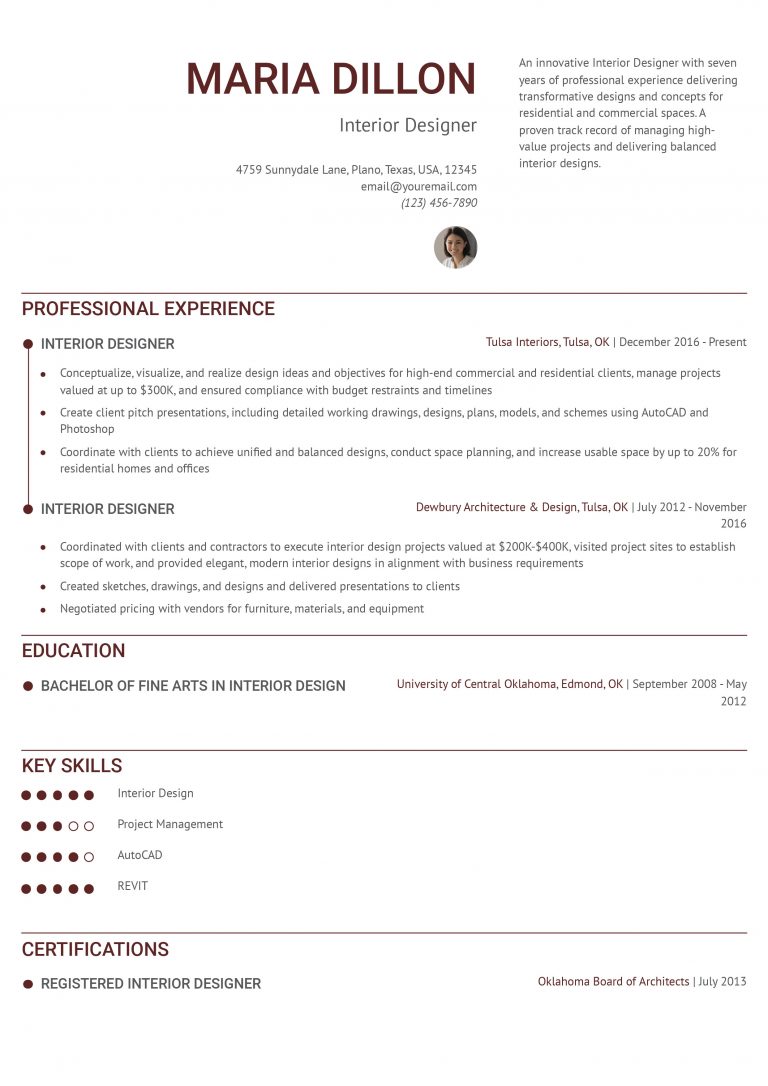
- Bachelor of Fine Arts in Interior Design
- University of Central Oklahoma, Edmond, OK | September 2008 – May 2012
Certifications
Template
- [Certification Name], [Awarding Organization], [Completion Year]
Example
- Registered Interior Designer, Oklahoma Board of Architects | June 2013
4. Include a list of your skills and proficiencies related to interior design
It’s common for companies to use applicant tracking systems (ATS) to collect resumes. These systems scan resumes, helping identify promising job candidates before recommending them to the hiring managers. Generally, an ATS can determine whether or not an applicant is a match for a position based on the number of specific key skills and proficiencies that appear within a resume. If your document lacks a certain number of specific keywords, it may never reach a hiring manager’s desk. Below are some common key skills for interior design resumes.
| Key Skills and Proficiencies | |
|---|---|
| Adobe Creative Suite | Adobe Illustrator |
| Adobe Photoshop | Architectural design |
| AutoCAD | Budgeting |
| Client relations | Commercial designs |
| Communication skills | Computer-aided design (CAD) |
| Home renovation | Interior architecture |
| Interior design | Project management |
| Residential designs | SketchUp |
| Space planning | Style |
| Vendor management | V-Ray |
How To Pick the Best Interior Design Resume Template
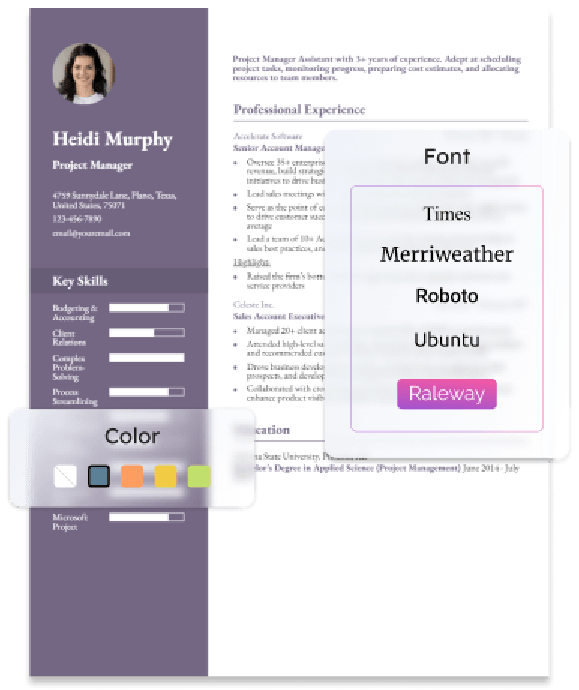
Selecting the best design template for your resume as an interior designer is crucial in effectively presenting your qualifications and professional achievements. Avoid overly decorative or flashy templates that may come across as unprofessional. Opt for a template that balances creativity and a business-like appearance. Remember, a cluttered or overly complex design can distract the hiring manager from your content. When in doubt, select a clean, well-structured, and easy-to-read template that keeps the focus on your skills and experience.
Frequently Asked Questions: Interior Design Resume Examples and Advice
How can I customize my Interior Design CV for a specific job role?
Customizing your Interior Design CV involves closely analyzing the job description and ensuring that you include the relevant skills and accomplishments that align with the employer’s needs. Use specific keywords from the job posting, and focus on tailoring your profile summary and professional experience sections to match the responsibilities of the position you're applying for.
What are common action verbs for interior design resumes?
One often-overlooked but immensely powerful tool at your disposal when crafting your resume is using action verbs. These dynamic, action-oriented words can breathe life into your resume, infusing it with energy and demonstrating your impact in previous roles. We’ve compiled a list of action verbs you can use to craft your professional experience section:
| Action Verbs | |
|---|---|
| Analyzed | Collaborated |
| Communicated | Conducted |
| Coordinated | Created |
| Designed | Developed |
| Drew | Identified |
| Illustrated | Led |
| Managed | Oversaw |
| Performed | Planned |
| Sourced | |
How do you align your resume with an interior design job description?
According to the Bureau of Labor Statistics (BLS), the average annual salary for interior designers was $61,590 in 2022. Although employment growth in this field is limited, the BLS forecasts over 9,000 new jobs yearly. New construction is expected to create demand for interior designers, especially in high-income areas and large cities. Align your resume with individual job descriptions to capitalize on these opportunities.
For example, if an employer seeks an interior designer with commercial design experience, highlight large-scale build-outs rather than smaller residential work. If a job description mentions an expertise in safety, demonstrate your knowledge of building codes, inspection regulations, and accessibility standards. By tailoring your resume to the job posting, you’ll have the best odds of securing your next big opportunity and propelling your career forward.
What is the best interior design resume format?
The reverse chronological format is the most commonly used format for interior designers. This approach lists your work experience in reverse chronological order, starting with your most recent job and working backward. It’s a preferred format because it highlights your most relevant work experience but also allows you to demonstrate your career progression and growth over time. This is particularly useful for an interior design resume because it makes your most recent projects the focal point of the document.
How many pages should my interior design resume be?
Generally, an interior design resume should be one page for candidates with fewer than 10 years of experience. A two-page resume is acceptable if you’re a seasoned professional with extensive accomplishments—but only if it provides meaningful details that strengthen your application. Tailor your content to the job, focusing on your most relevant qualifications.
Work history should typically cover the last 10 to 15 years. Older positions can be excluded or briefly summarized unless they’re highly relevant. A concise, focused resume demonstrates your ability to prioritize and communicate effectively.
Craft your perfect resume in minutes
Get 2x more interviews with Resume Builder. Access Pro Plan features for a limited time!

Once you’re done with your resume, add a cover letter before sending it off to your prospective employer. This is a great opportunity to speak directly to the hiring manager and make a case for why you’re the best candidate for the job.
Remember, a cover letter should be fairly succinct. Don’t exceed more than 400 words — 250 to 300 is ideal. For more information and ideas, view our graphic designer cover letter examples.