
Whether you’re writing a biology resume for a Ph.D. program or your next job opportunity, it must include your research interests, laboratory skills, and industry applications. Highlight your involvement in key studies, published materials in industry journals, and contributions to the discipline. Get tips on how to pull all of this into a cohesive and engaging resume below.
“Biology resumes should reflect lab techniques and safety, data analysis, and research experience. Show your role in advancing scientific understanding.”

How AI Has Raised the Bar for Biology Candidates
Hiring managers reviewing biology resumes now expect to see how candidates have worked alongside AI tools in actual research or lab settings. Automated image analysis, predictive modeling for experimental design, and AI-assisted literature review have moved from novel to expected in many labs. Candidates who can show they’ve used these tools to accelerate discovery or improve accuracy stand apart from those listing only traditional benchwork. Here’s where your resume can get specific:
- Sequence analysis tool experience that changed your approach to identifying variants or annotations across datasets.
- Image classification through machine learning platforms in microscopy or histology work.
Most Popular Biology Resumes
Entry-Level Biologist Resume
Why This Resume Stands Out
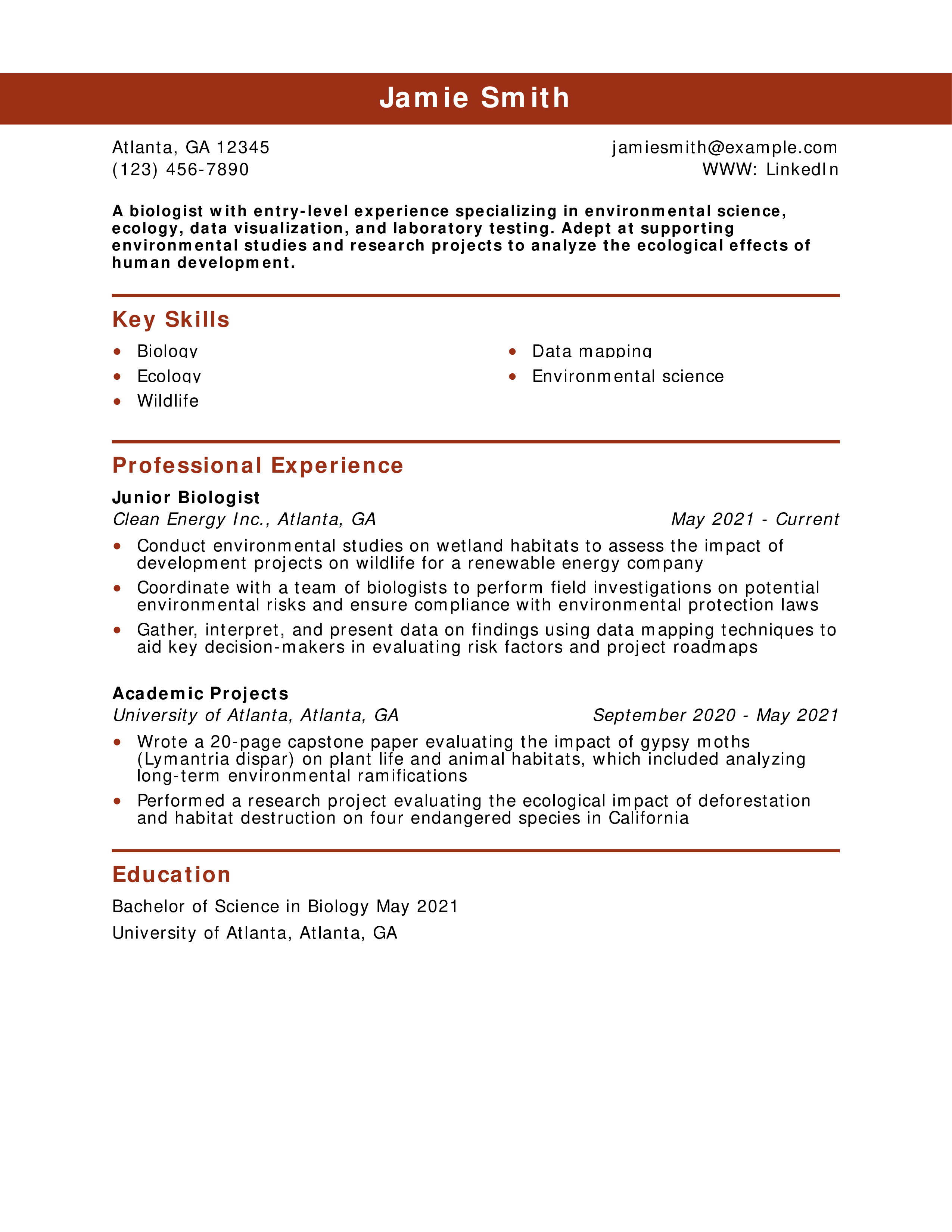
This resume clearly highlights academic and early professional experience, which is essential for entry-level biology roles. The use of academic projects adds depth and shows initiative, especially when professional experience is limited. The language is focused and relevant, aligning with environmental biology.
Microbiologist Resume
Why This Resume Stands Out
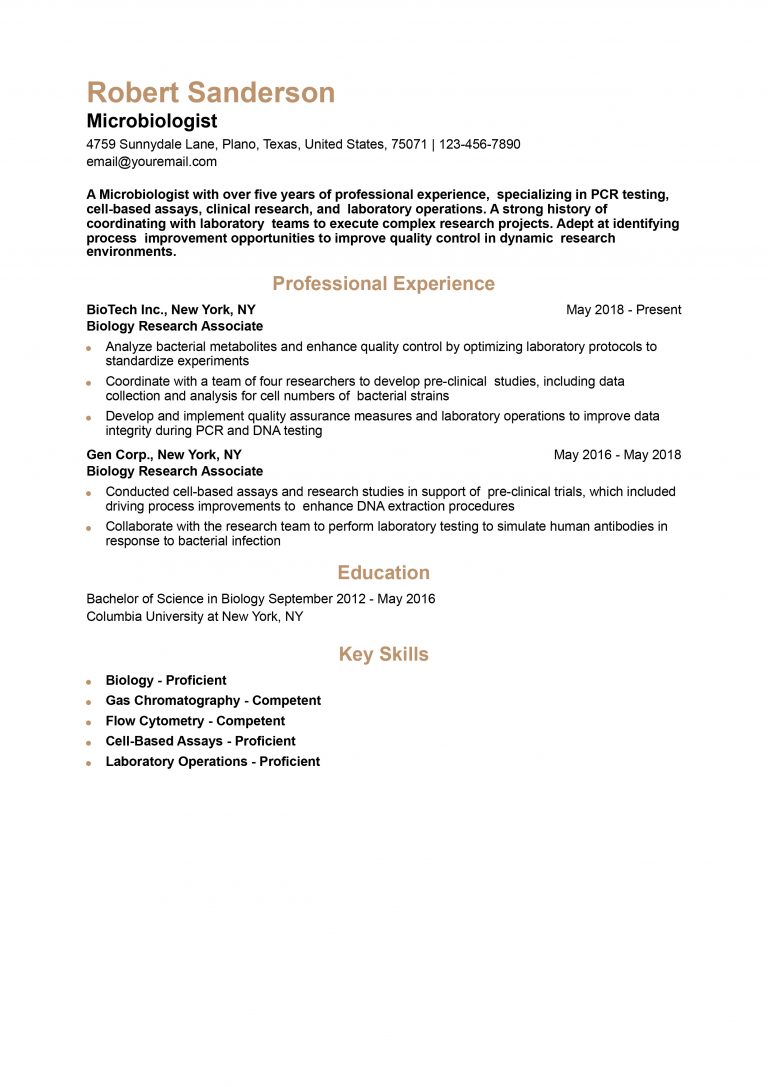
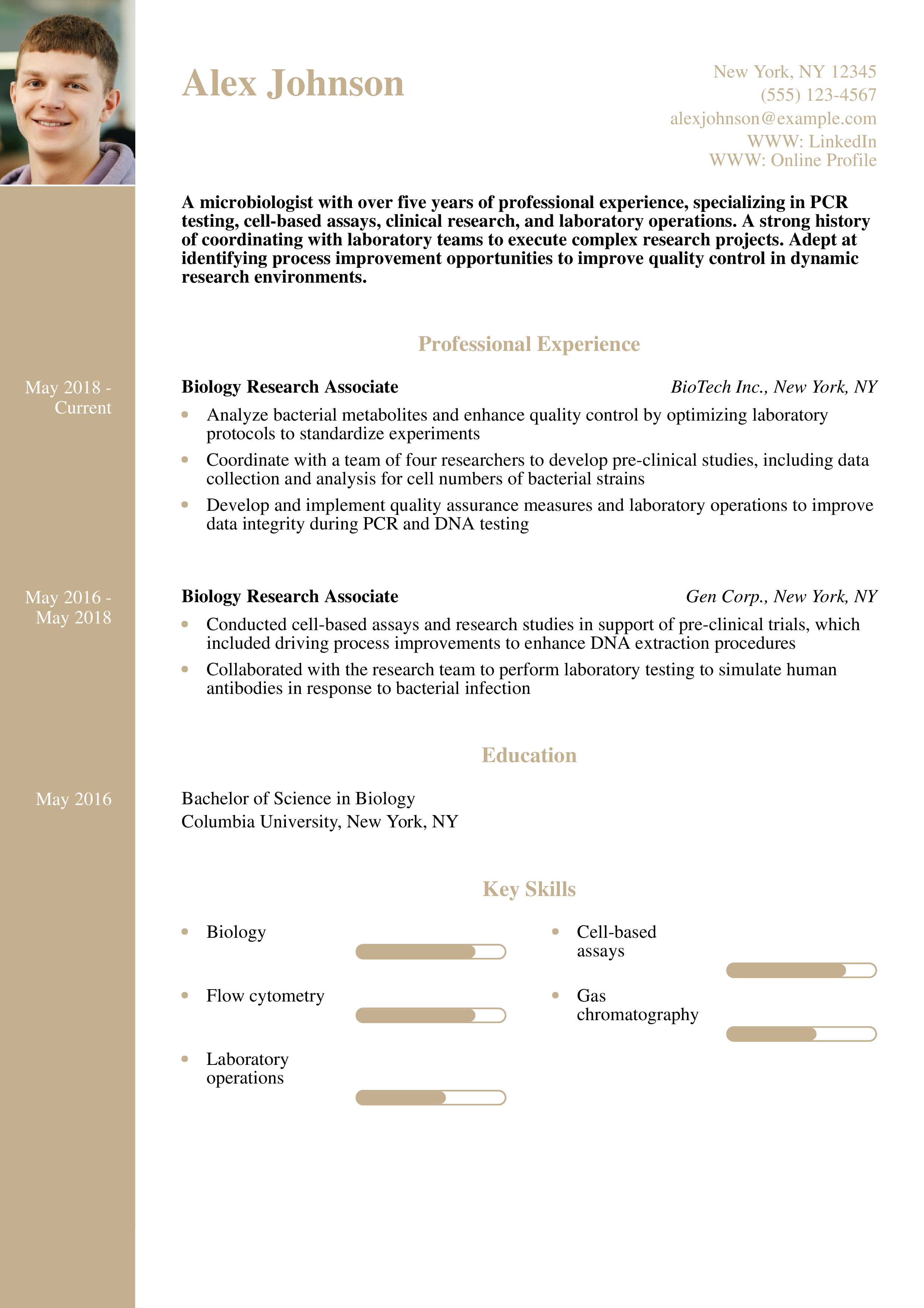
This resume stands out for its clarity, technical accuracy, and strong emphasis on lab-based processes. It focuses on the skills and tools critical for microbiology, and it presents a natural career progression. Using a reverse-chronological format helps show relevant achievements up front.
Senior Biologist Resume
Why This Resume Stands Out
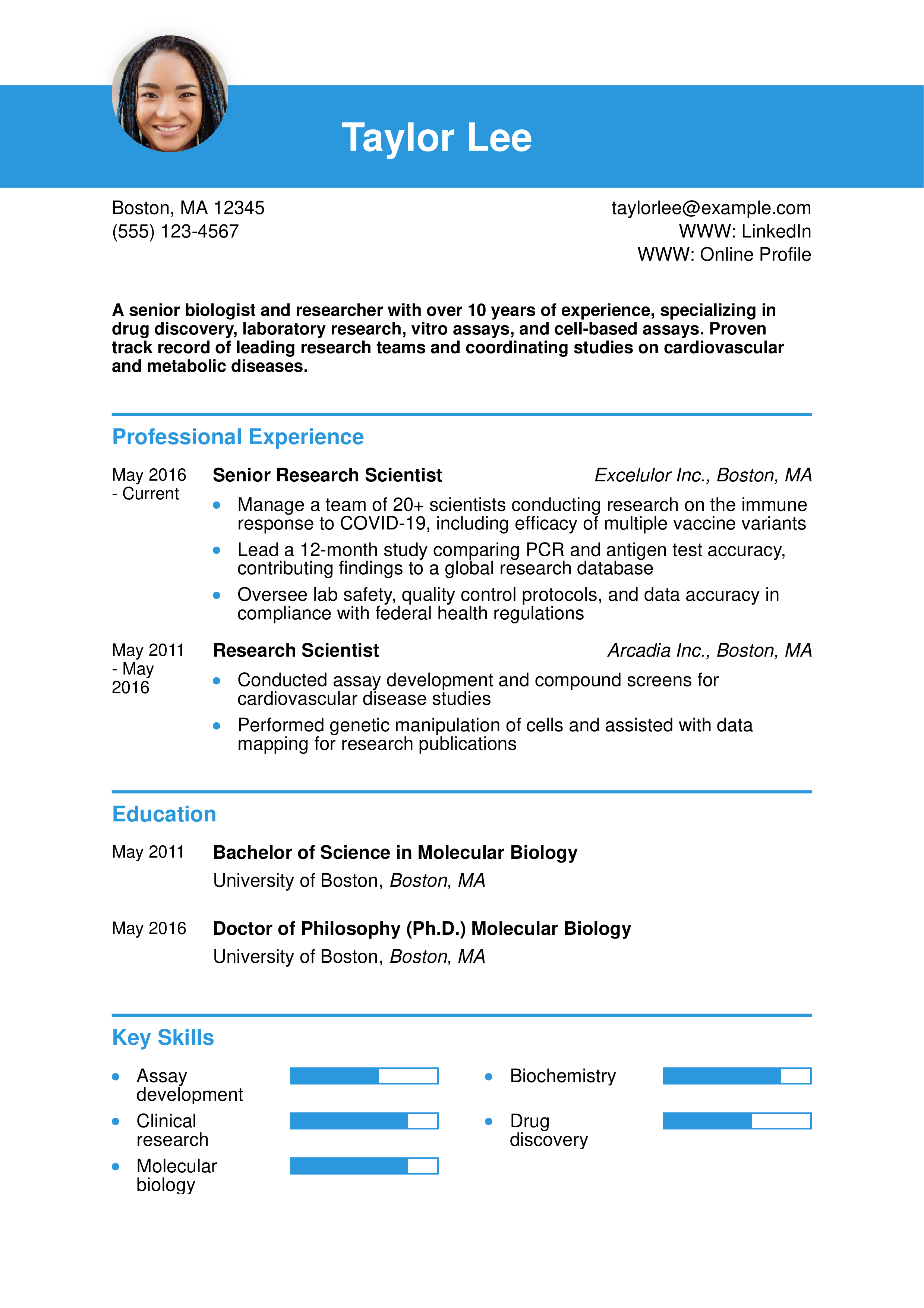
This resume demonstrates long-term leadership, deep technical knowledge, and the ability to manage high-stakes research. Each job includes measurable responsibilities and outcomes, which strengthens credibility.
Biology Instructor Resume
Why This Resume Stands Out
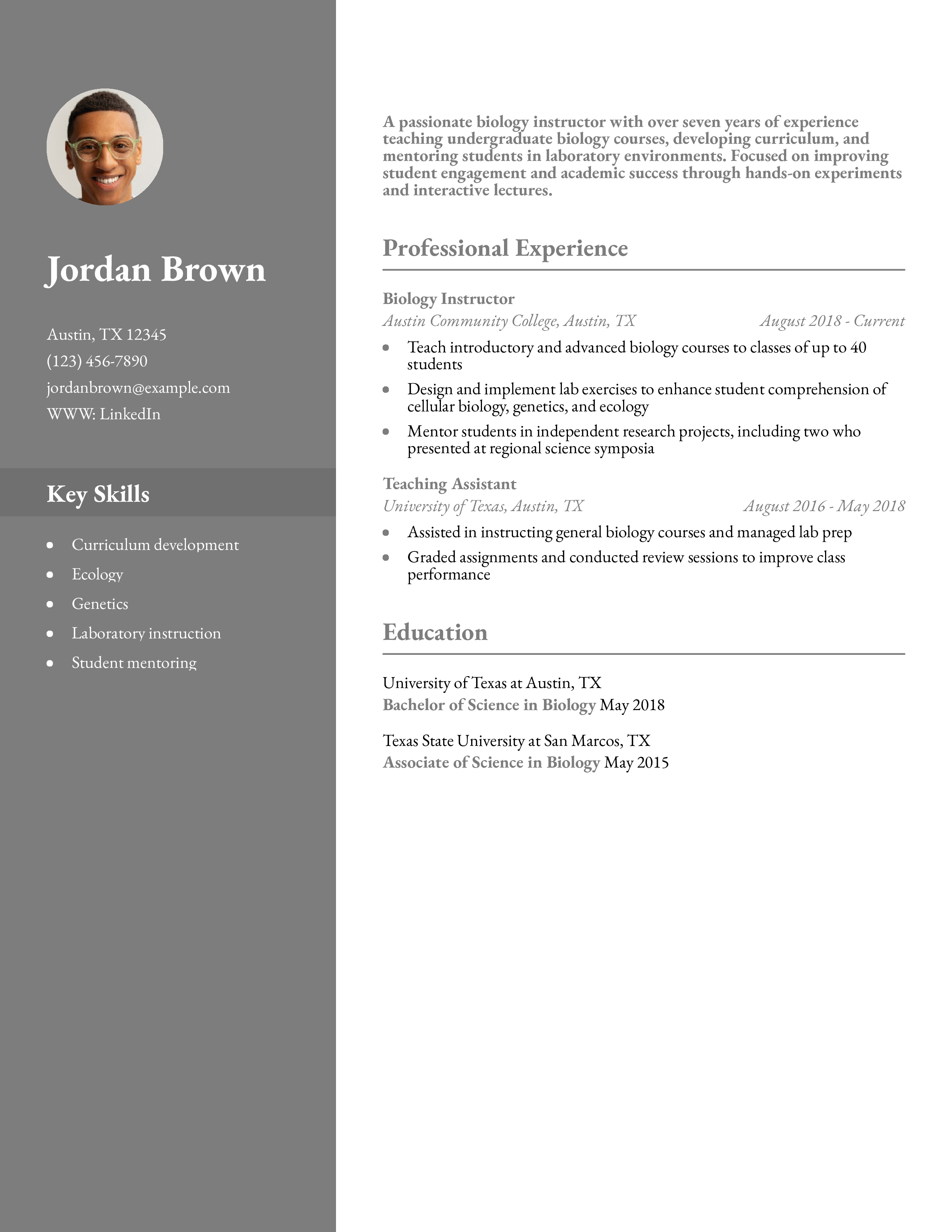
This resume highlights a clear teaching path, academic credentials, and hands-on instructional experience. It’s well-organized and prioritizes relevant teaching duties and educational contributions.
Biology Lab Technician Resume
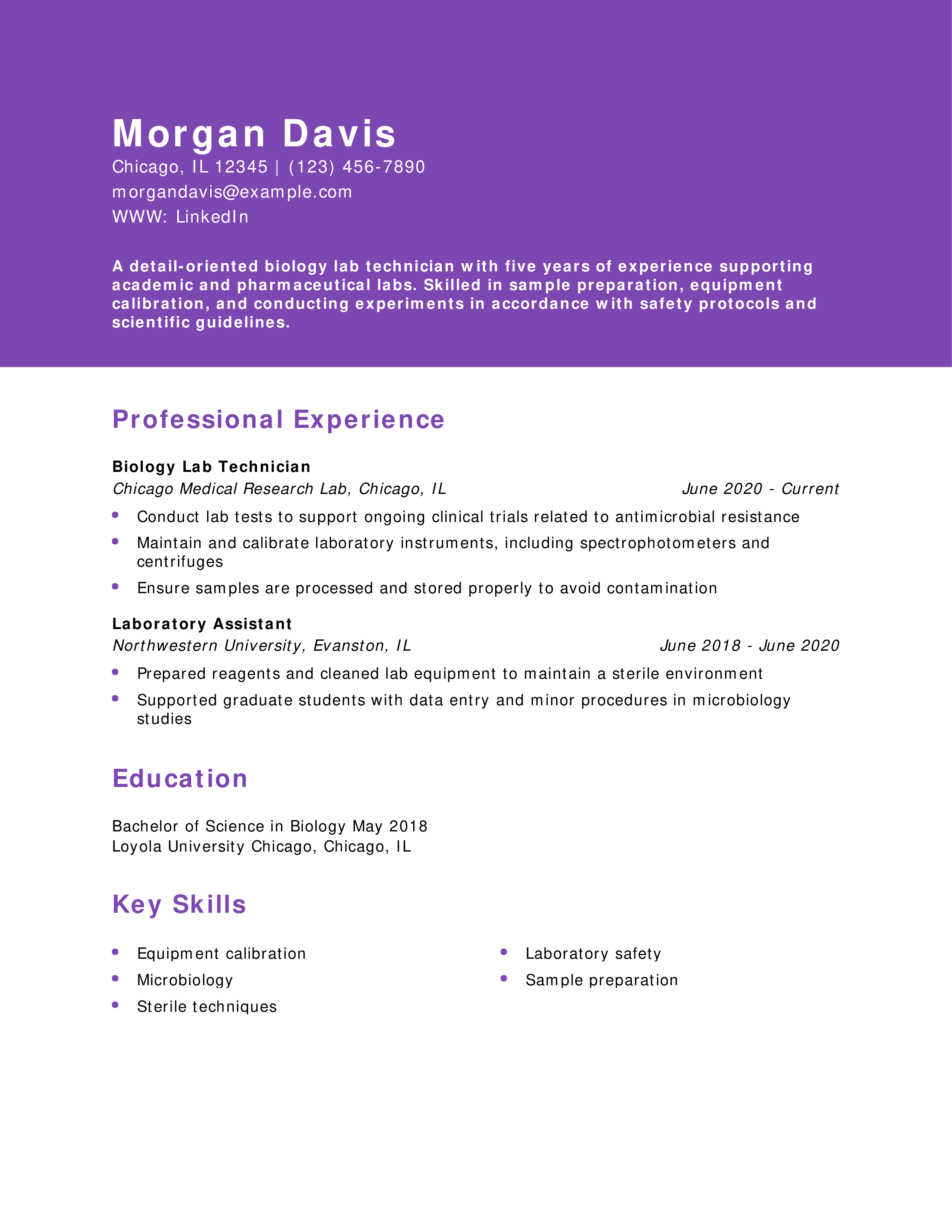
Why This Resume Stands Out
This resume is effective because it focuses on specific technical competencies required in lab work. The job history supports a logical growth from assistant to technician.
Biology Research Assistant Resume
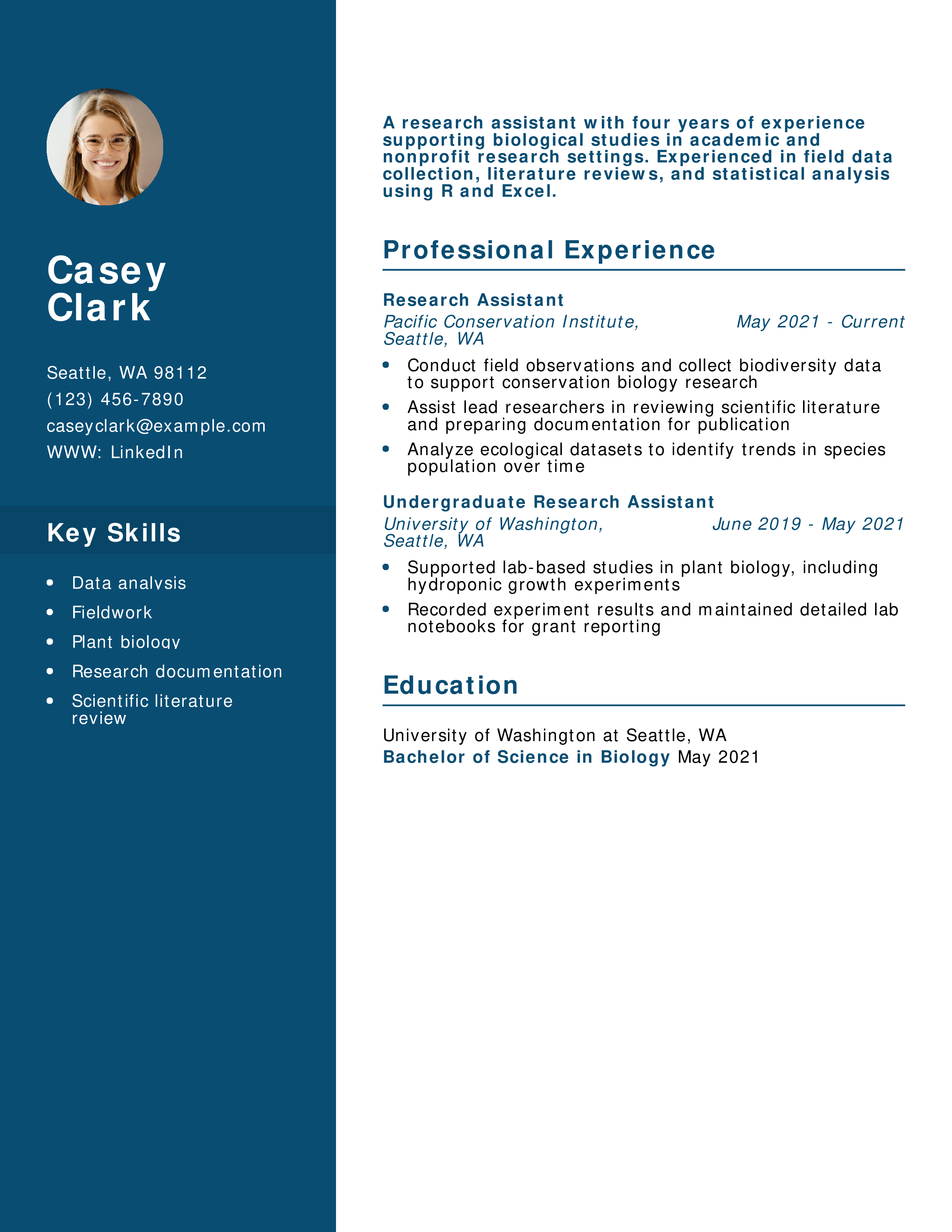
Why This Resume Stands Out
This resume succeeds by balancing field and lab work, showing versatility and attention to detail. It's ideal for entry-level research positions.
Biology Professor Resume
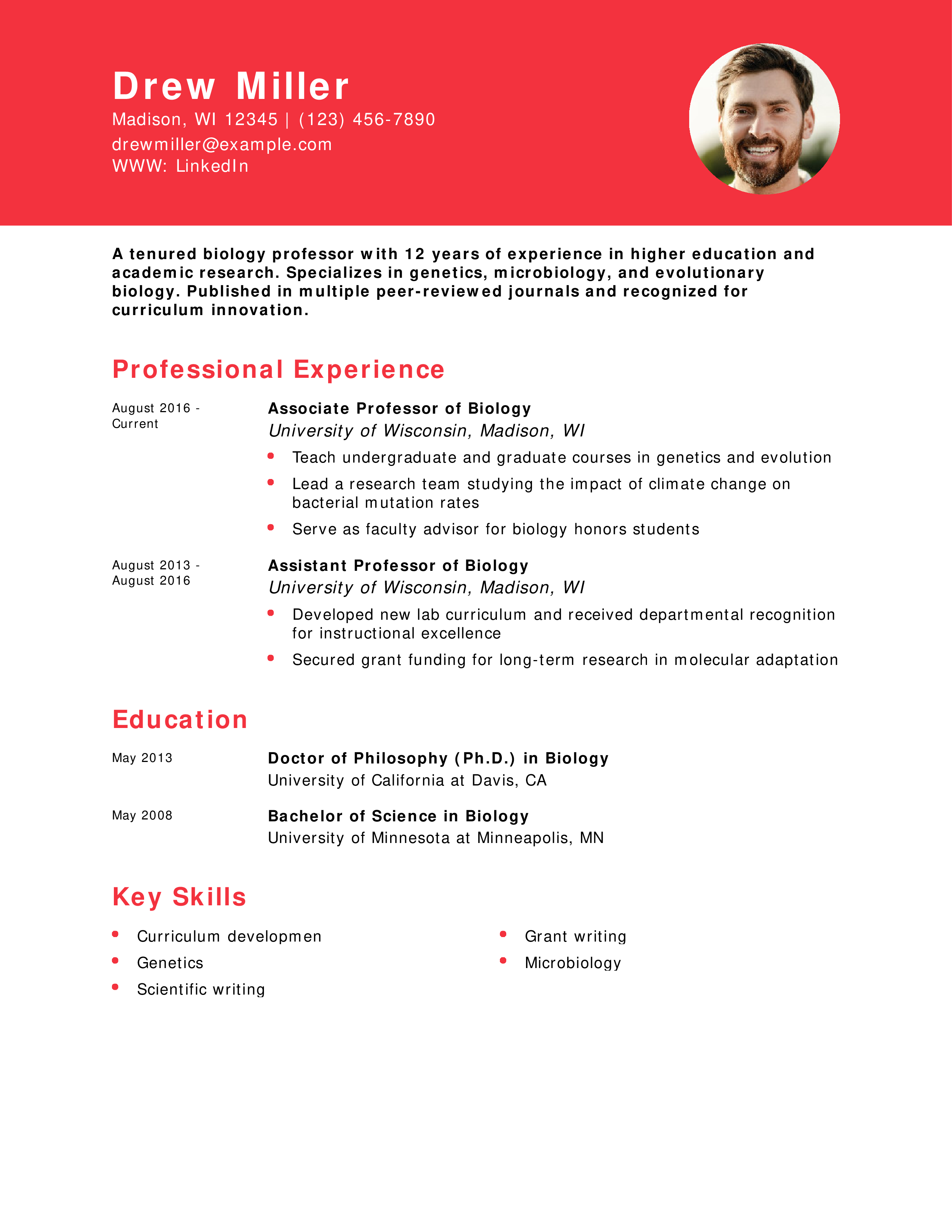
Why This Resume Stands Out
This resume is strong because it shows academic progression, research output, and teaching credentials. It also reflects leadership in mentoring and grant acquisition.
Biology Internship Resume
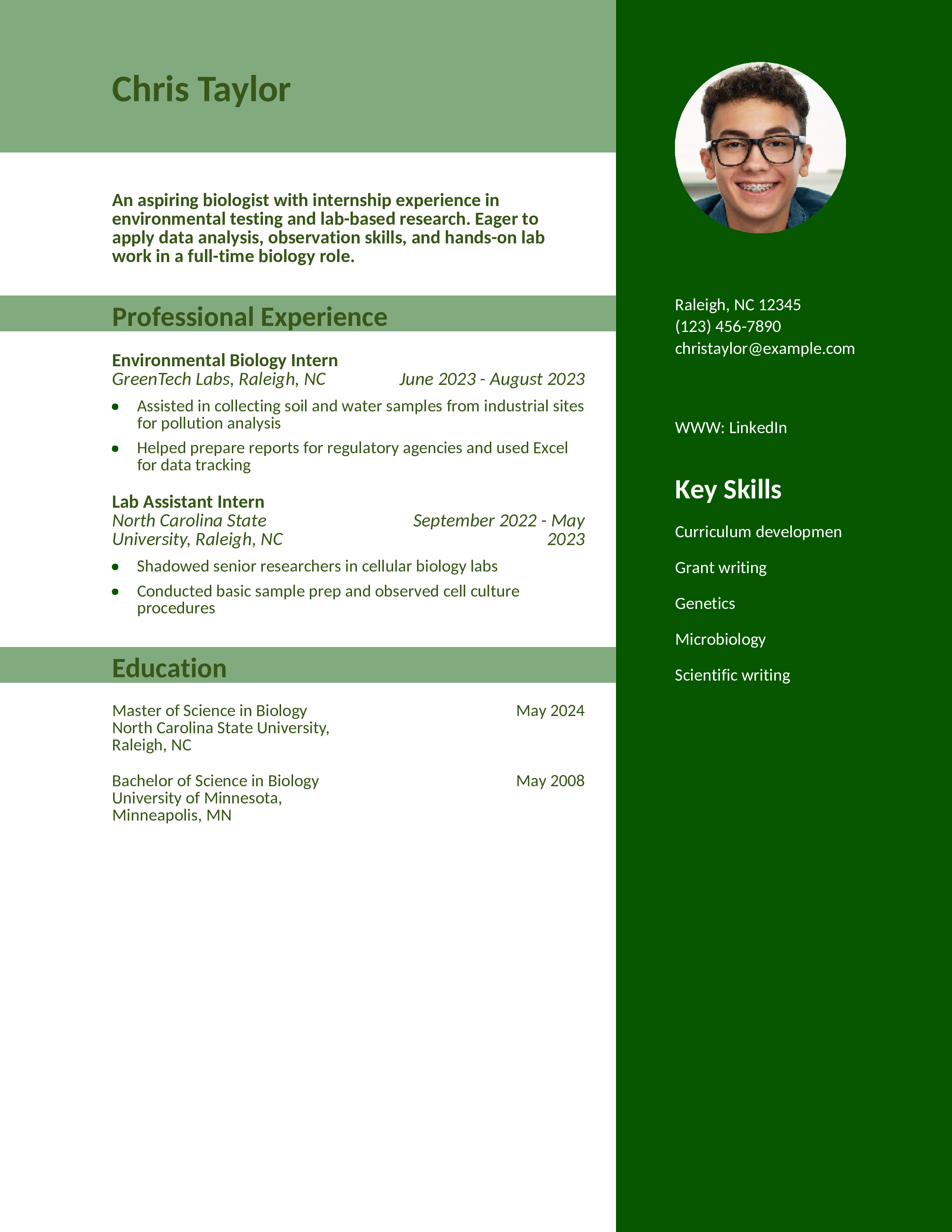
Why This Resume Stands Out
This resume does a great job demonstrating hands-on exposure for an early-career applicant. It focuses on basic lab skills and environmental relevance.
Molecular Biologist Resume
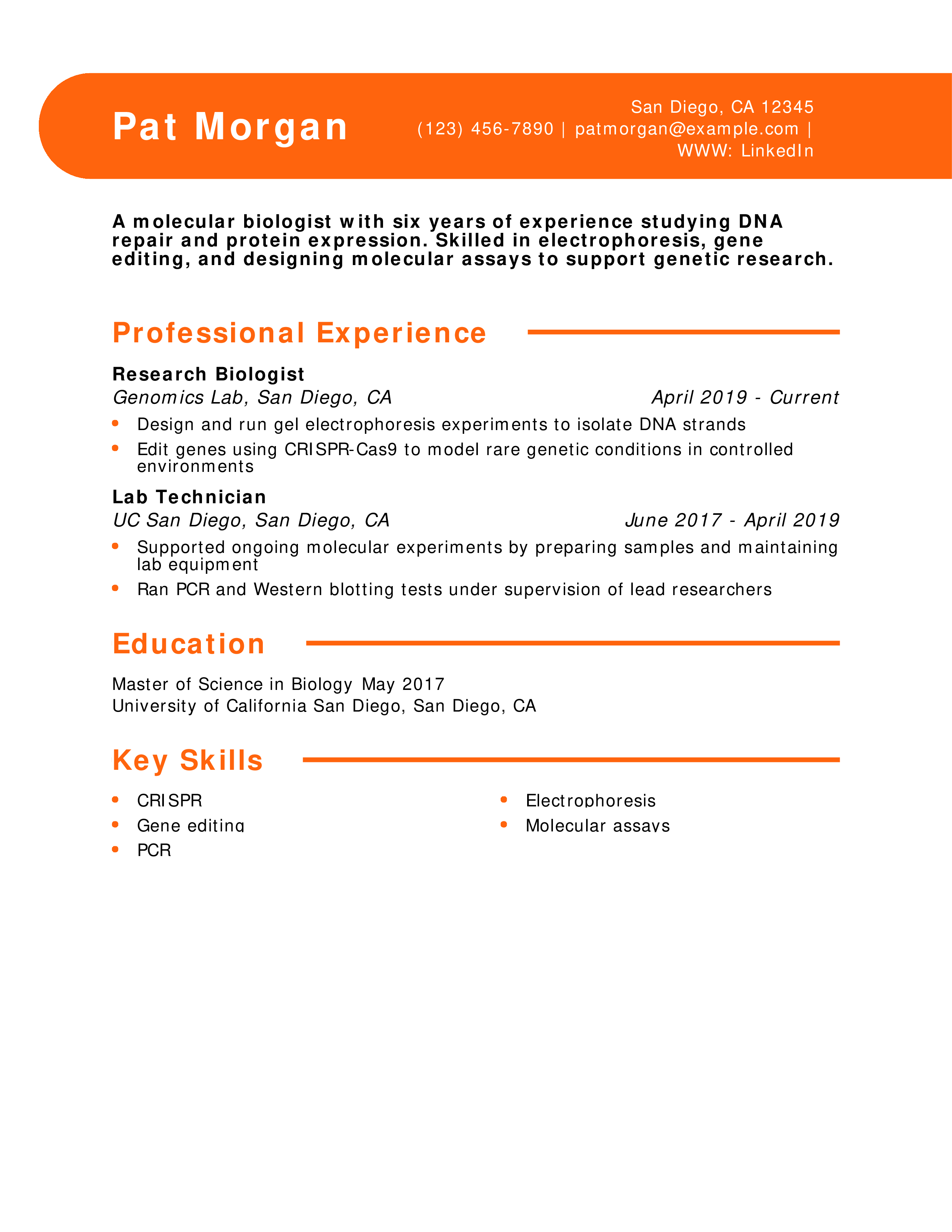
Why This Resume Stands Out
This resume is strong due to its focus on highly technical lab procedures and modern gene editing methods. It shows clear advancement in lab responsibility.
Conservation Biologist Resume
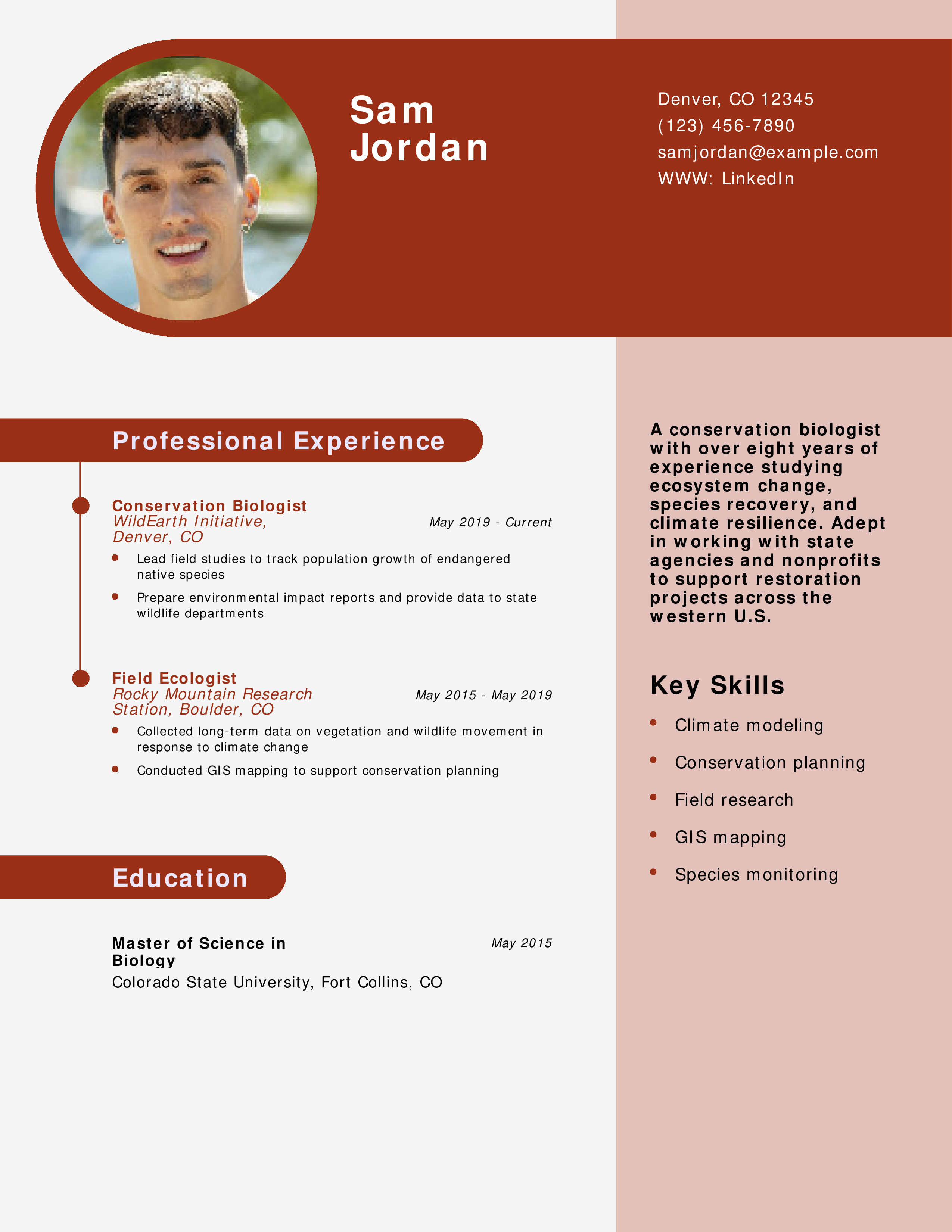
Why This Resume Stands Out
This resume provides a comprehensive look at real-world conservation work, which is crucial in environmental biology roles. It includes both data-driven and field-based responsibilities.
Biology Lab Assistant Resume
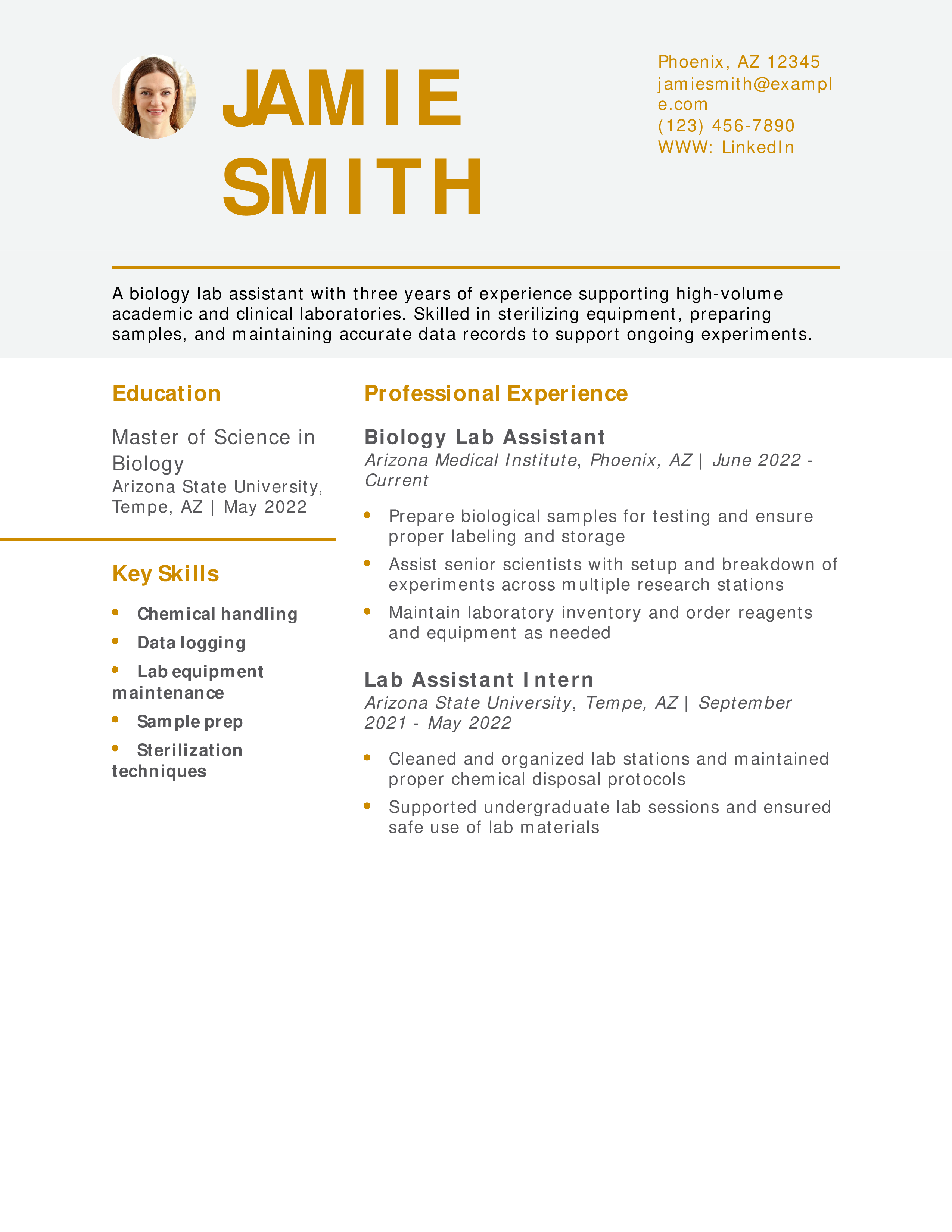
Why This Resume Stands Out
This resume is a strong example for lab-based entry roles because it clearly outlines technical duties and highlights support for academic labs. It also shows responsibility in maintaining lab safety.
Marine Biologist Resume
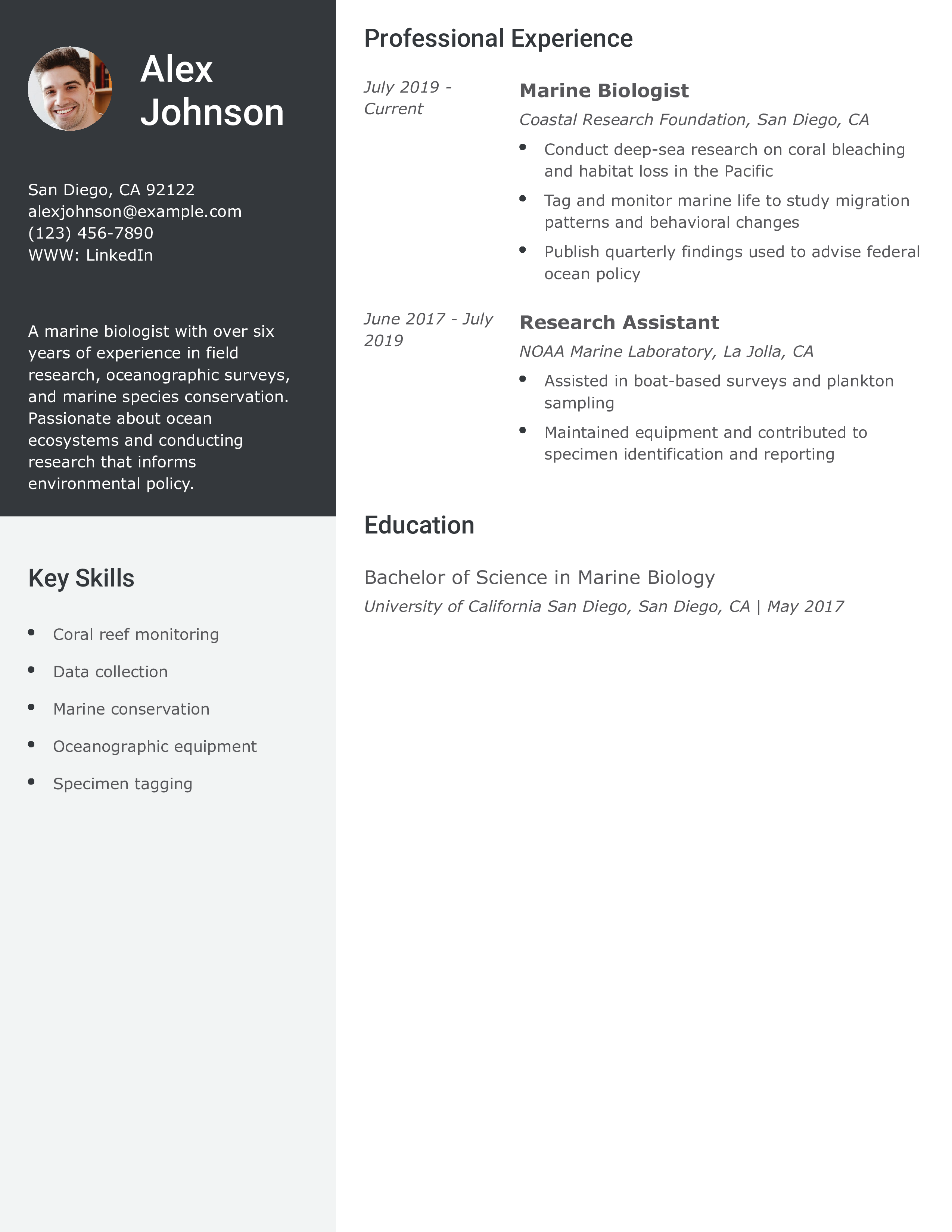
Why This Resume Stands Out
This resume demonstrates in-depth knowledge of marine ecosystems and field-based work. It includes contributions to both research and policy, making it ideal for environmental roles.
Biotechnology Specialist Resume
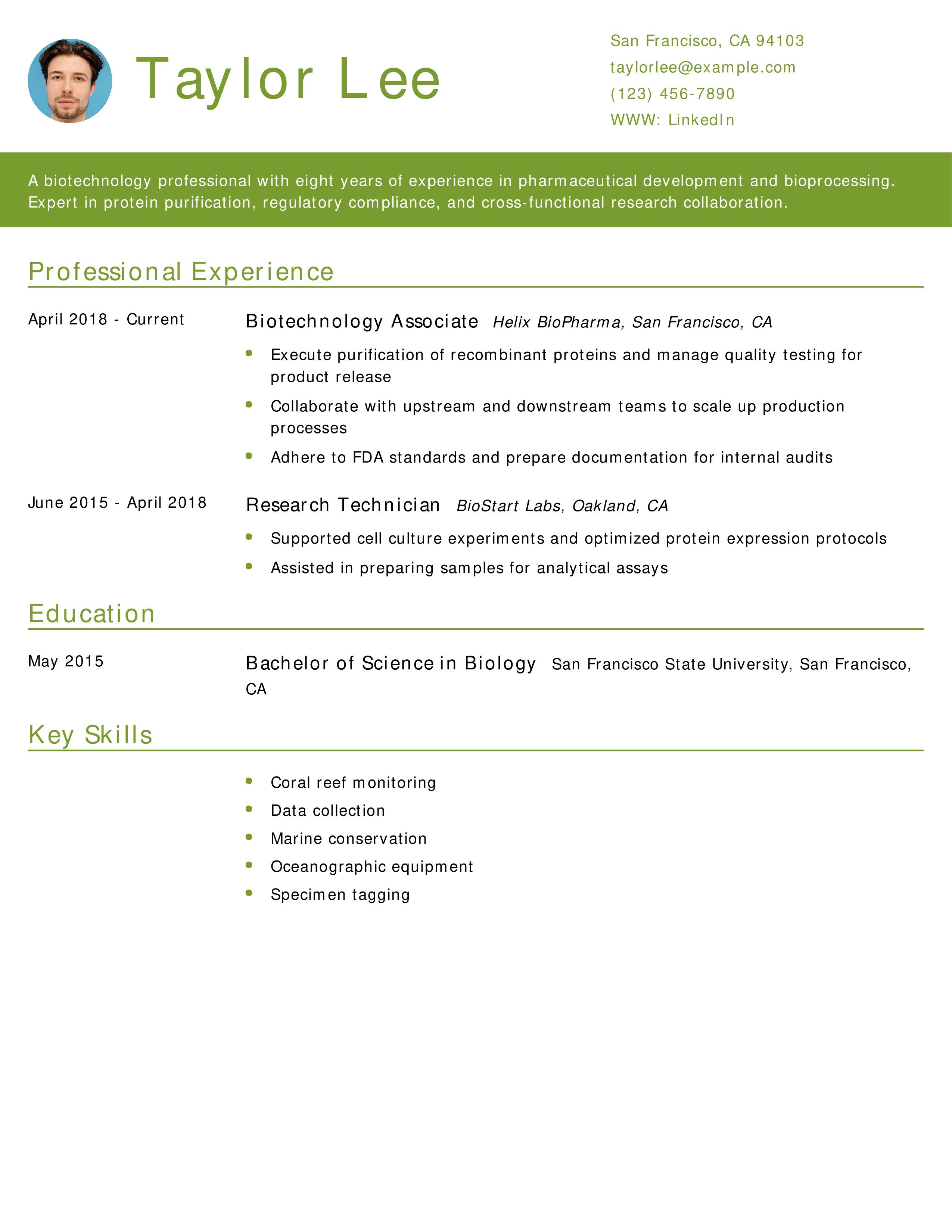
Why This Resume Stands Out
This resume is strong due to its focus on technical processes used in biotech, and it reflects industry-specific language that hiring managers seek.
Wildlife Biologist Resume
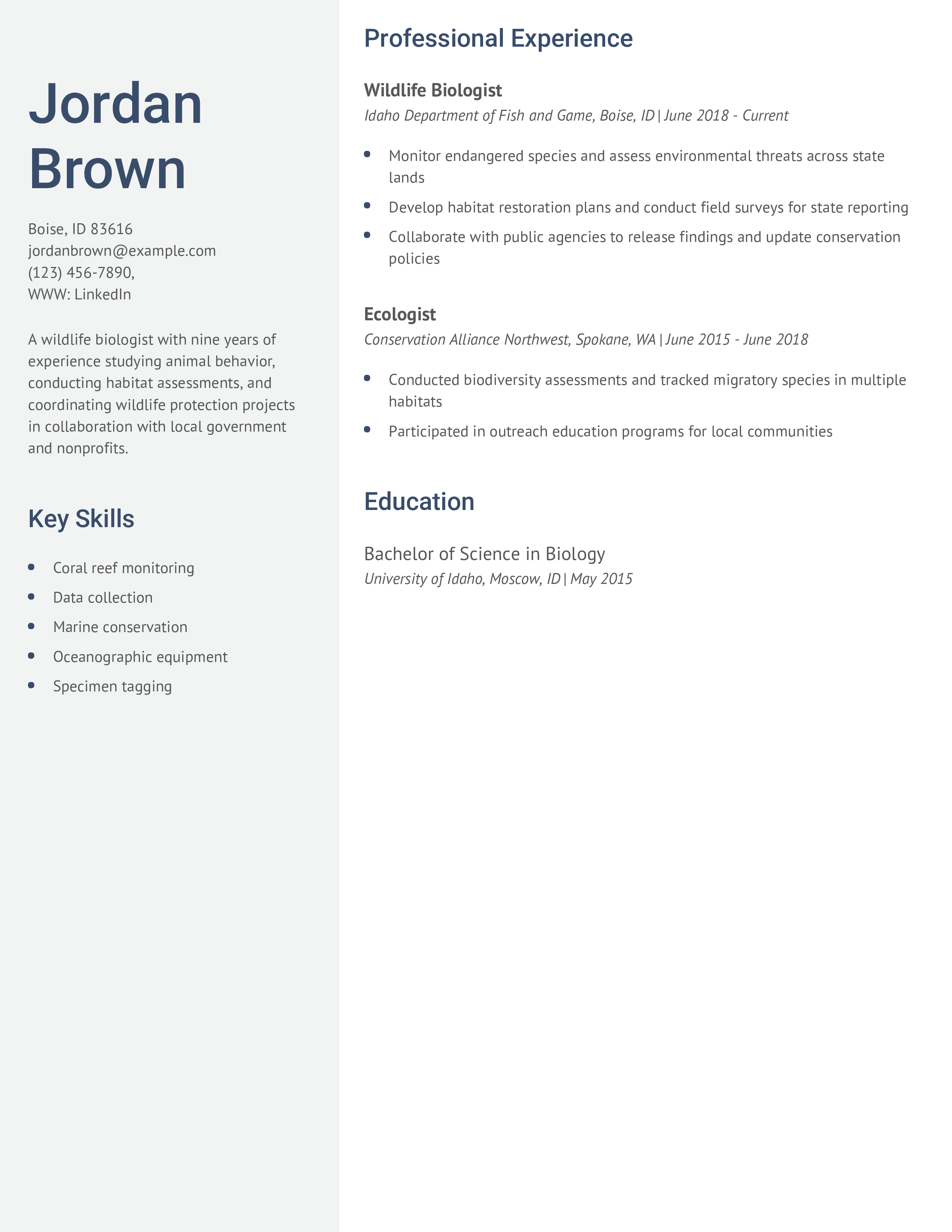
Why This Resume Stands Out
This resume combines fieldwork, policy development, and public education — three core areas in wildlife biology. The clear role descriptions show impact and purpose.
Biomedical Researcher Resume
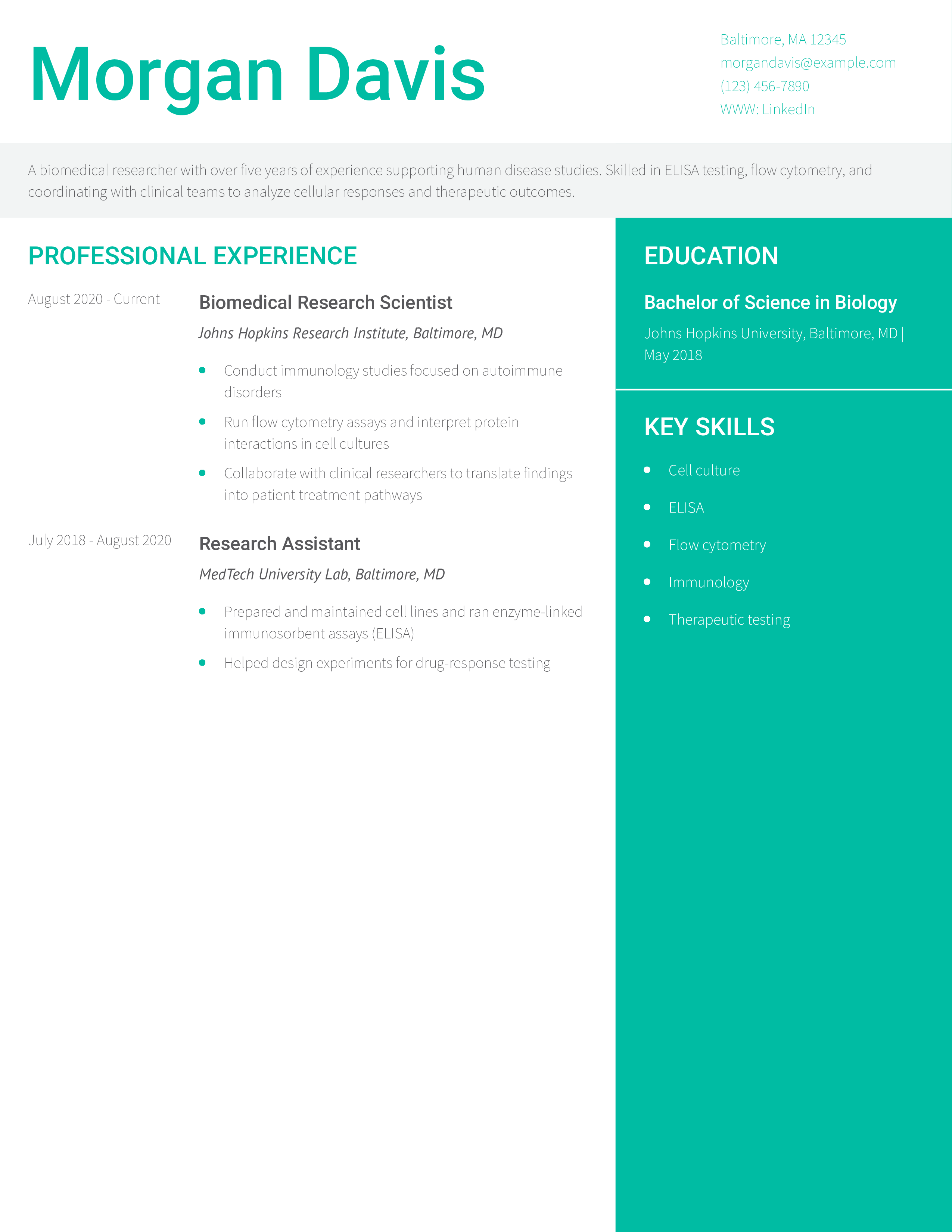
Why This Resume Stands Out
This resume stands out by emphasizing skills that bridge research and clinical outcomes. The language is targeted and includes commonly used lab techniques in biomedical research.
Genetics Research Assistant Resume
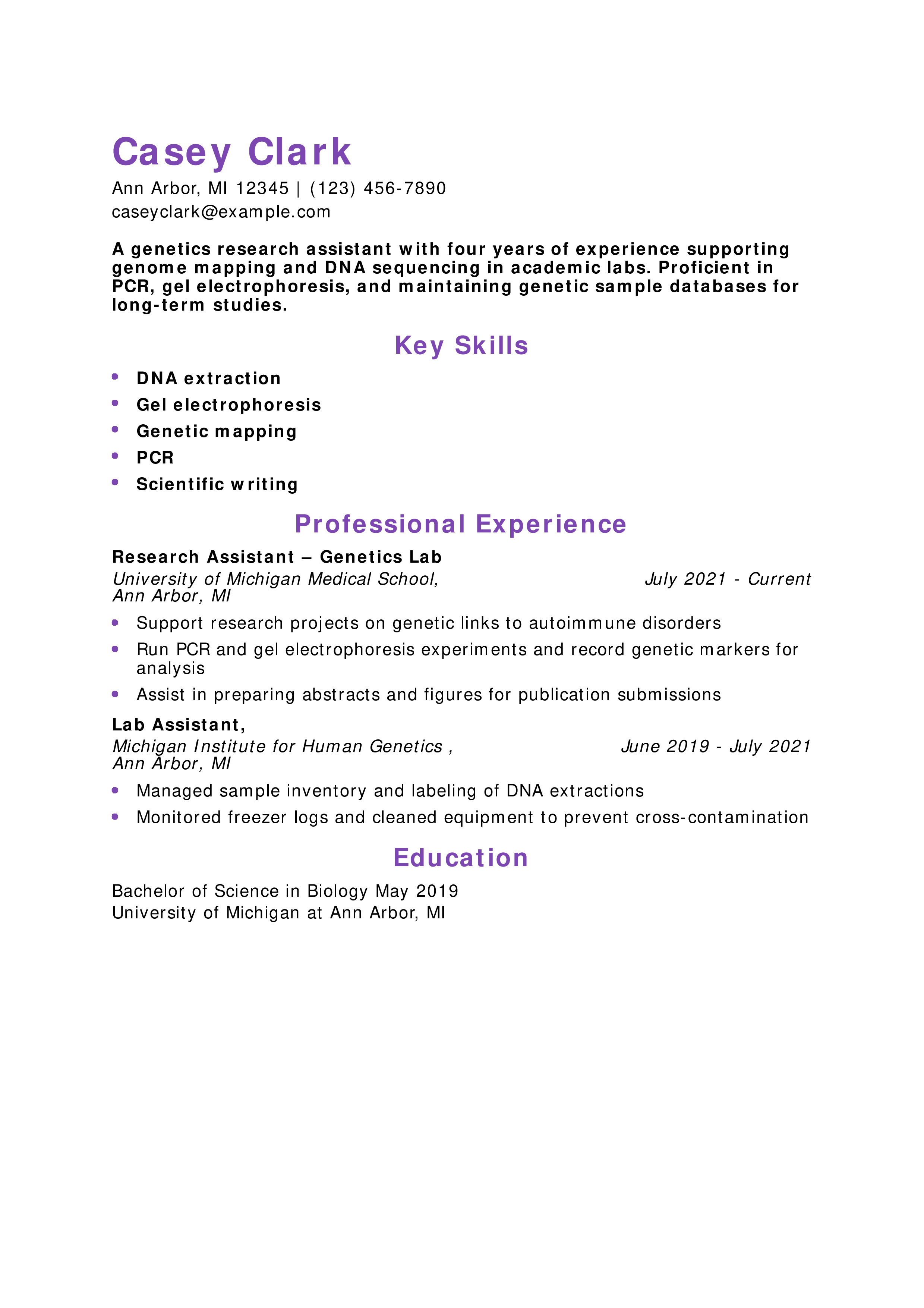
Why This Resume Stands Out
This resume effectively focuses on the applicant’s experience with technical lab procedures and contributions to published research. It's well-suited for graduate school or lab positions.
Clinical Laboratory Technologist Resume
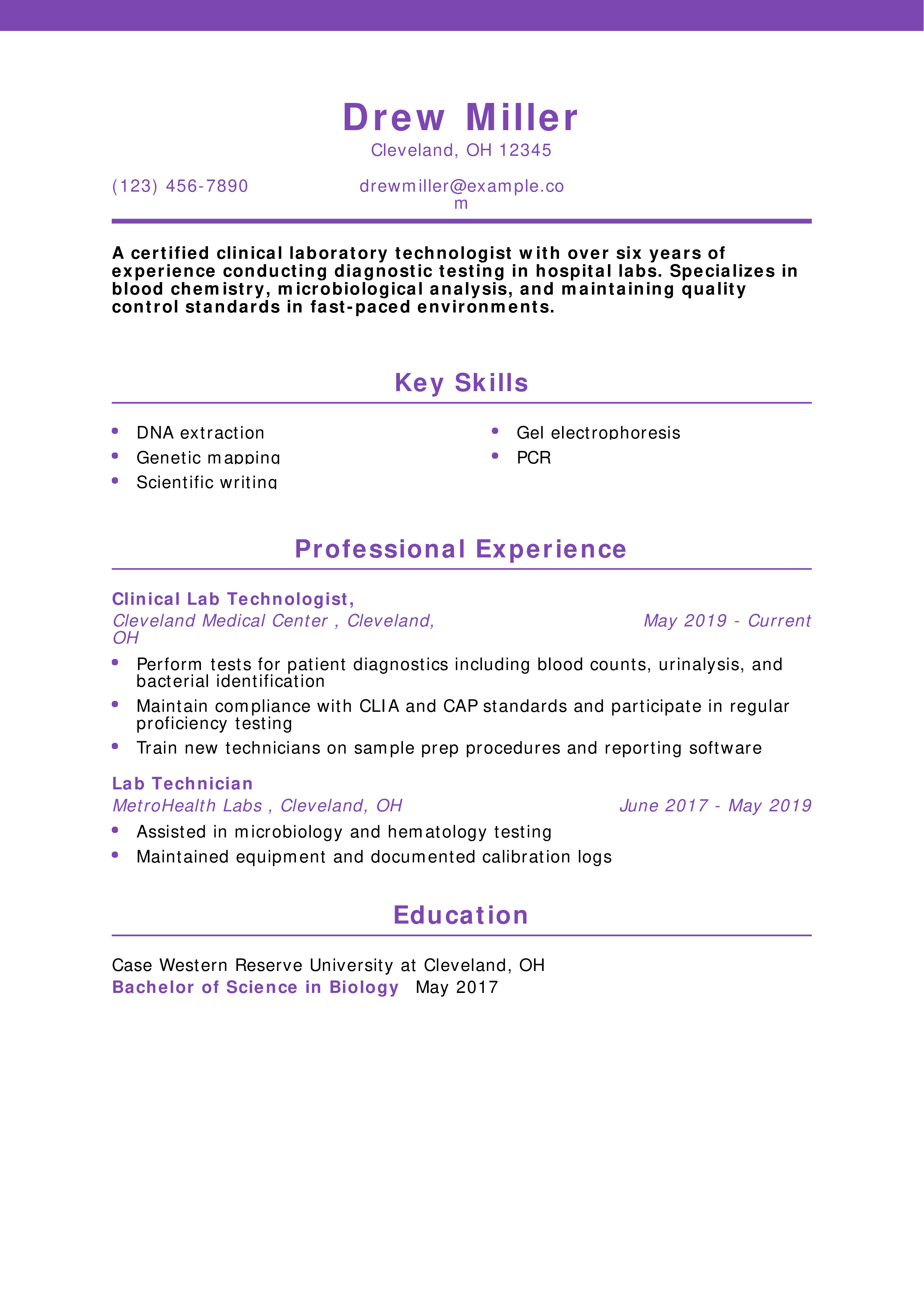
Why This Resume Stands Out
This resume is clear, concise, and tailored to hospital and diagnostic lab settings. It highlights certifications, regulatory knowledge, and clinical precision.
Environmental Biologist Resume
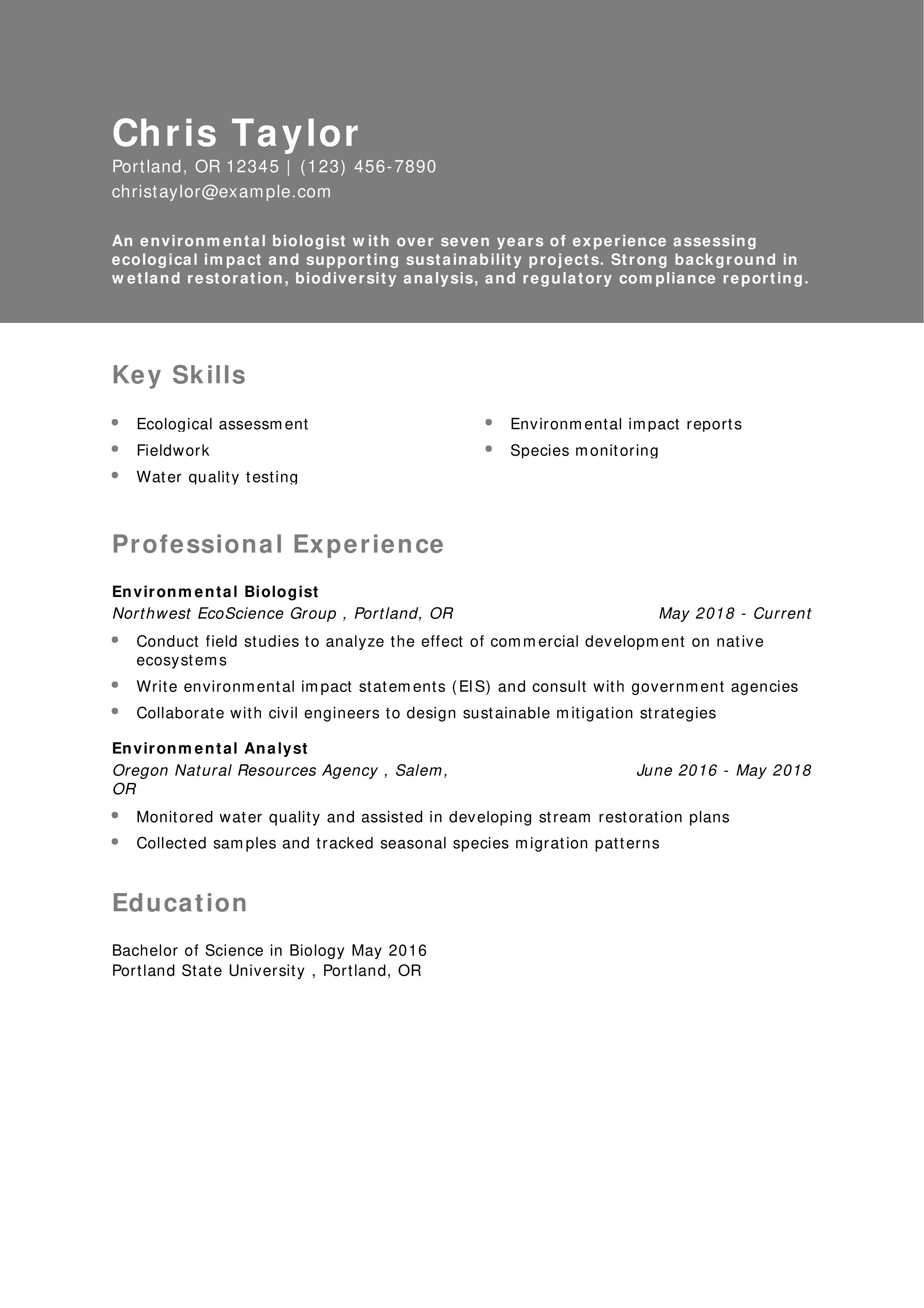
Why This Resume Stands Out
This resume shows a strong understanding of the environmental review process, with clear examples of real-world project involvement. It's ideal for roles in ecology or natural resources.
Botanist Resume
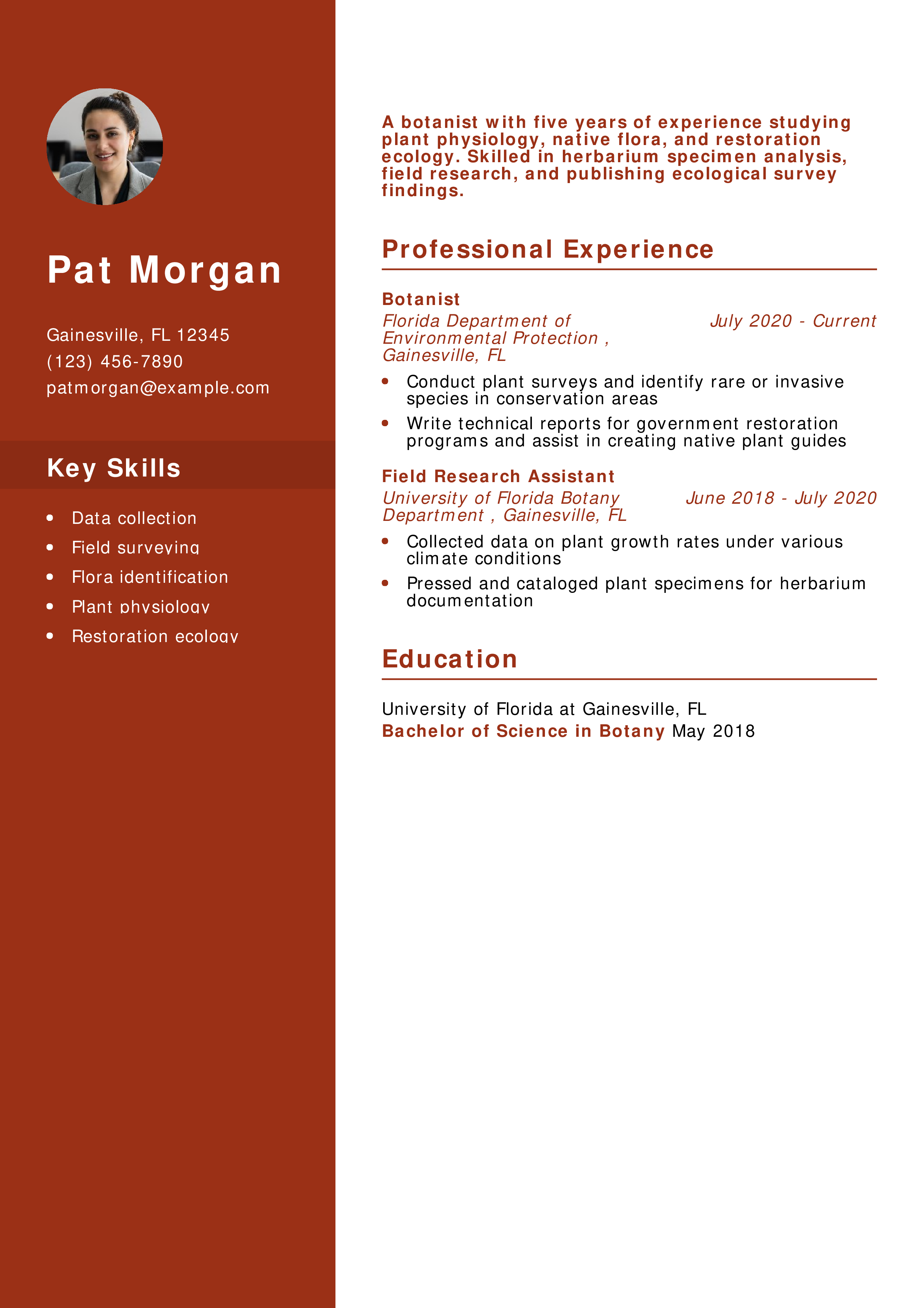
Why This Resume Stands Out
This resume demonstrates specialized plant science knowledge and field research experience. It uses role-specific terminology that helps it stand out to hiring managers.
Ecotoxicologist Resume
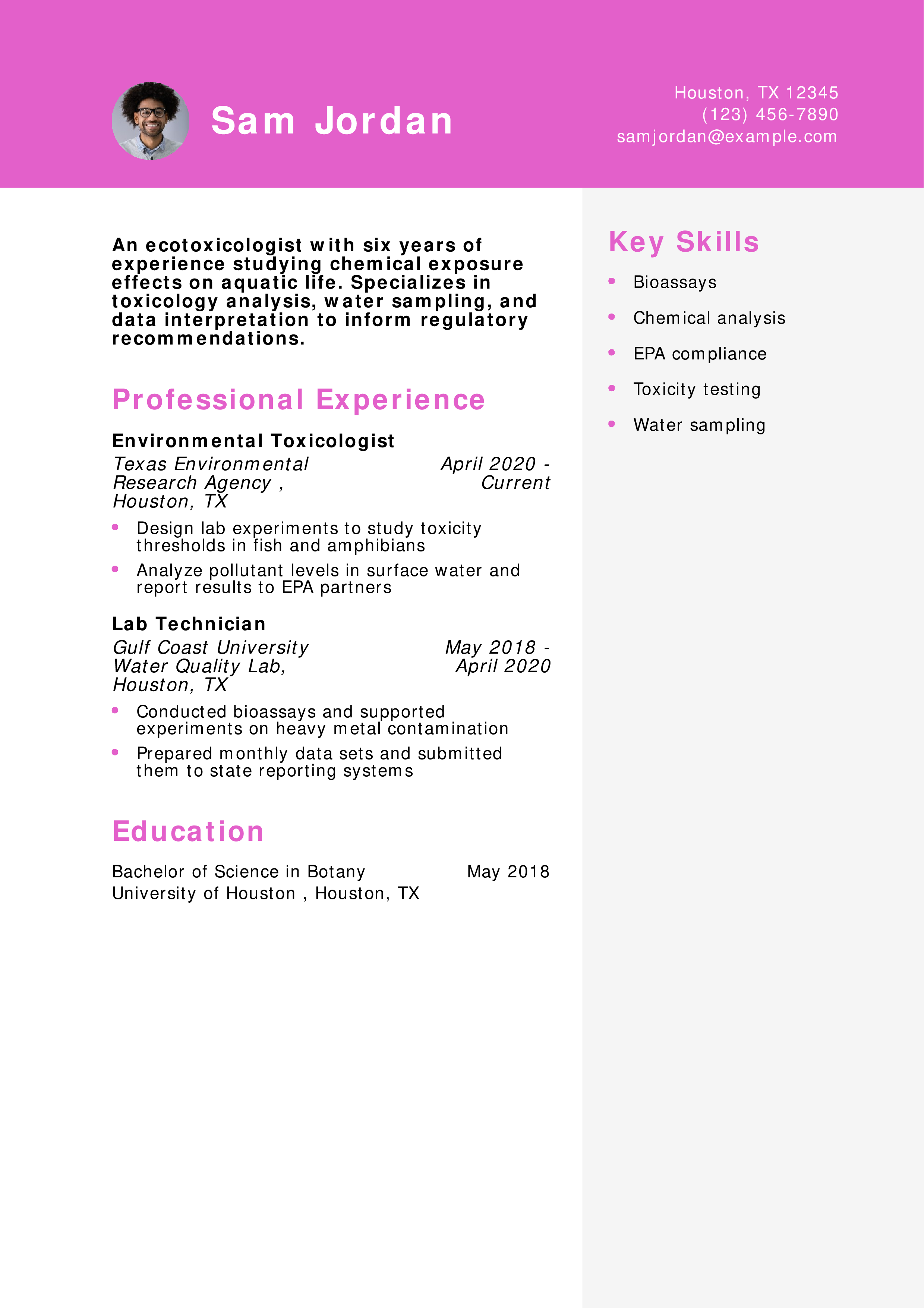
Why This Resume Stands Out
This resume is strong because it showcases field and lab experience and demonstrates compliance with federal guidelines. It focuses on analytical work critical to environmental safety.
Biology Curriculum Developer Resume
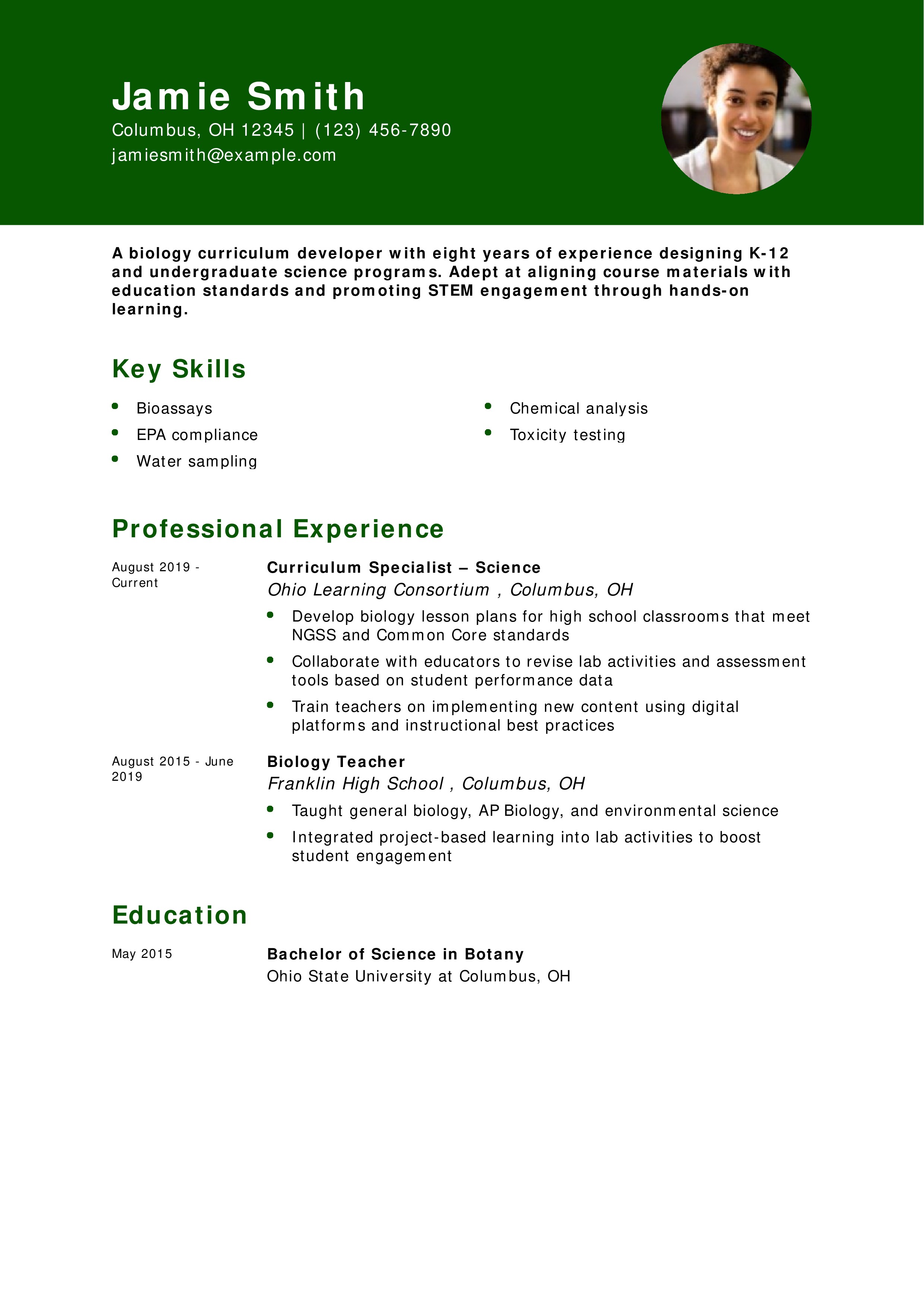
Why This Resume Stands Out
This resume highlights both classroom and instructional design experience, which is key for roles in education development. It also shows progression from educator to strategist.
Biomedical Equipment Specialist Resume
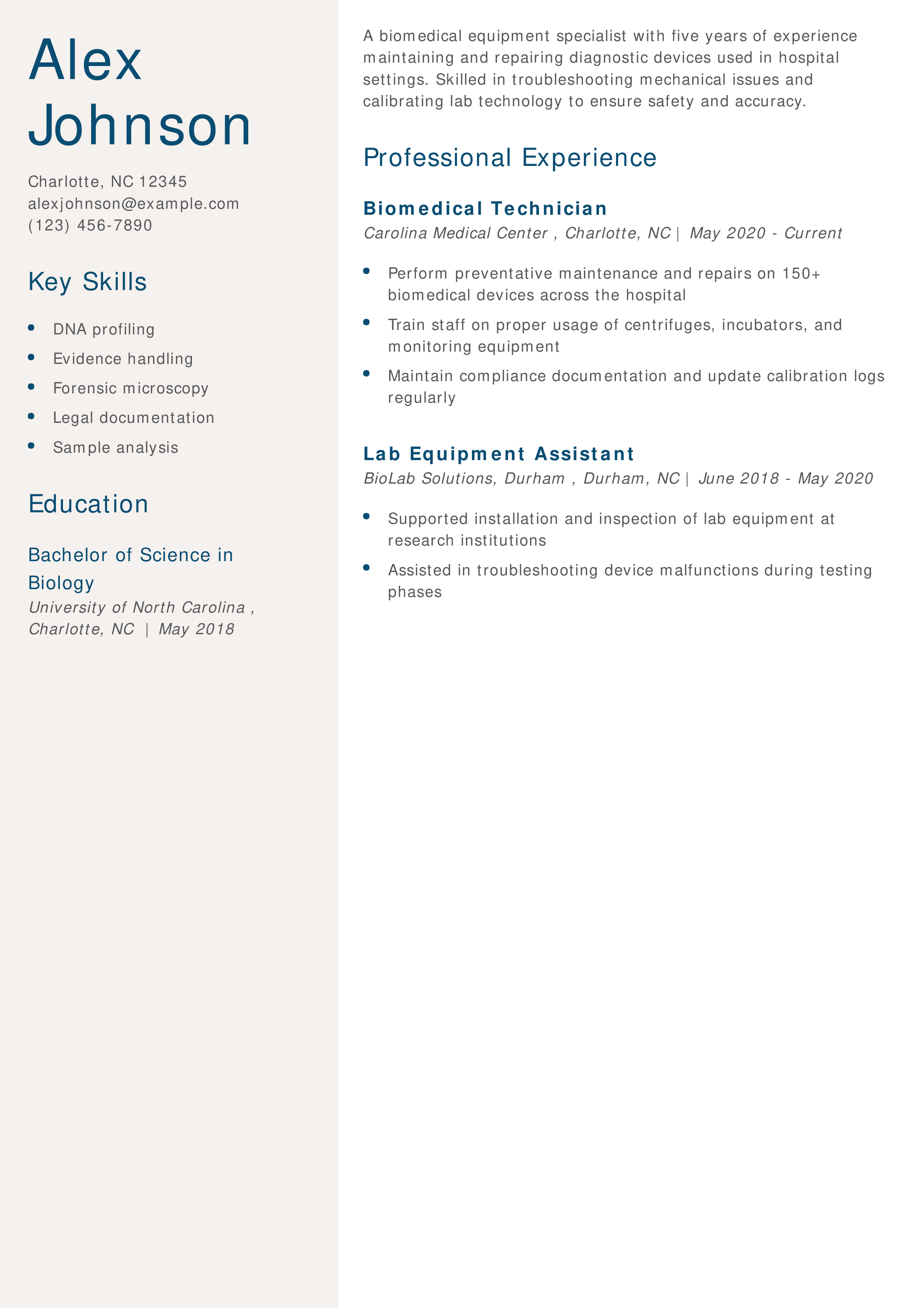
Why This Resume Stands Out
This resume succeeds by focusing on specialized technical skills, such as calibration and safety compliance, which are critical in biomedical equipment roles.
Biomedical Equipment Specialist Resume
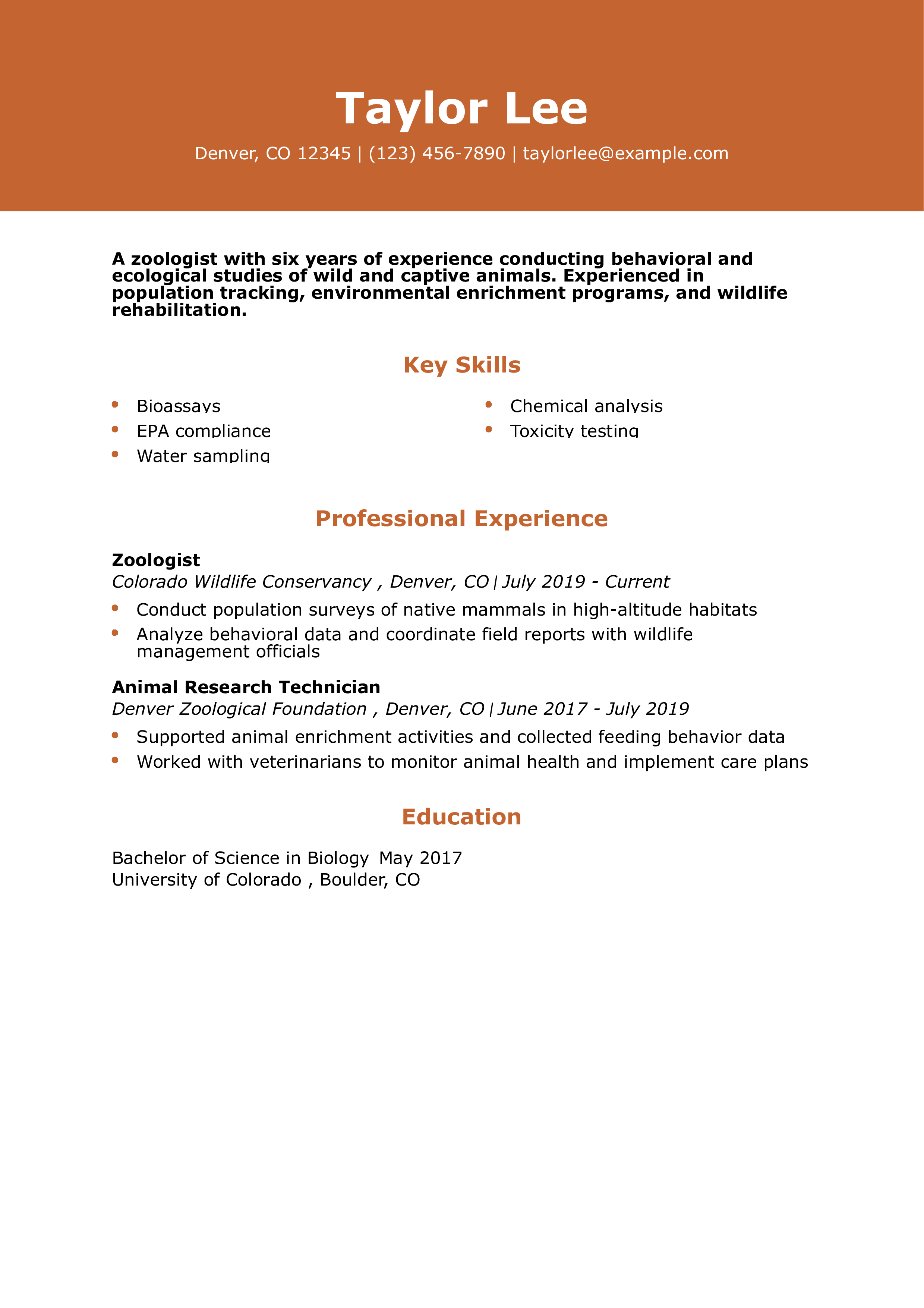
Why This Resume Stands Out
This resume clearly demonstrates experience with both wild and captive species, balancing field and lab responsibilities. It also shows attention to long-term species care.
Plant Pathologist Resume
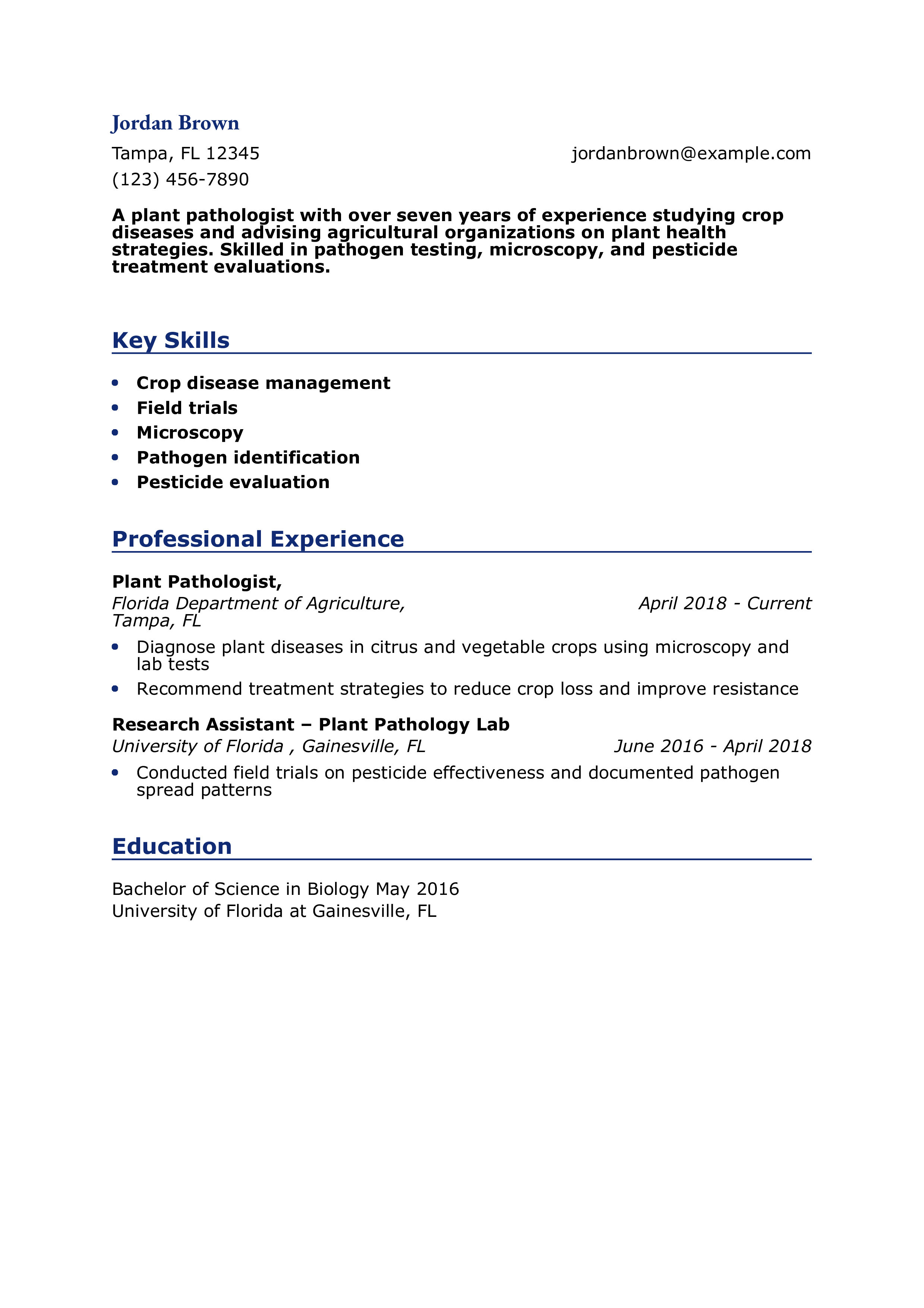
Why This Resume Stands Out
This resume is effective because it reflects agricultural impact and practical problem-solving. It also highlights niche plant science expertise.
Forensic Biologist Resume
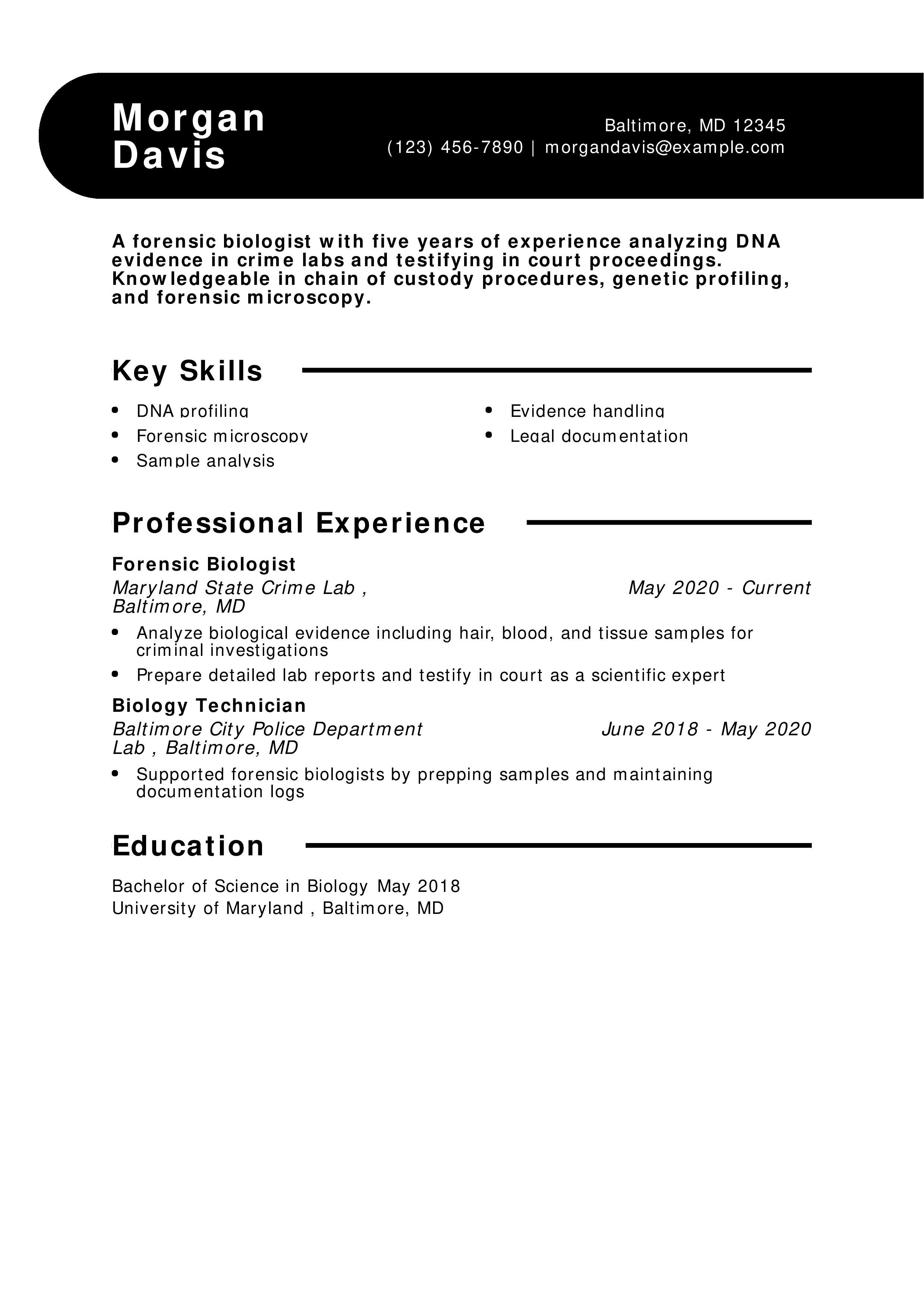
Why This Resume Stands Out
This resume combines scientific rigor with legal responsibility, showcasing a unique biology specialization. It reflects trustworthiness and technical ability under pressure.
Our templates are crafted by professional resume writers to make creating your resume quick, easy, and effective.
- Professional resume template downloads
- Customized cover letter generation
- AI resume writing support
- Career-building resources and advice
Biology Text-Only Resume Templates and Examples
How To Write a Biology Resume
Biology candidates should skip general science claims and highlight lab techniques, data accuracy improvements, and research contributions. Employers want hands-on skills that translate directly into smoother experiments and cleaner results.

1. Write a dynamic profile summarizing your biology qualifications
Think of the profile section of your resume as the abstract for a journal article. It’s short and to the point. But it still includes everything the hiring manager needs to know to determine if they should keep reading.
Your profile should include your current job title or the one you’re seeking and how many years of experience you have. Include any specializations or areas of interest, such as clinical research, virus mutations, or metabolic diseases.
Senior-Level Profile Example
A Senior Biologist and Researcher with over 10+ years of professional experience, specializing in drug discovery, laboratory research, vitro assays, and cell-based assays. A proven track record of developing and leading research teams to conduct comprehensive studies of cardiovascular and metabolic diseases to support drug development.
Entry-Level Profile Example
A Biologist with entry-level experience specializing in environmental science, ecology, data visualization, and laboratory testing. Adept at supporting environmental studies and research projects to analyze the ecological effects of human development.
2. Showcase your biology experience
When you’re writing the professional experience section of your resume, emphasize your strongest accomplishments. Include what you did and why it was important. Be sure to include data or metrics whenever it makes sense. This will establish a sense of scope for the hiring manager and enhance the impact of your bullet points. For example, saying you “managed a team” doesn’t provide as much information as saying that you “managed a team of over 10 biologists and researchers in a laboratory setting for a multi-million dollar clinical trial.”
Be specific when describing your professional achievements. Biology is a broad field, so provide details to paint a clearer picture of your biology expertise. Depending on your discipline, you may want to specify the types of assays you worked with during research projects or the type of laboratory equipment you were utilizing to conduct experiments.
Senior-Level Professional Experience Example
Senior Research Scientist, Excelulor Inc., Boston, MA
May 2016 – Present
- Manage a team of 20+ molecular biologists, scientists, and researchers to perform clinical research on the cellular immune response to Covid-19 variants, including conducting studies on the efficacy of vaccines after four months of inoculation
- Lead the development of a 12-month research study comparing the accuracy of PCR, rapid PCR, and rapid antigen tests in detecting viral molecules
- Coordinate all aspects of laboratory operations, refine quality control measures to ensure data integrity, and maintain compliance with Covid-19 safety guidelines
Entry-Level Professional Experience Example
Junior Biologist, Clean Energy Inc., Atlanta, GA
May 2021 – Present
- Conduct environmental studies on wetland habitats to assess the impact of development projects on wildlife for a renewable energy company
- Coordinate with a team of biologists to perform field investigations on potential environmental risks and ensure compliance with environmental protection laws
- Gather, interpret, and present data on findings using data mapping techniques to aid key decision-makers in evaluating risk factors and project roadmaps
3. List any education and certifications relevant to biology
Hiring managers are often looking for candidates with specific areas of expertise and certain relevant degrees and certifications. Listing your education, including your major and institution, ensures a hiring manager knows if you’re a good fit.
For example, a molecular biologist with experience in assay development may be a better fit for a position than a biologist who specializes in environmental science and wildlife. Having the correct degree is also critical for candidates going on to graduate school or doctorate programs.
Education
Template
- [Degree Name]
- [School Name], [City, State Abbreviation] | [Graduation Year]
Example
- Doctor of Philosophy (Ph.D.) Molecular Biology
- University of Boston, Boston, MA | 2016
Certifications
Template
- [Certification Name], [Awarding Organization], [Completion Year]
Example
- Administrative Assistant Certification, National Career Certification Board, 2013
4. Include a list of skills and proficiencies related to biology
One of the most important goals of your resume is to show the hiring manager you have the skills they’re looking for. But reviewers spend an average of just a few seconds per resume, so make it easy to see your qualifications with a bulleted skills list.
Biology is such a varied field that this list could be extremely long, so limit yourself to five to 10 skills most relevant to the position. Here are some options you may want to consider:
| Key Skills and Proficiencies | |
|---|---|
| Assay development | Biochemistry |
| Biology | Cell-based assays |
| Clinical research | Data analysis |
| DNA testing | Drug discovery |
| Ecology | Environmental science |
| Flow cytometry | Microbiology |
| Molecular biology | Laboratory operations |
| Laboratory safety | Polymerase chain reaction (PCR) |
| Project management | Quality assurance |
| Quality control | Research |
How To Pick the Best Biology Resume Template
Templates are great tools that can make the resume creation process substantially easier. Ensure the design you choose has clear headers for each section, including the profile, professional experience, key skills, and education pieces. It should also have your contact information in the header.
Resume templates for science-based disciplines should be clean and professional, so stay away from flashy fonts or anything too creative. Don’t forget to download the completed resume as a PDF to ensure the formatting is preserved.
Frequently Asked Questions: Biology Resume Examples and Advice
Why should I use a Biology resume example as a template for my own resume?-
A Biology resume example provides a solid foundation for structuring your own resume. It showcases how to highlight achievements, use quantifiable metrics, and present your experience in an organized manner. You can personalize it by adding your unique qualifications and adjusting sections to better reflect your skills and career history.
What are common action verbs for biology resumes?-
Using action verbs on a biology resume helps emphasize your achievements and create a dynamic resume that’s more engaging to read. However, it’s easy to start repeating yourself — particularly if you have years of experience to include. Use the options below to vary your word choice and choose specific language that accurately describes your experience.
Don’t forget to check the job description for any verbs you can include to further target your resume.
| Action Verbs | |
|---|---|
| Analyzed | Calibrated |
| Cultured | Dissected |
| Documented | Extracted |
| Formulated | Genotyped |
| Harvested | Identified |
| Interpreted | Isolated |
| Measured | Modeled |
| Observed | Published |
| Quantified | Recorded |
| Sampled | Validated |
How do you align your resume with a job description?-
Many biology careers are expected to see faster-than-average growth through 2032, according to the Bureau of Labor Statistics (BLS). For example, the job outlook for biological technicians over that time period includes 5% growth. Those working in in-demand fields such as virus research could see even more openings.
Maximize your chances of success by aligning your resume with the job description. For example, a resume for a position as a research associate should include different skills and verbiage than one for a college biology professor.
What is the best biology resume format?-
If you have years of lab experience or are a senior-level applicant, the reverse chronological format is probably the best option to highlight your qualifications and experience. This places your most recent and relevant experience first while demonstrating your career progression. Combination formats may be more flexible and offer more options to ensure your technical skills and professional achievements are represented.
How long should my biology resume be?-
A biology resume should typically be one page long, especially if you have less than 10 years of experience. A two-page resume may be appropriate for seasoned professionals with extensive achievements, but only if every detail adds value to your candidacy. Focus on conciseness and relevance by tailoring your resume to the job you're applying for. Highlight your most impactful accomplishments, certifications, and key skills rather than listing every career detail.
Including work experience from the last 10 to 15 years is generally recommended. Older positions can be summarized briefly or omitted unless highly relevant. Remember, your resume is a snapshot of your qualifications, not an exhaustive career history. Prioritize clarity and impact to make a strong impression.
Craft your perfect resume in minutes
Get 2x more interviews with Resume Builder. Access Pro Plan features for a limited time!