The workplace phenomenon of “job hugging”—clinging to a current role out of market fear rather than loyalty—is no longer just a trend, and it’s becoming increasingly common.
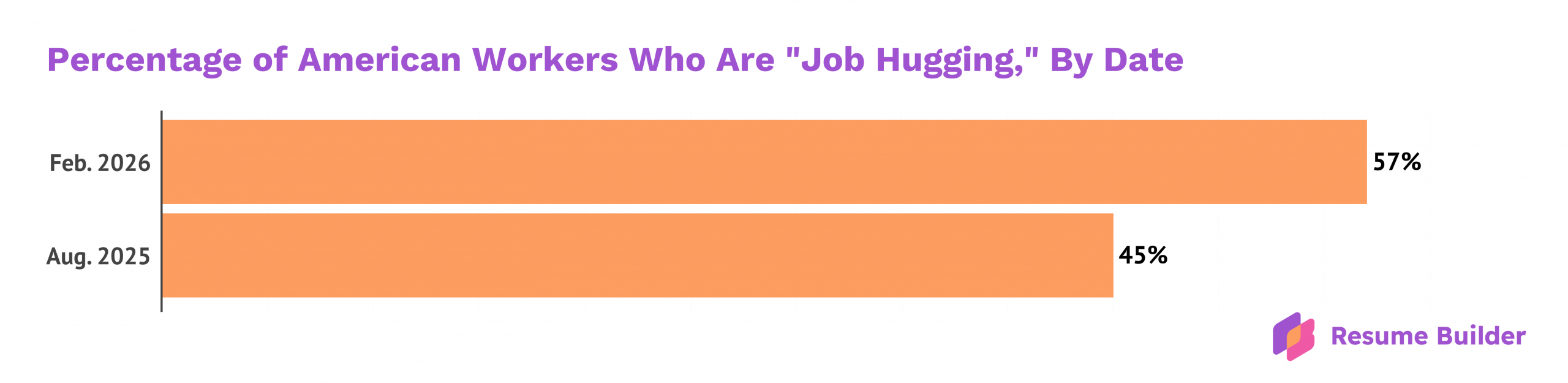
A February 2026 survey from ResumeBuilder.com reveals that the percentage of workers identifying as “job huggers” has surged from 45% in August 2025 to 57% in February 2026, a 12-point jump in just five months. This rapid escalation signals a workforce that has moved from caution to active risk aversion as layoff fears and AI-driven displacement become front-of-mind.
Key findings:
- Job hugging is on the rise: 45% of workers reported job hugging in August 2025 compared to 57% in February 2026.
- Job huggers are staying put out of fear: 70% worried about AI affecting job security and 63% worried about layoffs in the next six months.
- Job hugging isn’t expected to fade anytime soon: 71% say they’ll continue doing it for at least six months.
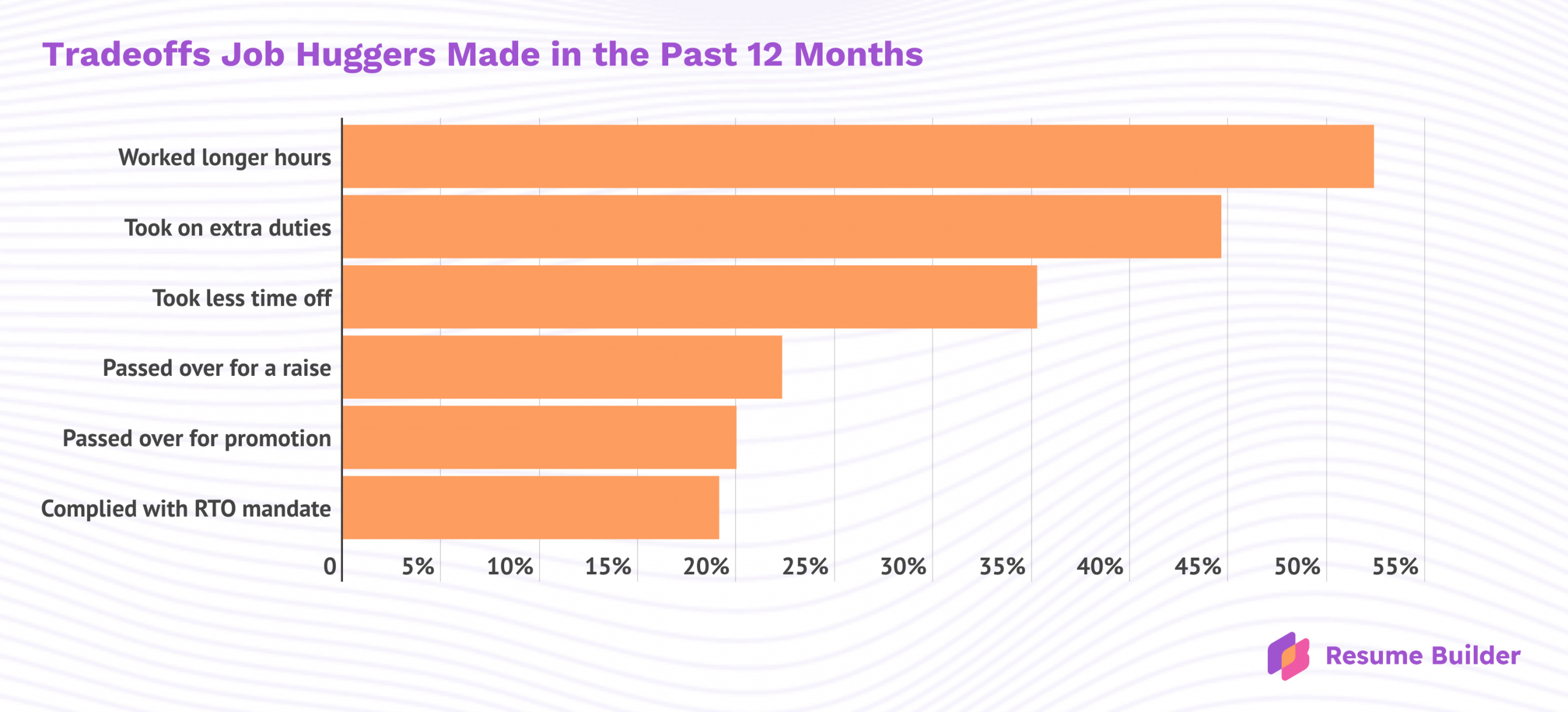
- Job huggers are making tradeoffs: 52% are working longer hours and many report missed raises, promotions, or time off.
Job Hugging Is the New Normal: Over Half of Employees Are Staying Put Due to Market Fears
The increase in job hugging signals a workforce that is becoming more risk-averse, with career decisions increasingly shaped by fear of the job market
Among job huggers, near-term concerns are especially pronounced.
- AI Replacement: 70% of job huggers worry AI will impact their job security in the next six months.
- Layoffs: 63% are concerned they will be laid off within six months.
There is little indication that this behavior will reverse in the near term. The vast majority (71%) of workers expect to continue job hugging well into 2026 and beyond.
When workers expect to feel secure enough to stop job hugging:
- 8% say within 3 months
- 21% say 3 to 6 months
- 27% say 6 to 12 months
- 34% say 1 to 2 years
- 10% say more than 2 years
“Employers must recognize that their workforce may be composed of individuals who are staying not out of loyalty or fulfillment, but out of necessity and fear,” says ResumeBuilder’s Chief Career Advisor Stacie Haller. “This environment can lead to a stagnation of skills and ideas, as employees remain in roles that may not fully utilize their capabilities or align with their aspirations. This reality calls for a nuanced approach to talent management, one that addresses the root causes of job hugging and seeks to build genuine engagement and trust.”
8 in 10 Fear Changing Jobs And Falling Victim to “Last In, First Out” Policy
Market uncertainty is suppressing job search activity because many employees see switching roles as a major risk. In a volatile environment, workers worry that joining a new company could make them more vulnerable to layoffs as a newer hire.
That concern shows up clearly in fears about “last in, first out” policies: more than 80% say they would be worried about being laid off first if they moved to a new employer, and nearly a third say they would be very worried.
Majority of job huggers aren’t actively job searching
As a result, job search activity is cautious rather than aggressive, even though interest in new opportunities remains. Over three-quarters say they would be more active in their search if they believed the job market was stronger. For now:
- 14% are not searching at all
- 44% are passively browsing listings
- 20% are sending a few applications
- 19% are actively applying or interviewing
- 3% are in advanced interviews or negotiations
The data reveals a deliberate decision to avoid the perceived downside of making a move right now. Of those not actively searching for another job at the moment, 75% say they would be more actively looking if the job market was better.
In their next role, job huggers would want better pay (75%), better benefits (61%), growth opportunities (51%), and the ability to work remotely (40%).
Job Huggers Are Working Harder and Accepting Less To Gain Job Security
Efforts to stay employed in a shaky job market are coming with real tradeoffs. Employees report taking on heavier workloads, giving up time off, and accepting stalled career progression in exchange for perceived stability.
More than half (52%) say they’ve worked longer hours than they normally would, and 45% have taken on additional work outside their core responsibilities. These increases in workload are often paired with personal sacrifices, as 35% say they took less time off than usual.
Career and financial concessions are also common. Nearly a quarter of employees say they were not given a raise (22%) or a promotion (20%), even though they were up for one. At the same time, 19% report complying with return-to-office mandates they otherwise would not have followed.
“While making tradeoffs at work may provide short-term security, it raises important questions about long-term morale, engagement, and equity. Organizations must be mindful of the potential for resentment, disengagement, and turnover once market conditions improve or employee leverage increases. Addressing these risks requires a proactive approach to recognition, reward, and support for those who have made significant sacrifices during periods of uncertainty,” says Haller.
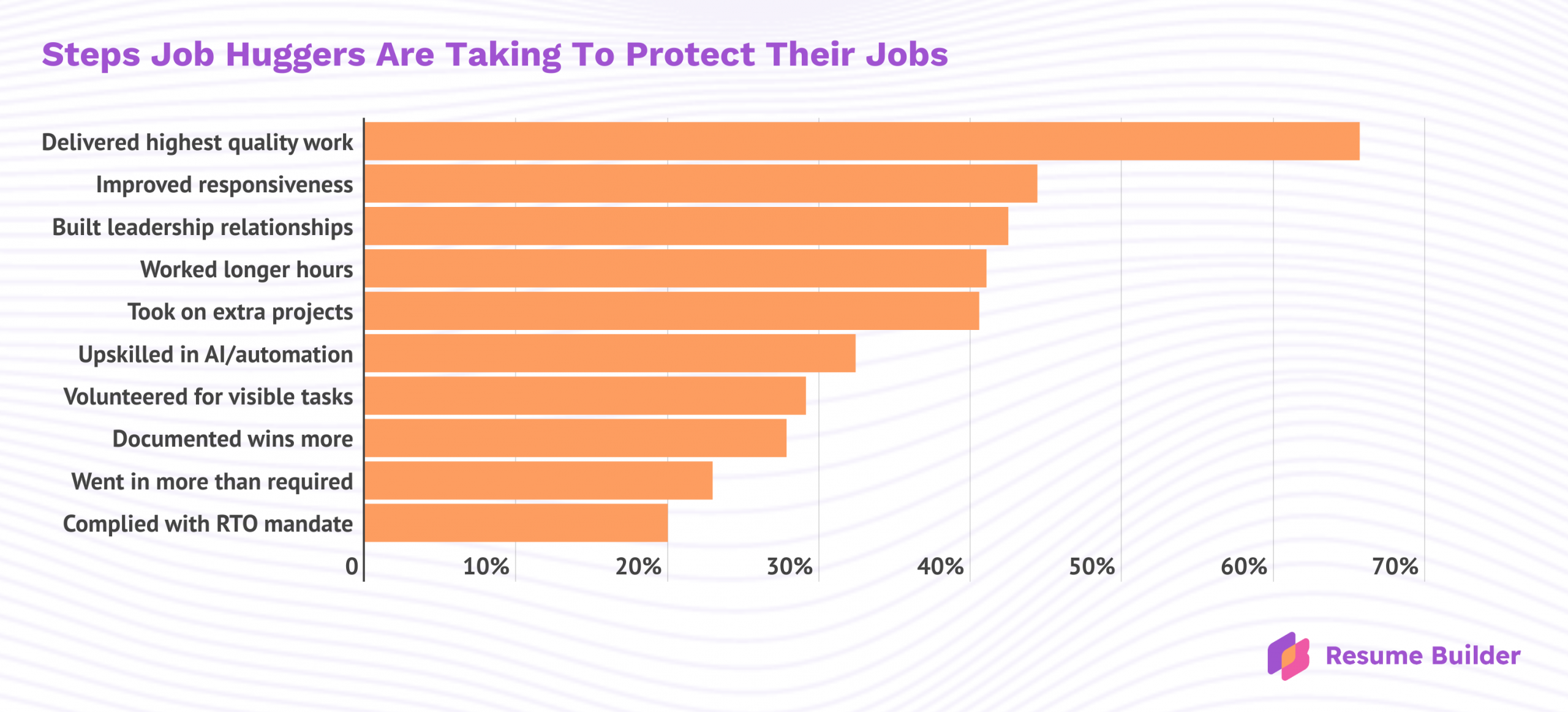
Workers are making themselves harder to cut
Workers are also actively trying to make themselves harder to cut by improving performance and increasing visibility.
While two-thirds (66%) say they’re delivering the best quality work possible, many are leaning into behaviors that signal reliability and value, such as improving response times and availability (44%) and building stronger relationships with leadership (42%).
Other efforts include:
- Upskilling on AI or automation (32%)
- Volunteering for visible tasks (29%)
- Documenting wins more visibly (28%)
- Going into the office more than required (23%)
Job Huggers Highly Engaged But Stressed
While engagement levels are high, stress and mental health challenges are pervasive across the workforce.
Despite 53% of employees reporting high engagement, nearly three-quarters experience moderate to high workplace stress, and over 45% rate their mental health as only ‘ok’ or worse.
“The coexistence of high engagement and high stress presents both opportunities and risks for organizations. On one hand, it demonstrates the resilience and dedication of employees in the face of adversity. On the other, it raises concerns about the sustainability of current levels of effort and the potential for burnout, disengagement, and turnover. Addressing these issues requires a holistic approach that supports both performance and well-being, recognizing that the two are inextricably linked,” says Haller.
Additionally, Haller also urges organizations to acknowledge that a significant portion of their workforce is staying on the job out of fear of not finding another, and to examine why so many want to leave and work to correct that deeper issue.
Methodology
This report is based on a survey of 2,188 U.S. workers conducted via Pollfish in February 2026. Of those respondents, 1,250 identified as “job hugging” and completed the full survey used for this analysis.
Pollfish distributes surveys through its mobile-first network and applies multiple layers of data-quality controls designed to reduce fraudulent or low-quality responses, including attention or quality checks and ongoing monitoring that can remove respondents who fail those checks.
For questions about this report, contact Sarah at [email protected]