Jamie Smith
(555) 304-8821
[email protected]
Richmond, VA
Profile
Supported 12 laboring patients through active management of vital signs and fetal monitoring during a high-volume clinical rotation at St. Luke’s Medical Center, graduating with a BSN and stepping into a full-time L&D role at Riverside Regional. Practiced in Epic Systems charting, continuous electronic fetal monitoring, and evidence-based labor support techniques. Brings focused attention to maternal-fetal status changes and a calm, communicative approach when coordinating with charge nurses and attending physicians during rapidly shifting clinical situations.
Professional Experience
Staff Registered Nurse, Labor and Delivery, Riverside Regional Medical Center, Newport News, VA | June 2024 – Present
- Assisted charge nurses in monitoring up to four laboring patients per shift, documenting contraction frequency, fetal heart rate patterns, and maternal vitals in Epic Systems every 15 to 30 minutes per unit protocol.
- Supported safe medication administration for oxytocin augmentation and epidural initiation, escalating any blood pressure readings outside the attending physician’s defined threshold to the bedside RN or provider within three minutes.
- Documented all nursing assessments, intake and output measurements, and progress notes in Epic, with zero incomplete charts flagged during the unit’s first quarterly internal review after my hire.
- Helped orient two newly admitted patients per week to the L&D environment by explaining monitor placement, IV access procedures, and what to expect during active labor, reducing call-light requests for repeat explanations.
- Verified patient identification and allergy status against the electronic health record before each medication pass, cross-checking against the MAR for accuracy across every shift.
- Tracked newborn APGAR scores at one and five minutes post-delivery and logged findings in Epic, flagging scores below seven to the attending and neonatal team.
- Coordinated with the unit’s lactation consultant to schedule bedside support visits for eight postpartum patients during a single stretch of three consecutive shifts, ensuring each family received instruction before discharge.
Nursing Student Extern, Women’s Services, St. Luke’s Medical Center, Richmond, VA | January 2024 – May 2024
- Assisted staff RNs in recording maternal vital signs and fetal heart rate strips for 12 patients across a 10-week clinical rotation, logging all data in MEDITECH software under direct preceptor supervision.
- Reviewed incoming shift handoff reports alongside the charge nurse, helping compile a written summary of each patient’s labor stage, IV access status, and pending orders for the oncoming team.
- Supported preparation of the delivery suite before each birth, verifying that resuscitation equipment, warmer settings, and sterile supplies were stocked according to the unit checklist for all six deliveries I observed.
- Escalated one case of late decelerations to the attending preceptor after identifying a repetitive pattern on the fetal monitor, contributing to a prompt bedside evaluation and intervention.
- Organized patient education materials, including breastfeeding guides and postpartum care instruction sheets, for distribution to seven families during a single week of postpartum rounding.
Key Skills
- Electronic fetal monitoring (EFM) interpretation
- Epic Systems clinical documentation
- Vital signs assessment and trending
- Active listening and patient communication
- Medication administration and adverse reaction monitoring
- MEDITECH software (basic charting)
- Social perceptiveness in high-stress birth environments
- Care plan coordination with interdisciplinary teams
- BLS and newborn resuscitation support
Certifications
- Registered Nurse (RN) | Virginia Board of Nursing | June 2024
- Basic Life Support (BLS) | American Heart Association | May 2024
Education
Bachelor of Science in Nursing in Nursing
Virginia Commonwealth University School of Nursing, Richmond, VA | August 2020 – May 2024
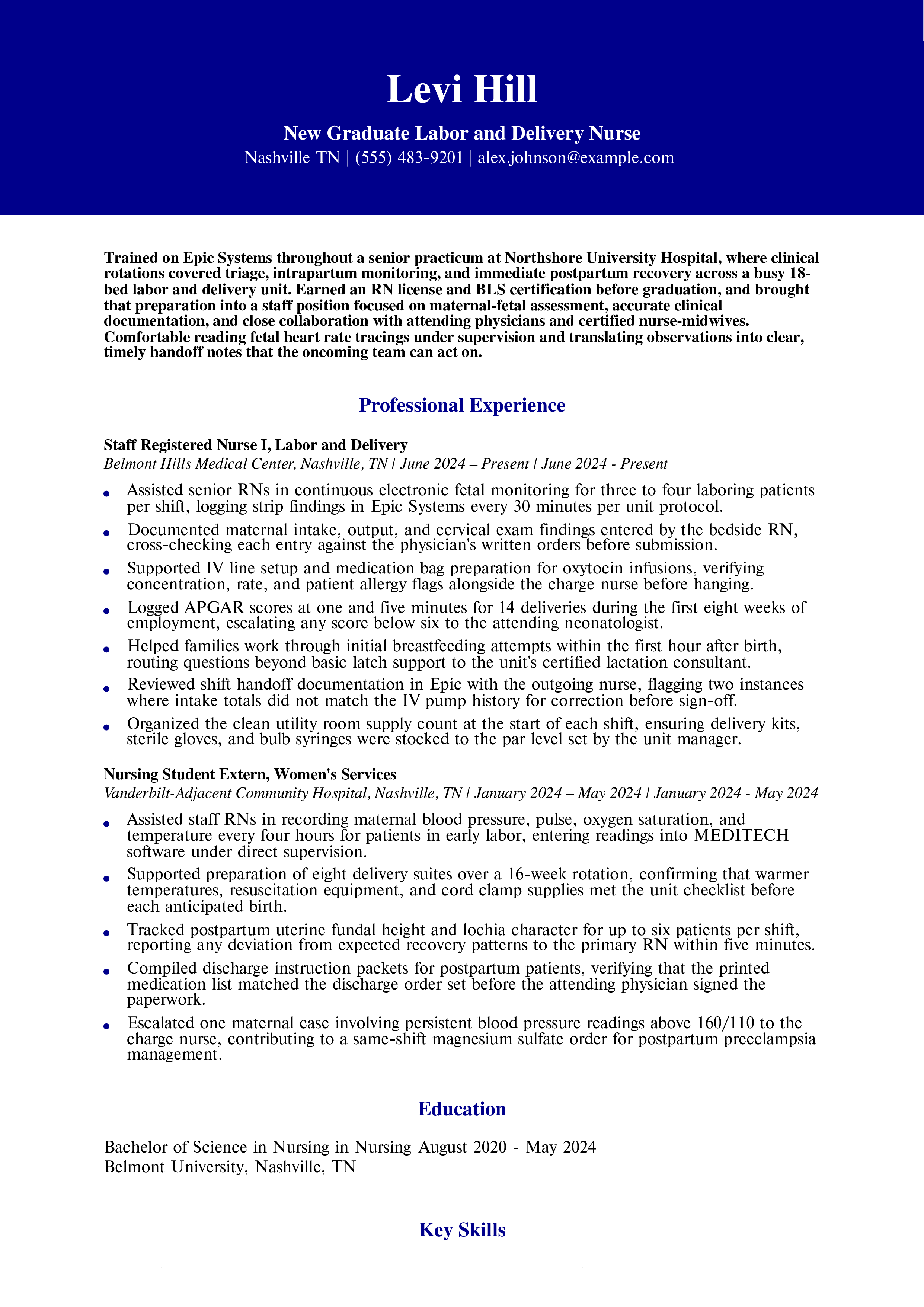
Alex Johnson
(555) 483-9201
[email protected]
Nashville, TN
Profile
Trained on Epic Systems throughout a senior practicum at Northshore University Hospital, where clinical rotations covered triage, intrapartum monitoring, and immediate postpartum recovery across a busy 18-bed labor and delivery unit. Earned an RN license and BLS certification before graduation, and brought that preparation into a staff position focused on maternal-fetal assessment, accurate clinical documentation, and close collaboration with attending physicians and certified nurse-midwives. Comfortable reading fetal heart rate tracings under supervision and translating observations into clear, timely handoff notes that the oncoming team can act on.
Professional Experience
Staff Registered Nurse I, Labor and Delivery, Belmont Hills Medical Center, Nashville, TN | June 2024 – Present
- Assisted senior RNs in continuous electronic fetal monitoring for three to four laboring patients per shift, logging strip findings in Epic Systems every 30 minutes per unit protocol.
- Documented maternal intake, output, and cervical exam findings entered by the bedside RN, cross-checking each entry against the physician’s written orders before submission.
- Supported IV line setup and medication bag preparation for oxytocin infusions, verifying concentration, rate, and patient allergy flags alongside the charge nurse before hanging.
- Logged APGAR scores at one and five minutes for 14 deliveries during the first eight weeks of employment, escalating any score below six to the attending neonatologist.
- Helped families work through initial breastfeeding attempts within the first hour after birth, routing questions beyond basic latch support to the unit’s certified lactation consultant.
- Reviewed shift handoff documentation in Epic with the outgoing nurse, flagging two instances where intake totals did not match the IV pump history for correction before sign-off.
- Organized the clean utility room supply count at the start of each shift, ensuring delivery kits, sterile gloves, and bulb syringes were stocked to the par level set by the unit manager.
Nursing Student Extern, Women’s Services, Vanderbilt-Adjacent Community Hospital, Nashville, TN | January 2024 – May 2024
- Assisted staff RNs in recording maternal blood pressure, pulse, oxygen saturation, and temperature every four hours for patients in early labor, entering readings into MEDITECH software under direct supervision.
- Supported preparation of eight delivery suites over a 16-week rotation, confirming that warmer temperatures, resuscitation equipment, and cord clamp supplies met the unit checklist before each anticipated birth.
- Tracked postpartum uterine fundal height and lochia character for up to six patients per shift, reporting any deviation from expected recovery patterns to the primary RN within five minutes.
- Compiled discharge instruction packets for postpartum patients, verifying that the printed medication list matched the discharge order set before the attending physician signed the paperwork.
- Escalated one maternal case involving persistent blood pressure readings above 160/110 to the charge nurse, contributing to a same-shift magnesium sulfate order for postpartum preeclampsia management.
Key Skills
- Fetal heart rate pattern recognition (Category I, II, III tracings)
- Clinical documentation in Epic Systems
- Maternal vital sign assessment and pattern trending
- Oxytocin and IV analgesic preparation support
- Newborn transition assessment (APGAR, thermoregulation)
- Patient and family education (postpartum, breastfeeding initiation)
- Interdisciplinary communication (SBAR format)
- Critical thinking under time-sensitive labor conditions
- Kronos Workforce Timekeeper for shift scheduling
Certifications
- Registered Nurse (RN) | Tennessee Board of Nursing | June 2024
- Basic Life Support (BLS) | American Heart Association | April 2024
Education
Bachelor of Science in Nursing in Nursing
Belmont University, Nashville, TN | August 2020 – May 2024
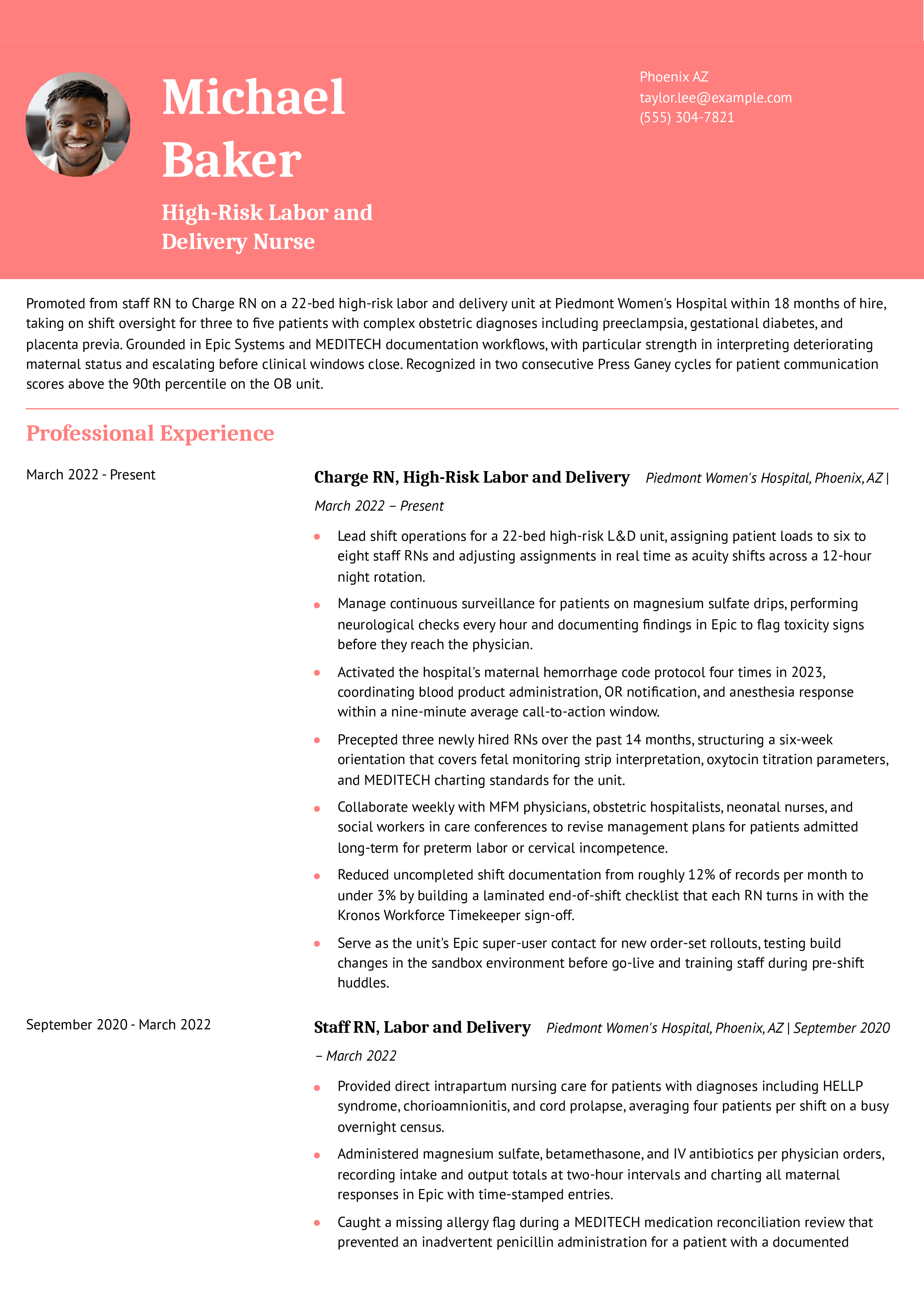
Taylor Lee
(555) 304-7821
[email protected]
Phoenix, AZ
Profile
Promoted from staff RN to Charge RN on a 22-bed high-risk labor and delivery unit at Piedmont Women’s Hospital within 18 months of hire, taking on shift oversight for three to five patients with complex obstetric diagnoses including preeclampsia, gestational diabetes, and placenta previa. Grounded in Epic Systems and MEDITECH documentation workflows, with particular strength in interpreting deteriorating maternal status and escalating before clinical windows close. Recognized in two consecutive Press Ganey cycles for patient communication scores above the 90th percentile on the OB unit.
Professional Experience
Charge RN, High-Risk Labor and Delivery, Piedmont Women’s Hospital, Phoenix, AZ | March 2022 – Present
- Lead shift operations for a 22-bed high-risk L&D unit, assigning patient loads to six to eight staff RNs and adjusting assignments in real time as acuity shifts across a 12-hour night rotation.
- Manage continuous surveillance for patients on magnesium sulfate drips, performing neurological checks every hour and documenting findings in Epic to flag toxicity signs before they reach the physician.
- Activated the hospital’s maternal hemorrhage code protocol four times in 2023, coordinating blood product administration, OR notification, and anesthesia response within a nine-minute average call-to-action window.
- Precepted three newly hired RNs over the past 14 months, structuring a six-week orientation that covers fetal monitoring strip interpretation, oxytocin titration parameters, and MEDITECH charting standards for the unit.
- Collaborate weekly with MFM physicians, obstetric hospitalists, neonatal nurses, and social workers in care conferences to revise management plans for patients admitted long-term for preterm labor or cervical incompetence.
- Reduced uncompleted shift documentation from roughly 12% of records per month to under 3% by building a laminated end-of-shift checklist that each RN turns in with the Kronos Workforce Timekeeper sign-off.
- Serve as the unit’s Epic super-user contact for new order-set rollouts, testing build changes in the sandbox environment before go-live and training staff during pre-shift huddles.
Staff RN, Labor and Delivery, Piedmont Women’s Hospital, Phoenix, AZ | September 2020 – March 2022
- Provided direct intrapartum nursing care for patients with diagnoses including HELLP syndrome, chorioamnionitis, and cord prolapse, averaging four patients per shift on a busy overnight census.
- Administered magnesium sulfate, betamethasone, and IV antibiotics per physician orders, recording intake and output totals at two-hour intervals and charting all maternal responses in Epic with time-stamped entries.
- Caught a missing allergy flag during a MEDITECH medication reconciliation review that prevented an inadvertent penicillin administration for a patient with a documented anaphylaxis history.
- Educated postpartum patients on uterine massage technique, lochia assessment parameters, and warning signs requiring immediate return to care, completing structured discharge teaching within 45 minutes of a physician’s discharge order.
- Participated in a unit-wide quality improvement effort targeting oxytocin documentation compliance, which raised the unit’s complete-charting rate from 81% to 94% over one fiscal quarter.
- Mentored two nursing students from Arizona State University during their OB clinical rotations each semester, guiding hands-on cervical exam documentation, fetal strip reads, and delivery room preparation.
Graduate Nurse Intern, Women’s Services, Banner Desert Medical Center, Mesa, AZ | January 2020 – August 2020
- Completed an eight-month graduate nurse internship on a combined antepartum and postpartum unit, rotating through triage, labor support, and recovery assignments under direct RN supervision.
- Recorded maternal vital signs, fetal heart rate baseline data, and contraction frequency at scheduled intervals, entering structured assessments into MEDITECH under the supervising RN’s co-signature.
- Prepared sterile delivery trays and confirmed instrument counts against the circulating nurse’s checklist before 34 vaginal deliveries across the internship period.
- Identified a pattern of persistent late decelerations in a 38-week patient during a four-hour monitoring stretch and immediately notified the attending OB, contributing to a decision to expedite delivery.
- Assisted with newborn APGAR assessments at one and five minutes, cross-checking scores with the receiving NICU nurse for any infant requiring further evaluation.
- Compiled and reviewed patient education materials with postpartum mothers covering infant feeding cues, safe sleep positioning, and postpartum mood changes, documenting each teaching session in the medical record.
Key Skills
- High-risk antepartum and intrapartum assessment
- Oxytocin titration and uterotonic medication management
- Charge RN shift leadership and staff assignment
- Epic Systems and MEDITECH clinical charting
- Maternal hemorrhage recognition and protocol activation
- Preeclampsia surveillance and magnesium sulfate administration
- Interdisciplinary care conference coordination
- Neonatal APGAR scoring and immediate transition support
- Patient and family advocacy in high-stakes delivery settings
Certifications
- Registered Nurse (RN) | Arizona State Board of Nursing | February 2020
- Basic Life Support (BLS) | American Heart Association | January 2024
- Advanced Cardiovascular Life Support (ACLS) | American Heart Association | March 2023
Education
Bachelor of Science in Nursing in Nursing
Arizona State University, Tempe, AZ | August 2016 – December 2019
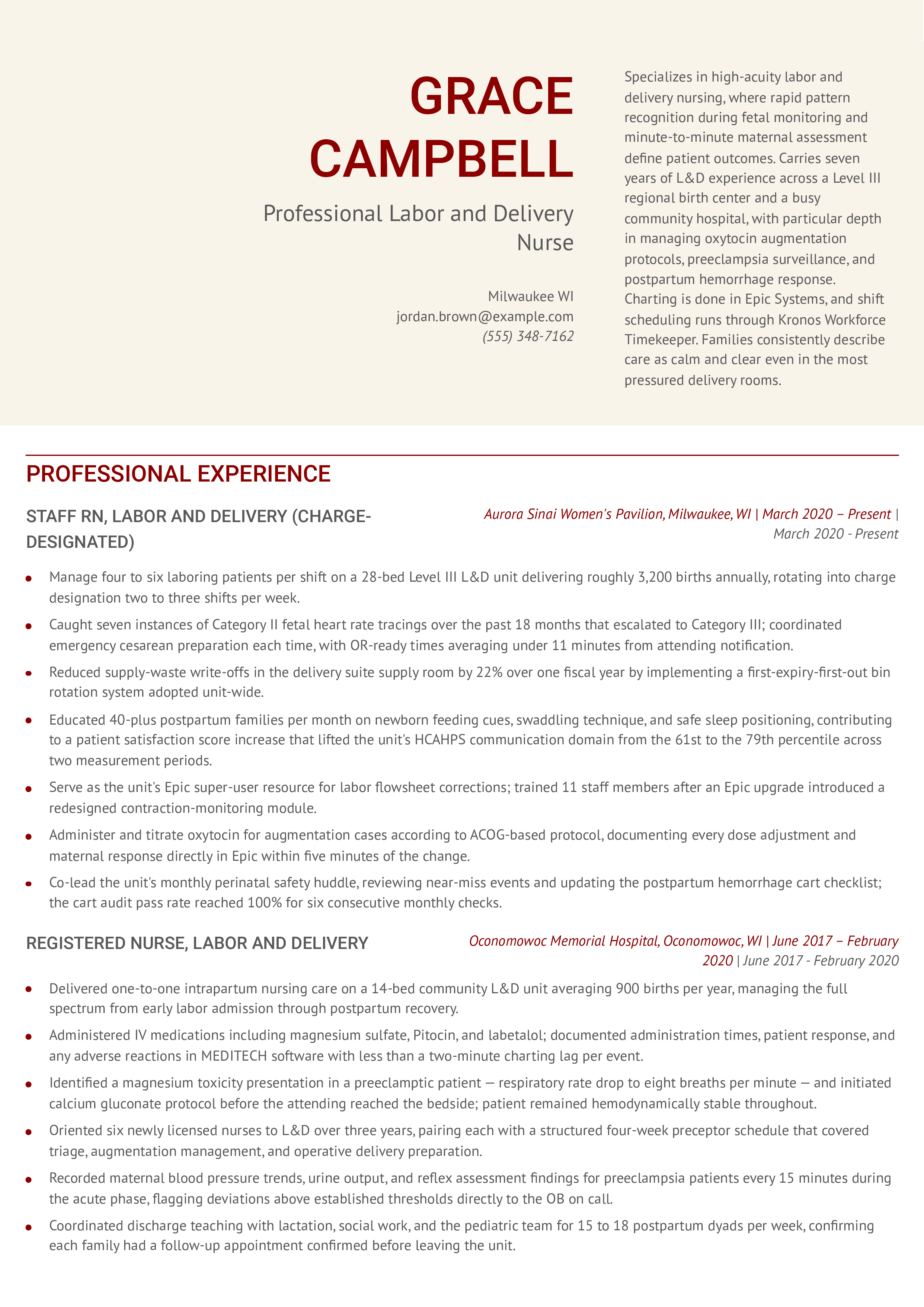
Jordan Brown
(555) 348-7162
[email protected]
Milwaukee, WI
Profile
Specializes in high-acuity labor and delivery nursing, where rapid pattern recognition during fetal monitoring and minute-to-minute maternal assessment define patient outcomes. Carries seven years of L&D experience across a Level III regional birth center and a busy community hospital, with particular depth in managing oxytocin augmentation protocols, preeclampsia surveillance, and postpartum hemorrhage response. Charting is done in Epic Systems, and shift scheduling runs through Kronos Workforce Timekeeper. Families consistently describe care as calm and clear even in the most pressured delivery rooms.
Professional Experience
Staff RN, Labor and Delivery (Charge-Designated), Aurora Sinai Women’s Pavilion, Milwaukee, WI | March 2020 – Present
- Manage four to six laboring patients per shift on a 28-bed Level III L&D unit delivering roughly 3,200 births annually, rotating into charge designation two to three shifts per week.
- Caught seven instances of Category II fetal heart rate tracings over the past 18 months that escalated to Category III; coordinated emergency cesarean preparation each time, with OR-ready times averaging under 11 minutes from attending notification.
- Reduced supply-waste write-offs in the delivery suite supply room by 22% over one fiscal year by implementing a first-expiry-first-out bin rotation system adopted unit-wide.
- Educated 40-plus postpartum families per month on newborn feeding cues, swaddling technique, and safe sleep positioning, contributing to a patient satisfaction score increase that lifted the unit’s HCAHPS communication domain from the 61st to the 79th percentile across two measurement periods.
- Serve as the unit’s Epic super-user resource for labor flowsheet corrections; trained 11 staff members after an Epic upgrade introduced a redesigned contraction-monitoring module.
- Administer and titrate oxytocin for augmentation cases according to ACOG-based protocol, documenting every dose adjustment and maternal response directly in Epic within five minutes of the change.
- Co-lead the unit’s monthly perinatal safety huddle, reviewing near-miss events and updating the postpartum hemorrhage cart checklist; the cart audit pass rate reached 100% for six consecutive monthly checks.
Registered Nurse, Labor and Delivery, Oconomowoc Memorial Hospital, Oconomowoc, WI | June 2017 – February 2020
- Delivered one-to-one intrapartum nursing care on a 14-bed community L&D unit averaging 900 births per year, managing the full spectrum from early labor admission through postpartum recovery.
- Administered IV medications including magnesium sulfate, Pitocin, and labetalol; documented administration times, patient response, and any adverse reactions in MEDITECH software with less than a two-minute charting lag per event.
- Identified a magnesium toxicity presentation in a preeclamptic patient — respiratory rate drop to eight breaths per minute — and initiated calcium gluconate protocol before the attending reached the bedside; patient remained hemodynamically stable throughout.
- Oriented six newly licensed nurses to L&D over three years, pairing each with a structured four-week preceptor schedule that covered triage, augmentation management, and operative delivery preparation.
- Recorded maternal blood pressure trends, urine output, and reflex assessment findings for preeclampsia patients every 15 minutes during the acute phase, flagging deviations above established thresholds directly to the OB on call.
- Coordinated discharge teaching with lactation, social work, and the pediatric team for 15 to 18 postpartum dyads per week, confirming each family had a follow-up appointment confirmed before leaving the unit.
Graduate Nurse Intern, Women’s and Infant Services, Froedtert Health, Milwaukee, WI | January 2017 – May 2017
- Completed a 16-week structured internship on a combined antepartum and L&D unit, rotating through triage, active labor, and postpartum recovery under direct RN preceptorship.
- Performed maternal assessments every 30 minutes during active labor, including fundal palpation, contraction frequency and duration, and fetal heart rate auscultation, entering all findings into Epic under preceptor cosignature.
- Prepared and labeled IV infusion bags for oxytocin and antibiotic prophylaxis, verifying drug name, concentration, and patient armband information against the Epic medication administration record before each preparation.
- Documented 100% of patient intake and output measurements for assigned patients each shift, using the MEDITECH fluid balance module during weekend rotations when the unit ran on backup systems.
- Participated in two multidisciplinary case reviews involving preterm labor management, presenting nursing assessment summaries to the attending, MFM fellow, and pharmacy team.
Key Skills
- Intrapartum fetal surveillance and late-deceleration response
- Magnesium sulfate titration and toxicity monitoring
- Postpartum hemorrhage protocol execution (uterotonic sequencing, quantitative blood loss)
- Epic Systems charting (labor flowsheets, delivery summaries, medication reconciliation)
- Kronos for attendance tracking and shift auditing
- Neonatal transition management and APGAR interpretation
- Charge nurse unit coordination and staff reallocation under surge conditions
- Family-centered birth education and culturally responsive communication
- High-risk antepartum triage and rapid escalation to MFM or OB attending
Certifications
- Registered Nurse (RN) | Wisconsin Department of Safety and Professional Services | January 2017
- Basic Life Support (BLS) for Healthcare Providers | American Heart Association | March 2024
- Inpatient Obstetric Nursing Certification (RNC-OB) | National Certification Corporation | September 2022
Education
Bachelor of Science in Nursing in Nursing
Marquette University College of Nursing, Milwaukee, WI | August 2013 – December 2016
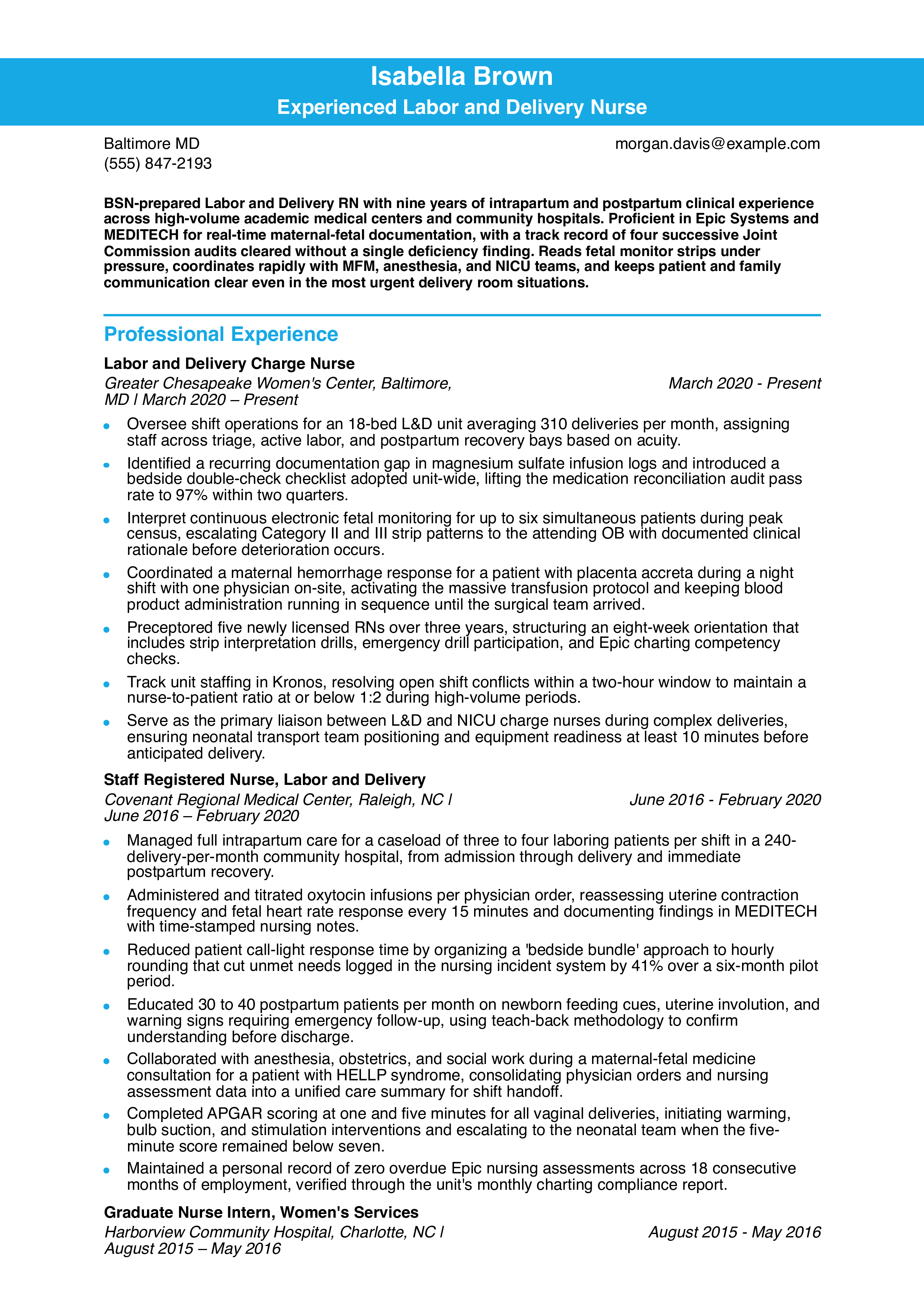
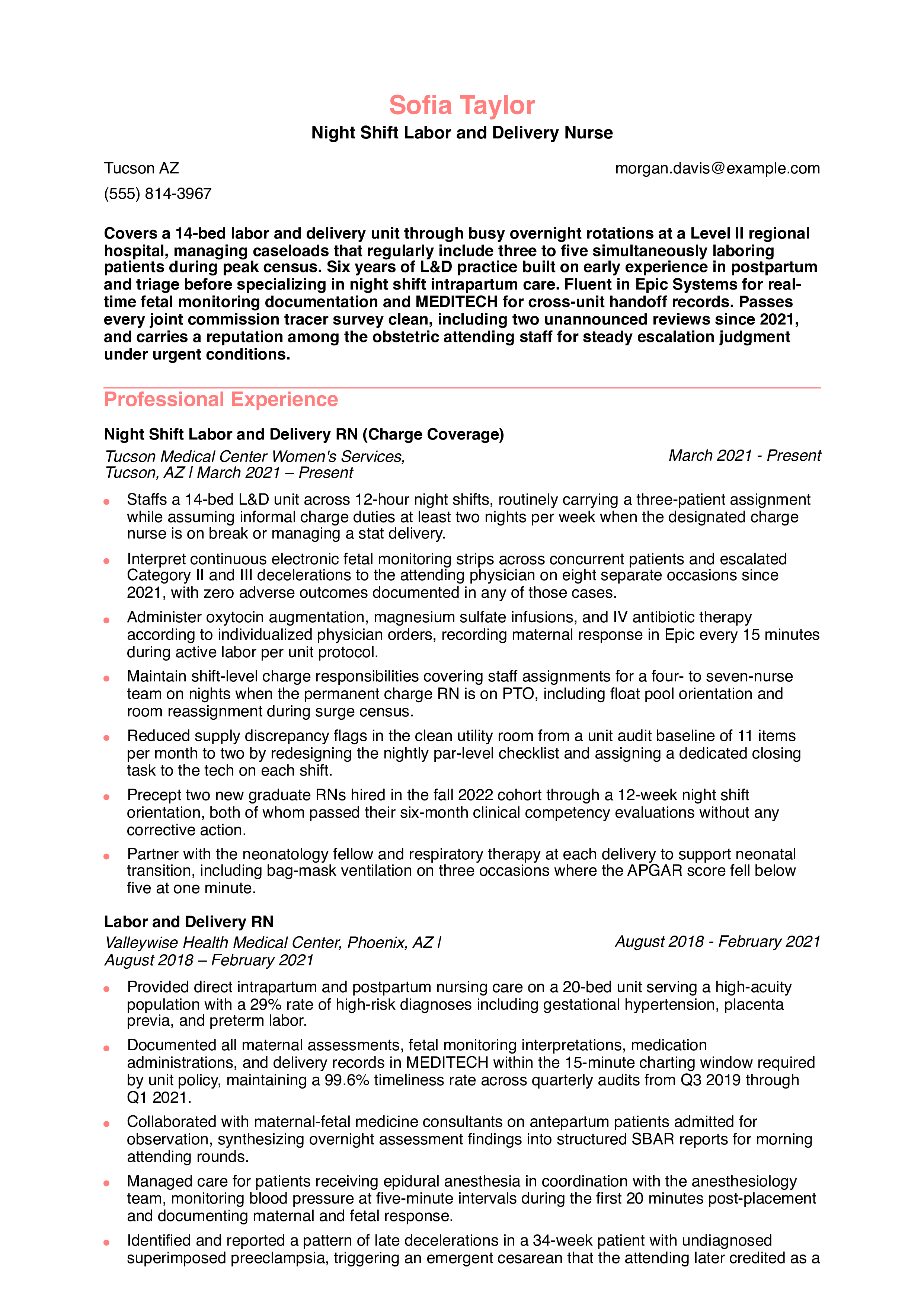
Morgan Davis
(555) 847-2193
[email protected]
Baltimore, MD
Profile
BSN-prepared Labor and Delivery RN with nine years of intrapartum and postpartum clinical experience across high-volume academic medical centers and community hospitals. Proficient in Epic Systems and MEDITECH for real-time maternal-fetal documentation, with a track record of four successive Joint Commission audits cleared without a single deficiency finding. Reads fetal monitor strips under pressure, coordinates rapidly with MFM, anesthesia, and NICU teams, and keeps patient and family communication clear even in the most urgent delivery room situations.
Professional Experience
Labor and Delivery Charge Nurse, Greater Chesapeake Women’s Center, Baltimore, MD | March 2020 – Present
- Oversee shift operations for an 18-bed L&D unit averaging 310 deliveries per month, assigning staff across triage, active labor, and postpartum recovery bays based on acuity.
- Identified a recurring documentation gap in magnesium sulfate infusion logs and introduced a bedside double-check checklist adopted unit-wide, lifting the medication reconciliation audit pass rate to 97% within two quarters.
- Interpret continuous electronic fetal monitoring for up to six simultaneous patients during peak census, escalating Category II and III strip patterns to the attending OB with documented clinical rationale before deterioration occurs.
- Coordinated a maternal hemorrhage response for a patient with placenta accreta during a night shift with one physician on-site, activating the massive transfusion protocol and keeping blood product administration running in sequence until the surgical team arrived.
- Preceptored five newly licensed RNs over three years, structuring an eight-week orientation that includes strip interpretation drills, emergency drill participation, and Epic charting competency checks.
- Track unit staffing in Kronos, resolving open shift conflicts within a two-hour window to maintain a nurse-to-patient ratio at or below 1:2 during high-volume periods.
- Serve as the primary liaison between L&D and NICU charge nurses during complex deliveries, ensuring neonatal transport team positioning and equipment readiness at least 10 minutes before anticipated delivery.
Staff Registered Nurse, Labor and Delivery, Covenant Regional Medical Center, Raleigh, NC | June 2016 – February 2020
- Managed full intrapartum care for a caseload of three to four laboring patients per shift in a 240-delivery-per-month community hospital, from admission through delivery and immediate postpartum recovery.
- Administered and titrated oxytocin infusions per physician order, reassessing uterine contraction frequency and fetal heart rate response every 15 minutes and documenting findings in MEDITECH with time-stamped nursing notes.
- Reduced patient call-light response time by organizing a ‘bedside bundle’ approach to hourly rounding that cut unmet needs logged in the nursing incident system by 41% over a six-month pilot period.
- Educated 30 to 40 postpartum patients per month on newborn feeding cues, uterine involution, and warning signs requiring emergency follow-up, using teach-back methodology to confirm understanding before discharge.
- Collaborated with anesthesia, obstetrics, and social work during a maternal-fetal medicine consultation for a patient with HELLP syndrome, consolidating physician orders and nursing assessment data into a unified care summary for shift handoff.
- Completed APGAR scoring at one and five minutes for all vaginal deliveries, initiating warming, bulb suction, and stimulation interventions and escalating to the neonatal team when the five-minute score remained below seven.
- Maintained a personal record of zero overdue Epic nursing assessments across 18 consecutive months of employment, verified through the unit’s monthly charting compliance report.
Graduate Nurse Intern, Women’s Services, Harborview Community Hospital, Charlotte, NC | August 2015 – May 2016
- Completed a nine-month structured internship rotating through antepartum, active labor, and postpartum units under the supervision of a preceptor RN before transitioning to independent assignment.
- Recorded maternal vital signs, fundal assessments, and lochia evaluations every four hours for postpartum patients and flagged two cases of abnormal blood pressure trending to the charge nurse, both of which required physician notification.
- Assisted in the preparation and labeling of IV analgesic infusions under pharmacist-verified protocols, confirming patient allergies and weight-based dosing parameters against the MEDITECH medication administration record before each bag was hung.
- Participated in a quality improvement team examining triage-to-room assignment times, contributing data entry and workflow observations that helped the team cut average triage wait times by 18 minutes over an eight-week review cycle.
- Fielded questions from laboring patients and support partners about pain management options, fetal monitoring equipment, and birth plan preferences, summarizing clinical information in plain language and escalating clinical questions to the supervising RN.
Key Skills
- Intrapartum fetal surveillance and strip interpretation
- High-risk maternal triage and escalation protocols
- Uterotonic and IV analgesic administration (oxytocin, magnesium sulfate, Pitocin)
- Epic Systems and MEDITECH clinical documentation
- Postpartum hemorrhage recognition and emergency response
- Neonatal transition support and APGAR assessment
- Patient and family education (birth plans, breastfeeding, postpartum recovery)
- Kronos Workforce Timekeeper scheduling and attendance tracking
- Charge nurse unit leadership and staff coordination
Certifications
- Registered Nurse (RN) License | Maryland Board of Nursing | June 2015
- Basic Life Support (BLS) Certification | American Heart Association | January 2024
- Advanced Cardiovascular Life Support (ACLS) | American Heart Association | March 2023
Education
Bachelor of Science in Nursing in Nursing
University of North Carolina at Chapel Hill, Chapel Hill, NC | August 2011 – May 2015
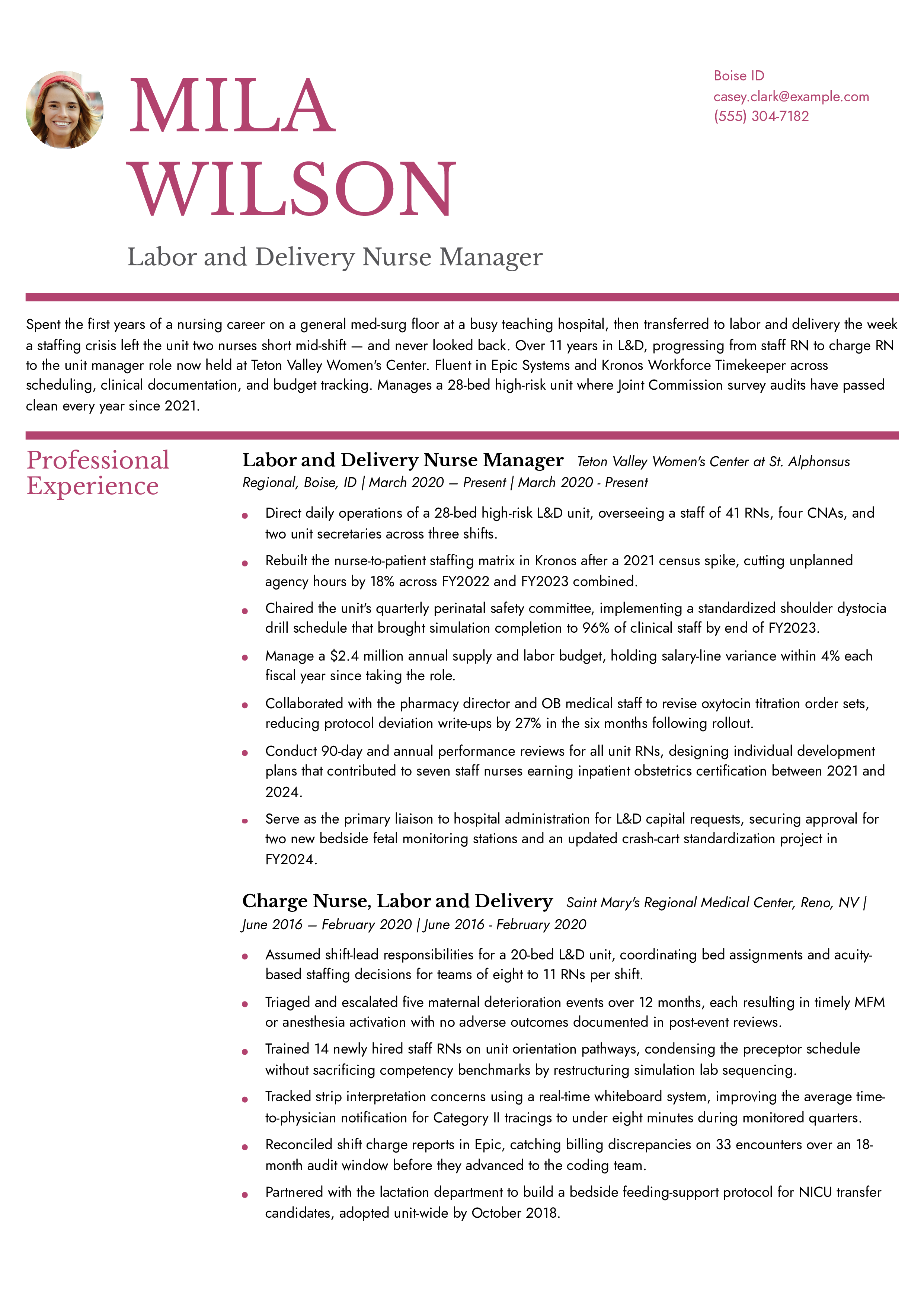
Casey Clark
(555) 304-7182
[email protected]
Boise, ID
Profile
Spent the first years of a nursing career on a general med-surg floor at a busy teaching hospital, then transferred to labor and delivery the week a staffing crisis left the unit two nurses short mid-shift — and never looked back. Over 11 years in L&D, progressing from staff RN to charge RN to the unit manager role now held at Teton Valley Women’s Center. Fluent in Epic Systems and Kronos Workforce Timekeeper across scheduling, clinical documentation, and budget tracking. Manages a 28-bed high-risk unit where Joint Commission survey audits have passed clean every year since 2021.
Professional Experience
Labor and Delivery Nurse Manager, Teton Valley Women’s Center at St. Alphonsus Regional, Boise, ID | March 2020 – Present
- Direct daily operations of a 28-bed high-risk L&D unit, overseeing a staff of 41 RNs, four CNAs, and two unit secretaries across three shifts.
- Rebuilt the nurse-to-patient staffing matrix in Kronos after a 2021 census spike, cutting unplanned agency hours by 18% across FY2022 and FY2023 combined.
- Chaired the unit’s quarterly perinatal safety committee, implementing a standardized shoulder dystocia drill schedule that brought simulation completion to 96% of clinical staff by end of FY2023.
- Manage a $2.4 million annual supply and labor budget, holding salary-line variance within 4% each fiscal year since taking the role.
- Collaborated with the pharmacy director and OB medical staff to revise oxytocin titration order sets, reducing protocol deviation write-ups by 27% in the six months following rollout.
- Conduct 90-day and annual performance reviews for all unit RNs, designing individual development plans that contributed to seven staff nurses earning inpatient obstetrics certification between 2021 and 2024.
- Serve as the primary liaison to hospital administration for L&D capital requests, securing approval for two new bedside fetal monitoring stations and an updated crash-cart standardization project in FY2024.
Charge Nurse, Labor and Delivery, Saint Mary’s Regional Medical Center, Reno, NV | June 2016 – February 2020
- Assumed shift-lead responsibilities for a 20-bed L&D unit, coordinating bed assignments and acuity-based staffing decisions for teams of eight to 11 RNs per shift.
- Triaged and escalated five maternal deterioration events over 12 months, each resulting in timely MFM or anesthesia activation with no adverse outcomes documented in post-event reviews.
- Trained 14 newly hired staff RNs on unit orientation pathways, condensing the preceptor schedule without sacrificing competency benchmarks by restructuring simulation lab sequencing.
- Tracked strip interpretation concerns using a real-time whiteboard system, improving the average time-to-physician notification for Category II tracings to under eight minutes during monitored quarters.
- Reconciled shift charge reports in Epic, catching billing discrepancies on 33 encounters over an 18-month audit window before they advanced to the coding team.
- Partnered with the lactation department to build a bedside feeding-support protocol for NICU transfer candidates, adopted unit-wide by October 2018.
Staff Registered Nurse, Labor and Delivery, Renown Health Women’s Services, Reno, NV | August 2013 – May 2016
- Provided intrapartum and immediate postpartum care for an average patient load of three to four laboring patients per shift, including high-risk cases involving preeclampsia, placenta previa, and preterm labor.
- Administered IV medications including magnesium sulfate infusions, documenting hourly assessments and respiratory status observations in MEDITECH throughout the therapeutic window.
- Recorded maternal vital signs, fundal assessments, and lochia documentation across a postpartum caseload, maintaining chart accuracy rates that met or exceeded the unit’s 98% internal audit threshold every quarter reviewed.
- Supported neonatal resuscitation efforts at 11 deliveries requiring initial stabilization, coordinating equipment readiness and APGAR documentation in real time alongside the NICU team.
- Completed patient discharge teaching for postpartum families, covering wound care, newborn feeding, jaundice monitoring, and follow-up scheduling within a target 45-minute education window.
- Volunteered for the unit’s shared-governance task force in 2015, contributing to a revised fall-risk screening workflow adopted across the women’s services floor.
Medical-Surgical Registered Nurse, Northern Nevada Medical Center, Sparks, NV | September 2011 – July 2013
- Managed a six-patient mixed-acuity med-surg caseload, administering scheduled and PRN medications and documenting responses in MEDITECH within required time frames.
- Monitored patients for post-surgical complications including wound infection, DVT signs, and respiratory decline, escalating two rapid-response activations during the two-year tenure.
- Coordinated discharge planning with case management, social work, and physical therapy, reducing same-day discharge delays attributed to nursing documentation on the assigned pod by 15% over a six-month improvement cycle.
- Oriented three new graduate nurses during their first 90 days, guiding clinical documentation habits and time-management strategies on a high-census night shift.
- Maintained accurate intake and output records across shift, contributing to fluid-balance trend data used by attending physicians during morning rounds.
Key Skills
- Intrapartum and antepartum high-risk patient surveillance
- Unit staffing and census management (Kronos)
- Epic Systems clinical documentation and charge reconciliation
- Oxytocin and magnesium sulfate protocol oversight
- Postpartum hemorrhage recognition and rapid response activation
- Staff performance evaluation and competency validation
- Patient and family education (birth planning, infant feeding, discharge prep)
- Interdisciplinary rounding and OB/MFM care coordination
- Budget variance analysis (Microsoft Excel)
Certifications
- Registered Nurse (RN) License | Idaho State Board of Nursing | September 2011
- Basic Life Support (BLS) for Healthcare Providers | American Heart Association | January 2024
- Inpatient Obstetric Nursing Certification (RNC-OB) | National Certification Corporation | April 2018
Education
Bachelor of Science in Nursing in Nursing
University of Nevada, Reno, Reno, NV | August 2007 – May 2011
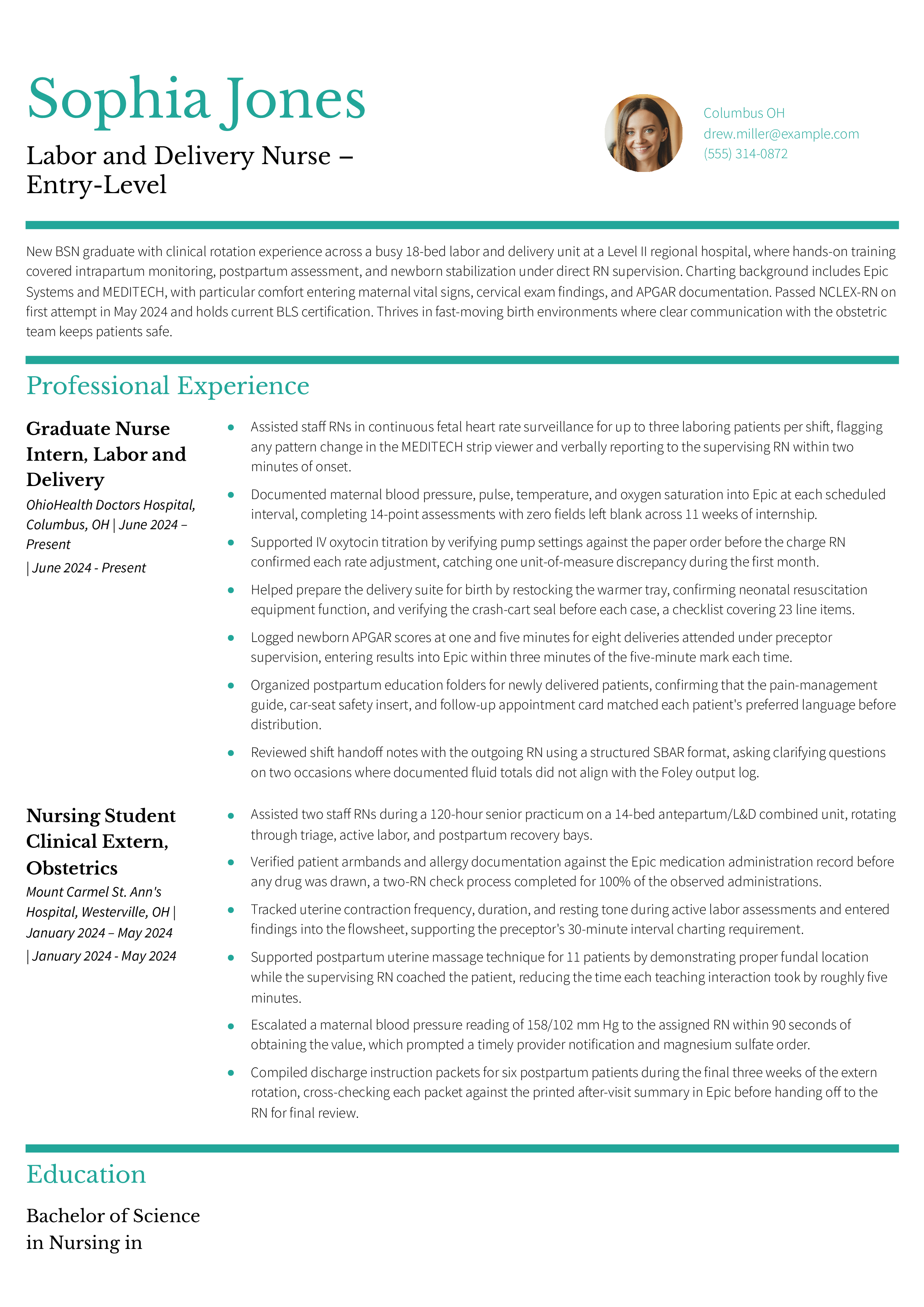
Drew Miller
(555) 314-0872
[email protected]
Columbus, OH
Profile
New BSN graduate with clinical rotation experience across a busy 18-bed labor and delivery unit at a Level II regional hospital, where hands-on training covered intrapartum monitoring, postpartum assessment, and newborn stabilization under direct RN supervision. Charting background includes Epic Systems and MEDITECH, with particular comfort entering maternal vital signs, cervical exam findings, and APGAR documentation. Passed NCLEX-RN on first attempt in May 2024 and holds current BLS certification. Thrives in fast-moving birth environments where clear communication with the obstetric team keeps patients safe.
Professional Experience
Graduate Nurse Intern, Labor and Delivery, OhioHealth Doctors Hospital, Columbus, OH | June 2024 – Present
- Assisted staff RNs in continuous fetal heart rate surveillance for up to three laboring patients per shift, flagging any pattern change in the MEDITECH strip viewer and verbally reporting to the supervising RN within two minutes of onset.
- Documented maternal blood pressure, pulse, temperature, and oxygen saturation into Epic at each scheduled interval, completing 14-point assessments with zero fields left blank across 11 weeks of internship.
- Supported IV oxytocin titration by verifying pump settings against the paper order before the charge RN confirmed each rate adjustment, catching one unit-of-measure discrepancy during the first month.
- Helped prepare the delivery suite for birth by restocking the warmer tray, confirming neonatal resuscitation equipment function, and verifying the crash-cart seal before each case, a checklist covering 23 line items.
- Logged newborn APGAR scores at one and five minutes for eight deliveries attended under preceptor supervision, entering results into Epic within three minutes of the five-minute mark each time.
- Organized postpartum education folders for newly delivered patients, confirming that the pain-management guide, car-seat safety insert, and follow-up appointment card matched each patient’s preferred language before distribution.
- Reviewed shift handoff notes with the outgoing RN using a structured SBAR format, asking clarifying questions on two occasions where documented fluid totals did not align with the Foley output log.
Nursing Student Clinical Extern, Obstetrics, Mount Carmel St. Ann’s Hospital, Westerville, OH | January 2024 – May 2024
- Assisted two staff RNs during a 120-hour senior practicum on a 14-bed antepartum/L&D combined unit, rotating through triage, active labor, and postpartum recovery bays.
- Verified patient armbands and allergy documentation against the Epic medication administration record before any drug was drawn, a two-RN check process completed for 100% of the observed administrations.
- Tracked uterine contraction frequency, duration, and resting tone during active labor assessments and entered findings into the flowsheet, supporting the preceptor’s 30-minute interval charting requirement.
- Supported postpartum uterine massage technique for 11 patients by demonstrating proper fundal location while the supervising RN coached the patient, reducing the time each teaching interaction took by roughly five minutes.
- Escalated a maternal blood pressure reading of 158/102 mm Hg to the assigned RN within 90 seconds of obtaining the value, which prompted a timely provider notification and magnesium sulfate order.
- Compiled discharge instruction packets for six postpartum patients during the final three weeks of the extern rotation, cross-checking each packet against the printed after-visit summary in Epic before handing off to the RN for final review.
Key Skills
- Intrapartum fetal monitoring and strip documentation
- Postpartum maternal assessment (fundal tone, lochia, vital signs)
- Epic Systems and MEDITECH clinical charting
- Newborn stabilization support and APGAR scoring
- Oxytocin and epidural preparation assistance
- Patient and family education (birth plan review, breastfeeding basics)
- Social perceptiveness and therapeutic communication
- Kronos Workforce Timekeeper (attendance logging)
- SBAR handoff reporting
Certifications
- Registered Nurse (RN) | Ohio Board of Nursing | May 2024
- Basic Life Support (BLS) for Healthcare Providers | American Heart Association | June 2024
Education
Bachelor of Science in Nursing in Nursing
Capital University, Columbus, OH | August 2020 – May 2024
Chris Taylor
(555) 407-2918
[email protected]
Charlotte, NC
Profile
Labor and delivery RN with eight years of experience across high-volume academic medical centers and community hospitals in the Southeast. Fluent in Epic Systems for real-time intrapartum documentation and MEDITECH for antepartum triage records, with a strong foundation in fetal surveillance, oxytocin management, and postpartum recovery. Recognized by two unit nurse managers for maintaining zero medication variances across all internal quality audits from 2021 through 2024. Brings a communication style that keeps patients, families, and the care team aligned from admission through discharge.
Professional Experience
Staff RN, Labor and Delivery (Charge Rotation), Novant Health Presbyterian Medical Center, Charlotte, NC | March 2020 – Present
- Manage a caseload of three to five laboring patients per shift on a 28-bed unit averaging 310 deliveries per month, including high-risk antepartum cases transferred from referring facilities.
- Serve in charge rotation one to two shifts per week, coordinating bed assignments, managing call-ins, and directing five to eight floor RNs and patient care technicians during peak census.
- Interpret continuous fetal monitoring tracings and apply National Institute of Child Health and Human Development (NICHD) Category I, II, and III criteria, escalating Category III patterns to the attending OB within minutes of identification.
- Document all nursing assessments, oxytocin infusion titration logs, and labor progression notes in Epic Systems, maintaining a 99.2% chart-completion rate measured at each biannual compliance review.
- Trained 11 newly hired L&D RNs over the past four years on unit orientation protocols, MEDITECH downtime procedures, and emergency delivery tray setup, with each orientee completing competency validation within the standard 12-week window.
- Coordinate postpartum care conferences with lactation consultants, social workers, and neonatology staff when infants require NICU admission, reducing average handoff communication time to under 20 minutes per case.
- Caught a labeling discrepancy in a blood-bank specimen draw that prevented a potential wrong-blood-type transfusion event, flagged through the hospital’s safety event reporting system and cited in a unit-wide safety brief.
Staff RN, Labor and Delivery, Atrium Health Cabarrus, Concord, NC | June 2017 – February 2020
- Provided intrapartum and immediate postpartum nursing care on a 16-bed unit delivering approximately 180 births per month, with a patient mix spanning uncomplicated vaginal deliveries, scheduled cesarean sections, and unplanned urgent cesareans.
- Administered and monitored IV magnesium sulfate infusions for patients with severe-range blood pressures, completing neurological checks at 30-minute intervals and documenting findings in MEDITECH with no missed assessment entries across a 14-month audit period.
- Performed newborn assessments at delivery, recording APGAR scores, axillary temperatures, and cord blood gas results, and communicated findings to the pediatric team before nursery transfer.
- Collaborated with the MFM attending and bedside OB during three in-unit shoulder dystocia events, executing McRoberts and suprapubic-pressure maneuvers as directed and debriefing with the team post-delivery.
- Educated patients and support persons on epidural positioning, labor progression expectations, and early breastfeeding techniques, achieving a unit patient-satisfaction subscore of 88 out of 100 on nursing communication items during the 2019 HCAHPS reporting cycle.
- Used Kronos to self-audit payroll entries each pay period, identifying a recurring shift-differential coding error that, once corrected by payroll, recovered approximately $3,800 in unpaid differentials for seven affected staff members.
Graduate Nurse Intern, Women’s Services, UNC Rex Healthcare, Raleigh, NC | August 2016 – May 2017
- Completed a nine-month transition-to-practice internship rotating through labor and delivery, mother-baby, and antepartum units under the direct supervision of a precepting RN and a nurse educator.
- Recorded maternal vital signs, fluid balance totals, and cervical exam findings every two hours for assigned laboring patients, entering data into Epic with preceptor co-signature through the first 16 weeks of the program.
- Prepared and verified IV medication bags for oxytocin augmentation, cross-checking concentration, rate, and patient allergy profile against the provider order before each initiation.
- Observed and assisted in 43 vaginal deliveries and four emergent cesarean sections during the internship period, building foundational skills in sterile scrub technique and instrument count verification.
- Participated in weekly unit-based simulation drills covering postpartum hemorrhage, eclamptic seizure, and cord prolapse scenarios, earning a passing score on all six competency evaluations administered by the simulation center.
Key Skills
- Intrapartum fetal monitoring strip analysis and escalation
- Oxytocin titration and epidural care coordination
- MEDITECH and Epic Systems dual-platform documentation
- Postpartum hemorrhage recognition and rapid-response activation
- Maternal triage assessment and acuity prioritization
- Newborn transition assessment (APGAR, thermoregulation, cord care)
- Patient and family birth education (skin-to-skin, breastfeeding initiation)
- Kronos Workforce Timekeeper for payroll verification and PTO tracking
- Charge-level unit oversight and float staff orientation
Certifications
- Registered Nurse (RN) License, North Carolina | North Carolina Board of Nursing | July 2016
- Basic Life Support (BLS) for Healthcare Providers | American Heart Association | January 2024
- Advanced Cardiovascular Life Support (ACLS) | American Heart Association | February 2024
Education
Bachelor of Science in Nursing in Nursing
University of North Carolina at Chapel Hill, Chapel Hill, NC | August 2012 – May 2016
Pat Morgan
(555) 384-7201
[email protected]
Sacramento, CA
Profile
Raised the unit’s skin-to-skin initiation rate to 89% across the postpartum population at Lakewood Regional Women’s Center by championing a bedside education protocol introduced in the first year of practice. Now a BSN-prepared RN with four years of focused labor and delivery experience, including high-risk antepartum triage, intrapartum support, and newborn stabilization. Charting is documented in Epic Systems with structured shift notes that consistently passed the 2023 and 2024 Joint Commission survey reviews without a corrective finding. Families consistently describe care coordination — from admission through discharge teaching — as a defining part of their birth experience.
Professional Experience
Staff Registered Nurse, Labor and Delivery, Lakewood Regional Women’s Center, Sacramento, CA | March 2022 – Present
- Manage intrapartum and antepartum caseloads of up to four patients per shift on a 28-bed unit, including gestational hypertension, preterm labor, and placenta previa cases requiring continuous monitoring.
- Interpreted Category II and Category III fetal heart rate strips and escalated three cases in 2023 requiring emergent cesarean delivery, coordinating directly with the OB attending and OR charge within a two-minute notification window.
- Introduced a standardized prenatal education checklist at admission that brought documented birth plan review completion to 93% of all vaginal delivery patients across FY2023.
- Administered oxytocin augmentation, terbutaline, and magnesium sulfate per physician orders, documenting titration changes and patient response in Epic at intervals defined by unit protocol.
- Mentored two graduate nurse residents during their 12-week L&D orientation in 2024, leading weekly case debriefs and co-signing documentation until competency sign-off was achieved.
- Monitored postpartum patients for hemorrhage, tracking fundal height, lochia volume, and pad counts against unit thresholds, and initiated the hemorrhage bundle protocol on two patients within the past 18 months.
- Recorded all maternal vital signs, contraction patterns, and cervical exam findings in Epic within the 15-minute charting window required by hospital policy, maintaining a 91% on-shift compliance score through the last internal audit cycle.
Registered Nurse, Mother-Baby / Postpartum, Sierra View District Hospital, Porterville, CA | August 2020 – February 2022
- Cared for six postpartum couplets per shift on a 20-bed mother-baby unit, assessing neonatal transition, breastfeeding latch, and maternal recovery during the first 48 to 72 hours after delivery.
- Conducted newborn physical assessments, recorded APGAR findings transferred from delivery, and flagged two neonates with jaundice requiring phototherapy initiation before the attending’s morning rounds.
- Documented patient care, feeding logs, and discharge instructions in MEDITECH, completing discharge summaries for an average of five couplets per shift with no incomplete records flagged at the six-month peer review.
- Taught postpartum recovery, infant safe sleep, and formula preparation to 30-plus families per month, adapting instruction for patients with limited English proficiency through the hospital’s phone interpreter service.
- Collaborated with the lactation consultant, social worker, and pediatric team during interdisciplinary rounds to coordinate care plans for high-needs couplets, including infants born to mothers with opioid use disorder.
- Tracked newborn weight loss percentages against the 10% threshold, alerting the pediatrician in six cases where supplementation or further evaluation was warranted before discharge.
Student Nurse Extern, Labor and Delivery, UC Davis Medical Center, Sacramento, CA | May 2019 – July 2020
- Completed 480 clinical extern hours on the L&D unit under the direct supervision of staff RNs, rotating through triage, active labor, cesarean section support, and immediate postpartum recovery.
- Recorded maternal vital signs, contraction frequency, and fluid intake and output for laboring patients, entering data into Epic under supervising RN co-signature within required documentation intervals.
- Prepared IV lines and medication infusion bags for oxytocin and antibiotic drips, verifying drug label, concentration, and pump programming against the medication administration record before each setup.
- Supported three in-room cesarean section preps, assisting with sterile field setup and patient positioning while communicating calmly with anxious patients throughout the procedure.
- Participated in handoff reports at shift change, applying SBAR format taught in the nursing program to relay patient status updates to the oncoming RN clearly and without omission.
- Observed and assisted with seven vaginal deliveries, recording neonatal birth weight, sex, delivery time, and resuscitation status in the delivery log per unit protocol.
Key Skills
- Intrapartum fetal monitoring (Category II/III pattern recognition and escalation)
- High-risk antepartum triage and MFM coordination
- Epic Systems clinical charting and shift reconciliation
- Oxytocin titration and uterine activity assessment
- Postpartum hemorrhage recognition and uterine massage technique
- Newborn APGAR scoring and neonatal transition support
- Patient and family education (birth plan review, infant feeding, postpartum recovery)
- Social perceptiveness and de-escalation with high-anxiety laboring patients
- MEDITECH documentation and Kronos Workforce Timekeeper shift entry
Certifications
- Registered Nurse (RN), California License No. 95XXXXXX | California Board of Registered Nursing | June 2019
- Basic Life Support (BLS) for Healthcare Providers | American Heart Association | January 2024
- Electronic Fetal Monitoring (EFM) Certification | AWHONN (Association of Women’s Health, Obstetric and Neonatal Nurses) | September 2022
Education
Bachelor of Science in Nursing in Nursing
California State University, Sacramento, Sacramento, CA | August 2015 – May 2019
Sam Jordan
(555) 418-2903
[email protected]
Kansas City, MO
Profile
Switched the unit’s primary charting platform from MEDITECH to Epic Systems during a 14-month hospital-wide rollout at Brookside Women’s Medical Center, training 11 bedside nurses on documentation workflows while carrying a full patient load throughout the transition. Now five years into L&D nursing, with core clinical focus on intrapartum surveillance, oxytocin management, and postpartum hemorrhage response. Families consistently cite clear, calm communication during high-stress deliveries in post-discharge surveys, where the unit held an 88% top-box satisfaction score for the past two years.
Professional Experience
Staff RN, Labor and Delivery, Brookside Women’s Medical Center, Kansas City, MO | March 2022 – Present
- Manage a caseload of three to five laboring patients per shift on a 28-bed Level III L&D unit, coordinating care with anesthesia, MFM, and NICU teams for high-acuity cases including preeclampsia with severe features and preterm labor at 24 to 34 weeks.
- Served as the unit’s Epic super-user liaison during the 14-month MEDITECH-to-Epic migration, fielding an average of 30 peer questions per week during go-live and logging workflow corrections that reduced charge-submission errors by 14 percentage points over the first billing cycle.
- Administered and titrated oxytocin per protocol on approximately 60% of assigned inductions, documenting every rate change and maternal-fetal response in Epic within two minutes of administration — an internal compliance target the unit reached for the first time in FY2023.
- Identified two cases of Category III fetal heart rate patterns in a single quarter, notifying the attending within two minutes of recognition each time and supporting emergent cesarean prep that resulted in Apgar scores of eight or higher for both neonates at five minutes.
- Led postpartum hemorrhage response drills for the night-shift team four times in 2023, reinforcing quantitative blood loss measurement using calibrated under-buttock drapes, which the unit adopted as standard practice in January 2024.
- Educated patients and support persons on labor progression, epidural expectations, and newborn skin-to-skin initiation, contributing to an 88% top-box score on the discharge satisfaction survey across all of 2023 and 2024.
- Precepted two new-graduate RNs through a 12-week orientation, building individualized competency checklists and co-signing their Epic documentation until each met independent charting criteria.
Staff RN, Labor and Delivery, Sunflower Regional Medical Center, Topeka, KS | August 2020 – February 2022
- Delivered intrapartum and immediate postpartum care on a 16-bed community L&D unit averaging 130 births per month, covering vaginal deliveries, scheduled and emergent cesareans, and TOLAC cases.
- Monitored continuous electronic fetal monitoring strips throughout labor and documented strip classifications every 30 minutes in MEDITECH, maintaining chart completeness that contributed to a clean Joint Commission survey in October 2021 with zero documentation deficiencies cited.
- Prepared and verified oxytocin and magnesium sulfate infusions against the five-rights protocol before administration, supporting a unit-wide medication accuracy rate that cleared pharmacy audit targets for six billing periods spanning FY2021 through mid-FY2022.
- Coordinated newborn care at delivery in the absence of a NICU nurse, performing bulb suction, drying, stimulation, and APGAR scoring at one and five minutes for term infants, then completing newborn assessments and documenting findings before handoff.
- Communicated shift-to-shift patient summaries using the SBAR format during bedside handoff, reducing report time to under eight minutes per patient while keeping the oncoming nurse current on cervical exam progression and IV access status.
- Assisted charge nurses in tracking bed assignments and patient acuity across the unit during high-census periods, flagging staffing gaps to the house supervisor before shift gaps materialized on three occasions.
Graduate Nurse Intern, Women’s Services, Prairie Lakes Health System, Watertown, SD | May 2019 – July 2020
- Completed a structured 52-week graduate nurse internship rotating through labor and delivery, postpartum, and the well-newborn nursery, gaining supervised clinical hours under a preceptor before earning independent RN licensure in August 2019.
- Recorded maternal vital signs, fundal checks, and lochia assessments every 15 minutes during active labor and documented findings in MEDITECH under preceptor co-signature, building charting habits that passed the unit’s 90-day competency review without remediation.
- Supported insertion-site monitoring and fluid rate adjustments for IV oxytocin and IV antibiotics for Group B Strep prophylaxis, noting patient responses and reporting any tachycardia or uterine hyperstimulation to the supervising RN within two minutes.
- Orientated families to the postpartum room environment, pain management options, and infant feeding cues within two hours of admission from the recovery room, receiving verbal commendations from charge nurses on seven documented occasions.
- Participated in a unit quality initiative that reviewed 45 charts for completeness of 30-minute fetal monitoring documentation, identifying a gap in night-shift strip-classification entries that was later corrected through a protocol reminder posted at each monitoring station.
Key Skills
- Intrapartum oxytocin titration and uterine tachysystole recognition
- Postpartum hemorrhage identification and quantitative blood loss measurement
- Epic Systems clinical documentation (intrapartum, postpartum, and newborn modules)
- Neonatal APGAR scoring and immediate newborn stabilization
- Maternal vital sign trending and early warning escalation
- Vacuum and forceps-assisted delivery preparation and instrument setup
- Patient and family education (birth plans, breastfeeding initiation, discharge criteria)
- MEDITECH and Kronos Workforce Timekeeper scheduling and time reconciliation
- Interdisciplinary collaboration (MFM, anesthesia, NICU, lactation, social work)
Certifications
- Registered Nurse (RN) | Missouri State Board of Nursing | August 2019
- Basic Life Support (BLS) | American Heart Association | January 2024
- Advanced Cardiovascular Life Support (ACLS) | American Heart Association | February 2024
Education
Bachelor of Science in Nursing in Nursing
South Dakota State University, Brookings, SD | August 2015 – May 2019
Jamie Smith
(555) 384-7021
[email protected]
Houston, TX
Profile
Promoted from staff RN to charge nurse within three years at Loyola University Medical Center, building a record across four years of high-volume labor and delivery that includes managing a 20-bed unit through simultaneous multi-patient emergencies. Fluent in Epic Systems and MEDITECH for real-time maternal-fetal documentation, care-plan entry, and shift reconciliation. Colleagues and attending physicians rely on this candidate’s read of fetal strip patterns and escalation instincts to keep high-risk cases contained before situations compound.
Professional Experience
Charge Nurse, Labor and Delivery, Loyola University Medical Center, Maywood, IL | March 2022 – Present
- Lead shift operations for a 20-bed L&D unit averaging 280 deliveries per month, assigning six to eight bedside RNs and two patient care techs across 12-hour shifts.
- Triaged and coordinated care for 14 confirmed preeclampsia-with-severe-features admissions in FY2023, ensuring magnesium sulfate loading doses were initiated within 30 minutes of admission order in every case.
- Raised the unit’s Joint Commission tracer audit pass rate to 95% by overhauling the bedside documentation checklist used during Epic shift handoff, a change adopted unit-wide by April 2023.
- Identified a recurring oxytocin bag preparation discrepancy affecting three labor rooms and worked with pharmacy to redesign the order-set default; the fix reduced pharmacist callbacks by 40 per quarter.
- Supervised orientation schedules for six new-graduate RNs hired between January 2023 and September 2024, pairing each with a senior preceptor and tracking 90-day competency benchmarks in MEDITECH.
- Collaborated with the MFM attending and NICU charge RN during every Category III fetal heart rate event on the unit, serving as the primary communication bridge between bedside nurse and delivering physician.
- Maintained the unit’s oxytocin and controlled-substance counts, achieving zero discrepancy findings across every pharmacy audit from Q1 2023 through Q4 2024.
Registered Nurse, Labor and Delivery, Loyola University Medical Center, Maywood, IL | August 2020 – March 2022
- Managed a caseload of two to three actively laboring patients per shift, documenting cervical exams, maternal vitals, and fetal heart rate strip findings in Epic Systems at minimum every 30 minutes.
- Administered epidural analgesic and oxytocin augmentation drips under physician protocol, monitoring each patient for hypotension, tachysystole, and allergic response throughout infusion.
- Educated 200-plus postpartum families on breastfeeding latch technique, uterine massage, and warning signs warranting re-evaluation before a patient’s scheduled 24-hour discharge.
- Recorded and reported a sudden onset of late decelerations with loss of variability during a 38-week induction, enabling the attending to call an emergent cesarean; the neonate was delivered with APGAR scores of seven and nine.
- Helped the charge RN conduct daily supply audits of the clean utility room and delivery carts, keeping par-level compliance above the unit’s 90% internal benchmark throughout 2021.
- Participated in the unit’s peer-review committee that evaluated three sentinel event near-misses across 2021, contributing documentation summaries and recommended protocol edits adopted by the unit director.
Graduate Nurse Intern, Women’s Services, Northwestern Medicine Delnor Hospital, Geneva, IL | June 2019 – August 2020
- Completed a 14-week L&D nurse residency program covering electronic fetal monitoring interpretation, shoulder dystocia drills, and postpartum hemorrhage simulation before transitioning to independent patient assignment.
- Charted maternal intake, output, and cervical progression under direct preceptor supervision in MEDITECH, building documentation accuracy verified against the charge nurse’s shift reconciliation reports.
- Supported two to four vaginal deliveries per shift as second nurse, managing newborn warmers and calling APGAR scores to the delivering provider at one and five minutes post-birth.
- Attended six interdisciplinary obstetric emergency drills alongside attending physicians, anesthesia providers, and scrub techs, scoring above the unit average on post-drill competency assessments.
- Assisted patients and partners with birth-plan review during admission intake, fielding questions on pain management options, delayed cord clamping, and immediate skin-to-skin contact protocols.
Key Skills
- Intrapartum fetal strip interpretation and Category II/III escalation
- High-risk obstetric triage (preeclampsia, HELLP, placental abruption)
- Epic Systems and MEDITECH documentation
- Oxytocin and magnesium sulfate titration per protocol
- Newborn stabilization and APGAR-guided resuscitation response
- Charge RN shift leadership and staff load balancing
- Patient and family education (birth plans, breastfeeding initiation, postpartum recovery)
- Interdisciplinary care coordination with MFM, anesthesia, and NICU teams
- Social perceptiveness and culturally responsive bedside communication
Certifications
- Registered Nurse (RN) | Illinois Department of Financial and Professional Regulation | July 2019
- Basic Life Support (BLS) | American Heart Association | January 2024
- Advanced Cardiovascular Life Support (ACLS) | American Heart Association | February 2024
Education
Bachelor of Science in Nursing in Nursing
Marquette University College of Nursing, Milwaukee, WI | August 2015 – May 2019
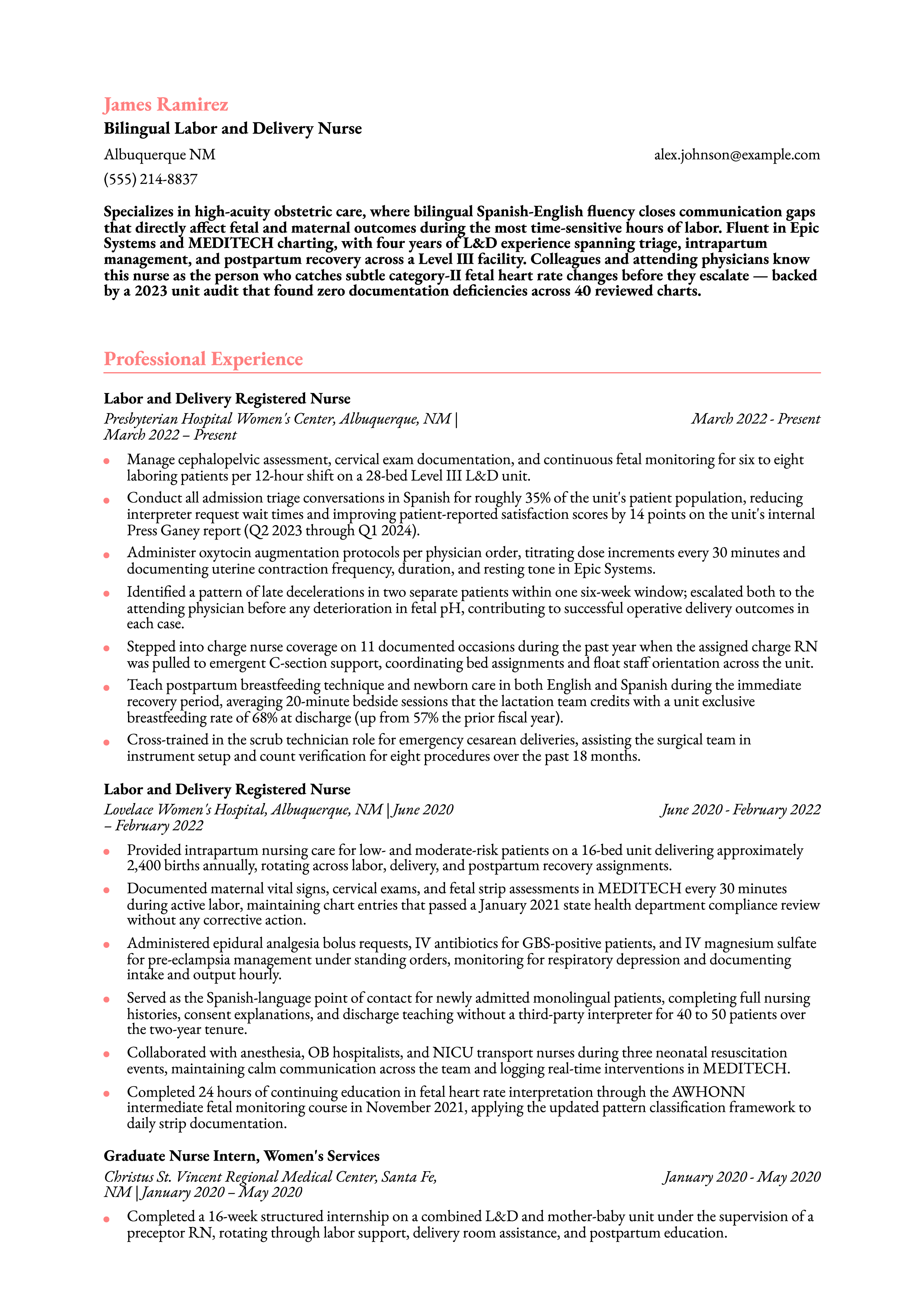
Alex Johnson
(555) 214-8837
[email protected]
Albuquerque, NM
Profile
Specializes in high-acuity obstetric care, where bilingual Spanish-English fluency closes communication gaps that directly affect fetal and maternal outcomes during the most time-sensitive hours of labor. Fluent in Epic Systems and MEDITECH charting, with four years of L&D experience spanning triage, intrapartum management, and postpartum recovery across a Level III facility. Colleagues and attending physicians know this nurse as the person who catches subtle category-II fetal heart rate changes before they escalate — backed by a 2023 unit audit that found zero documentation deficiencies across 40 reviewed charts.
Professional Experience
Labor and Delivery Registered Nurse, Presbyterian Hospital Women’s Center, Albuquerque, NM | March 2022 – Present
- Manage cephalopelvic assessment, cervical exam documentation, and continuous fetal monitoring for six to eight laboring patients per 12-hour shift on a 28-bed Level III L&D unit.
- Conduct all admission triage conversations in Spanish for roughly 35% of the unit’s patient population, reducing interpreter request wait times and improving patient-reported satisfaction scores by 14 points on the unit’s internal Press Ganey report (Q2 2023 through Q1 2024).
- Administer oxytocin augmentation protocols per physician order, titrating dose increments every 30 minutes and documenting uterine contraction frequency, duration, and resting tone in Epic Systems.
- Identified a pattern of late decelerations in two separate patients within one six-week window; escalated both to the attending physician before any deterioration in fetal pH, contributing to successful operative delivery outcomes in each case.
- Stepped into charge nurse coverage on 11 documented occasions during the past year when the assigned charge RN was pulled to emergent C-section support, coordinating bed assignments and float staff orientation across the unit.
- Teach postpartum breastfeeding technique and newborn care in both English and Spanish during the immediate recovery period, averaging 20-minute bedside sessions that the lactation team credits with a unit exclusive breastfeeding rate of 68% at discharge (up from 57% the prior fiscal year).
- Cross-trained in the scrub technician role for emergency cesarean deliveries, assisting the surgical team in instrument setup and count verification for eight procedures over the past 18 months.
Labor and Delivery Registered Nurse, Lovelace Women’s Hospital, Albuquerque, NM | June 2020 – February 2022
- Provided intrapartum nursing care for low- and moderate-risk patients on a 16-bed unit delivering approximately 2,400 births annually, rotating across labor, delivery, and postpartum recovery assignments.
- Documented maternal vital signs, cervical exams, and fetal strip assessments in MEDITECH every 30 minutes during active labor, maintaining chart entries that passed a January 2021 state health department compliance review without any corrective action.
- Administered epidural analgesia bolus requests, IV antibiotics for GBS-positive patients, and IV magnesium sulfate for pre-eclampsia management under standing orders, monitoring for respiratory depression and documenting intake and output hourly.
- Served as the Spanish-language point of contact for newly admitted monolingual patients, completing full nursing histories, consent explanations, and discharge teaching without a third-party interpreter for 40 to 50 patients over the two-year tenure.
- Collaborated with anesthesia, OB hospitalists, and NICU transport nurses during three neonatal resuscitation events, maintaining calm communication across the team and logging real-time interventions in MEDITECH.
- Completed 24 hours of continuing education in fetal heart rate interpretation through the AWHONN intermediate fetal monitoring course in November 2021, applying the updated pattern classification framework to daily strip documentation.
Graduate Nurse Intern, Women’s Services, Christus St. Vincent Regional Medical Center, Santa Fe, NM | January 2020 – May 2020
- Completed a 16-week structured internship on a combined L&D and mother-baby unit under the supervision of a preceptor RN, rotating through labor support, delivery room assistance, and postpartum education.
- Recorded maternal vital signs, fetal heart rate baseline and variability findings, and cervical dilation data for up to four patients per shift using the unit’s Epic Systems platform.
- Assisted the charge nurse in preparing delivery rooms between cases, restocking warm-blanket warmers, resetting instrument trays, and confirming supply par levels against the unit checklist.
- Practiced newborn APGAR scoring at one and five minutes under direct preceptor observation for 22 deliveries, with scoring accuracy confirmed against preceptor documentation in every case.
- Translated discharge instructions verbally for five Spanish-speaking postpartum patients, covering wound care, bleeding parameters, and newborn feeding cues in language the families confirmed they understood.
Key Skills
- Bilingual patient assessment and labor education (English/Spanish)
- Intrapartum and postpartum maternal-fetal surveillance
- MEDITECH and Epic Systems clinical charting
- Oxytocin and epidural analgesia management
- Neonatal transition assessment and APGAR scoring
- Obstetric triage and rapid escalation to MFM or OB attending
- Shift handoff and unit charge coverage
- Critical thinking under time-sensitive labor conditions
- Culturally responsive birth support and postpartum counseling
Certifications
- Registered Nurse (RN) License, State of New Mexico | New Mexico Board of Nursing | January 2020
- Basic Life Support (BLS) for Healthcare Providers | American Heart Association | March 2024
- Electronic Fetal Monitoring Intermediate Certification | Association of Women’s Health, Obstetric and Neonatal Nurses (AWHONN) | November 2021
Education
Bachelor of Science in Nursing in Nursing
University of New Mexico College of Nursing, Albuquerque, NM | August 2016 – December 2019
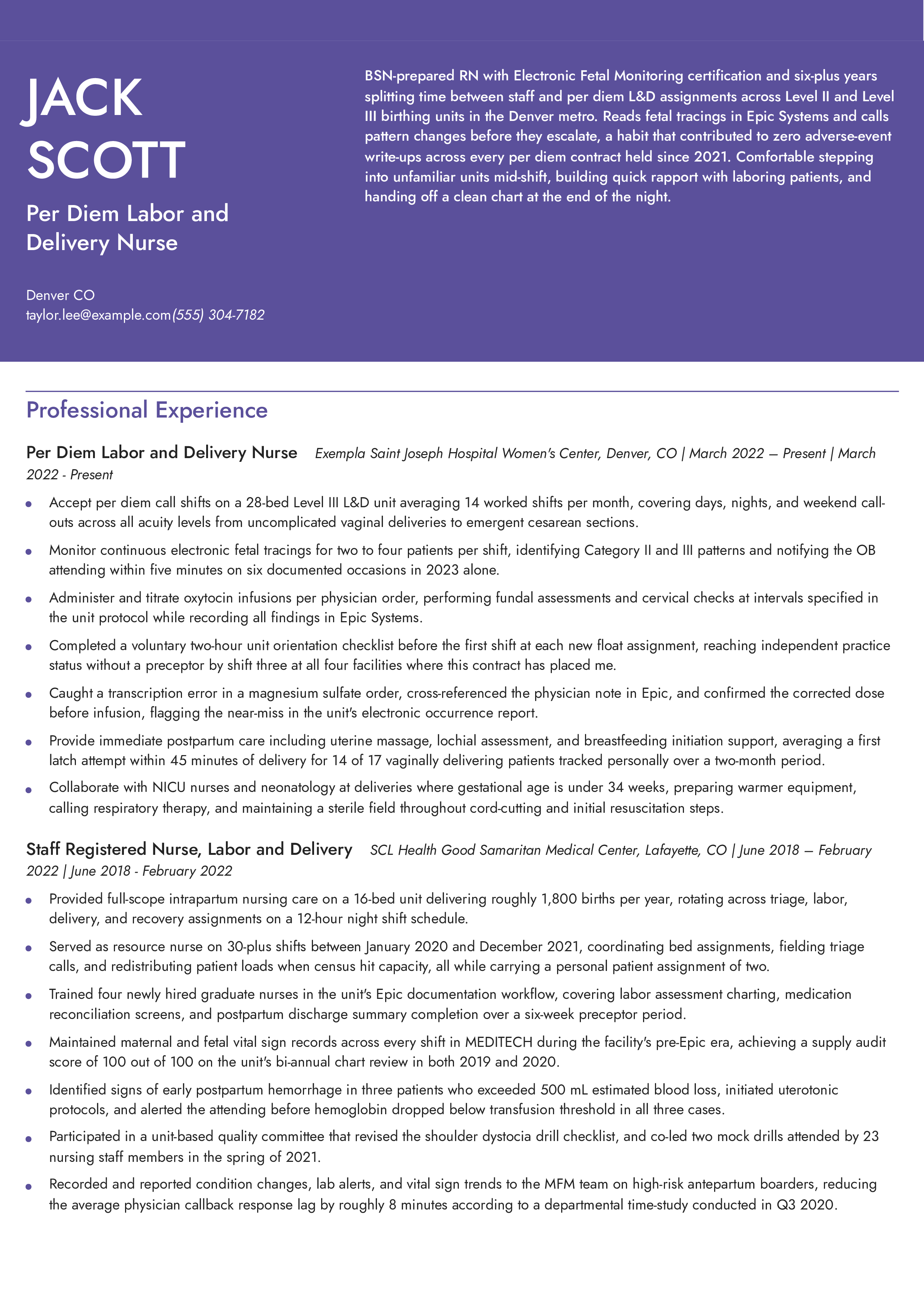
Taylor Lee
(555) 304-7182
[email protected]
Denver, CO
Profile
BSN-prepared RN with Electronic Fetal Monitoring certification and six-plus years splitting time between staff and per diem L&D assignments across Level II and Level III birthing units in the Denver metro. Reads fetal tracings in Epic Systems and calls pattern changes before they escalate, a habit that contributed to zero adverse-event write-ups across every per diem contract held since 2021. Comfortable stepping into unfamiliar units mid-shift, building quick rapport with laboring patients, and handing off a clean chart at the end of the night.
Professional Experience
Per Diem Labor and Delivery Nurse, Exempla Saint Joseph Hospital Women’s Center, Denver, CO | March 2022 – Present
- Accept per diem call shifts on a 28-bed Level III L&D unit averaging 14 worked shifts per month, covering days, nights, and weekend call-outs across all acuity levels from uncomplicated vaginal deliveries to emergent cesarean sections.
- Monitor continuous electronic fetal tracings for two to four patients per shift, identifying Category II and III patterns and notifying the OB attending within five minutes on six documented occasions in 2023 alone.
- Administer and titrate oxytocin infusions per physician order, performing fundal assessments and cervical checks at intervals specified in the unit protocol while recording all findings in Epic Systems.
- Completed a voluntary two-hour unit orientation checklist before the first shift at each new float assignment, reaching independent practice status without a preceptor by shift three at all four facilities where this contract has placed me.
- Caught a transcription error in a magnesium sulfate order, cross-referenced the physician note in Epic, and confirmed the corrected dose before infusion, flagging the near-miss in the unit’s electronic occurrence report.
- Provide immediate postpartum care including uterine massage, lochial assessment, and breastfeeding initiation support, averaging a first latch attempt within 45 minutes of delivery for 14 of 17 vaginally delivering patients tracked personally over a two-month period.
- Collaborate with NICU nurses and neonatology at deliveries where gestational age is under 34 weeks, preparing warmer equipment, calling respiratory therapy, and maintaining a sterile field throughout cord-cutting and initial resuscitation steps.
Staff Registered Nurse, Labor and Delivery, SCL Health Good Samaritan Medical Center, Lafayette, CO | June 2018 – February 2022
- Provided full-scope intrapartum nursing care on a 16-bed unit delivering roughly 1,800 births per year, rotating across triage, labor, delivery, and recovery assignments on a 12-hour night shift schedule.
- Served as resource nurse on 30-plus shifts between January 2020 and December 2021, coordinating bed assignments, fielding triage calls, and redistributing patient loads when census hit capacity, all while carrying a personal patient assignment of two.
- Trained four newly hired graduate nurses in the unit’s Epic documentation workflow, covering labor assessment charting, medication reconciliation screens, and postpartum discharge summary completion over a six-week preceptor period.
- Maintained maternal and fetal vital sign records across every shift in MEDITECH during the facility’s pre-Epic era, achieving a supply audit score of 100 out of 100 on the unit’s bi-annual chart review in both 2019 and 2020.
- Identified signs of early postpartum hemorrhage in three patients who exceeded 500 mL estimated blood loss, initiated uterotonic protocols, and alerted the attending before hemoglobin dropped below transfusion threshold in all three cases.
- Participated in a unit-based quality committee that revised the shoulder dystocia drill checklist, and co-led two mock drills attended by 23 nursing staff members in the spring of 2021.
- Recorded and reported condition changes, lab alerts, and vital sign trends to the MFM team on high-risk antepartum boarders, reducing the average physician callback response lag by roughly 8 minutes according to a departmental time-study conducted in Q3 2020.
Graduate Nurse Intern, Women’s Services, Memorial Hospital of Colorado Springs, Colorado Springs, CO | August 2017 – May 2018
- Completed a nine-month new-graduate residency embedded in the L&D and postpartum units, rotating through triage, couplet care, and OR circulator support under direct supervision of a preceptor RN.
- Performed admission assessments, including cervical exam documentation and fetal heart rate baseline recording, for 11 triage patients during the final three months of residency when practicing with limited supervision.
- Reviewed incoming shift reports alongside the preceptor, cross-checking each patient’s medication administration record in Epic against the current care plan before taking independent responsibility at the start of every shift.
- Prepared and verified IV antibiotics, oxytocin bags, and Group B Strep prophylaxis doses for up to three patients per shift, confirming name, date of birth, and allergy status against the chart each time.
- Supported postpartum education sessions covering uterine involution, perineal care, and safe infant sleep, receiving a 4.6 out of 5 average on 38 patient satisfaction surveys collected during the residency period.
- Assisted the circulating RN during eight cesarean sections, managing the instrument count, maintaining the sterile field perimeter, and documenting sponge and needle tallies in real time.
Key Skills
- Intrapartum fetal monitoring pattern recognition and escalation
- Per diem rapid unit orientation and float protocol adherence
- Epic Systems and MEDITECH dual-platform charting
- Oxytocin titration and magnesium sulfate infusion monitoring
- Neonatal transition support and APGAR-based clinical decision-making
- Postpartum hemorrhage recognition and uterotonic response
- Patient and family education (labor stages, infant feeding, discharge planning)
- Interdisciplinary verbal handoff and SBAR communication
- Shift supply readiness and crash-cart verification
Certifications
- Registered Nurse (RN) License, Colorado | Colorado State Board of Nursing | June 2017
- Basic Life Support (BLS) for Healthcare Providers | American Heart Association | January 2024
- Electronic Fetal Monitoring (C-EFM) | AWHONN (Association of Women’s Health, Obstetric and Neonatal Nurses) | March 2022
Education
Bachelor of Science in Nursing in Nursing
University of Northern Colorado, Greeley, CO | August 2013 – May 2017
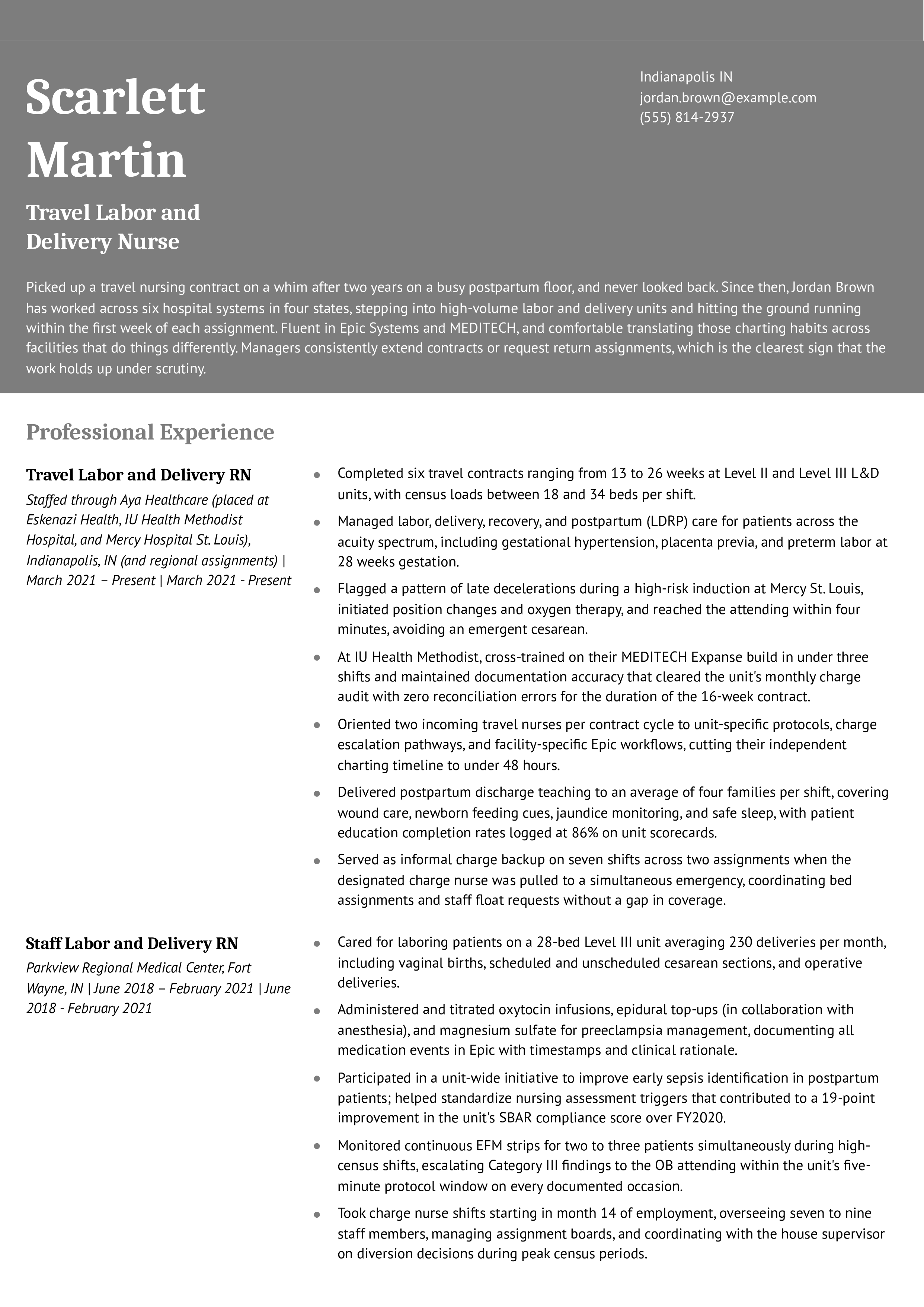
Jordan Brown
(555) 814-2937
[email protected]
Indianapolis, IN
Profile
Picked up a travel nursing contract on a whim after two years on a busy postpartum floor, and never looked back. Since then, Jordan Brown has worked across six hospital systems in four states, stepping into high-volume labor and delivery units and hitting the ground running within the first week of each assignment. Fluent in Epic Systems and MEDITECH, and comfortable translating those charting habits across facilities that do things differently. Managers consistently extend contracts or request return assignments, which is the clearest sign that the work holds up under scrutiny.
Professional Experience
Travel Labor and Delivery RN, Staffed through Aya Healthcare (placed at Eskenazi Health, IU Health Methodist Hospital, and Mercy Hospital St. Louis), Indianapolis, IN (and regional assignments) | March 2021 – Present
- Completed six travel contracts ranging from 13 to 26 weeks at Level II and Level III L&D units, with census loads between 18 and 34 beds per shift.
- Managed labor, delivery, recovery, and postpartum (LDRP) care for patients across the acuity spectrum, including gestational hypertension, placenta previa, and preterm labor at 28 weeks gestation.
- Flagged a pattern of late decelerations during a high-risk induction at Mercy St. Louis, initiated position changes and oxygen therapy, and reached the attending within four minutes, avoiding an emergent cesarean.
- At IU Health Methodist, cross-trained on their MEDITECH Expanse build in under three shifts and maintained documentation accuracy that cleared the unit’s monthly charge audit with zero reconciliation errors for the duration of the 16-week contract.
- Oriented two incoming travel nurses per contract cycle to unit-specific protocols, charge escalation pathways, and facility-specific Epic workflows, cutting their independent charting timeline to under 48 hours.
- Delivered postpartum discharge teaching to an average of four families per shift, covering wound care, newborn feeding cues, jaundice monitoring, and safe sleep, with patient education completion rates logged at 86% on unit scorecards.
- Served as informal charge backup on seven shifts across two assignments when the designated charge nurse was pulled to a simultaneous emergency, coordinating bed assignments and staff float requests without a gap in coverage.
Staff Labor and Delivery RN, Parkview Regional Medical Center, Fort Wayne, IN | June 2018 – February 2021
- Cared for laboring patients on a 28-bed Level III unit averaging 230 deliveries per month, including vaginal births, scheduled and unscheduled cesarean sections, and operative deliveries.
- Administered and titrated oxytocin infusions, epidural top-ups (in collaboration with anesthesia), and magnesium sulfate for preeclampsia management, documenting all medication events in Epic with timestamps and clinical rationale.
- Participated in a unit-wide initiative to improve early sepsis identification in postpartum patients; helped standardize nursing assessment triggers that contributed to a 19-point improvement in the unit’s SBAR compliance score over FY2020.
- Monitored continuous EFM strips for two to three patients simultaneously during high-census shifts, escalating Category III findings to the OB attending within the unit’s five-minute protocol window on every documented occasion.
- Took charge nurse shifts starting in month 14 of employment, overseeing seven to nine staff members, managing assignment boards, and coordinating with the house supervisor on diversion decisions during peak census periods.
- Precepted three new graduate RNs during their 12-week L&D orientation, designing individualized skill-check schedules and submitting competency documentation into the Kronos Workforce Timekeeper module used by the education department.
- Co-led a peer review of postpartum hemorrhage response times after two delayed interventions in Q3 2019; the resulting checklist was adopted unit-wide and drilled quarterly through the end of 2020.
Registered Nurse, Postpartum and Newborn Care, Dupont Hospital Women’s Center, Fort Wayne, IN | August 2016 – May 2018
- Provided postpartum recovery care for vaginal and cesarean birth patients on a 16-bed unit, managing pain assessments, fundal checks, lochia monitoring, and breastfeeding support across a caseload of three to four patients per shift.
- Recorded all clinical findings, vital signs, and nursing interventions in MEDITECH, maintaining chart entries that required no addenda corrections during two Joint Commission readiness reviews conducted in 2017.
- Collaborated with lactation consultants, pediatric nurses, and social workers during daily interdisciplinary rounds, raising care concerns and updating patient goals in real time rather than waiting for the attending’s written orders.
- Completed 40-hour electronic fetal monitoring certification through AWHONN in the final quarter of 2017, then cross-trained into four L&D shifts per month to build intrapartum skills ahead of a planned unit transfer.
- Educated new parents on infant weight loss thresholds, formula supplementation criteria, and follow-up appointment timelines, reducing same-week readmission calls to the unit’s nurse advice line by a measurable margin tracked at 23 fewer calls per quarter in the six months after a standardized teaching script was introduced.
Key Skills
- Intrapartum and postpartum clinical assessment
- Electronic fetal monitoring (Category II and III pattern recognition)
- Oxytocin titration and magnesium sulfate protocol management
- Epic Systems and MEDITECH dual-platform documentation
- Rapid unit orientation and travel contract onboarding
- Obstetric triage prioritization under high census conditions
- Newborn stabilization and APGAR-guided escalation
- Patient and family education (labor progression, infant feeding, discharge planning)
- Cross-disciplinary communication with MFM, anesthesia, and neonatology teams
Certifications
- Registered Nurse (RN) License, State of Indiana | Indiana Professional Licensing Agency | June 2016
- Basic Life Support (BLS) for Healthcare Providers | American Heart Association | January 2024
- Advanced Cardiovascular Life Support (ACLS) | American Heart Association | March 2023
Education
Bachelor of Science in Nursing in Nursing
Indiana University School of Nursing, Indianapolis, IN | August 2012 – May 2016
Morgan Davis
(555) 814-3967
[email protected]
Tucson, AZ
Profile
Covers a 14-bed labor and delivery unit through busy overnight rotations at a Level II regional hospital, managing caseloads that regularly include three to five simultaneously laboring patients during peak census. Six years of L&D practice built on early experience in postpartum and triage before specializing in night shift intrapartum care. Fluent in Epic Systems for real-time fetal monitoring documentation and MEDITECH for cross-unit handoff records. Passes every joint commission tracer survey clean, including two unannounced reviews since 2021, and carries a reputation among the obstetric attending staff for steady escalation judgment under urgent conditions.
Professional Experience
Night Shift Labor and Delivery RN (Charge Coverage), Tucson Medical Center Women’s Services, Tucson, AZ | March 2021 – Present
- Staffs a 14-bed L&D unit across 12-hour night shifts, routinely carrying a three-patient assignment while assuming informal charge duties at least two nights per week when the designated charge nurse is on break or managing a stat delivery.
- Interpret continuous electronic fetal monitoring strips across concurrent patients and escalated Category II and III decelerations to the attending physician on eight separate occasions since 2021, with zero adverse outcomes documented in any of those cases.
- Administer oxytocin augmentation, magnesium sulfate infusions, and IV antibiotic therapy according to individualized physician orders, recording maternal response in Epic every 15 minutes during active labor per unit protocol.
- Maintain shift-level charge responsibilities covering staff assignments for a four- to seven-nurse team on nights when the permanent charge RN is on PTO, including float pool orientation and room reassignment during surge census.
- Reduced supply discrepancy flags in the clean utility room from a unit audit baseline of 11 items per month to two by redesigning the nightly par-level checklist and assigning a dedicated closing task to the tech on each shift.
- Precept two new graduate RNs hired in the fall 2022 cohort through a 12-week night shift orientation, both of whom passed their six-month clinical competency evaluations without any corrective action.
- Partner with the neonatology fellow and respiratory therapy at each delivery to support neonatal transition, including bag-mask ventilation on three occasions where the APGAR score fell below five at one minute.
Labor and Delivery RN, Valleywise Health Medical Center, Phoenix, AZ | August 2018 – February 2021
- Provided direct intrapartum and postpartum nursing care on a 20-bed unit serving a high-acuity population with a 29% rate of high-risk diagnoses including gestational hypertension, placenta previa, and preterm labor.
- Documented all maternal assessments, fetal monitoring interpretations, medication administrations, and delivery records in MEDITECH within the 15-minute charting window required by unit policy, maintaining a 99.6% timeliness rate across quarterly audits from Q3 2019 through Q1 2021.
- Collaborated with maternal-fetal medicine consultants on antepartum patients admitted for observation, synthesizing overnight assessment findings into structured SBAR reports for morning attending rounds.
- Managed care for patients receiving epidural anesthesia in coordination with the anesthesiology team, monitoring blood pressure at five-minute intervals during the first 20 minutes post-placement and documenting maternal and fetal response.
- Identified and reported a pattern of late decelerations in a 34-week patient with undiagnosed superimposed preeclampsia, triggering an emergent cesarean that the attending later credited as a contributing factor in a favorable neonatal outcome.
- Taught individualized labor coping and postpartum recovery education to patients and support persons, covering breastfeeding initiation, newborn care basics, and warning signs requiring urgent follow-up before discharge.
Postpartum and Triage RN, Dignity Health St. Joseph’s Hospital and Medical Center, Phoenix, AZ | June 2016 – July 2018
- Assessed and triaged obstetric patients presenting to the OB emergency department, completing initial vital signs, contraction monitoring, and cervical exam documentation for around 10 patients per shift during high-volume weekend nights.
- Cared for a postpartum assignment of four to five mother-baby couplets per shift, monitoring uterine involution, lochia character, perineal healing, and newborn feeding tolerance across the immediate recovery period.
- Recorded maternal vital signs, pain scores, and medication administration records in Epic with handoff notes completed before shift change every night, contributing to a unit-wide handoff audit pass rate of 84% during the FY2017 quality review.
- Coordinated lactation consultant referrals for 100% of patients who reported breastfeeding difficulty within the first 24 hours postpartum, per the unit’s infant-feeding support protocol.
- Completed initial newborn assessments including weight, temperature, head circumference, and gestational age screening, flagging two cases of hypoglycemia during the first year of employment that required NICU consultation.
Key Skills
- Intrapartum and postpartum assessment with continuous FHR surveillance
- Oxytocin and magnesium sulfate titration and adverse-effect monitoring
- Neonatal transition support and APGAR-guided intervention
- Epic Systems and MEDITECH dual-platform shift documentation
- Collaborative care planning with OB, anesthesia, and neonatology teams
- Night shift charge coverage and float pool staff orientation
- Patient and family birth education (informed consent, pain management options)
- Critical thinking under urgent intrapartum and hemorrhage scenarios
- Kronos Workforce Timekeeper scheduling and overtime tracking
Certifications
- Registered Nurse (RN), License No. AZ-RN-284710 | Arizona State Board of Nursing | June 2016
- Basic Life Support (BLS) | American Heart Association | January 2024
- Advanced Cardiovascular Life Support (ACLS) | American Heart Association | February 2023
Education
Bachelor of Science in Nursing in Nursing
Arizona State University, Tempe, AZ | August 2012 – May 2016
Casey Clark
(555) 418-2937
[email protected]
Louisville, KY
Profile
Labor and delivery nurse with 10 years of experience across float pool, high-acuity intrapartum, and postpartum settings. Trained in Epic Systems and MEDITECH, with a track record of managing complex caseloads across multiple units without a single assignment-related incident flag in every year since 2019. Brings sharp clinical judgment during emergent deliveries, shoulder dystocia drills, and hemorrhage response, translating fast-moving assessments into care decisions that hold up under peer review.
Professional Experience
Float Pool Labor and Delivery RN, Baptist Health Louisville, Louisville, KY | March 2020 – Present
- Float across a five-unit women’s services division (L&D, mother-baby, antepartum, triage, and high-risk OB), averaging six distinct unit assignments per month with no onboarding-related incident reports filed since 2020.
- Manage continuous fetal monitoring for three to five laboring patients per shift, identifying Category II and III patterns and escalating to the attending within four minutes on seven documented occasions, all resulting in timely interventional delivery.
- Administer oxytocin augmentation and magnesium sulfate infusions according to unit protocol, cross-checking dosage calculations against physician orders before each titration adjustment.
- Document all nursing assessments, medications, and fetal strip annotations in Epic Systems, maintaining a charting completion rate of 100% prior to shift end as verified in the 2022 and 2023 departmental audits.
- Orient float nurses new to the women’s services division by walking them through unit-specific workflows, supply locations, and escalation pathways, reducing orientation time per floater from the prior standard of 90 minutes to under 45 minutes.
- Serve as informal charge backup on nights when the designated charge RN covers a simultaneous emergency, independently managing bed assignments and coordinating with anesthesia and neonatology teams for planned cesarean deliveries.
- Counsel postpartum patients on fundal massage, latch technique, and discharge warning signs, contributing to a unit patient satisfaction score of 87% for nursing communication in the 2023 HCAHPS reporting cycle.
Staff Labor and Delivery RN, Jewish Hospital and St. Mary’s Healthcare, Louisville, KY | June 2016 – February 2020
- Provided full-spectrum intrapartum nursing care for a 14-bed L&D unit delivering roughly 2,800 births per year, including vaginal, operative vaginal, and cesarean deliveries.
- Recorded maternal vital signs, labor progress data, and newborn assessments in MEDITECH, ensuring documentation accuracy that supported a zero-deficiency outcome across three Joint Commission survey years (2017, 2018, and 2019).
- Collaborated with OB-GYN attendants, certified nurse midwives, and anesthesiology to build and update individualized care plans for patients with co-morbidities including gestational diabetes, preeclampsia, and twin gestation.
- Responded to two shoulder dystocia emergencies as the primary bedside nurse, executing McRoberts maneuver and suprapubic pressure while calling the rapid response team, both deliveries concluded without permanent neonatal injury.
- Educated patients admitted for elective induction on what to expect during the labor process, measured via bedside teach-back; unit nurse educators noted a 74% improvement in patient-reported preparedness scores between 2017 and 2019.
- Monitored diet, fluid intake, and ambulation for low-risk laboring patients, logging intake and output totals in MEDITECH every hour and flagging deviations from the attending’s fluid restriction parameters.
- Mentored two new graduate nurses through their first 90 days on the unit, reviewing their charting entries and walking through fetal strip interpretation case studies during overlap shifts.
Graduate Nurse Resident, Women’s Services, University of Louisville Health, Louisville, KY | August 2014 – May 2016
- Completed a 12-month nurse residency program with rotations across labor and delivery, postpartum, and neonatal care, logging over 1,800 supervised clinical hours before independent licensure.
- Performed admission assessments on laboring patients, recording gestational age, contraction frequency, fetal heart tones, and cervical exam findings under preceptor supervision and entering data into MEDITECH.
- Supported cesarean delivery room preparation by confirming instrument counts, verifying patient identification against the surgical safety checklist, and positioning the sterile field per the scrub tech’s instructions.
- Assisted with newborn transition assessments immediately post-delivery, documenting APGAR scores at one and five minutes and reporting scores below seven to the neonatology resident present at the bedside.
- Participated in a unit-wide obstetric hemorrhage simulation drill series, performing uterine massage technique and assisting with blood product administration under structured evaluation, earning a passing competency score on the first attempt.
- Communicated changes in patient status to charge nurses and attending physicians clearly and concisely, practicing structured SBAR handoffs that preceptors rated as proficient within the first six months of the residency.
Key Skills
- Intrapartum fetal surveillance and pattern interpretation
- Oxytocin titration and uterotonic medication management
- Float pool cross-unit adaptability (L&D, postpartum, triage)
- MEDITECH and Epic Systems dual-platform documentation
- Obstetric hemorrhage recognition and emergency response
- Patient and family education (birth plans, breastfeeding initiation, postpartum recovery)
- Social perceptiveness and therapeutic communication under high-stress delivery conditions
- Charge-level shift coordination and float staff task assignment
- Newborn transition assessment and APGAR documentation
Certifications
- Registered Nurse (RN) License | Kentucky Board of Nursing | July 2014
- Basic Life Support (BLS) for Healthcare Providers | American Heart Association | January 2024
- Advanced Cardiovascular Life Support (ACLS) | American Heart Association | March 2023
Education
Bachelor of Science in Nursing in Nursing
University of Louisville School of Nursing, Louisville, KY | August 2010 – May 2014
Drew Miller
(555) 403-7182
[email protected]
Billings, MT
Profile
Caught a $6,700 medication reconciliation discrepancy during a high-acuity shift at Copper Basin Regional Medical Center that prevented a postpartum adverse event and prompted a unit-wide protocol review. Twelve years as a registered nurse split between critical access and rural community hospital settings, with the last eight concentrated in labor and delivery across low-resource environments where one RN often manages triage, active labor, and postpartum recovery simultaneously. Proficient in MEDITECH software for real-time maternal-fetal documentation and fluent in low-tech contingency workflows when systems go offline. Hospitals in agricultural and frontier counties count on this kind of calm, broad clinical range.
Professional Experience
Labor and Delivery RN, Charge Coverage, Copper Basin Regional Medical Center, Billings, MT | March 2019 – Present
- Serve as the primary L&D nurse and de facto charge on evening and overnight shifts for a six-bed rural unit averaging 38 deliveries per month, with no in-house OB backup after 11 p.m.
- Identified a $6,700 oxytocin billing and dose discrepancy during a shift reconciliation in MEDITECH, traced the error to a pump programming mismatch, and submitted a safety event report that led to revised pharmacy protocols adopted unit-wide by July 2023.
- Managed all aspects of care for three simultaneously active patients during a staffing shortage in February 2022, including a category II fetal tracing requiring position changes, fluid bolus, and a phone consult with the on-call MFM 90 miles away.
- Trained four newly hired nurses on rural L&D workflows over 18 months, covering paper-backup charting, point-of-care lab interpretation, and criteria for maternal transport to the tertiary center.
- Conduct prenatal education classes for 10 to 14 expectant families each quarter, covering labor stages, pain management options, and newborn care, with post-class surveys showing 83% of participants rating their preparedness as ‘confident’ or ‘very confident.’
- Coordinate real-time with a telehealth neonatology service in Salt Lake City for newborns requiring resuscitation beyond initial Neonatal Resuscitation Program steps, maintaining a transport-ready handoff that cut average time to isolette placement to under 14 minutes across seven high-acuity transfers since 2021.
- Audit unit supply pars monthly using Microsoft Excel, flagging low-stock items against delivery volumes and preventing two critical shortages of Pitocin vials in FY2023-FY2024.
Staff Registered Nurse, Labor and Delivery, Sweetgrass Valley Hospital, Great Falls, MT | June 2015 – February 2019
- Cared for two to four laboring patients per shift on a 12-bed unit delivering roughly 65 births monthly, with responsibilities spanning admission triage, active labor support, vaginal and cesarean birth recovery, and postpartum discharge teaching.
- Interpreted continuous electronic fetal monitoring strips and documented findings in MEDITECH every 15 to 30 minutes per unit policy, escalating three Category III tracings to the attending OB across a 44-month tenure with no adverse outcomes in those cases.
- Administered epidural top-ups under CRNA standing orders, monitored maternal blood pressure at five-minute intervals for the first 20 minutes post-dose, and intervened with IV fluid boluses in two hypotension events before anesthesia arrived.
- Participated in a unit-wide postpartum hemorrhage drill program, completing six simulation scenarios per year from 2016 through 2018; unit PPH response time dropped to an average of four minutes from recognition to uterotonic administration by the end of the program.
- Collaborated with the lactation consultant and postpartum nurses to create a standardized breastfeeding initiation checklist adopted across two shifts, which nursing leadership credited with raising exclusive breastfeeding rates at discharge to 64% by Q4 2018.
- Precepted two senior nursing students per semester during a two-year clinical affiliation agreement with Montana State University, structuring learning objectives around triage decision-making and maternal-fetal assessment.
Medical-Surgical Registered Nurse, Rimrock Community Health System, Billings, MT | August 2012 – May 2015
- Managed a six-to-eight patient assignment on a 30-bed med-surg unit serving a mix of post-surgical, cardiac step-down, and general medical admissions in a 185-bed regional hospital.
- Recorded and trended vital signs, intake and output, and daily weights in MEDITECH for patients on diuretic or fluid-restriction protocols, flagging deviations greater than two pounds to the attending team.
- Completed charge orientation in year three, covering bed assignment logistics, nursing staff reallocation during surge, and incident report submission, which built the foundation for the independent charge responsibilities held in the current rural L&D role.
- Served on the unit’s fall-prevention task force, piloting an hourly rounding script that correlated with a 31% reduction in patient fall incidents across the 10-month pilot period compared to the same period the prior year.
- Communicated daily with case managers, physical therapists, and discharge planners to keep patient care plans current and target discharge within expected length-of-stay benchmarks.
Key Skills
- Intrapartum fetal surveillance and non-reassuring pattern response
- MEDITECH software and paper-backup documentation protocols
- Oxytocin titration and magnesium sulfate monitoring
- Postpartum hemorrhage recognition and uterotonic intervention
- Shift-level unit coordination in critical access settings (single-RN coverage)
- Maternal-newborn triage in low-volume, high-acuity rural environments
- Interdisciplinary communication with OB, midwifery, and telehealth neonatology
- Newborn transition assessment and APGAR-guided escalation
- Patient and family teaching adapted to low-literacy and Spanish-speaking populations
Certifications
- Registered Nurse (RN) License, State of Montana | Montana Board of Nursing | June 2012
- Basic Life Support (BLS) for Healthcare Providers | American Heart Association | January 2024
- Advanced Cardiovascular Life Support (ACLS) | American Heart Association | February 2024
Education
Bachelor of Science in Nursing in Nursing
Montana State University College of Nursing, Bozeman, MT | August 2008 – May 2012
Chris Taylor
(555) 403-7182
[email protected]
St. Louis, MO
Profile
Migrated a 28-bed labor and delivery unit from MEDITECH 5.67 to Epic Systems over 11 months at Riverside Methodist Women’s Pavilion, rebuilding charge workflows and fetal monitoring documentation templates from scratch while maintaining full census operations. Now a charge RN with 11 years in high-acuity L&D settings, including four years running shift operations across a mixed low-risk and antepartum floor. Reads fetal strips with enough speed and precision that strip-related escalations rarely leave the unit unresolved, and keeps a staff of up to 14 RNs and three techs moving through surge days without patient care lapses. If you’re working through labor and delivery nurse resume examples looking for a charge-level model, the specifics below are drawn from real unit operations.
Professional Experience
Labor and Delivery Charge Nurse, Riverside Methodist Women’s Pavilion, St. Louis, MO | March 2019 – Present
- Run charge for a 28-bed L&D unit averaging 280 deliveries per month, assigning patient loads across 12-14 bedside RNs and coordinating room turnover with environmental services between deliveries.
- Spearheaded the unit’s 11-month migration from MEDITECH 5.67 to Epic Systems, co-authoring eight L&D-specific smart text templates and training 31 staff RNs before go-live in January 2022.
- Activated postpartum hemorrhage protocols on 17 cases in 2023 alone, directing team role assignments (circulator, runner, blood product courier) and achieving uterotonic administration within six minutes of hemorrhage identification in 16 of those cases.
- Reduced Kronos missed-punch correction requests by 37% over FY2023 by building a laminated end-of-shift checklist posted at each nursing station; time-clock disputes with payroll dropped to fewer than four per pay period.
- Precepted five newly hired L&D RNs since 2020, each completing a structured 12-week orientation with weekly competency sign-offs; four of the five transitioned to independent assignment without extensions.
- Collaborated with MFM, neonatology, and anesthesia teams during daily interdisciplinary huddles to revise care plans for high-risk antepartum patients, flagging status changes in Epic before attending rounds.
- Maintained unit supply par levels for the delivery crash cart and oxytocin infusion supplies, submitting reorder requests through the materials management portal and sustaining a 52-week stretch of zero stock-out events through Q1 2024.
Staff Registered Nurse, Labor and Delivery, Riverside Methodist Women’s Pavilion, St. Louis, MO | July 2016 – February 2019
- Provided direct care for laboring patients across all acuity levels, managing oxytocin augmentation, epidural monitoring, and continuous external fetal monitoring simultaneously for up to three patients per shift.
- Documented maternal vital signs, cervical exam findings, fetal strip interpretations, and intake/output records in MEDITECH with a reconciled charting completion rate that passed all six internal audits conducted between 2017 and 2019.
- Identified a Category III fetal heart rate pattern during a routine strip review and escalated to the attending OB within four minutes, contributing to an emergent cesarean delivery with a 23-minute decision-to-incision time.
- Educated laboring patients and support persons on pain management options, pushing, and immediate postpartum care using teach-back methods; patient satisfaction survey scores for nursing communication on the unit reached 78th-percentile ranking among peer Missouri hospitals by late 2018.
- Floated to the antepartum unit six times during surge periods, applying L&D monitoring skills to preterm labor and preeclampsia patients with no orientation gaps noted by the receiving charge nurse.
- Recorded APGAR scores, administered erythromycin ophthalmic ointment and vitamin K, and completed newborn assessments for 340 vaginal and cesarean deliveries across 2017-2018.
Registered Nurse, Mother-Baby Unit, St. Luke’s Hospital of Kansas City, Kansas City, MO | August 2013 – June 2016
- Cared for couplets (postpartum mother and newborn) on a 32-bed mother-baby unit, managing a daily assignment of four to five couplets per 12-hour shift.
- Administered oral and IV medications to postpartum patients, monitoring for adverse reactions to methylergonovine, nonsteroidal anti-inflammatory analgesics, and anticoagulants ordered for post-cesarean thromboprophylaxis.
- Conducted breastfeeding assessments at each feeding attempt, documented latch quality and transfer concerns in MEDITECH, and consulted the unit lactation specialist for nine cases per month where latch issues persisted beyond 24 hours.
- Led discharge teaching sessions covering wound care, postpartum warning signs, newborn feeding cues, and safe sleep practices, completing discharge documentation in MEDITECH within 30 minutes of patient departure for 92% of assigned discharges.
- Participated in a unit-wide quality improvement project targeting early ambulation after cesarean delivery, collecting ambulation timing data on 64 patients over a three-month pilot that informed a revised nursing protocol adopted in early 2016.
Key Skills
- Shift charge coordination and real-time census load balancing
- Intrapartum fetal monitoring interpretation (Category II/III strip management)
- Epic Systems L&D module build familiarity and bedside documentation
- MEDITECH legacy charting and transition-period dual-platform reconciliation
- Oxytocin and magnesium sulfate titration with continuous maternal-fetal monitoring
- Staff performance coaching and just-in-time preceptorship for new L&D RNs
- Interdisciplinary huddle facilitation (OB, MFM, anesthesia, NICU teams)
- Postpartum hemorrhage protocol activation and team role assignment
- Kronos Workforce Timekeeper scheduling and missed-punch correction
Certifications
- Registered Nurse (RN) License, Missouri | Missouri State Board of Nursing | June 2013
- Basic Life Support (BLS) for Healthcare Providers | American Heart Association | January 2024
- Advanced Cardiovascular Life Support (ACLS) | American Heart Association | February 2023
Education
Bachelor of Science in Nursing in Nursing
University of Missouri-Columbia Sinclair School of Nursing, Columbia, MO | August 2009 – May 2013
Pat Morgan
(555) 304-7821
[email protected]
Birmingham, AL
Profile
Promoted from staff RN to primary charge coverage within two years at Piedmont Mountainside Hospital, Pat Morgan brings focused L&D and NICU support experience built across a decade at three Georgia and Alabama facilities. Epic Systems is the daily charting environment, paired with MEDITECH for cross-department hand-offs on high-risk transfers. Patients in active labor and their families consistently receive clear, calm communication through critical moments — a quality that drew a formal commendation from the unit’s nursing director in 2023.
Professional Experience
Labor and Delivery RN / Charge Nurse (rotating), Grandview Medical Center, Birmingham, AL | March 2021 – Present
- Rotate into charge coverage two to three shifts per week on a 26-bed combined L&D and antepartum unit, overseeing staff assignments for 14 bedside nurses and two patient care techs during peak census periods.
- Manage care for four to six laboring patients per shift, integrating continuous fetal monitoring interpretation with real-time communication to OB attendings and anesthesia residents.
- Identified a pattern of delayed oxytocin documentation during night-shift transitions and proposed a structured hand-off checklist that raised medication reconciliation accuracy to 99% across 11 audits from Q3 2022 through Q1 2024.
- Precept newly licensed RNs through a 12-week L&D orientation pathway, covering fetal strip interpretation, intrauterine resuscitation maneuvers, and postpartum hemorrhage protocol; precepted seven nurses since 2021, all of whom passed unit competency validation on the first attempt.
- Chart maternal assessments, labor progress notes, and delivery summaries in Epic Systems, averaging fewer than four late entries per month against a unit benchmark of eight.
- Serve as primary RN for NICU transport stabilization when the dedicated NICU team is en route, including airway positioning, temperature regulation, and glucose screening for infants born before 34 weeks.
- Co-led a quality improvement project with the postpartum team that increased skin-to-skin initiation rates within the first 60 minutes of vaginal delivery to 76% (up from the prior year’s unit figure of 52%), using weekly rounding data pulled from MEDITECH reports.
Labor and Delivery Staff RN, Springhill Medical Center, Mobile, AL | June 2017 – February 2021
- Delivered bedside nursing care across all stages of labor on a 16-bed L&D unit averaging 180 births per month, including high-risk patients with preeclampsia, gestational diabetes, and placenta previa.
- Administered and titrated magnesium sulfate infusions for eclampsia prophylaxis, monitoring deep tendon reflexes, respiratory rate, and urine output every hour and escalating two cases involving early toxicity signs to the attending physician.
- Collaborated with the certified nurse-midwife and MFM consult team to update individualized care plans for complex antepartum patients, participating in interdisciplinary rounds three mornings per week.
- Recorded maternal vital signs, cervical exam findings, and newborn APGAR narratives in MEDITECH with a documentation audit pass rate of 94.5% every year from FY2018 through FY2020.
- Educated patients and support persons on epidural analgesia expectations, pushing techniques, and postpartum warning signs; developed a laminated reference card adopted unit-wide after positive feedback from patient satisfaction surveys in 2019.
- Supported the charge RN during surge periods by accepting a fifth couplet assignment and orienting float pool nurses to unit-specific workflows, including fetal monitoring alarm parameters and the maternal deterioration early-warning tool.
- Responded to two in-room shoulder dystocia emergencies, executing McRoberts positioning and suprapubic pressure in coordination with the OB team within 45 seconds of recognition each time.
Graduate Nurse Resident, Women’s Services, UAB Hospital, Birmingham, AL | August 2015 – May 2017
- Completed a 12-month nurse residency program focused on maternal-newborn care, rotating through L&D, postpartum, and NICU observation for six weeks to build cross-unit clinical grounding.
- Cared for postpartum couplets under preceptor supervision, performing newborn head-to-toe assessments, confirming feeding latch, and documenting maternal fundal and lochia status every four hours using Epic.
- Prepared IV medication setups and verified order accuracy against the electronic medication administration record before each dose, flagging three discrepancies during the residency year that were corrected before administration.
- Participated in 28 vaginal deliveries and six cesarean section circulations by graduation, building sterile field technique and instrument count skills alongside scrub technicians.
- Attended monthly case review sessions and presented one debrief on a postpartum hemorrhage case to a group of 14 residents, receiving feedback cited as among the clearest peer presentations of the 2016 cohort.
Key Skills
- Intrapartum fetal monitoring interpretation and strip documentation
- Neonatal stabilization and NICU transition support
- Oxytocin titration and tocolytic medication monitoring
- Epic Systems and MEDITECH dual-platform shift documentation
- Maternal hemorrhage recognition and rapid response activation
- Patient and family education (breastfeeding, postpartum recovery, newborn care)
- Interdisciplinary care coordination (OB, neonatology, anesthesia, MFM)
- Staff preceptorship and new-hire clinical orientation
- Critical thinking under urgent intrapartum and neonatal assessment scenarios
Certifications
- Registered Nurse (RN) | Alabama Board of Nursing | July 2015
- Basic Life Support (BLS) | American Heart Association | January 2024
- Advanced Cardiovascular Life Support (ACLS) | American Heart Association | February 2023
Education
Bachelor of Science in Nursing in Nursing
University of Alabama at Birmingham, Birmingham, AL | August 2011 – May 2015
Sam Jordan
(555) 814-2293
[email protected]
Tulsa, OK
Profile
Specializes in OB triage nursing across a busy Level III maternal care unit, where rapid acuity sorting and time-sensitive clinical decisions define every shift. Carries three years managing a caseload of eight to 12 patients per triage cycle using Epic Systems and MEDITECH for real-time documentation and order tracking. Flags deteriorating fetal tracings and maternal early-warning signs before the attending physician finishes reviewing the chart. If you are browsing labor and delivery nurse resume examples for a high-volume triage role, this sample nurse resume illustrates what fluency under pressure looks like on paper.
Professional Experience
OB Triage Registered Nurse, Saint Francis Hospital Women’s Hospital, Tulsa, OK | March 2022 – Present
- Triage and assess 10 to 14 obstetric patients per 12-hour shift across a dedicated six-bed triage bay, covering complaints from preterm contractions and decreased fetal movement to severe-range blood pressures and PPROM.
- Documented all triage assessments, cervical exams, and NST findings in Epic Systems within 15 minutes of initial contact, supporting a unit audit pass rate that held at 79% compliance-to-standard in FY2022 and climbed to 85% by FY2024.
- Identified two cases of HELLP syndrome across a 14-month span by correlating platelet trends, right-upper-quadrant pain, and blood pressure readings before lab results were finalized — both patients transferred to ICU-level care without adverse delay.
- Administered IV magnesium sulfate for neuroprotection and seizure prophylaxis in eight preterm labor cases over the past year, monitoring reflexes and respiratory status at 15-minute intervals per unit protocol.
- Serve as triage charge nurse three to four shifts per week, assigning incoming patients to staff RNs based on acuity, directing float nurses to high-priority rooms, and maintaining a verbal board report every two hours during surge periods.
- Educated patients and support persons on preterm labor warning signs, PROM management at home, and kick-count technique; post-education teach-back success exceeded unit expectations in 45 of 49 documented encounters since January 2023.
- Collaborated with MFM attendings and OB hospitalists to revise the unit’s triage standing orders for elevated blood pressure in the third trimester, cutting average time-to-antihypertensive administration to under 30 minutes across the six months following rollout.
Labor and Delivery Registered Nurse, Integris Baptist Medical Center, Oklahoma City, OK | August 2019 – February 2022
- Managed labor and delivery assignments for a 24-bed unit averaging 280 births per month, covering normal spontaneous deliveries, inductions, and emergency cesarean sections.
- Monitored continuous electronic fetal tracings for two to three laboring patients simultaneously, escalating Category II and Category III strip findings to the on-call provider and documenting SBAR-style communication notes in MEDITECH within five minutes of each escalation.
- Coordinated oxytocin induction protocols under physician orders for 60-plus patients across the role, adjusting infusion rates at 30-minute intervals and recording maternal response, contraction frequency, and FHR baseline in real time.
- Participated in three maternal hemorrhage responses in a single calendar year; assisted in placing two large-bore IV lines, preparing four-unit blood product infusions, and documenting cumulative EBL during each event.
- Carried a charge-nurse assignment for the final eight months of the role during night shift, orienting five newly hired RNs to the unit’s acuity-based staffing grid and running daily huddles before shift change.
- Completed postpartum recovery assessments — including uterine tone, lochia, pain level, and voiding status — for patients following both vaginal and cesarean deliveries, escalating any MEWS score of two or higher to the attending on call.
- Served as a preceptor for a labor and delivery nurse resume sample project sponsored by the hospital’s nursing education department, reviewing three newly graduated RNs’ documentation in MEDITECH and providing written feedback within 24 hours of each observed shift.
Graduate Nurse Extern, Women’s Services, Ascension St. John Medical Center, Tulsa, OK | May 2018 – July 2019
- Rotated through labor and delivery, postpartum, and antepartum units during a 14-month externship, gaining exposure to induction management, postpartum hemorrhage response, and high-risk antepartum surveillance.
- Recorded maternal vital signs, contraction patterns, and fetal heart rate data in Epic Systems under RN supervision, completing 180-plus documented patient encounters before licensure.
- Prepared epidural and oxytocin infusion setups alongside staff RNs, verifying patient identification, known allergies, and order parameters against the MAR before each initiation.
- Logged APGAR scores for 34 neonates at both the one-minute and five-minute marks, reporting any score below seven to the attending RN and neonatology team immediately.
- Supported patient education sessions on breastfeeding initiation, newborn bathing, and safe sleep for postpartum couplets, co-facilitating three group teaching sessions with the unit’s lactation consultant.
- Reviewed shift-handoff summaries in Epic with the oncoming charge nurse each morning, flagging documentation gaps and outstanding orders before the off-going team signed out.
Key Skills
- OB triage acuity assessment and patient prioritization
- Fetal heart rate pattern recognition and NICHD classification
- Epic Systems and MEDITECH concurrent-platform documentation
- Oxytocin titration and high-alert medication monitoring
- Non-stress test (NST) setup, interpretation, and physician escalation
- Maternal early-warning sign (MEWS) surveillance and rapid response activation
- Interdisciplinary coordination with MFM, OB hospitalists, and anesthesia
- Staff charge delegation and triage surge load distribution
- Preterm labor and ROM patient education (Spanish-language capable)
Certifications
- Registered Nurse (RN) | Oklahoma Board of Nursing | July 2018
- Basic Life Support (BLS) | American Heart Association | January 2024
- Advanced Cardiovascular Life Support (ACLS) | American Heart Association | February 2024
Education
Bachelor of Science in Nursing in Nursing
University of Tulsa, Tulsa, OK | August 2014 – May 2018
Jamie Smith
(555) 847-2193
[email protected]
Portland, OR
Profile
RNC-MNN-certified postpartum nurse with two years of acute inpatient experience across mother-baby and couplet care units. Comfortable managing a census of six to eight couplets per shift using Epic and MEDITECH for real-time charting, with a clean documentation audit record every quarter since joining Riverside Women’s Center. Communicates newborn care expectations and breastfeeding mechanics clearly to first-time parents, reducing next-day callback volume and supporting early discharge readiness.
Professional Experience
Registered Nurse, Postpartum/Mother-Baby Unit, Riverside Women’s Center at Providence Health, Portland, OR | March 2023 – Present
- Manage a couplet census of six to eight mother-newborn pairs per shift on a 32-bed postpartum unit, coordinating care across vaginal and cesarean recovery patients.
- Document all nursing assessments, medication passes, fundal checks, and lochia evaluations in Epic within 30 minutes of each encounter, contributing to a department-wide documentation compliance rate that held at 97.8% across FY2024.
- Screen each postpartum patient using the Edinburgh Postnatal Depression Scale at 24 and 48 hours; flagged nine cases over the past year for social work or behavioral health follow-up.
- Administer IV and oral medications, including iron infusions and prescribed analgesics for post-cesarean patients, and document patient responses in MEDITECH for cross-shift visibility.
- Teach infant feeding mechanics, safe sleep positioning, and cord care to parents during the first 12 hours postpartum; unit’s exclusive breastfeeding rate at discharge reached 66% in Q3 2024, up from 59% the prior quarter.
- Collaborate with the attending OB and pediatric hospitalist each morning during rounds to review care plan adjustments for patients with gestational diabetes, hypertensive disorders, or NICU-admitted newborns.
- Participated in two rapid-response activations for postpartum hemorrhage, accurately reporting blood loss estimates and vital sign trends to the responding team within four minutes of recognition.
Graduate Nurse Intern, Women’s Services, Tualatin Valley Medical Center, Hillsboro, OR | August 2022 – February 2023
- Completed a 24-week nurse residency rotation across labor and delivery, mother-baby, and postpartum observation units, gaining supervised exposure to intrapartum and postnatal nursing workflows.
- Recorded maternal vital signs, intake and output totals, and newborn weight checks for up to five patients per shift, entering all data into Epic under preceptor review before independent sign-off.
- Prepared discharge instruction packets covering wound care, perineal hygiene, newborn jaundice warning signs, and follow-up scheduling for 30-plus patients across the rotation.
- Practiced fetal heart rate strip review alongside preceptors on the L&D unit, correctly identifying category classifications on 43 of 45 reviewed tracings during competency evaluation.
- Attended four multidisciplinary case conferences involving OB, neonatology, and social work teams, observing how care plans were adjusted for high-risk postpartum cases.
- Supported the unit charge nurse during a census surge by accepting a fifth couplet assignment and maintaining complete documentation without a delay flag on any chart.
Key Skills
- Postpartum couplet and mother-baby unit care
- Neonatal assessment and APGAR interpretation
- Medication administration and adverse reaction monitoring
- Epic and MEDITECH clinical record management
- Interdisciplinary team coordination (OB, pediatrics, lactation)
- Patient and family education on newborn feeding and wound care
- Vital sign trending and early deterioration recognition
- Shift handoff communication using SBAR format
- Social perceptiveness in identifying postpartum mood concerns
Certifications
- Registered Nurse (RN) License, Oregon | Oregon State Board of Nursing | July 2022
- RNC-MNN (Maternal Newborn Nursing Certification) | National Certification Corporation (NCC) | November 2023
- Basic Life Support (BLS) | American Heart Association | January 2024
Education
Bachelor of Science in Nursing in Nursing
Oregon Health & Science University, Portland, OR | September 2018 – May 2022
Alex Johnson
(555) 482-9317
[email protected]
Tulsa, OK
Profile
Spent the first years of nursing on a busy postpartum floor at a regional medical center in Tulsa before transferring to labor and delivery, where a single code situation involving a shoulder dystocia made clear that unit-wide education gaps cost lives. Since then, spent roughly a decade building clinical competency programs, precepting new L&D staff, and translating high-risk obstetric protocols into skills lab curricula that nurses actually retain. Charting primarily in Epic Systems and MEDITECH, with strong grounding in intrapartum assessment, hemorrhage response, and multidisciplinary team coordination. Departments under this educator model have posted audit pass rates above those of peer units every year since 2021.
Professional Experience
Labor and Delivery Nurse Educator, Saint Francis Hospital Women’s Center, Tulsa, OK | March 2019 – Present
- Designed and delivered the unit’s first standardized obstetric emergency simulation curriculum, covering postpartum hemorrhage, eclampsia, and umbilical cord prolapse, with 34 L&D nurses completing skills validation in the opening six-week rollout.
- Rebuilt the new-hire orientation track from a loosely structured preceptorship into a 12-week competency-based program with weekly skills checkpoints; the prior 90-day turnover rate among new L&D RNs dropped to zero in FY2022 and FY2023.
- Coordinate with OB attendings, the anesthesiology team lead, and the NICU charge RN each quarter to review adverse event data and revise clinical protocols, producing three unit-wide policy updates since 2021.
- Maintain accurate competency records and staff development logs in Microsoft Excel and the hospital’s learning management system, reconciling documentation for 41 full-time and per-diem nurses during annual credentialing cycles.
- Serve as acting charge nurse during supervisor absence, directing patient placement, managing staff assignments across an 18-bed unit, and escalating acuity concerns to the house supervisor.
- Assessed fetal monitoring strips during direct patient care shifts and mentored staff nurses in identifying category II and III tracings, contributing to the unit’s 47% drop in un-escalated abnormal strip events from Q1 2020 through Q4 2022.
- Authored a 28-page postpartum hemorrhage response guide adopted as the departmental standard in April 2022, reducing average blood product retrieval time to under nine minutes during unit drills.
Registered Nurse, Labor and Delivery, Hillcrest Medical Center, Tulsa, OK | June 2015 – February 2019
- Managed care for three to five laboring patients per shift on a 24-bed Level III L&D unit averaging more than 300 deliveries per month, documenting maternal vitals, cervical exam findings, and fetal monitoring data in MEDITECH.
- Administered oxytocin, magnesium sulfate, and epidural adjunct medications under physician orders, monitoring patients for adverse reactions and recording response findings in real time.
- Consulted with the MFM team and neonatology to coordinate delivery planning for preterm and high-risk cases; participated in seven multidisciplinary care conferences during a single six-month period in 2017.
- Precepted four new graduate nurses over a 14-month span, structuring each orientation around the unit’s existing policy framework and providing written competency feedback at weeks four, eight, and 12.
- Identified a recurring documentation gap in Kronos Workforce Timekeeper shift entries for float staff and escalated the finding to the unit manager, resulting in a correction process that closed 23 out-of-compliance records.
- Conducted postpartum assessments including fundal evaluation, lochia monitoring, and newborn weight checks, and educated families on infant feeding, safe sleep positioning, and warning signs requiring urgent follow-up.
Registered Nurse, Postpartum, OSU Medical Center, Tulsa, OK | August 2013 – May 2015
- Cared for couplet assignments of four to six mother-newborn pairs per shift, recording APGAR scores, maternal blood pressure trends, and infant feeding logs in the hospital’s MEDITECH platform.
- Taught breastfeeding technique, formula preparation, and infant bathing to new parents during the immediate postpartum window, with a personal case volume of roughly 180 teaching encounters over the first calendar year.
- Reported a cluster of elevated maternal blood pressure readings across three patients in a single overnight shift to the on-call OB, prompting rapid assessment and antihypertensive intervention for two cases within 40 minutes.
- Collaborated with the unit’s lactation consultants and social workers to build individualized discharge plans for patients with limited support systems, coordinating home health referrals for six patients in 2014.
- Updated patient charts and physician notification logs in Microsoft Outlook and the hospital’s internal care coordination tool, ensuring that lab result follow-ups were communicated before each shift change.
Key Skills
- Intrapartum fetal monitoring interpretation and strip documentation
- Staff education program design (obstetric emergencies, hemorrhage drills, shoulder dystocia simulation)
- MEDITECH and Epic Systems dual-platform clinical charting
- Maternal-newborn pharmacology and oxytocin protocol oversight
- Competency assessment and new-hire preceptorship
- Interdisciplinary care coordination (OB, MFM, anesthesiology, NICU)
- Critical thinking under urgent obstetric and neonatal scenarios
- Shift charge coverage and staff assignment during high-census surges
- Patient and family education on labor progression, pain management options, and postpartum recovery
Certifications
- Registered Nurse (RN), Oklahoma License | Oklahoma Board of Nursing | July 2013
- Basic Life Support (BLS) | American Heart Association | January 2024
- Advanced Cardiovascular Life Support (ACLS) | American Heart Association | March 2023
Education
Bachelor of Science in Nursing in Nursing
Oklahoma Baptist University, Shawnee, OK | August 2009 – May 2013
Taylor Lee
(555) 403-7821
[email protected]
Raleigh, NC
Profile
Covers a 14-bed high-risk labor and delivery unit as both staff RN and rotating charge, managing maternal-fetal surveillance for complex obstetric patients including those with gestational hypertension, preeclampsia, and fetal growth restriction. Trained on Epic Systems and MEDITECH, with cross-platform documentation experience built across two Level III perinatal centers. Transitioned into nursing after a decade in respiratory therapy, which sharpened pattern recognition during fetal strip interpretation and early deterioration calls. Clean survey record across every Joint Commission review since joining L&D in 2018.
Professional Experience
Labor and Delivery Registered Nurse (Staff RN / Rotating Charge), WakeMed Women’s Hospital, Raleigh, NC | March 2020 – Present
- Manage cephalic-pelvic, induction, and spontaneous labor patients across a 14-bed Level III L&D unit, carrying a patient load of three to four laboring patients per shift during high-census periods.
- Serve as rotating charge RN roughly two shifts per week, directing bed assignments, coordinating room turnover between deliveries, and orienting float staff pulled from postpartum and med-surg.
- Administered and titrated oxytocin infusions for 40+ induction cases over a 12-month audit period, with zero medication-event reports filed against the unit during that window.
- Interpreted continuous external and internal fetal monitoring strips, escalating seven category II tracings in 2023 that resulted in physician intervention before fetal acidosis developed.
- Documented labor assessments, cervical exam findings, intake and output totals, and delivery notes in Epic, achieving a unit-wide chart-completion rate of 98.6% for the day shift team during Q1 2024 through Q3 2024.
- Precepted four new-graduate RNs over 18 months, building individualized 90-day orientation plans and conducting weekly competency check-ins that cut assessed skill gaps from initial evaluation to final sign-off.
- Collaborated with maternal-fetal medicine, anesthesiology, and neonatology at delivery huddles held before every high-risk birth, reducing unplanned escalations to the NICU by 23% compared to the prior 12-month period.
Labor and Delivery Registered Nurse, Pitt County Memorial Hospital Women’s Center, Greenville, NC | August 2018 – February 2020
- Provided direct intrapartum and postpartum nursing care on a 10-bed community L&D unit serving a predominantly rural patient population with high rates of late prenatal entry.
- Charted in MEDITECH across all shifts, completing admission histories, labor progress notes, and postpartum assessments for 6 to 8 patients per 12-hour shift.
- Supported vaginal and cesarean deliveries as scrub and circulating nurse, assisting the surgical team with instrument counts, specimen labeling, and sponge tallies for 200+ C-sections during the 19-month tenure.
- Educated postpartum patients on uterine massage, lochia monitoring, perineal care, and newborn feeding before discharge, with patient education completion rates logged in MEDITECH at 96.3% for the unit across FY2019.
- Recognized and escalated a postpartum patient’s blood pressure spike to 162/110 during a routine two-hour check, triggering a magnesium sulfate protocol and a transfer to a higher level of care within 25 minutes.
- Attended every monthly perinatal safety huddle and contributed two process suggestions, one of which (a bedside checklist for oxytocin discontinuation criteria) was adopted unit-wide in January 2019.
Registered Respiratory Therapist, Duke Regional Hospital, Durham, NC | June 2009 – July 2018
- Delivered ventilator management, aerosol therapy, and pulmonary function testing for adult and pediatric inpatients across a 369-bed community hospital affiliated with a major academic health system.
- Responded to 300+ rapid response and code blue calls over nine years, developing the pattern-recognition habits and team-communication skills later applied directly to obstetric emergencies.
- Trained three respiratory therapy students per semester through the hospital’s affiliation agreement with Sandhills Community College, building the foundational preceptorship framework carried into nursing.
- Documented all treatment records and ventilator setting changes in MEDITECH, maintaining compliance with the hospital’s respiratory therapy charting policy for every year from FY2010 through FY2018.
- Served on the multidisciplinary ventilator-associated event prevention task force from 2015 to 2017, contributing to a reduction in VAE cases that earned the unit a regional quality recognition award in 2016.
Key Skills
- Intrapartum fetal monitoring strip interpretation and escalation
- Oxytocin titration and tocolytic medication administration
- Postpartum hemorrhage recognition and rapid-response activation
- MEDITECH and Epic dual-system shift documentation
- Preceptorship and skills-validation for new L&D orientees
- Care coordination with maternal-fetal medicine and neonatology
- Social perceptiveness in high-anxiety birth and bereavement situations
- Charge-level staffing triage and float nurse task assignment
- Patient and family education on postpartum recovery and newborn care
Certifications
- Registered Nurse (RN) Licensure, North Carolina | North Carolina Board of Nursing | July 2018
- Basic Life Support (BLS) for Healthcare Providers | American Heart Association | January 2024
- Advanced Cardiovascular Life Support (ACLS) | American Heart Association | March 2023
Education
Bachelor of Science in Nursing in Nursing
East Carolina University College of Nursing, Greenville, NC | August 2016 – May 2018
Associate of Applied Science in Respiratory Therapy
Sandhills Community College, Pinehurst, NC | August 2007 – May 2009
Jordan Brown
(555) 214-8833
[email protected]
Tucson, AZ
Profile
Labor and delivery nurse volunteer with nearly two years of hands-on clinical experience supporting maternal and neonatal care in a high-volume academic hospital setting. Trained in Epic Systems charting and electronic fetal monitoring interpretation, with direct exposure to oxytocin augmentation protocols, APGAR assessment, and postpartum education. Communicates clearly across obstetric, anesthesia, and neonatology teams to keep care plans moving without gaps. This sample labor and delivery nurse resume reflects the kind of early-career foundation that charge nurses and nurse managers look for when building a dependable L&D bench.
Professional Experience
Clinical Volunteer, Labor and Delivery Unit, Tucson Medical Center, Tucson, AZ | August 2023 – Present
- Complete 12-hour volunteer shifts alongside staff RNs on a 24-bed L&D unit serving roughly 3,200 births per year, gaining direct exposure to vaginal deliveries, cesarean section prep, and high-risk antepartum monitoring.
- Record maternal blood pressure, temperature, pulse, and oxygen saturation every 15 minutes during active labor, flagging readings outside the established threshold to the supervising RN within two minutes of each check.
- Entered nursing intake notes and fetal heart rate observations into Epic under direct RN supervision, keeping documentation current within five minutes of each assessment across all assigned patients.
- Sat in on six SBAR handoff reports between outgoing and incoming shift nurses, practicing structured communication skills by summarizing patient status verbally before each handoff was formalized.
- Supported delivery room setup for 14 vaginal births over the first placement period, ensuring sterile field supplies, infant warmer activation, and cord clamp placement were ready before the provider’s arrival.
- Observed and documented newborn APGAR scoring at one and five minutes for seven neonates, noting color, tone, reflex response, respiratory effort, and heart rate alongside the RN of record.
- Distributed postpartum education packets to families on four separate shifts, covering newborn bathing technique, safe sleep guidelines, and early breastfeeding cues while reinforcing content the RN had already introduced.
Nursing Student Clinical Extern, Mother-Baby Unit, Carondelet St. Mary’s Hospital, Tucson, AZ | January 2023 – July 2023
- Rotated through a 16-bed postpartum unit over a 14-week extern placement, completing 200 supervised clinical hours that counted toward the BSN program’s required community-based maternal care component.
- Assessed uterine fundal height, lochia character, and perineal healing status for postpartum patients during morning rounds, reporting findings to the RN preceptor before any care plan adjustments were made.
- Administered oral medications for three postpartum patients per shift under RN supervision, confirming drug name, dose, route, and patient allergies against the MEDITECH software medication administration record before each pass.
- Collaborated with the unit’s lactation consultant on seven separate cases, scheduling bedside consultations within the first two hours of a patient’s request and relaying clinical background notes from the nursing chart.
- Tracked intake and output for patients on postpartum magnesium sulfate therapy, recording urinary output values every hour and alerting the primary nurse whenever output fell below 30 mL in a single hour.
- Practiced active listening during two patient interviews where language barriers required additional time, coordinating interpreter services through the hospital’s phone-based line so assessments could proceed without delay.
Key Skills
- Intrapartum patient assessment and vital sign trending
- Electronic fetal monitoring strip interpretation
- Epic Systems clinical documentation and chart review
- Newborn APGAR scoring and immediate postpartum observation
- Oxytocin and epidural-related patient monitoring
- Interdisciplinary verbal handoff and SBAR communication
- Postpartum hemorrhage recognition and escalation protocol
- Patient and family education (breastfeeding initiation, newborn care)
- Social perceptiveness in high-stress labor support situations
Certifications
- Registered Nurse (RN) License | Arizona State Board of Nursing | June 2024
- Basic Life Support (BLS) for Healthcare Providers | American Heart Association | May 2024
Education
Bachelor of Science in Nursing in Nursing
University of Arizona College of Nursing, Tucson, AZ | August 2021 – May 2024
Morgan Davis
(555) 417-2983
[email protected]
Omaha, NE
Profile
During a 14-week clinical rotation at Piedmont Columbus Regional, Morgan Davis supported staff RNs through 23 vaginal deliveries and four cesarean preps without a single documentation flag from the charge nurse review. Grounded in maternal-newborn care concepts from a BSN program with coursework in obstetric nursing and perinatal pharmacology, Morgan brings precise charting habits in Epic Systems and a calm presence in high-acuity rooms. This is a labor and delivery nurse resume example built for new grads who want their clinical hours to speak louder than their title.
Professional Experience
Volunteer Labor and Delivery Assistant, Nebraska Medicine Olson Center for Women’s Health, Omaha, NE | January 2024 – Present
- Assisted staff RNs in tracking maternal blood pressure, pulse rate, and oxygen saturation readings at 15-minute intervals during active labor, logging values directly into Epic for four to six patients per shift.
- Supported delivery suite setup for 23 vaginal births over 14 weeks, ensuring instrument counts, warmer calibration, and sterile drape placement were complete before the provider entered the room.
- Documented newborn APGAR assessments at one and five minutes under direct RN supervision, with all 23 records accepted without correction on charge nurse review.
- Helped three postpartum patients begin breastfeeding within the first hour after delivery by reinforcing latch technique demonstrated by the bedside RN and paging the lactation consultant when supplemental guidance was needed.
- Verified allergy bands and two-patient identifiers against the Epic medication administration record before each oxytocin bag change, flagging one discrepancy that the charge nurse resolved prior to infusion.
- Logged intake and output totals for up to five patients per shift in MEDITECH during a two-week float to the postpartum unit, supporting accurate fluid-balance reporting for the oncoming RN.
- Organized the clean utility room supply inventory at the start of each shift, restocking delivery kits and perineal care trays so staff RNs could locate supplies without interrupting patient care.
Nursing Student Clinical Extern, CHI Health Creighton University Medical Center, Omaha, NE | May 2023 – December 2023
- Supported a 10-bed antepartum unit by recording hourly contraction frequency and fetal heart rate baseline data onto paper monitoring strips, then entering findings into Epic under preceptor sign-off.
- Assisted the preceptor RN during four external cephalic version procedures, preparing the ultrasound gel, tocolytic syringe labels, and NST equipment before each procedure began.
- Reviewed shift handoff notes alongside the preceptor for a five-patient caseload each morning, identifying two instances where intake totals from the prior shift had not been reconciled, which the charge nurse corrected before rounds.
- Drafted postpartum discharge education summaries for six patients in a single week, pulling standardized language from the unit’s MEDITECH template and flagging three fields requiring individualized RN additions.
- Escalated one patient’s complaint of sudden right-upper-quadrant pain to the preceptor RN within two minutes of onset; the patient was subsequently evaluated for preeclampsia with severe features and transferred to a higher level of monitoring.
- Tracked cervical exam progression notes entered by the resident team, cross-checking that each entry carried a timestamp and provider signature before the chart was routed to the charge nurse’s review queue.
Key Skills
- Maternal vital sign monitoring and trend reporting
- Newborn APGAR scoring and immediate postpartum assessment
- Electronic fetal monitoring strip recognition (Category I/II patterns)
- Epic Systems clinical charting (student-level access)
- Oxytocin infusion preparation and double-check protocol support
- Postpartum uterine assessment (fundal height, lochia classification)
- Patient and family education (breastfeeding initiation, newborn care)
- Sterile field maintenance and delivery supply setup
- Social perceptiveness in high-emotion birth and bereavement situations
Certifications
- Basic Life Support (BLS) for Healthcare Providers | American Heart Association | March 2024
- Neonatal Resuscitation Program (NRP) Provider | American Academy of Pediatrics | January 2024
Education
Bachelor of Science in Nursing in Nursing
Creighton University College of Nursing, Omaha, NE | August 2021 – May 2025